Descent into Hell ~Carl Jung

Standard

CARL JUNGDESCENT INTO HELLHELLMADNESSSCARABSNAKESOULSPIRIT

My spirit is a spirit of torment, it tears asunder my contemplation, it would dismantle everything and rip it apart. I am still a victim of my thinking. When can I order my thinking to be quiet, so that my thoughts, those unruly hounds, will crawl to my feet? How can I ever hope to hear your voice louder, to see your face clearer, when all my thoughts howl? I am stunned, but I want to be stunned, since I have sworn to you, my soul, to trust you even if you lead me through the madness.

via  https://carljungdepthpsychologysite.blog/

Life, Work and Legacy of Carl Jung

I wondered always how Dr Jung could remember his magnificent dreams, as it was also stunning to here my lovely aunt to explain hers. She was also a wonder-dreamer, I pitied a much when I keep forgetting my dreams mostly though, in my family, there have been many who have kept them and interpret them as well.

In the following night, the air was filled with many voices. A loud voice called, “I am falling.” Others cried out confused and excited during this: “Where to? What do you want?” Should I entrust myself to this confusion? I shuddered. It is a dreadful deep. Do you want me to leave myself to chance, to the madness of my own darkness? Wither? Wither? You fall, and I want to fall with you, whoever you are.

The spirit of the depths opened my eyes and I caught a glimpse of the inner things, the world of my soul, the many-formed and changing.

I see a grey rock face along which I sink into great depths. I stand in black dirt up to my ankles in a dark cave. Shadows sweep over me. I am seized by fear, but I know I must go in. I crawl through a narrow crack in the rock and reach an inner cave whose bottom is covered with black water. But beyond this, I catch a glimpse of a luminous red stone which I must reach. I wade through the muddy water. The cave is full of the frightful noise of shrieking voices. I take the stone, it covers a dark opening in the rock. I hold the stone in my hand, peering around inquiringly. I do not want to listen to the voices, they keep me away But I want to know. Here something wants to be uttered. I place my ear to the opening. I hear the flow of underground waters. I see the bloody head of a man on the dark stream. Someone wounded, someone slain floats there. I take in this image for a long time, shuddering. I see a large black scarab floating past on the dark stream.

In the deepest reach of the stream shines a red sun, radiating through the dark water. There I see-and a terror seizes me-small serpents on the dark rock walls, striving toward the depths, where the sun shines. A thousand serpents crowd around, veiling the sun. Deep night falls. A red stream of blood, thick red blood springs up, surging for a long time, then ebbing. I am seized by fear. What did I see?

Heal the wounds that doubt inflicts on me, my soul. That too is to be overcome, so that I can recognize your supreme meaning. How far away everything is, and how I have turned back! My spirit is a spirit of torment, it tears asunder my contemplation, it would dismantle everything and rip it apart. I am still a victim of my thinking. When can I order my thinking to be quiet, so that my thoughts, those unruly hounds, will crawl to my feet? How can I ever hope to hear your voice louder, to see your face clearer, when all my thoughts howl? I am stunned, but I want to be stunned, since I have sworn to you, my soul, to trust you even if you lead me through the madness.

How shall I ever walk under your sun if I do not drink the bitter draught of slumber to the lees? Help me so that I do not choke on my own knowledge. The fullness of my knowledge threatens to fall in on me. My knowledge has a thousand voices, an army roaring like lions; the air trembles when they speak, and I am their defenceless sacrifice. Keep it far from me, science that clever knower, that bad prison master who binds the soul and imprisons it in a lightless cell. But above all protect me from the serpent of judgment, which only appears to be a healing serpent, yet in your depths is an infernal prison and agonizing death. I want to go down cleansed into your depths with white garments and not rush in like some thief seizing whatever I can and fleeing breathlessly. Let me persist in divine astonishment so that I am ready to behold your wonders. Let me lay my head on a stone before your door, so that I am prepared to receive your light.

[2] When the desert begins to bloom, it brings forth strange plants. You will consider yourself mad, and in a certain sense, you will, in fact, be mad. To the extent that the Christianity of this time lacks madness, it lacks divine life. Take note of what the ancients taught us in images: madness is divine. But because the ancients lived this image concretely in events, it became a deception for us, since we became masters of the reality of the world. It is unquestionable: if you enter into the world of the soul, you are like a madman, and a doctor would consider you to be sick. What I say here can be seen as a sickness, but no one can see it as sickness more than I do. This is how I overcame madness. If you do not know what divine madness is, suspend judgment and wait for the fruits. But know that there is a divine madness which is nothing other than the overpowering of the spirit of this time through the spirit of the depths. Speak then of sick delusion when the spirit of the depths can no longer stay down and forces a man to speak in tongues instead of in human speech, and makes him believe that he himself is the spirit of the depths. But also speak of sick delusion when the spirit of this time does not leave a man and forces him to see only the surface, to deny the spirit of the depths and to take himself for the spirit of the times. The spirit of this time is ungodly; the spirit of the depths is ungodly; the balance is godly.

Because I was caught up in the spirit of this time, precisely what happened to me on this night had to happen to me, namely that the spirit of the depths erupted with force, and swept away the spirit of this time with a powerful wave. But the spirit of the depths had gained this power because I had spoken to my soul during nights in the desert and I had given her all my love and submission. But during the 25 days, I gave all my love and submission to things, to men, and to the thoughts of this time.

I went into the desert only at night. Thus can you differentiate sick and divine delusion? Whoever
does the one and does without the other you may call sick since he is out of balance. But who can withstand fear when the divine intoxication and madness come to him? Love, soul, and God are beautiful and terrible. The ancients brought over some of the beauty of God into this world, and this world became so beautiful that it appeared to the spirit of the time to be fulfilled and better than the bosom of the Godhead. The frightfulness and cruelty of the world lay under wraps and in the depths of our hearts. If the spirit of the depths seizes you, you will feel the cruelty and cry out in torment. The spirit of the depths is pregnant with ice, fire, and death. You are right to fear the spirit of the depths, as he is full of horror. You see in these days what the spirit of the depths bore. You did not believe it, but you would have known it if you had taken counsel with your fear.

Blood shone at me from the red light of the crystal, and when I picked it up to discover its mystery; there lay the horror uncovered before me: in the depths of what is to come lay murder. The blond hero lay slain. The black beetle is the death that is necessary for renewal; and so thereafter, a new sun glowed, the sun of the depths, full of riddles, a sun of the night. And as the rising sun of spring quickens the dead earth, so the sun of the depths quickened the dead, and thus began the terrible struggle between light and darkness. Out of that burst the powerful and ever unvanquished source of blood. This was what was to come, which you now experience in your life, and it is even more than that. (I had this vision on the night of 12 December 1913.)

Depths and surface should mix so that new life can develop. Yet the new life does not develop outside of us but within us. What happens outside us in these days is the image that the peoples live in events, to bequeath this image immemorially to far-off times so that they might learn from it for their own way; just as we learned from the images that the ancients had lived before us in events.

Life does not come from events, but from us. Everything that happens outside has already been. Therefore whoever considers the event from outside always sees only that it already was, and that it is always the same. But whoever looks from inside, knows that everything is new. The events that happen are always the same.
But the creative depths of man are not always the same. Events signify nothing, they signify only in us. We create the meaning of events. The meaning is and always was artificial. We make it. Because of this, we seek in ourselves the meaning of events, so that the way of / what is to come becomes apparent and our life can pow again. That which you need comes from yourself, namely the meaning of the event. The meaning of events is not their particular meaning. This meaning exists in learned books. Events have no meaning. The meaning of events is the way of salvation that you create. The meaning of events comes from the possibility of oflife in this world that you create. It is the mastery of this world and the assertion of your soul in this world.

This meaning of events is the supreme meaning, that is not in events, and not in the soul, but is the God standing between events and the soul, the mediator of life, the way, the bridge and the going across. I would not have been able to see what was to come if I could not have seen it in myself Therefore I take part in that murder; the sun of the depths also shines in me after the murder has been accomplished; a thousand serpents that want to devour the sun are also in me. I myself am a murderer and murdered, sacrificer and sacrificed. The upwelling blood streams out of me.

You all have a share in the murder. In you, the reborn one will come to be, and the sun of the depths will rise, and a thousand serpents will develop from your dead matter and fall on the sun to choke it. Your blood will stream forth. The peoples demonstrate this at the present time in unforgettable acts, that will be written with blood in unforgettable books for eternal memory:

But I ask you, when do men fall on their brothers with mighty weapons and bloody acts? They do such if they do not know that their brother is themselves. They themselves are sacrifices, but they mutually do the service of sacrifice. They must all sacrifice each other since t.he time has not yet come when a man puts the bloody knife into himself in order to sacrifice the one he kills in his brother. But whom do people kill? They kill the noble, the brave, the heroes. They take aim at these and do not know that with these they mean themselves. They should sacrifice the hero in themselves, and because they do not know this, they kill their courageous brother. The time is still not ripe. But through this blood sacrifice, it should ripen. So long as it is possible to murder the brother instead of oneself the time is not ripe. Frightful things must happen until men grow ripe. But anything else will not ripen humanity.

Hence all this that takes place in these days must also be so that the renewal can come. Since the source of blood that follows the shrouding of the sun is also the source of the new life. As the fate of the peoples is represented to you in events, so will it happen in your heart. If the hero in you is slain, then the sun of the depths rises in you, glowing from afar, and from a dreadful place. But all the same, everything that up till now seemed to be dead in you will come to life and will change into poisonous serpents that will cover the sun, and you will fall into night and confusion. Your blood also will stream from many wounds in this frightful struggle. Your shock and doubt will be great, but from such torment, the new life will be born. Birth is blood and torment. Your darkness, which you did not suspect since it was dead, will come to life and you will feel the crush of total evil and the conflicts of life that still now lie buried in the matter of your body. But the serpents are dreadful evil thoughts and feelings.

You thought you knew that abyss? Oh, you clever people! It is another thing to experience it. Everything will happen to you. Think of all the frightful and devilish things that men have inflicted on their brothers. That should happen to you in your heart. Suffer it yourself through your own hand, and know that it is your own heinous and devilish hand that inflicts the suffering on you, but not your brother, who wrestles with his own devils. I would like you to see what the murdered hero means. Those nameless men who in our day have murdered a prince are blind prophets who demonstrate in events what then is valid only for the soul. Through the murder of princes, we will learn that the prince into us, the hero, is threatened. Whether this should be seen as a good or a bad sign need not concern us. What is awful today is good in a hundred years, and in two hundred years is bad again. But we must recognize what is happening:

there are nameless ones in you who threaten your prince, the hereditary ruler. But our ruler is the spirit of this time, which rules and leads in us all. It is the general spirit in which we think and act today. He is of frightful power since he has brought immeasurable good to this world and fascinated men with unbelievable pleasure. He is bejewelled with the most beautiful heroic virtue and wants to drive men up to the brightest solar heights, in everlasting ascent. The hero wants to open up everything he can. But the nameless spirit of the depths evokes everything that man cannot. Incapacity prevents further ascent. Greater height requires greater virtue. We do not possess it. We must first create it by learning to live with our incapacity. We must give it life. For how else shall it develop into ability?

We cannot slay our incapacity and rise above it. But that is precisely what we wanted. Incapacity will overcome us and demand its share of life. Our ability will desert us, and we will believe, in the sense of the spirit of this time, that it is a loss. Yet it is no loss but again, not for outer trappings, however, but for inner capability. The one who learns to live with his incapacity has learned a great deal. This will lead us to the valuation of the smallest things, and to wise limitation, which the greater height demands. If all heroism is erased, we fall back into the misery of humanity and into ever worse. Our foundations will be caught up in excitement since our highest tension, which concerns what lies outside us, will stir them up. We ‘will fall into the cesspool of our underworld,  among the rubble of all the centuries in us. The heroic in you is the fact that you are ruled by the thought that this or that is good, that this or that performance is indispensable, this or that cause is objectionable, this or that goal must be attained in headlong striving work, this or that pleasure should be ruthlessly repressed at all costs. Consequently, you sin against incapacity. But incapacity exists. No one should deny it, find fault with it, or shout it down.  ~Carl Jung, Red Book, Pages 237-240
Helen the Whore and the Curse of Beauty

Standard

Said to have ‘the face that launched a thousand ships’, Helen of Troy has been remembered, judged – and hated – by every age since she entered the written record 2,700 years ago. With great beauty comes great resentment.

It’s always fascinating me talking about Gods or Goddesses, in my opinion, it looks more logical that we’ve been created by a Goddess, because, the women are much more beautiful and desirable than the men!!

via https://www.historytoday.com/

Bettany Hughes | Published 14 August 2018
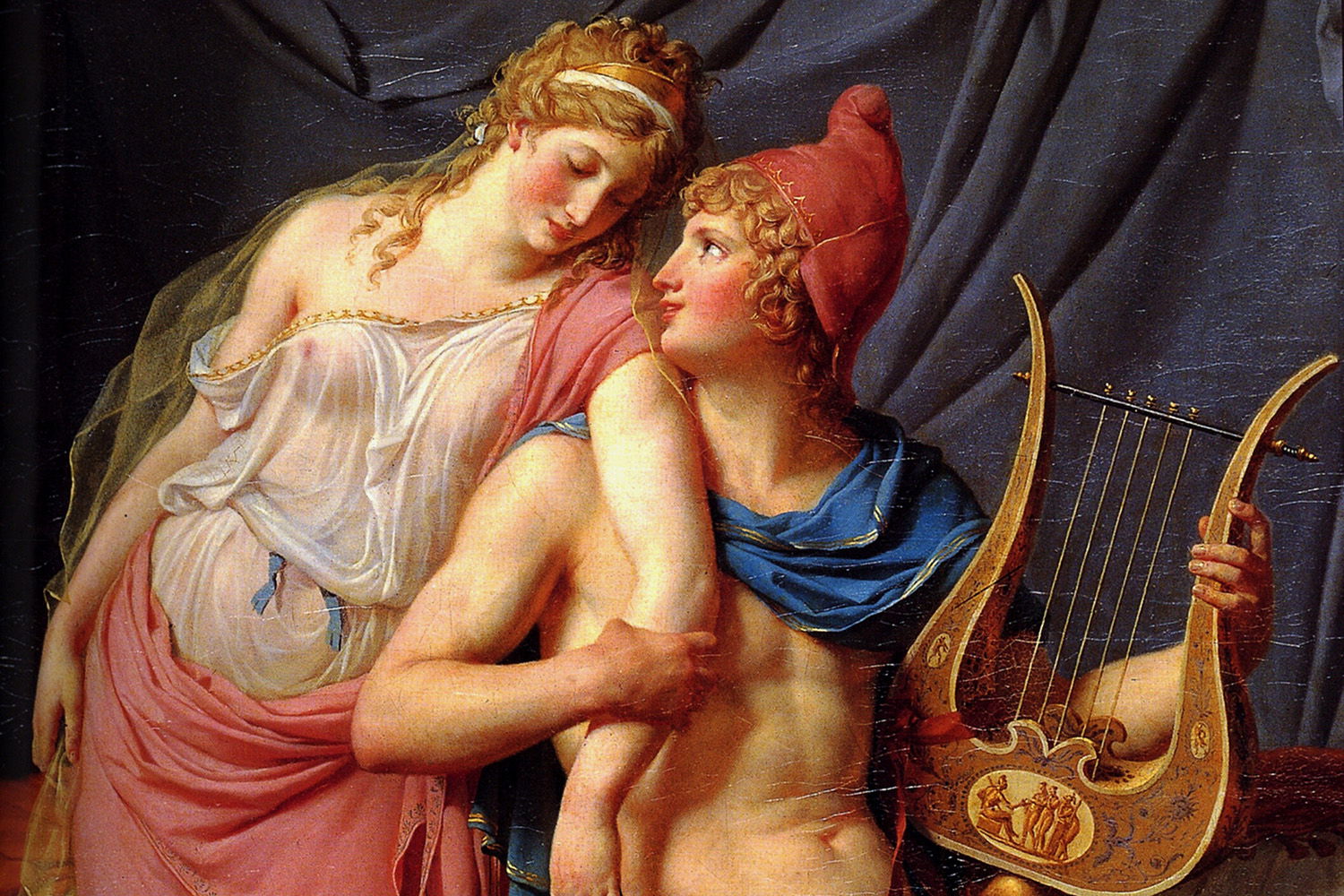
Detail from The Love of Helen and Paris, Jacques-Louis David, 1788.
Although we now tend to think of Helen as a passive figure, a feeble thing swept along to Troy on the tide of Paris’ libido, the simpering shell immortalized in Wolfgang Peterson’s movie Troy (2004), a close study of representations of Helen through the centuries yields a feistier figure. She is a woman who is at times applauded, but more often damned, for being sexually active – and is, furthermore, branded a whore. Helen of Troy is a telling icon: a woman who impacted on the world around her – as one of the earliest named authors of the West, Hesiod declared in his Works and Days: ‘[there was] a god-like race of hero-men … grim war and dread battle destroyed a part of them … [war] brought them in ships over the great sea gulf to Troy for rich-haired Helen’s sake’ – but whose impact has to be explained away in terms of a shabby sale of sex.

Of all Helen’s roles in the literary and artistic corpus (and it is a long career – she has been forgotten by not a single generation since she entered the written record 2,700 years ago), it is her part as fantasy whore that has been most tenacious. Her many sexual partners – the hero Theseus, her husband Menelaus, her lover Paris, her second Trojan husband Deiphobus, and (some whispered) Achilles after both he and Helen were dead – are trotted out by ancient and modern authors alike as the gossip columns would the client-list of a high-class prostitute. And so Euripides calls her a ‘bitch-whore’; she is Shakespeare’s ‘strumpet’; in Thomas Proctor’s The Reward of Whoredom by the Fall of Helen (1578) she is a ‘trull’ and a ‘flurt’, an embodiment of prostitution’s ‘vilde filthy fact’; Chaucer may well have been playing on words when he called her a ‘queene’ – a homophone for a ‘quene’ or harlot, and for Schiller a ‘Helen’ simply meant a prick-tease, a tart, a slut.

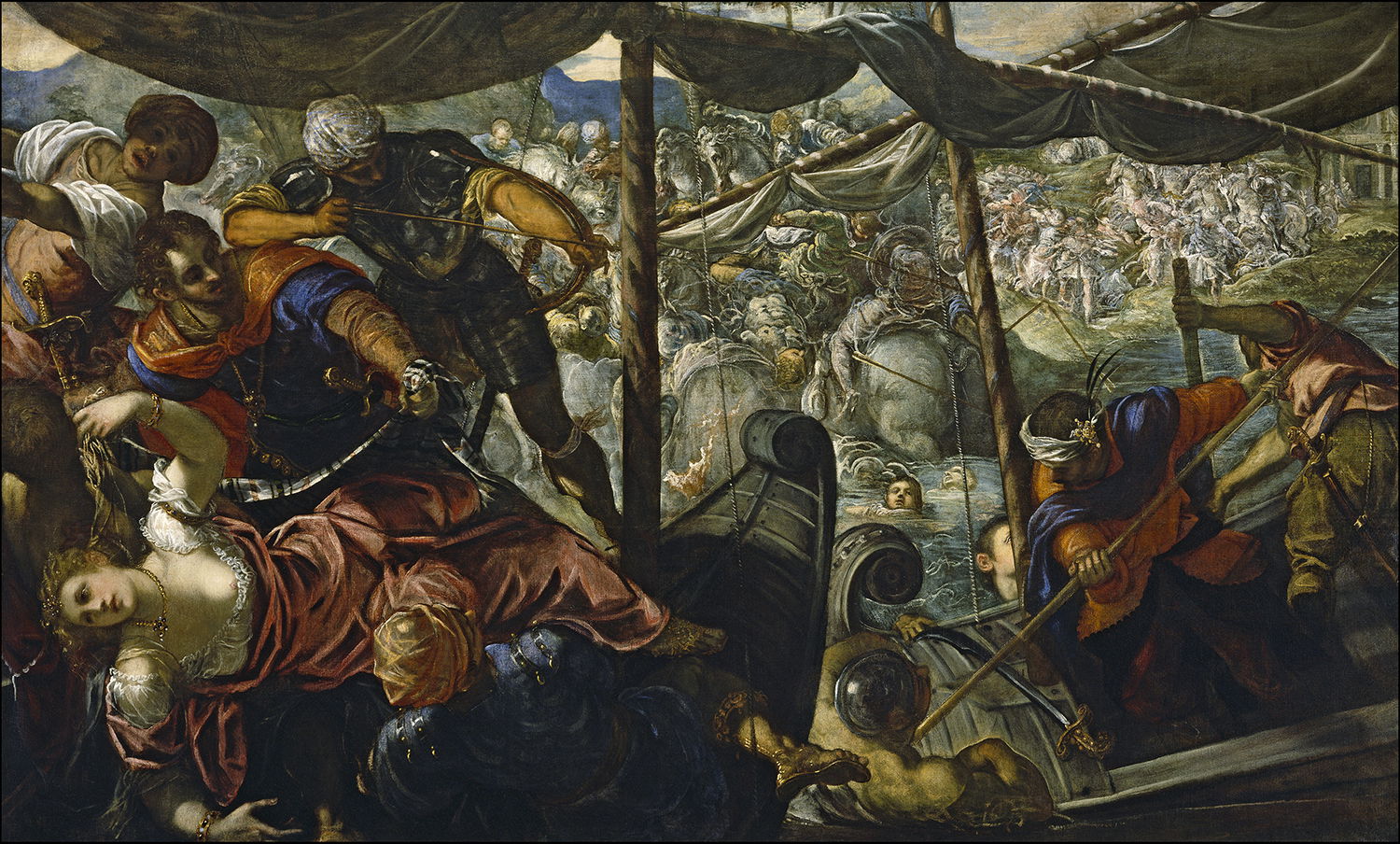
The Rape of Helen, Tintoretto, 1578–1579.The Rape of Helen, Tintoretto, 1578–1579.
The rationale (if the thought process involved can be distinguished with such a name) from the fifth century BC onwards was that Helen’s crime was not simply sleeping with another man, Paris, the prince of Troy, but being encouraged into his bed by rich treasures from the East, brought as gifts for Menelaus and the Spartan court. Euripides’ queen Hecuba interrogates Helen: ‘were the halls of Menelaus not large enough for your luxury to wanton in?’. ‘O adulterous beauty!’ bemoans a Clement of Alexandria in the second century AD. ‘Barbarian finery and effeminate luxury overthrew Greece; Lacedaemonian chastity was corrupted by clothes, and luxury, and graceful beauty; barbaric display proved Zeus’ daughter a whore.’ And in his loose adaptation of Euripides, the late modernist Israeli playwright Hanoch Levin has Hecuba (Paris’ mother and Priam’s widow) spit out at Helen:

My son Paris was a heart-stopping boy,
And you, adulterous witch, wanted him.
And he was rich. Your heart flew at that.
Your husband here, King Menelaus, had a nice, modest castle;
You’d heard about our palaces – luxurious,
lofty –
So-long Menelaus, Paris – come on in!
(The Lost Women of Troy by Hanoch Levin, working adaptation by Tanya Ronder)

Oddly – in an accrued narrative that is nine-tenths fiction and one-tenth fact – the notion that a visiting Trojan prince would have brought untold treasures to the Spartan court in the Late Bronze Age (the most likely period for a conflict we call the Trojan War) does have real historical weight. Both Troy and Sparta were important and strategic settlements between 1300–1100 BC – the kinds of places that would have sent envoys across the Aegean to negotiate with one another, to debate rights over trade routes, to promote marriage alliances. Detailed written evidence in the form of inscribed hieroglyphics and cuneiform tablets produced by the bureaucrats of the Egyptian and Hittite courts make it clear that the rulers of the day showered one another with gifts.

Extravagant gift-giving allowed aristocrats to trade without seeming to stoop to the ranks of merchantmen. Gift-exchange also bound states together in an abstract convention known as Xenia – or xenwia, as it appears in the Greek Late Bronze Age script, now called Linear B. Xenia roughly, translates as ‘guest-friendship’ (literally ‘for guest-gift’) and was a means by which the traveller could be safely entertained in a stranger’s halls, an exchange of gifts demonstrating the goodwill between the two parties.

The formal transfer of the richest of material goods, Xenia in action, gave the Eastern Mediterranean some cohesion in the Late Bronze Age. There is not a shred of evidence that a Bronze Age Helen bestowed sexual favours in return for booty – but equally, there is no question that a Mycenaean aristocrat such as Helen would have received rich gifts from visiting foreign dignitaries – particularly from a city as wealthy as Troy.

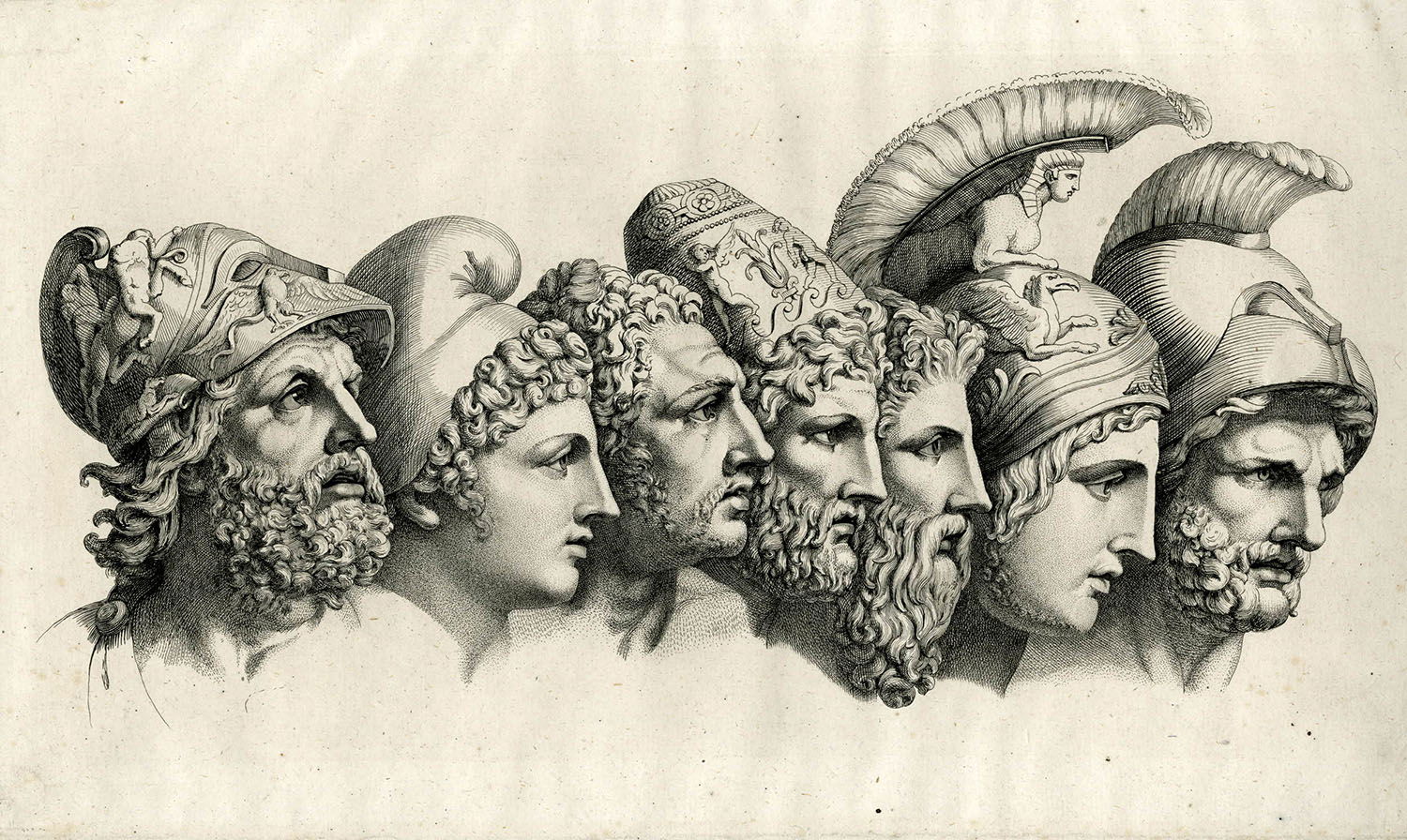
Seven heads of heroes from Homer's Iliad, Heinrich Dieterich, c.1796.Seven heads of heroes from Homer’s Iliad, Heinrich Dieterich, c.1796.

Yet a diplomatic explanation for Paris’ delivery of Anatolian exotica is far from the minds of Helen’s biographers. Instead, her dealings with the Trojan prince position her as the archetypal broad. Following Helen’s progression as a whore, and glancing sideways at other key female characters as one travels through time, a pattern emerges. Think of powerful women from history – women such as Cleopatra, Eleanor of Aquitaine, Anne Boleyn: the memory of each is coloured by sexual scandal. Cleopatra, like Helen, was described as a Fury by Virgil and in Lucan’s first-century Civil War we read: ‘Cleopatra, the shame of Egypt, the fatal Fury of Latium, whose unchastity cost Rome, dear. As the dangerous beauty of the Spartan queen overthrew Argos and Troy town, in like measure Cleopatra fanned the frenzy of Italy’.

Eleanor was the 12th-century heir to the duchy of Aquitaine, and ‘by the wrath of God Queen of England’ she chose to dress in red (we still have in the National Archives the pipe-rolls that detail the lengths of scarlet cloth ordered for her out of state funds) and chroniclers were quick to judge her a scarlet woman. Matthew Paris declared that ‘by reason of her excessive beauty, she destroyed or injured nations’. Henry VIII’s second wife Anne, ‘the Great Whore’, was lambasted by the Abbot of Whitby in the following terms: ‘the King’s Grace is ruled by one common, stewed whore, Anne Boleyn, who makes all the spirituality to be beggared, and the temporality also.’

And like Anne, Eleanor and Cleopatra, Helen’s sexual peccadilloes were doubly dreadful because they were perceived as hastening men not just to a woman’s bed but to their deaths.

Show me the strumpet that began this stir,
That with my nails her beauty I may tear!
Thy heat of lust, fond Paris, did incur
This load of wrath that burning Troy did bear;
Thy eye kindled the fire that burneth here,
And here in Troy, for trespass of thine eye,
The sire, the son, the dame and daughter die.
(Shakespeare, Lucrece 1, 471 – 7)

Helen’s misfortune was that her crime against humanity was equally heinous in a pagan and a Christian climate. The ancients thought Helen’s crime was the crime of a god, or rather a goddess, Aphrodite (in that Helen’s excessive sexual charisma was a gift of Aphrodite) – but through the medieval and Early Modern periods – in fact up until the 21st century, her affair was judged a sin against God himself. And so we find medieval theologians such as Joseph of Exeter, detailing her misdemeanours with overweening enthusiasm. Note here that Joseph of Exeter, writing in around 1184, describes her favoured sexual position with Paris as being on top – an attitude detailed in the penitential lists of the day as the mark of a whore.

Lying on him [Paris] with her whole body, she [Helen] opens her legs, presses him with her mouth and robs him of his semen. And as his ardour abates the purple bedlinen that was privy to their sins bears witness to his unseen dew. What evil! O wicked woman, were you able to put a check on such passionate desire? Was lust waiting for a purchaser? What marvellous power in the gentle sex! Woman holds back her precipitate lust to obtain wealth and does not deign to give joy unless her smile has been paid for!

Where ancient, medieval and modern worlds also concurred was not just on the guilt of Helen and women like her, but in the assertion that it was female allure (not you note Paris’, Mark Anthony’s, Henry II’s or Henry VIII’s hubris or lust) that brought exceptional suffering to the world. And in Helen’s case, the specific cause – the Spartan girl’s unparalleled, dreadful beauty.

Rather than positioning Helen’s beauty as a worthy gift of the gods – ancient authors (with the interesting exception of Sappho who seems to suggest in Fragment 16 that Helen’s beauty endows her with initiative) predominantly saw her ‘peerless face and form’ as a curse. Beauty in Greek men was thought to be a sign of inner goodness (the Greeks had a word for it, kalokagathia, meaning joint nobility in appearance and mind or conduct.) Whereas for the male of the species a perfect face was the patina for a perfect character, a woman’s beauty was thought to conceal a dark heart.

Helen’s beauty was believed pernicious. She was imagined to be a direct avatar of the kalon kakon – the beautiful evil – the first ever woman according to Hesiod’s revisionist theogony composed in the seventh century BC. Helen was a thing essentially bad, cloaked in beauty. Given that beauty was thought in the ancient world to be an active attribute with its own cogent power, the most beautiful woman in the world had, by definition, to be it’s most dangerous. As she walks along the walls of Troy, the old men of the benighted city start to chatter, muttering that now they understand why these two great peoples, the Trojans and the Greeks, have to fight. What beauty Helen has, they say, a terrible beauty like that of the goddess.

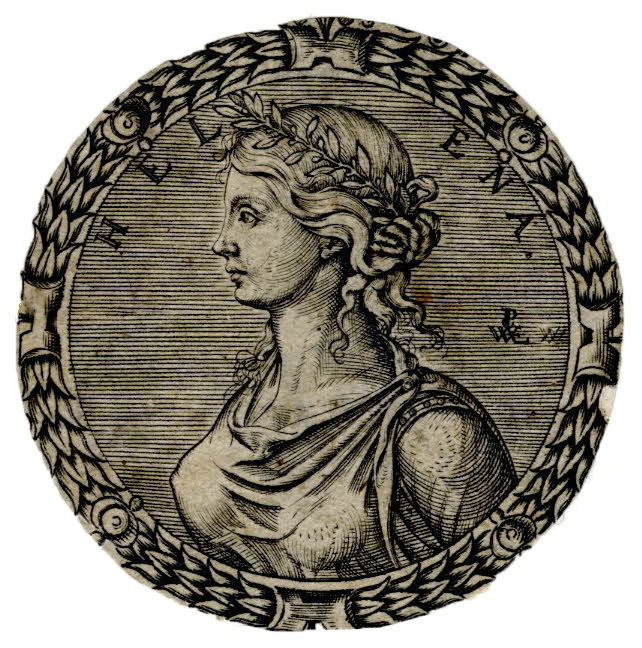
Bust portrait of Helen of Troy, Pierre Woeiriot, 1555-1562.Bust portrait of Helen of Troy, Pierre Woeiriot, 1555-1562.

‘Terrible’ because the Greeks believed that when you looked at the face of a goddess or one who, like Helen was quasi-divine, dreadful things happened. When Actaeon saw Diana bathing she turned the peeping Tom into a stag – a stag who was then harried by his own hounds. Those who stared at the Gorgon were petrified – turned to stone. It is for this reason that Helen despises her own beauty – and bemoans in Euripides’ eponymous drama Helen: ‘My life and fortunes are a monstrosity… partly because of my beauty. I wish I had been wiped clean like a painting and made plain instead of beautiful’.

Helen knows she cannot escape her own beauty, she cannot clamber out of her skin. On the vases of the fifth and fourth centuries BC, she is often depicted staring intently at herself in a mirror. Artists of the 19th and 20th centuries – painting their own versions of the Spartan Queen – interpreted this self-absorption as a sign of vanity – but for the ancients, it was a signal that by studying her reflection Helen was bringing her horrors home to roost.

The fancy that Helen’s beauty was a lint covering a festering wound proved perennially popular. A woman’s beauty was thought, in the Western tradition, to ‘trick’ men into a sexual relationship. The more beautiful a woman, the more likely her exterior attributes displayed a duplicitous nature. Simonides, composing in the seventh century BC, ranted:

Yes, women are the greatest evil Zeus has made,
And men are bound to them, hand and foot,
With impossible knots tied by god.
It is no wonder that Hades waits at the door
For men at each other’s throats
Over women.

On the Greek stage, much play was made of the notion that the handsome female was created to beguile and inveigle the male population. In Attic Comedy, fine women with their contrived beauty, and prostitutes are frequent characters whose job it is to ensnare men. Travelling forward 2,000 years in time, Alexander Ross, Anglican minister and author of the highly popular and widely read Mystagogus Poeticus (a myth dictionary listed in alphabetical order and published in 1647) opines:

… for she [Helen] had a deform’d soul, playing the strumpet, not only in her younger years with Theseus … but also being married to Menelaus, forsook him, and became a whore to Paris; and not content with him, committed incest with Gorythus, the son of Paris and Oenone; afterward betrayed the city of Troy to the Grecians, and treacherously caused her husband Deiphobus to be murdered in his bed by Menlaus … thus we see, that outward beauty of the body, without the inward graces of the mind, is but a gold ring in a swine’s snout.

In the Iliad, Helen wails: ‘On us is sent an evil destiny,/ That we should be a singer’s theme/ For generations to come’. Her prophecy holds. There has not been an age that has not hated her for her beauty and has not chosen to transmit her sexual adventure as an educative example of voracious whoring. In Terence la Nove’s series of artworks ‘Maelstrom’ created between 1999–2003, Helen is portrayed as a catalyst of disarray and in the site-specific installations of the American artist Joan Jonas ‘Lines in the Sand 2002’ – a mixed-media series which subtly and brilliantly aims to liberate Helen from her stereotype – Helen still appears reincarnated as a showgirl in Las Vegas.

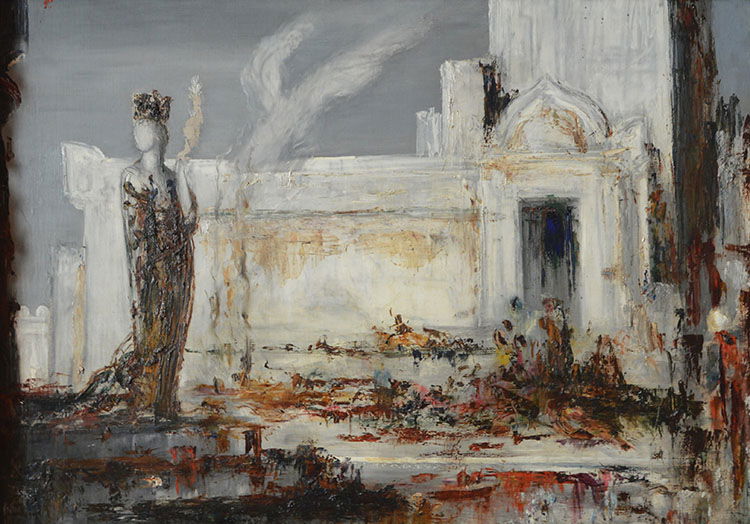
Helen at the Scaean Gate, Gustave Moreau, 1880s. Helen at the Scaean Gate, Gustave Moreau, 1880s.

The ancient authors were right to think of Helen’s beauty as a curse. She has been remembered – not as one of the Mycenaean potentates on whom her story was based, nor as sexually active player in Late Bronze Age international politics, nor even as Homer’s complex, tortured and resourceful Queen, but as ‘the face that launched a thousand ships’, ‘the most Beautiful Woman in the World’, ‘the Harlot of Greece’.

Helen of Troy has been established as a primal whore, a deceiver – in a long line of sexually powerful women whose purpose is credited as being to bring down men, whose sex life is viewed as a betrayal in pursuit of furtherment, perpetuating the ancient notion that female lust pollutes male intellect. To use the words of Jeffrey Toobin: ‘As is demonstrated by the history of scandal from Helen of Troy to Monica of Beverly Hills, sex has a way of befogging the higher intellectual faculties.’

 Bettany Hughes is a historian, broadcaster and author of Helen of Troy: Goddess, Princess, Whore (2005). Her latest book, Istanbul: A Tale of Three Cities, is out now. This article originally appeared in the November 2005 issue of History Today.

International Day of the Girl: Child Marriage

Standard

via https://medium.com/

I have always found it a horrible act in any kind and any name of any believing!!

Child marriage occurs in every region of the world. Globally, 15 million girls under 18 marry each year — one every two seconds. The overwhelming majority of married children are girls, most marrying older men — in some cases much older. Children are often forced or coerced to marry.

Child marriage is deeply harmful: it deprives girls of education, exposes them and their babies to serious health risks from early pregnancy sink their families deeper into poverty and raise the risk that they will face domestic violence.

Under the United Nations Sustainable Development Goals, countries around the world in 2016 set 2030 as a target year for ending all child marriage. Many countries are reforming their laws and developing plans for achieving this goal.

Some progress is being made on the issue. But more needs to be done.

USA — 49 states to go (and counting)

Child marriage is surprisingly common in the US. Over 167,000 children married in 38 states alone from 2000 to 2010. Most US states set the minimum age at 18. But except for Delaware, all still allow exceptions, most of which are very broad — for example with parental permission, or for pregnancy. In 23 states, children of any age can marry under some circumstances. Countries like Afghanistan, Honduras, and Malawi have tougher child marriage laws than many US states. Several US states — including Florida, New York, Texas, and Virginia — recently narrowed the circumstances under which children can marry, but still permit some child marriages.

On March 23 2018, Governor Rick Scott signed a bill to limit child marriage in Florida, but which still allowed for marriage with parental consent in some circumstances. From 2001 to 2015, over 16,000 children under the age of 18 married in Florida, the second highest rate in the US for that period.

In New York State Human Rights Watch launched a campaign to raise the legal marrying age from 14 to 17. Governor Andrew Cuomo signed legislation in June 2017 that will dramatically reduce the circumstances under which children can marry.

On May 9, this year Delaware’s governor signed a bill prohibiting marriage before age 18, making it the first US state to ban all child marriage. This is a crucial step toward ending child marriage in the US and around the world.

UK — Hypocrisy undermines pledge to fight child marriage overseas

As recently as September this year, Pauline Latham, a Conservative MP, introduced a bill to ban marriage before the age of 18 in England and Wales. In England, Wales, and Northern Ireland, children aged 16 and 17 can marry with their parents’ permission. In Scotland, the minimum age of marriage is 16, with no parental permission required.

In allowing some children to marry the UK is out of step with the international standards it claims to support.

In 2014, the UK government hosted the high-profile Girl Summit, designed to boost — and pledging UK leadership for — global efforts to end child marriage and female genital mutilation. But in the years since, the UK government not only failed to ban child marriage at home — it actually blocked an earlier effort to do so.

Hypocrisy has consequences. In 2017 Bangladesh re-legalized child marriage, and government officials there repeatedly cited the fact that child marriage is legal in the UK as justification. Other countries failing to enforce bans on child marriage have also cited the UK law to defend themselves. When key donors like the UK ignore their own problem at home, the SDG goal seems impossible.

Indonesia — Child marriage ban in the works

A girl is seen through a fence before prayers for the Muslim holiday of Eid Al-Adha on a street in Jakarta, Indonesia September 12, 2016. © 2016 Reuters

Also this year, President Joko “Jokowi” Widodo of Indonesia said he was committed to ending child marriage.

It was a bold statement in a country in which child marriage is widespread. According to UNICEF, 14 percent of girls in Indonesia are married before age 18, and one percent marry before age 15. The 1974 Marriage Law permits women and men to marry at 21 but allows girls to marry at 16 and men to marry at 19 with parental permission.

Indonesia — Stop distracting from the issue of child marriage

When the news broke in July 2018 that a 41-year-old man from Kelantan, Indonesia, had married an 11-year-old girl, alarm bells went off in Malaysia’s newly elected government as well as among nongovernmental groups. The Kelantan state police started an investigation, and activists stepped up calls to legislate a minimum marriage age of 18, with no exceptions.

But some politicians saw the issue differently. Mohd Amar Nik Abdullah, the deputy head of government in Kelantan state, which is ruled by the opposition Malaysian Islamic Party (PAS), said child marriage should not be “sensationalized” and does not violate religious principles.

“The issue of zina [sex outside marriage], children born out of wedlock, gays and lesbians, are bigger issues for the country.” — Mohd Amar Nik Abdullah

Not only do Mohd Amar’s comments belittle girls’ rights, but they also reinforce homophobic views.

Japan — Joining the global push to end child marriage

A proposed revision of Japan’s Civil Code would set the minimum age of marriage at 18 for both women and men. At present, people must be 20 years old to marry without parental permission; with parental permission, men can marry from 18, and girls can marry as young as 16. If passed, the law, which the government supports, would take effect in 2022.

This step is long overdue. Different marriage ages for women versus men violate Japan’s obligations under international human rights law not to discriminate.

Japan has a crucial role to play in the effort to end child marriage globally. The Japanese government is a major contributor to international development assistance and is active in many countries where child marriage is a serious problem. Of the 40 countries that, according to UNICEF, in 2017 had the highest rates of child marriage, the Japan International Cooperation Agency (JICA) works in 29 of them, across Asia, Africa, the Middle East, and Latin America, including hotspots for child marriage like Niger, Bangladesh, Burkina Faso, South Sudan, and India.

By ending child marriage at home, Japan makes itself a more credible partner in the global fight to end child marriage. The Japanese government should build on the new law by taking a more active role in the global effort to end child marriage, and by supporting reform in the many countries where far too many girls are getting married.

You can read these pieces in full, and more Human Rights Watch reporting on child marriage here: https://www.hrw.org/topic/womens-rights/child-marriage

We’re off to see…

Standard

cav12's avatarLuciana Cavallaro

Today, we are off to where Evan’s journey in the ancient world started: in the Mediterranean Sea. Literally. He was plucked from his comfortable 21st Century home by Zeus and ditched in the middle of a shipwreck.

View original post 110 more words

“A Terrifying & Edible Beauty,” Gaudi’s La Sagrada Familia

Standard

Deborah J. Brasket's avatarDeborah J. Brasket, Author

IMG_0349(1)

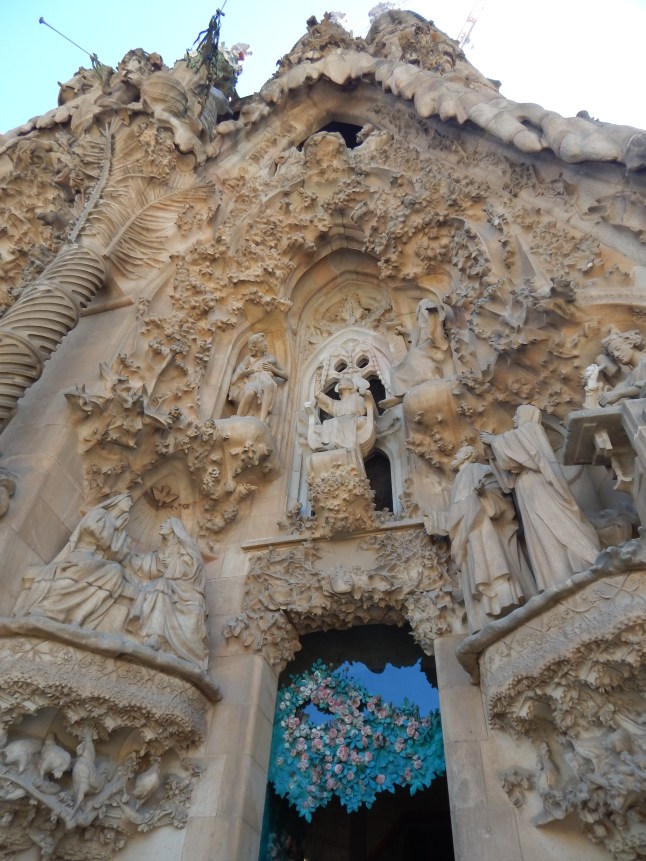
This stunning cathedral, a tribute to Antonio Gaudi’s genius and imagination, his love of God and Nature, was begun in 1882 and is still a work in progress. It’s hoped to be completed by the centennial of Gaudi’s death in 2026, but many believe it will stretch well beyond that date.

DSCN4482“There is no reason to regret that I cannot finish the church,” Gaudi wrote. “I will grow old but others will come after me. What must always be conserved is the spirit of the work, but its life has to depend on the generations it is handed down to and with whom it lives and is incarnated.”

“La Sagrada Família is made by the people and is mirrored in them. It is a work that is in the hands of God and the will of the people.”

DSCN4485

On it’s completion, it will tower 560 feet, slightly less than the…

View original post 338 more words

Deep Dark & Heavy

Standard

Cakeordeath's avatarcakeordeathsite

63c857e6900b3b333eff1c390ee73e4d[1] Valentine Hugo-L’heure exacte 1926

Of course you can give it away;
It’s only love,
Our final hope of everything
Indeed anything.
We’ve always squandered
All opportunities,
Wasted time, money and chances,
Not for gamblers like us
Calculated risks, urged cautions,
Instead all I need
Is a sign: to close my eyes,
Take your hand,
Leap into the deep dark & heavy.

View original post

Vedic Cultural Influence in Early Antiquity

Standard

See You Again

Standard

The Truth is out there ❤ 🙂

D. Parker's avataryadadarcyyada

https://yadadarcyyada.com/2018/07/15/see-you-again/Sorry I’m not sorry…Not sorry I took a blogging break to question myself. I was seized with a feeling, a feeling that I had nothing else to say…I know that doesn’t stop some folks, but I didn’t want to waste my time or yours, you know, overstay my welcome.https://yadadarcyyada.com/2018/07/15/see-you-again/Then lately, everything I read or watched seemed to have the theme of atonement, redemption – maybe my brain was begging to reclaim my blog, atone for not believing in myself, redeem my poor little lonely blog sitting here, hoping against hope, to be read, so I thought, what the heck, a few more posts couldn’t hurt (er, famous last words?).https://yadadarcyyada.com/2018/07/15/see-you-again/

  • Not sorry a couple of wonderful bloggers/authors, Teagan and John knew just how to lure me back, putting down Reese’s Pieces, or in this case, books/ARCs, to lead me back to blogging (Be Good).

https://yadadarcyyada.com/2018/07/15/see-you-again/

View original post 901 more words

Selene

Standard

Cakeordeath's avatarcakeordeathsite

Configuration-Max Ernst 1974 Configuration-Max Ernst 1974

I can’t believe this
I can’t
I can’t believe this feeling,
In control of my desolation,
Home in the alienation.
You said you’d take me higher,
And I’m higher,
Higher than ever before
I can’t believe that
I’m seeing the blue-green orb
Spinning frenetically
Ceaselessly ebbing, flowing, flooding,
Mutability the only constant
From this vantage-point
Of this Empire of Dust.
But I am tranquil in my isolation,
Calm in the knowledge,
Of this monthly death
And rebirth, the steady
Procession of waxing and waning,
Gibbous and crescent,
The fullness that must pass
Into invisibility before re-commencing
As two celestial bodies approach closer,
You take me still higher
The cycle and phases of lunacy,
Rays of translucent illumination
A ladder of fine silken threads
Leading upwards towards a point
Where I can glimpse some kind
Of knowledge, leading to communion
With the stellar inhuman intelligence,
The Alabaster Goddess

View original post 26 more words