We might search for our divided part, as I. And mine might be you, Amalia, though, if I meet you once somewhere, sometime, no guarantee for the Platonic love 😉 ❤ :* Great post again ❤ ❤
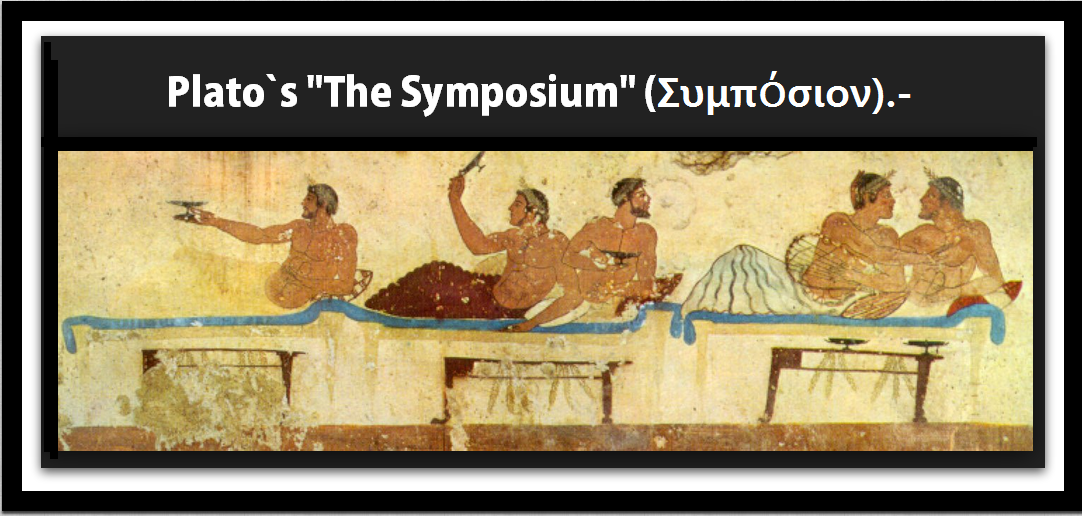
“The Symposium” ( Συμπόσιον) is a dialogue by Plato dated c. 385–380 BC.
Plato sets the action in a symposium hosted by the poet Agathon to celebrate his first victory in a dramatic competition, the Dionysia of 416 BC. Each man must deliver an encomiun, a speech in praise of Love (Eros). Each participant, by means of very personal expositions, adds something to a body that at the end is developed by Socrates.
The dialogue concerns itself at one level with the genesis, purpose and nature of love, and (in latter-day interpretations) is the origin of the concept of Platonic Love.
Platonic love is a type of Love that is chaste and non-sexual. This idea is also examined in this dialogue. Of particular importance is the speech of Socrates, relating the ideas attributed to the prophetess Diotima, which present love as…
I’ve just thought that the German version fails 😉 Antoine de Saint-Exupéry is my prophet ❤
"Es ist Wahnsinn, alle Rosen zu hassen, weil du mit einem Dorn gekratzt wurdest, deine Träume aufzugeben, weil einer nicht wahr geworden ist, alle Versuche aufzugeben, weil einer fehlgeschlagen ist.Es ist Wahnsinn, alle deine Freunde zu verurteilen, weil eine(r) dich betrogen hat, nicht an die Liebe zu glauben, weil jemand untreu war, alle deine Chancen, glücklich zu sein, wegwerfen, nur weil etwas nicht richtig lief.Es wird immer eine andere Gelegenheit geben, anderen Freund, andere Liebe, neue Stärke. Für jedes Ende, gibt es immer einen neuen Anfang. “
Antoine de Saint-Exupéry (né le 29 juin 1900 à Lyon et disparu en vol le 31 juillet 1944 au large de Marseille) – écrivain et aviateur français – auteur du “Petit Prince”.
⭐ “C’est une folie de haïr toutes les roses parce que une épine vous a piqué, d’abandonner tous les rêves parce que l’un d’entre eux ne s’est pas réalisé, de renoncer à toutes les tentatives parce qu’on a échoué…
C ‘est une folie de condamner toutes les amitiés parce qu’une d’elles vous a trahi, de ne croire plus en l’amour juste parce qu’un d’entre eux a été infidèle, de jeter toutes les chances d’être heureux juste parce que quelque chose n’est pas allé dans la bonne direction. Il y aura toujours une autre occasion, un autre ami, un autre amour, une force nouvelle. Pour chaque fin il y a…
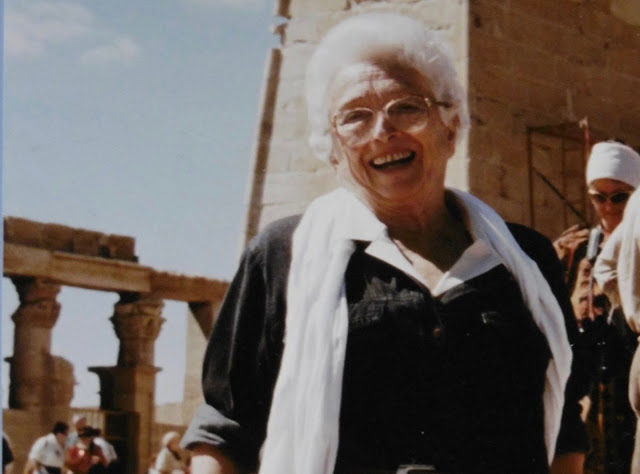
Born November 17, 1913, in Paris, Christiane Desroches (wife of Noblecourt) completed her secondary education at Lycée Molière, then followed the Egyptianology classes taught at the École du Louvre by Father Etienne Drioton (former director of the Antiquities Department of Egypt until 1952) and supports his thesis of archaeology in 1935. Under the direction of Gustave Lefebvre, she also prepares, at the École Pratique des Hautes Études, a philology thesis defended in 1937. From that time, She is in charge of the mission at the Louvre Museum. In 1938, the first woman appointed resident at the French Institute of Oriental Archeology in Cairo, she moved to Egypt until the end of May 1940 and took part in IFAO excavation sites, particularly in Upper Egypt. (Deir el-Medineh and Tell Edfu).
When World War II broke out, she enlisted in the Resistance and sheltered the Egyptian collections of the Louvre in southwestern France. Appointed assistant in 1942, she was promoted a few years later to the rank of conservative. In 1954-1955, UNESCO entrusted her with a mission to the Egyptian government to found the Center for the Study and Documentation on Ancient Egypt (CEDAE), an organ that has since been attached to the Supreme Council of Antiquities of Egypt (now the Ministry of Antiquities). This mission is a prelude to the international campaign to safeguard the monuments of Nubia, which she will be the linchpin alongside Saroite Okacha, Egyptian Minister of Culture. This action will be decisive for the rescue of the two temples of Abu Simbel (Ramses II and Nefertari) and especially that of Amada (Tuthmosis III, Amenhotep II and Thutmose IV) whose French government finances the movement on rails.
Assuming the post of a chief curator from 1957 (which will be permanently conferred in 1974), it provides, since 1960, teaching at the Ecole du Louvre which she holds the chair of Egyptian archaeology. In 1966, it associates the scientific work of CEDAE, in Nubia, with those of RCP 80 of the CNRS (Cooperative Research on Program), transformed in 1973 into ERA 439 (Associated Research Team). This CNRS formation, located in the Louvre, will conduct research in Nubia and Thebes on the temples of royal worship, the tombs of the pharaohs and the civil and civil furniture. During this same period, she contributed to the foundation of the Franco-Egyptian centre for the study of the Karnak temples (CFEETK), which will become a permanent mission of the CNRS (1973), where she will co-chair the management committee with Gamal Eddin. Mokhtar (at the time President of Egyptian Antiquities).
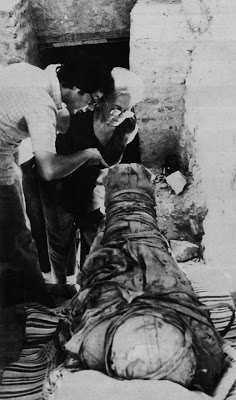
Christiane Desroches Noblecourt and Christian Leblanc upon release of the tomb of Tanedjemy in 1978 in the Valley of the Queens (photo Kurz)
In parallel to her masterly exhibition on Ramses the Great, held at the Grand Palais (Paris, 1976), she actively prepares for this year, with the Musée de l’Homme, the arrival in France of the mummy of Ramses II, whose precarious state requires urgent treatment by specialized laboratories. In 1980, she applied to the Egyptian Antiquities Organization for the opening of a new archaeological concession for the Louvre at Tod-Salamia (a temple dedicated to the god Montou, near Louqsor), whose work she directed the research until 1985. Admitted to claim her rights to retirement at the end of 1983, she continued nevertheless an intense activity of construction site until 1992. From 1984, she sets it up, thanks to the help of a private sponsorship (Germaine Ford Foundation of Maria), the renovation operation of the Valley of the Queens, of which she will assume the co-responsibility with Christian Leblanc, his successor, at the head of the CNRS team.
Vice-president of the Secular Mission and the France-Egypt Association, Desroches Noblecourt has been a corresponding member of several foreign archaeological institutes. Honorary Doctorate of Charles University of Prague and a foreign member of the Institute of Egypt, she was also recipient of several decorations and awards: Grand Cross of the Legion of Honor, Officer of the National Order of the merit, medal of resistance, commander of the Order of Academic Palms, Commander of the Order of Arts and Letters, Grand Officer of the Egyptian Order of Liberation, Vermeil Medal of the City of Paris (1967), silver medal from UNESCO (1968), CNRS gold medal (1975), silver medal of archeology awarded by the Paris Academy of Architecture (1975), great gold medal of the society of encouragement to progress. She died in Epernay, June 23, 2011. A solemn tribute was paid to her on September 27 in Aswan (in the presence of Mr Mounir Fakhry Abdel Nour, Egyptian Minister of Tourism and Mr Jean-Felix Paganon ambassador France in Egypt), then to the French Institute of Egypt in Cairo (Mounira and Heliopolis) on September 29 and October 3, 2011. In the IFAO exhibitions, a photographic exhibition prepared by MAFTO depicted on this occasion, her journey from Nubia to the Valley of the Queens. Today, in the sixteenth arrondissement of Paris, there is a “Christiane Desroches Noblecourt Garden” (formerly “Jardin de la Place Rodin”).
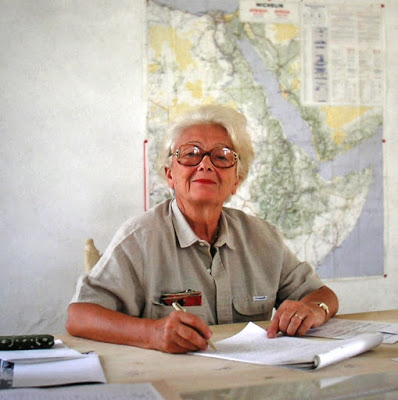
Christiane Desroches Noblecourt, at Tod 1982 (photo G. Lecuyot – Christian Leblanc collection)
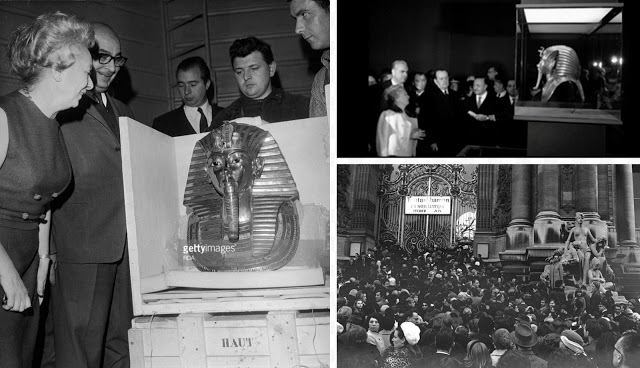
The work of Ch. Desroches Noblecourt began with surveys of everyday life and some Egyptian customs that have their origins in the mists of time. It has illuminated the meaning of certain decorations and forms, considered as belonging to the field of anecdote, but which, in reality, were aimed at ensuring the survival of the Egyptian. Her research, widely expounded in her archaeology class at the Ecole du Louvre, is due to a better understanding of the message of the reliefs and paintings in the temples and chapels of the tombs. Her studies of the Amarnian and post-Amarna period, sometimes daring, have particularly helped to lift the veil that obscured the person and reign of Tutankhamun; they also highlighted the reach of the treasure of this young pharaoh – the only almost complete royal funeral ensemble preserved to this day. The exhibition she devoted to him in 1967 (Paris, Petit Palais), was a masterful demonstration. Her interpretations paved the way for investigations into hitherto misunderstood and neglected symbols, which were taken up and developed by various foreign Egyptian schools.
Her vocation as an Egyptologist has naturally encouraged her to contribute to the vast enterprise of saving the monuments of Nubia threatened by the construction of the Aswan high dam. Since then, under the auspices of UNESCO, she participated in scientific surveys of temples, introducing new techniques such as photogrammetry, and took part in excavation missions and the founding of a specialized Egyptian center for the study of pharaonic monuments (CEDAE), with which still today, collaborates permanently the CNRS (MAFTO / UMR 8220-LAMS). In gratitude for its participation in this international heritage preservation work, France received from the Egyptian government, in 1972, the donation of a superb bust of Amenhotep IV-Akhenaten from the Gem-pa-Aton de Karnak-Est, and since then exhibited at the Louvre Museum.
Christiane Desroches Noblecourt to Dakka (photo Jean-Louis Clouard)
Along with her work in Nubia, Desroches Noblecourt initiated important research at Thebes West, involving researchers from different backgrounds. The vast search for the graffiti of the Theban mountain, which she put on the program in 1967, not only made it possible to establish a rich corpus of inscriptions associated with the ancient visitors of the mountain, but also to reveal the existence of a lithic industry (pre-Acheulean cobbles) attesting for the first time the presence of homo habilis Egypt, about two million years ago. These works of epigraphy, topography, cartography, geomorphology and prehistory led to the publication of twenty-three volumes published jointly by CEDAE and CNRS between 1969 and 1983. It was during this same period that she rediscovered, in the Valley of the Queens, the tomb of Toy, mother of Ramses II, lost since the expedition of R. Lepsius, whose excavation made it possible to expose, in March 1973, a superb portrait of the queen, today preserved in the Museum of Luxor. Other royal and princely burials were then explored in this necropolis, but it was not until 1984 that a major operation could see the day (renovation of the Valley of the Queens) and make it possible to explore and study about sixty tombs abandoned until then. Preliminary work was also conducted under her supervision at the Ramesseum (temple of Ramses II), and saw a significant development from 1989, thanks to the founding of the Association for the Protection of the Ramesseum, of which she was a member of honour. This archaeological site is today one of the flagship sites of the French Archeological Mission of Thebes-West (MAFTO / CNRS) and the Supreme Council of Antiquities of Egypt, in parallel with the excavations and studies conducted in the tombs of Ramses II (KV.7) and Merenptah (KV.8) in the Valley of the Kings.
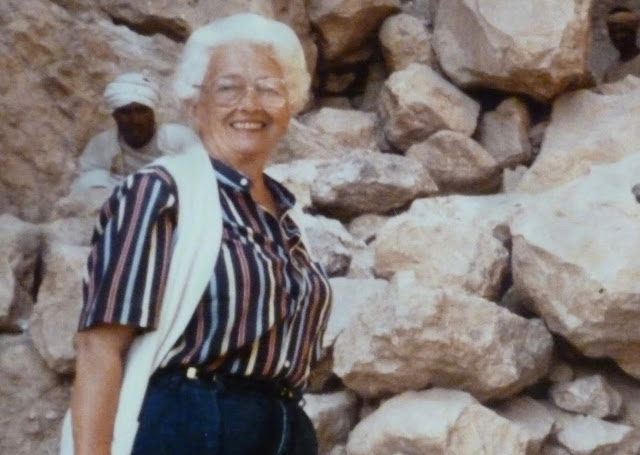
Christiane Desroches Noblecourt in 1985 Queens Valley (photo Jean-Louis Clouard)
Christiane Desroches Noblecourt leaves us the memory of a woman who knew how to face the challenges, overflowing with energy and full of convictions. She brilliantly set up a genuine Egyptian partnership, knowing how to associate Egyptians and French. It also appealed to researchers coming from other horizons, enriching by this necessary need for multidisciplinarity, scientific research, which earned it the highest distinction CNRS. Fascinated by Egypt from the past, but also by that of the present, she contributed, thanks to her extraordinary talent, to fortify this age-old history shared between our two countries. Christian Leblanc Emeritus Director of Research at the CNRS Director of the French Archaeological Mission of Thebes West MAFTO UMR 8220 CNRS (LAMS-Sorbonne) ANTENNA EGYPT Standing Scientific Advisor to the Center for Study and Documentation on Ancient Egypt (CEDAE) [From XXII volume Memnonia, Cairo, 2011]
Tributes: – In October 2011, the City of Le Mans has given its name to one of its streets. – Thursday, October 22 2015, in Abu Simbel, in the presence of his son, the Minister of Antiquities Mamdouh el Damaty, the Minister of Tourism Hisham Zaazou, and a French delegation, a statue was unveiled in his memory. She is represented alongside Sarwat Okasha, Minister of Culture and Egyptologist Selim Hassan, who toiled with it the rescue of the Nubian temples.
– In May 2016, the city of Paris was inaugurated in the sixteenth arrondissement, the “Garden Christiane Desroches Noblecourt” (former Garden of Rodin Place).
As I was watching this animation by Hertzfeldt, it reminded me at first to one of the songs from Beatles White Album; Revolution 9. as you might have listened to it; a description of an uprising of the youth for love and not war and also more 😉
An after a few minutes it came a scene from the movie; The Meaning of Life by Monty Python: “The Fish Tank” in front of my eyes 🙂
Anyhow, we all surely would like to solve this question; “what is the meaning of life? this masterpiece is another version of this issue 😀 have a wonderful weekend ❤ ❤
This is for the first time that I write a tribute about my brother on this site, who “changed the level” as he wrote in his last novel as picturing the death.
He left on this day in 2007 because of a fiendish brain tumour and I reminded this day always on FB but now I feel much cosier to share it here with you.
Of course, in my opinion, to lose a beloved one lingers all the time in the heart and mind. But to mention the very day; Birthday or dying day, is normally the highest point of this memory, as one is much closer than ever.
Yes, we were an unusual pair; when I was born he was just 20 months old and after a year of my residence on this earth, one day when my mother was outdoor, he suggested Dad that they should take the chance to make an end on this cranky kinky and whimsical trouble and threw him out!!
But I survived by the help of Dad and despite all our differences, became fine to each other. Especially, when our father died by a brain stroke, I was just seven years old and Al, my brother, almost a year older was nevertheless much wiser and his brain further than mine, therefore, he took the place of the protectionist.
And as father was just a writer with no idea about making money, he left us with a huge depth and Mom, although, as a young widow, had to find ways to pay all them off. Therefore, we were mostly alone in our big house. But with all exciting moments, we got through these all troubles and it brought us much nearer and closer together.
Anyway, He was a very happy freethinker and sometimes very hard; an honest critical genius with a generous heart.
I don’t believe in ghosts as some might do but in a might behind this earthly life and I feel it beside me, as my brother or Mom or Dad. With always love and gratitude ❤ ❤
Actually, I have no need to add something in this wonderful description by my adorable friend Symbol Reader but just wanted to say that when I was young and much curious about our inner unknown and of course inspired by Dr Sigmund Freud, he, Dr Carl Gustav Jung was the one who showed me how someone could be so genius and at the same time so open! 🙏🙏💖🙏🙏
“I resisted recognizing that the everyday belongs to the image of the Godhead. I fled this thought, I hid myself behind the highest and coldest stars.”
Hey Friends! There I get another version of this issue as I give it the No; 2, because I’ve written once about this effect in my life but now I get another point, and this is the Burnout at work!
Of course, please don’t look at the cravat, I’d never use it!! 😀
But the case is; as you might mention; I am writing a post on Tuesday on which I must normally be at work, but I’m at home 😉
I just wanna say the case; Burning Out is very serious and we might take care of it.
It is because I’ve got really a burnout last week. Let me tell you the story as short as I can; it’s may be repeated to tell that I’m working as a taxi driver in Germany and it might be right when one of my regular guest; a retired pastor and a wonderful man, once on the way, when we were talking about literature and I quote something from Shakespeare, he told me; “oh my God! you know Shakespeare? then you are downcasted!!”
You know, when I must do something, I’ll try to do it perfectly. And when I stayed here in Germany, the only chance for me to earn my own money was to do this job. Therefore, I tried to do it as a good driver, maybe the best 😉 then I became a very famous and beloved one in this small town. But unfortunately, it got a lot; I get sometimes in minutes’ beat phone calls one after another and you might imagine how hard is that when I’m driving the car in the streets 😛
Anyway, Yesterday I’ve got to my doctor and told the story and asked him if I needed a neurologist. You are not mad Mr Fazel! he said; only exhausted.
And now I have to take a rest and reading and writing and enjoying the good life, then gathering power to back to another one; wildlife!!!
May the force be with you all and have a nice week ahead ❤ ❤



 Antoine de Saint-Exupéry: Le Petit Prince – 1943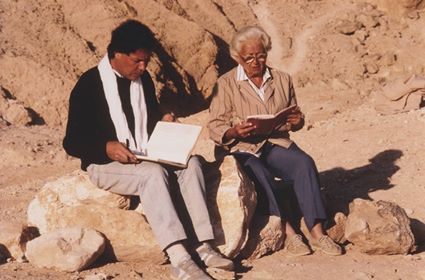








 lampmagician
You must be logged in to post a comment.