That’s of course, the title of the BBC article about the Genius of the all centuries. But as we actually know; He is standing still there, all the time, to make us wondering again and again about his ability and curiosity to find the answers to “all” questions.
First, after many thanks to luisa zambrottahttps://wordsmusicandstories.wordpress.com/ to mention this memorandum though, Leonardo da Vinci is not just an Italian but one part of the human beings,,, (if it’s so, should we be proud of it? Anyway, I hope we’ve deserved it), somehow, he belongs to the very special.
As I remember, in the early 70’s we’ve watched a TV serials on Persian TV: The Life of Leonardo da Vinci. As I remember with a wonderful soundtrack.
It was a fantastic production as BBC had often those days. (I was lucky also to see a many made of, from the Charles Dickens books)
And the other one was a very nice work too:
Anyway, it doesn’t have to be an advertisement for this English broadcasting but I have enjoyed a lot those days with all these wonderful illustrations.
Here is some “self portraits” plus more: isn’t it amazing this man? ❤ ❤
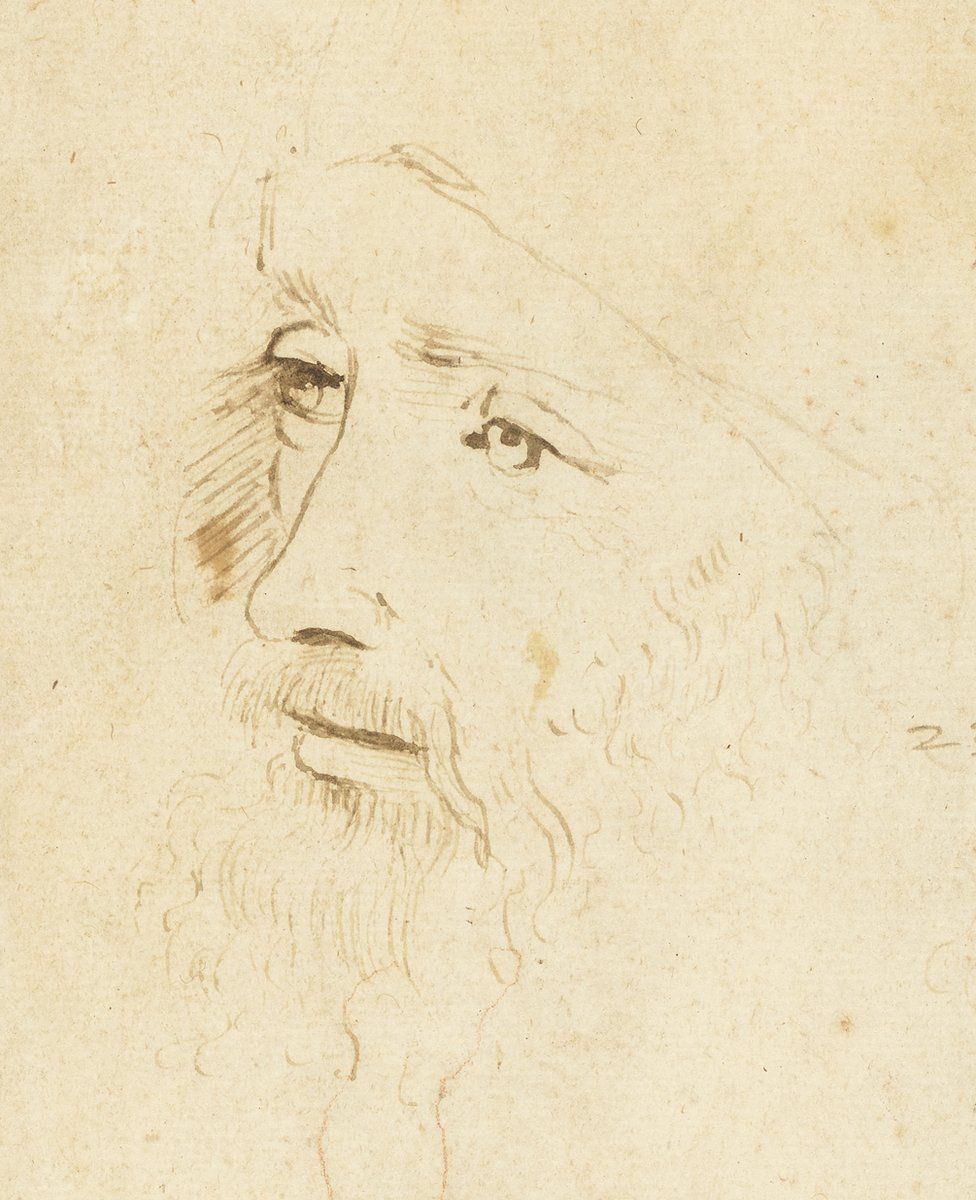
This portrait, newly identified as Leonardo da Vinci, is going on display in London as the world marks the 500th anniversary of the death of the artist and inventor.
Only one other portrait has survived from the artist’s lifetime, aside from self-portraits.
Martin Clayton was researching an exhibition for The Queen’s Gallery in London when he identified the sketch as a study of Leonardo made by an unidentified assistant shortly before the master’s death in 1519.
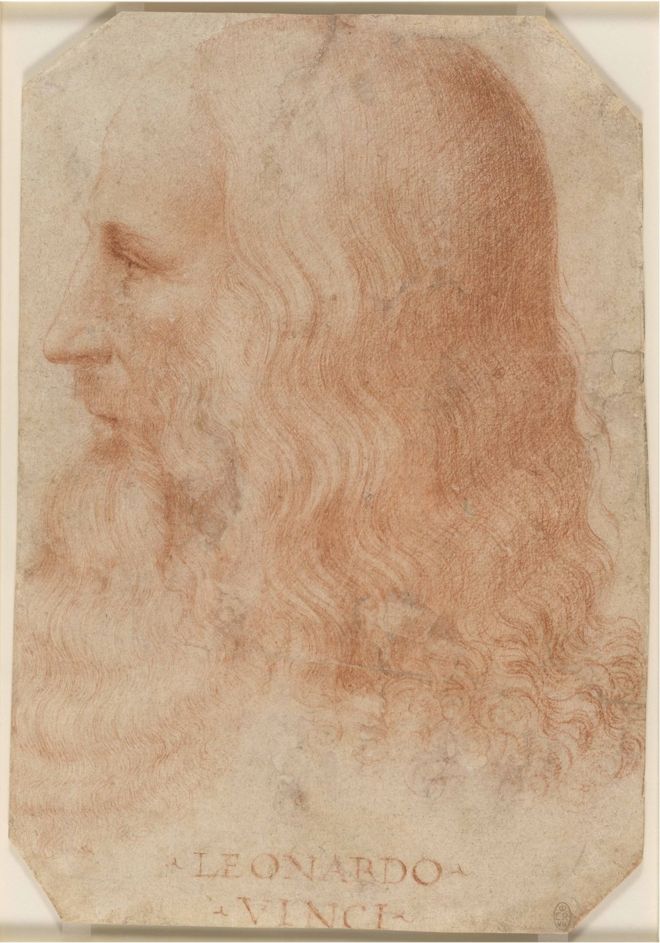
The only other contemporary image is by his pupil, Francesco Melzi, created around the same time, seen below.
“In the sketch, he is aged about 65 and appears a little melancholy and world-weary. If you compare this sketch with Francesco Melzi’s portrait of Leonardo, you can see strong indications that this too is a depiction of the artist,” says Mr Clayton of the Royal Collection Trust.
“The elegant straight nose, the line of the beard rising diagonally up the cheek to the ear, a ringlet falling from the moustache at the corner of the mouth, and the long wavy hair are all exactly as Melzi showed them in his portrait.
“Leonardo was renowned for his well-kept and luxuriant beard, at a time when relatively few men were bearded – though the beard was rapidly coming into fashion at this time.”
Museums and galleries are marking the Leonardo da Vinci anniversary. Here is a selection of his work, which will go on display in Italy, France and the UK.
At the master’s birthplace, Museo Leonardiano, Vinci, Italy
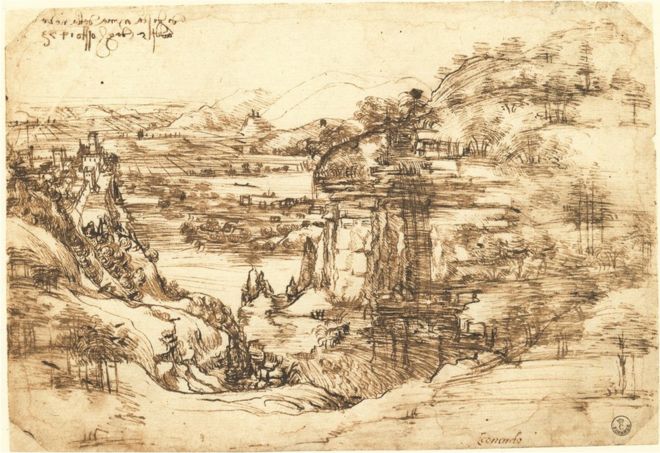
In the village of Vinci, the Museo Leonardiano is exhibiting the artist’s first known drawing, dated 5 August 1473, seen below.
Entitled Landscape 8P, it was sketched when the artist was 21. The museum describes the image as “a kind of palimpsest for all of Leonardo’s future output”.
The drawing includes a written reference to the Catholic festivity of Santa Maria della Neve (Our Lady of the Snow).
The museum say details in the sketch suggest the setting may be a combination of different places, including the Montalbano mountain ridge and the Valdinievole region in Tuscany.
A high-resolution three-dimensional digital version of the drawing will also be available at the exhibition, allowing visitors to see details not visible to the naked eye.
The sketch will be on display until 26 May and will then return to the Uffizi gallery in Florence.
Leonardo da Vinci’s Last Supper, Loire Valley, France
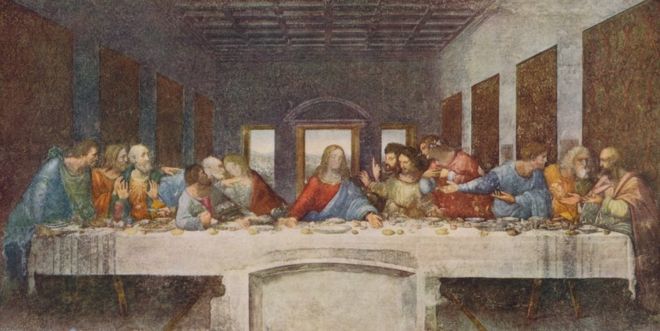
A tapestry based on Leonardo’s mural painting The Last Supper will be displayed at the Château du Clos Lucé in France, where he spent the final years of his life, between 1516 and 1519.
It is the first time the tapestry has been been outside the Vatican museum since the 16th Century.
The silk tapestry was woven for Louise of Savoy and her son, the future king of France, Francis I, some time before 1514. The new king invited Leonardo to move to France and much of the artist’s work went with him.
The original mural, seen above, is one of only around 20 paintings Leonardo completed and was commissioned for the refectory of the Convent of Santa Maria delle Grazie in Milan.
Leonardo da Vinci exhibition, Louvre museum, Paris, France
The Louvre in Paris expects huge demand for its forthcoming Leonardo da Vinci exhibition this October, urging visitors to book a time slot ahead of their visit.
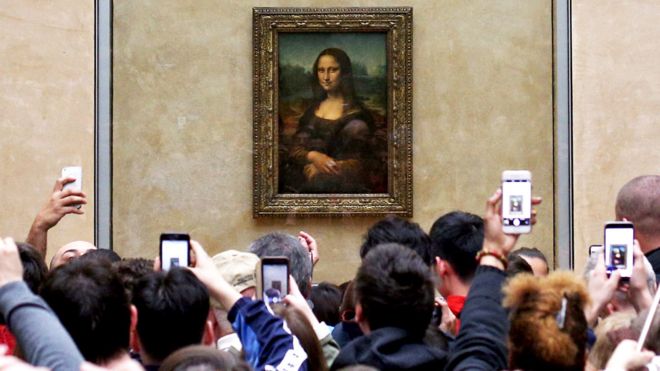
The museum holds the largest collection of his paintings, the best known of them being the Mona Lisa, seen above.
The gallery says the new exhibition will be the culmination of more than 10 years of work, including scientific examinations of the paintings.
Leonardo da Vinci: A Life in Drawing, The Queen’s Gallery, Buckingham Palace, London
Until 6 May, 144 of Leonardo’s drawings are on display in 12 simultaneous exhibitions across the UK in venues including Belfast, Cardiff and Glasgow.
The exhibitions are collectively called Leonardo da Vinci: A Life in Drawing.
From 24 May to 13 October, a single exhibition will open in The Queen’s Gallery in Buckingham Palace, featuring 200 drawings, before moving to The Queen’s Gallery in Edinburgh.
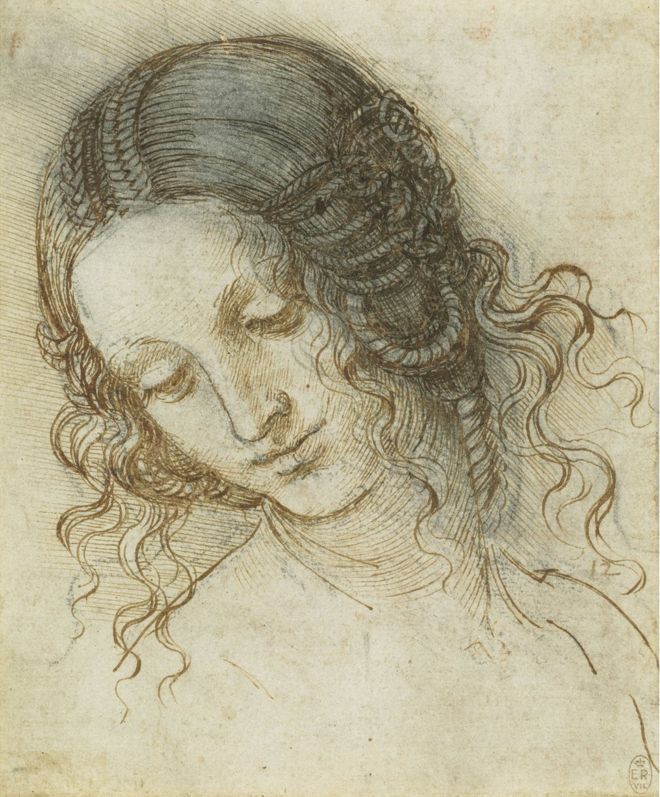
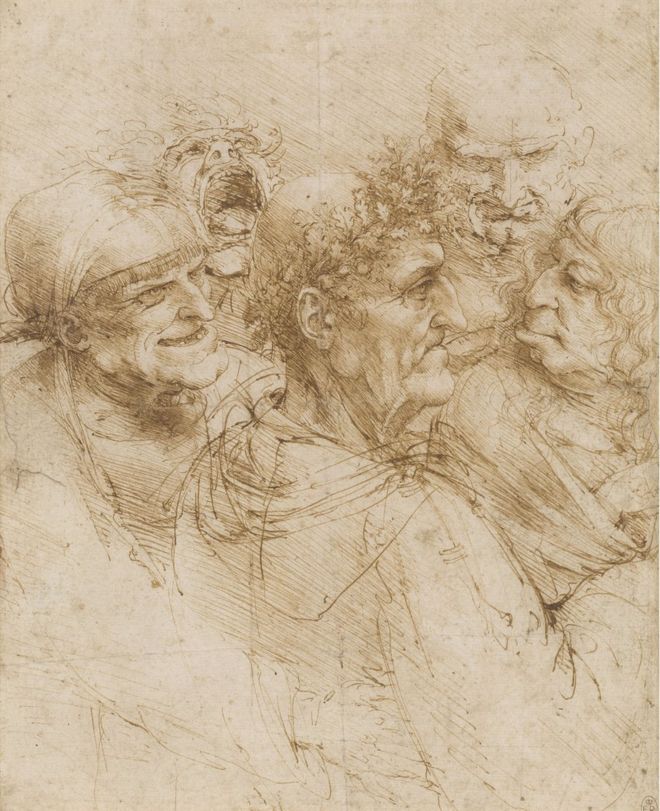
The drawings on display include The head of Leda in lack chalk, pen and ink (above) and A man tricked by Gypsies (from 1493, below).
Da Vinci has been regarded primarily as an artist, but the thousands of pages that survived from his notebooks show his diverse interests and achievements, including work on geology, anatomy, flight, gravity and optics.
He is often credited with coming up with concepts for the bicycle, aeroplane, helicopter, and parachute some 500 years ahead of their time.
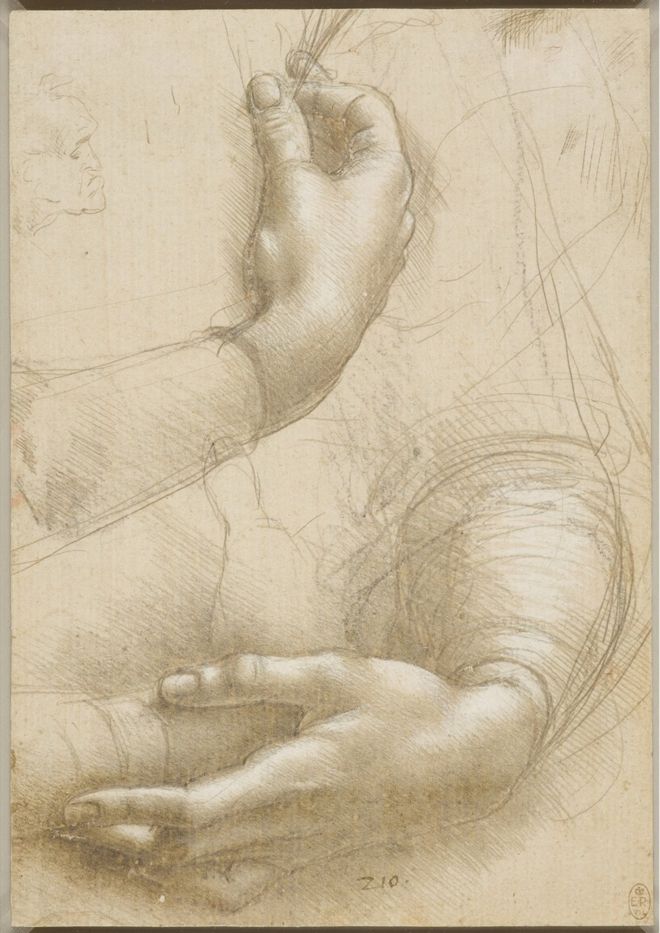
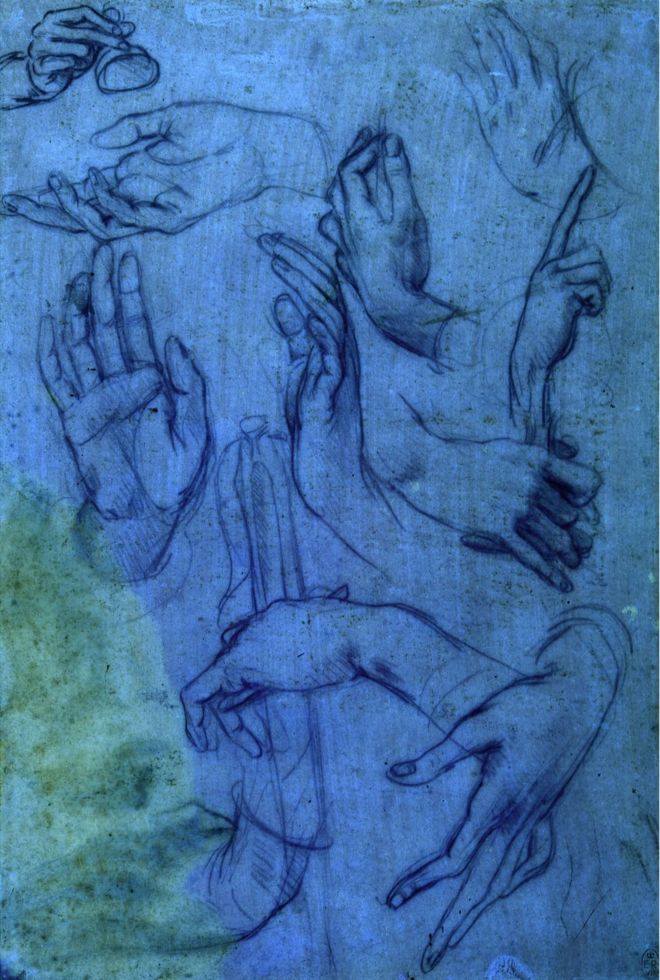
Image captionA study of a woman’s handsImage captionStudies of hands for the Adoration of the Magi painting in 1481, seen under ultraviolet light
Da Vinci produced ground-breaking work as an anatomist by dissecting 30 human corpses, which he studied in order to paint the human form more accurately.
The notes that accompany much of his work were written left-handed in mirror scripts.
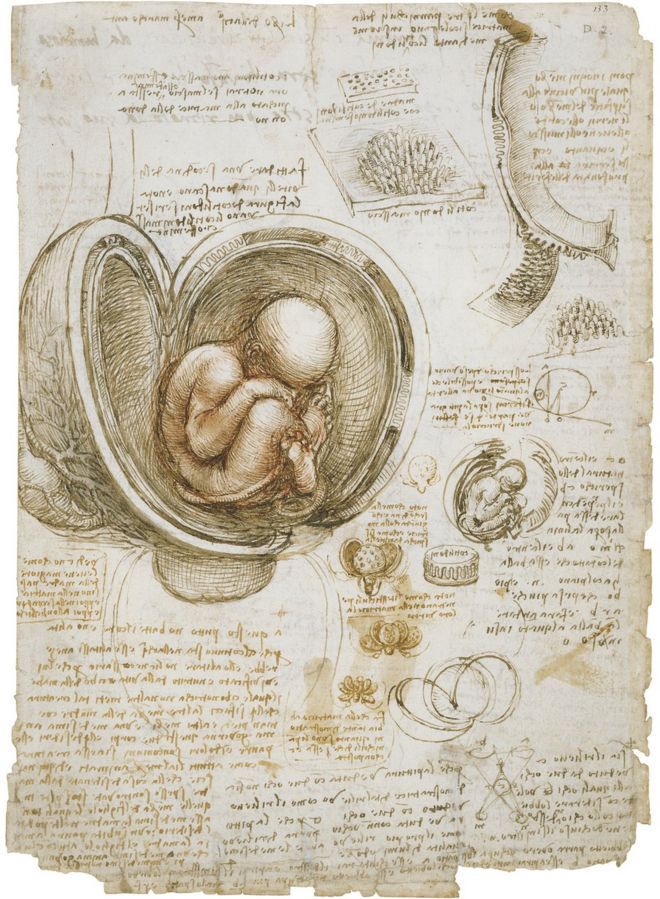
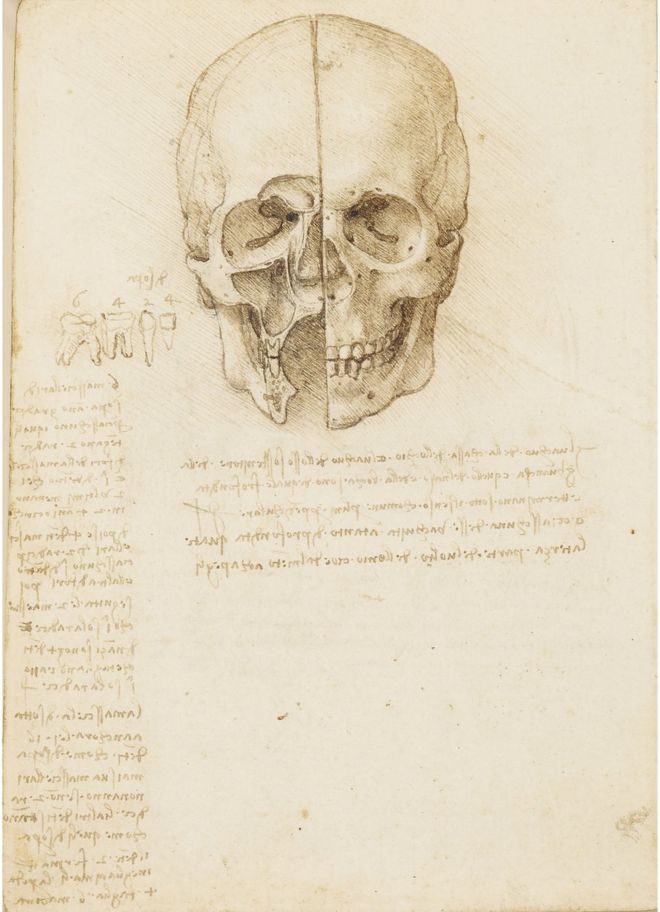
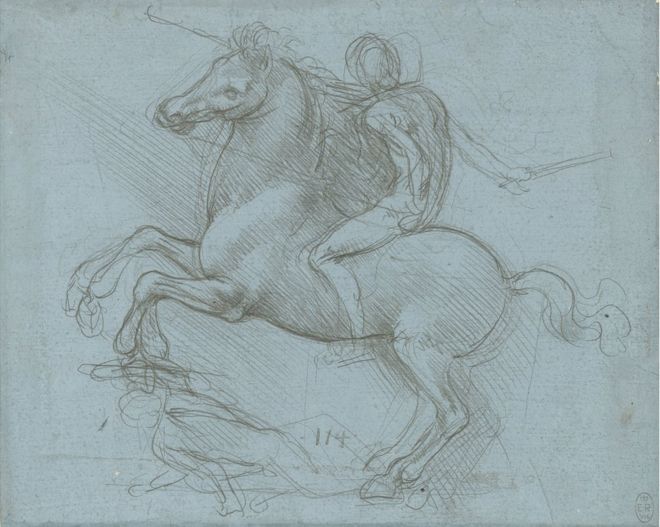
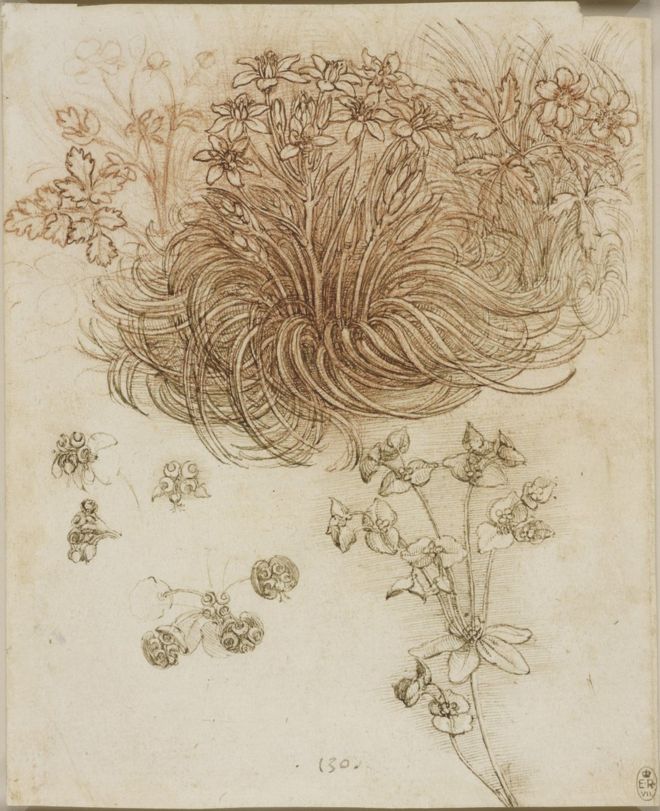
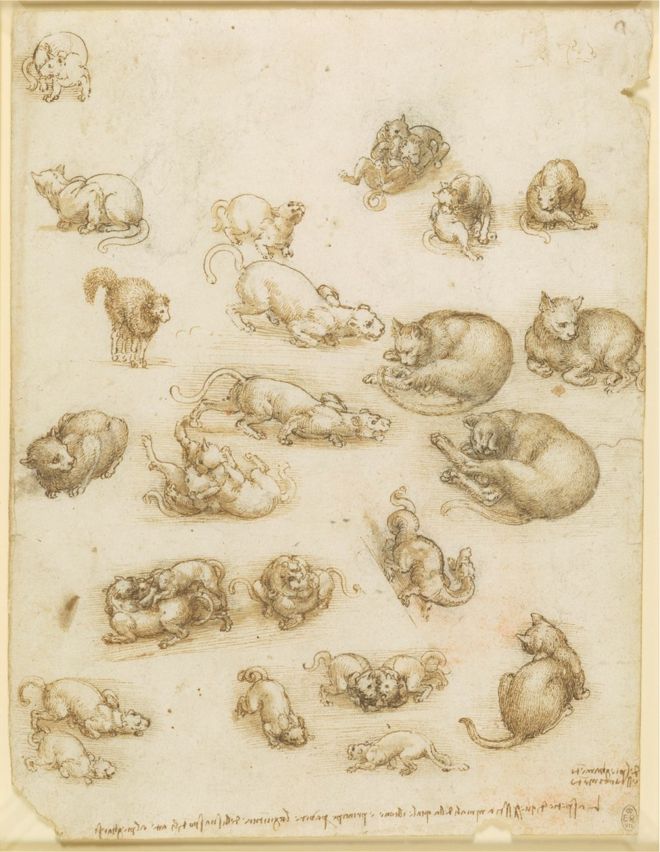
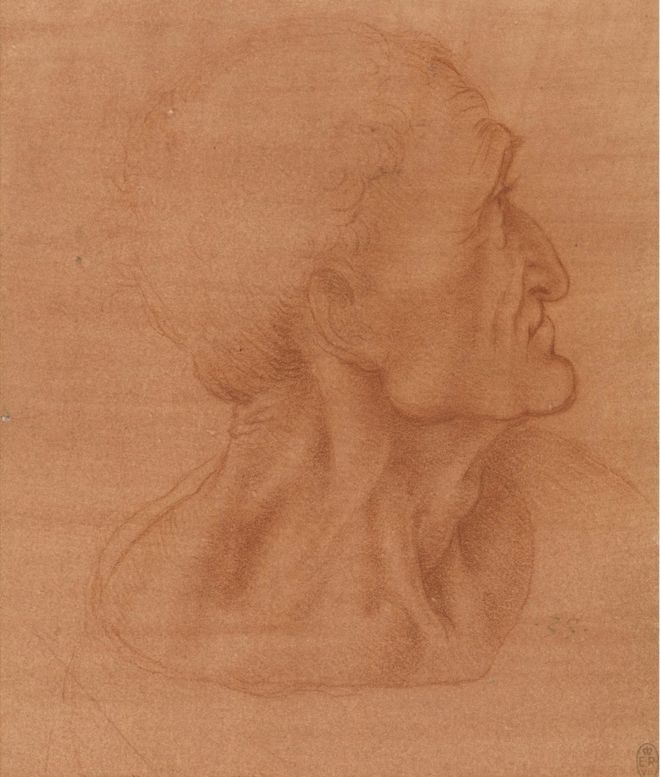
Image captionThe foetus in the womb, from 1511Image captionThe skull sectioned, from 1489Image captionA design for an equestrian monument, made around 1485Image captionA star-of-Bethlehem and other plantsImage captionA drawing of cats, lions and a dragonImage captionThe head of Judas
Yes! This word is getting more and more familiar to me nowadays.
At first, I wanted to thank you all my adorable and honourable friends for your kindness and generosity to let me feel at home to open my heart once more for you.
I’m almost a newcomer here but unfortunately, I am probably spending the last quartal of my life session though, I wished I’d be a young newcomer with a great ambitions with a bright look at my future.
That’s just because I lived my life mostly to present my brother for his success in his life; become a famous writer as he, in his whole almost short life, could and wanted to be. You know; to be a body for this soul. I might decide to do it just like my mother, she did it for my father from the beginning of their marriage till father’s death. that’s another story which I’ll write it down one day.
Of course, I have to mention that I, also have some talents in arts as I’ve tried sometimes; in the music and in the theatres, and the effects were not disappointing. To point it out here; my brother’s wished also to see me succeed in.
But for me, it was clear if I’d dive deeply too into the world of arts, we might both get lost without any success.
Anyhow, our fate wasn’t so fair and my effort to show the world his genius talent failed, he left this planet and I had to discover myself again as a newborn child, digging the oppressed talents and wishes, but to find out that it isn’t so easy. Let’s back to my condition with the symptom “Burnout”
After this short announcement above, I try to explain why I feel it so; as I keep working in the week the job which I just do it financially, I try to clean my soul at the weekend by actuating my inner spirit. But lately, I felt it’s getting too much!! It is at first because of my interests to several objects like; Archaeology(Egyptology), Psychology, Philosophy, Social Politics (I worked as a political journalist once in Iran) and for all these, I have only time in the weekends. on the other side, I try not to miss anything in through the weeks as I doing my job, by looking permanently on my poor Smartphone (Smallphone!! 😀 ) and you can’t imagine how big is the difference between these two worlds; the job which I earn money by it and there is no need for any talent or creativity, and the lovely work which I do on the weekends. they are two different worlds. There I noticed by the way, that I’m getting confused. You know; forgetting this or mix-up that and making mistakes. I am not the youngest one who I once was anymore, you know? Therefore, I decided to reduce the themes at the weekend, it is a pity but the only chance not to lose my mind! I’d rather reduce the job in the week but unfortunately, I can’t because of the financial situation. the only hope is my retirement that will be in the next year and if I stay alive, I will surely work on my lovely part more.
At the end, I just wanna say that it is very nice and calming for me to open my heart and share my thoughts with you dear friends, you’re much appreciated and wishing you all the best. ❤ ❤
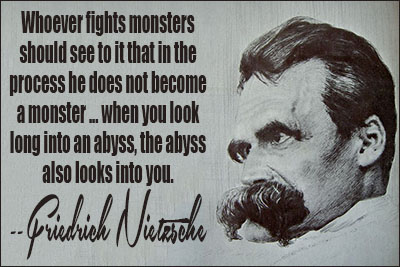
There’s no doubt that any thinker is somehow fascinated over this man; Nietzsche. As I once in my youth was interested in Philosophy, after struggling to understand Socrates by Plato, got a book about the story of philosophy; by Will Durant ” William James “Will” Durant ” of course translated in Persian, by Abbas Zirab-Khuii, a great historian and translator in Iran, from Plato to the new world philosophers like William James. You can imagine the situation for a young man about 20 years old, to handle all these new thoughts (for me of course!) and to process with.
Anyway, one of these highly recommended geniuses was Friedrich Nietzsche, who got my not only thoughts but also soul occupied or more engaged to keep thinking about him and to understand this madness!
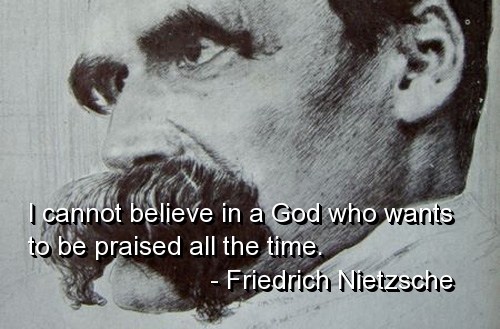
I adore Socrates and I love Espinoza and I’d stared in front of Schuppenhauer but Nietzsche makes me crazy!! his determination over “Selbstüberwindung” overcome self, or “übermensch” Superman. or his desperation about God’s creation;
or his doubt of a God who wants to be adored;
or “Sklavenmoral” slave morality. especially the latest; I was and am also against this term; Moral or Morality, this is a social problem! as history tells us, the moral has been changing all through the time especially, in the time of wars in according with the situation. I prefer to use “Conscience” as in German: “Gewissen”; that has nothing to do with the mass, it is individual, it is the self; you with you yourselves conscience, and nobody else.
There’s no shame if you’ve never known how to pronounce Friedrich Nietzsche’s name correctly. Even less if you never remember how to spell it. If these happen to be the case, you may be less than familiar with his philosophy. Let Alain de Botton’s animated School of Life video briefly introduce you, and you’ll never forget how to say it: “Knee Cha.” (As for remembering the spelling, you’re on your own.) You’ll also get a short biography of the disgruntled, dyspeptic German philosopher, who left a promising academic career at the University of Basel in his mid-20s and embarked to the Swiss Alps to write his violently original books in solitude before succumbing to a mental breakdown at 44 when he saw a cart driver beating a horse.
Nietzsche died after remaining almost entirely silent for 11 years. In these years and after his death, thanks to the machinations of his sister Elizabeth, his thought was twisted into a hateful caricature. He has since been rehabilitated from associations with the Nazis, but he still calls up fear and loathing for many people because of his relentless critiques of Christianity and reputation for staring too long into abysses. Maybe we can’t help but hear fascistic overtones in his concept of the ubermensch, and his ideas about slave morality can make for uncomfortable reading. Those steeped in Nietzsche’s thought may not feel that de Botton’s commentary gives these ideas their proper critical due.
Likewise, Nietzsche himself is treated as something of an ubermensch, an approach that pulls him out of his social world. Important figures who had a tremendous impact on his personal and intellectual life—like Arthur Schopenhauer, Richard and Cosima Wagner, Lou Salomé, and Nietzsche’s sister—don’t even receive a mention. But this is a lot to ask from a six-minute summary. De Botton hits some of philosophical highlights and explains some misconceptions. Yes, Nietzsche held no brief for Christianity at all, but this was because it caused tremendous suffering, he thought, by making people morally stunted and bitterly resentful.
Instead, he argued, we should embrace our desires, and use so-called sinful passions like envy to leverage our ambitions. Nietzsche is not a seducer, corrupting the youth with promises of greatness. You may very well fail, he admitted, and fail miserably. But to deny yourself is to never become who you are. Nietzsche scholar Babette Babich has described this aspect of the philosopher’s thought as the ethics of the supportive friend. She quotes David B. Allison, who writes that Nietzsche’s advice comes to us “like a friend who seems to share your every concern—and your aversions and suspicions as well. Like a true friend, he rarely tells you what you should do.”
Except that he often does. Babich also writes about Nietzsche as educator, and indeed he considered education one of the highest human goods, too precious to be squandered on those who do not appreciate it. His philosophy of education is consistent with his views on culture. Since God is Dead, we must replace scripture and liturgy with art, literature, and music. So far, so many a young Nietzsche enthusiast, pursuing their own form of Nietzschean education, will be on board with the philosopher’s program.
But as de Botton also explains, Nietzsche, who turned Dionysus into a philosophical ideal, might have issued one prescription too many for the average college student: no drinking. If that’s too much to stomach, we should at least take seriously that stuff about staring into abysses. Nietzsche meant it as a warning. Instead, writes Peter Prevos at The Horizon of Reason, “we should go beyond staring and bravely leap into the boundless chasm and practice philosophical base jumping.” No matter how much Nietzsche you read, he’s never going to tell you that means. We only become who we are, he suggests, when we figure it on our own.
Reducing an artist’s work to their biography produces crude understanding. But in very many cases, life and work cannot be teased apart. This applies not only to Sylvia Plath and her contemporary confessional poets but also to James Joyce and Marcel Proust and writers they admired, like Dante and Cervantes.
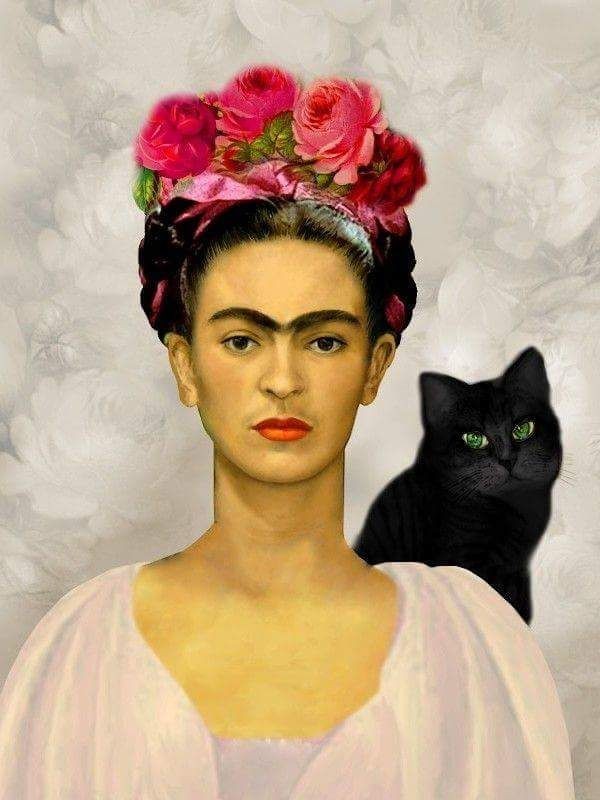
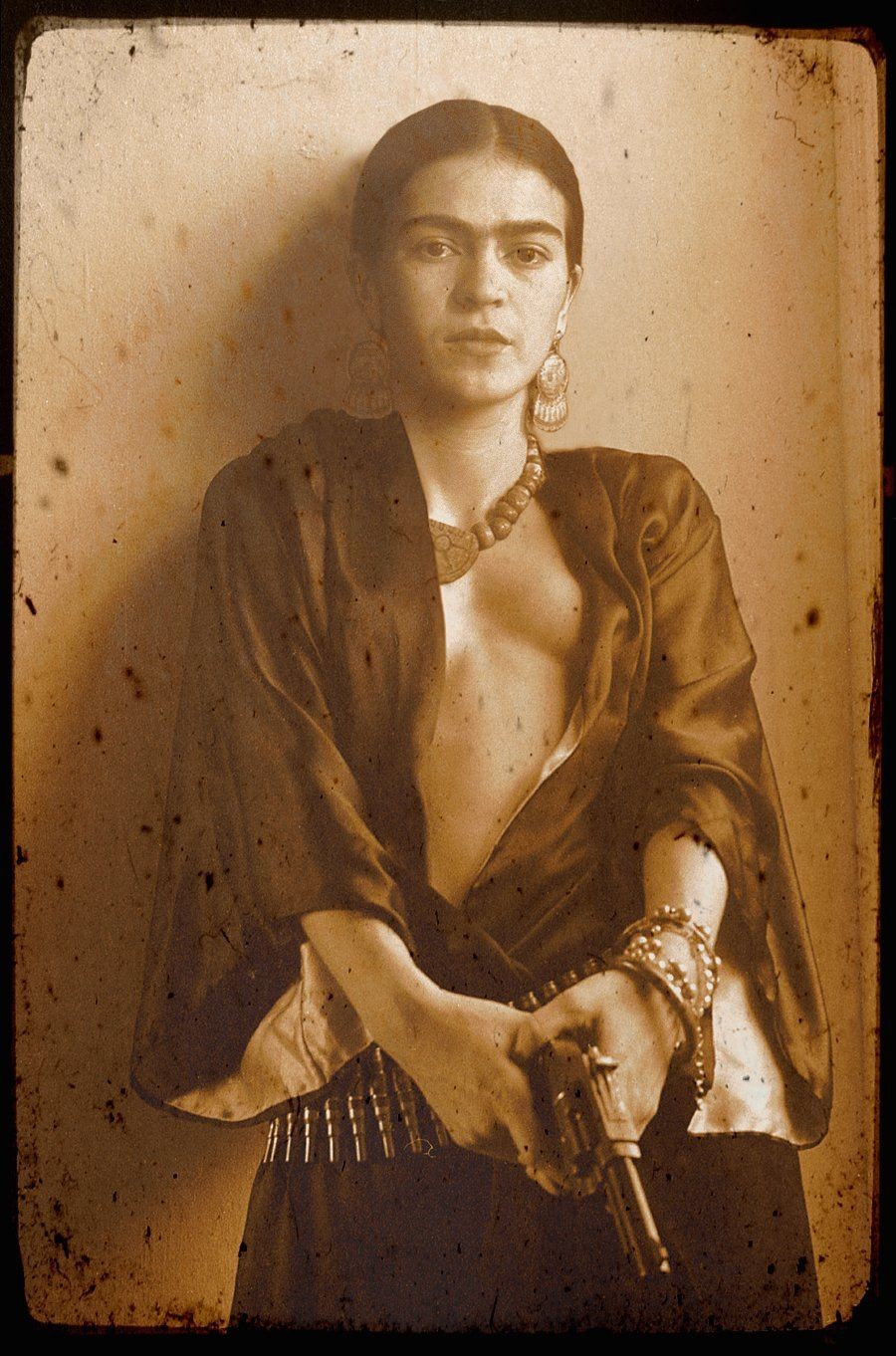
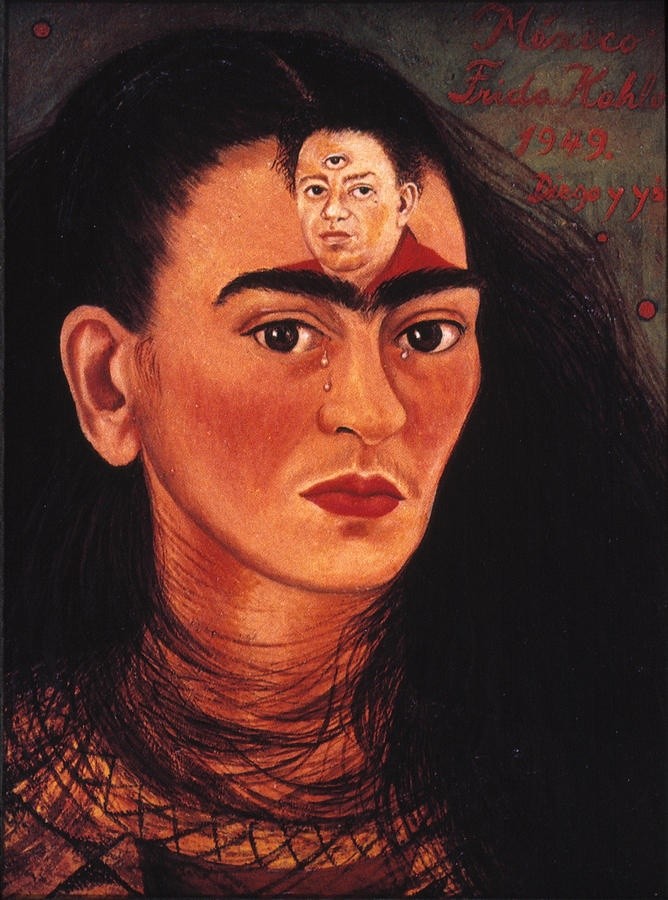
Such an artist too is Frida Kahlo, a practitioner of narrative self-portraits in a modernizing idiom that at the same time draws extensively on tradition. The literary nature of her art is a subject much neglected in popular discussions of her work. She wrote passionate, eloquent love poems and letters to her husband Diego Rivera and others, full of the same kind of visceral, violent, verdant imagery she deployed in her paintings.
More generally, the “obsession with Kahlo’s biography,” writes Maria Garcia at WBUR, ends up focusing “almost voyeuristically—on the tragic experiences of her life more than her artistry.” Those terribly compounded tragedies include surviving polio and, as you’ll learn in Iseult Gillespie’s short TED-Ed video above, a bus crash that nearly tore her in half. She began painting while recovering in bed. She was never the same and lived her life in chronic pain and frequent hospitalizations.
Perhaps a certain cult of Kahlo does place morbid fascination above real appreciation for her vision. “There’s a compulsion that’s satiated only through consuming Kahlo’s agony,” Garcia writes. But it’s also true that we cannot reasonably separate her story from her work. It’s just that there is so more to the story than suffering, all of it woven into the texts of her paintings. Kahlo’s mythology, or “inspirational personal brand,” ties together her commitments to Marxism and Mexico, indigenous culture, and native spirituality.
Like all self-mythologizing before her, she folded her personal story into that of her nation. And unlike European surrealists, who “used dreamlike images to explore the unconscious mind, Kahlo used them to represent her physical body and life experiences.” The experience of disability was no less a part of her ecology than mortality, symbolic landscapes, floral tapestries, animals, and the physically anguished experiences of love and loss.
Generous approaches to Kahlo’s work, and this short overview is one of them, implicitly recognize that there is no need to separate the life from the work, to the extent that the artist saw no reason to do so. But also, there is no need to isolate one narrative theme, whether intense physical or emotional suffering, from themes of self-transformation and transfiguration or experiments in re-creating personal identity as a political act.
Or; I believe every Artists: Male or Female, need a Guardian Angel 😉
a happy end? I couldn’t imagine in the life of the great genius; Dostoyevsky, as I almost have grown up with his works (among the others 😉 ) I felt that he was, almost in his life, trying to focus the dark side of the human being;
“Happy? But I haven’t had any happiness yet. At least, not the kind of happiness I always dreamed of. I am still waiting for it.”
For example; when I read the Charles Dickens works, I got to know his abilities and his observation on the humans, that is genial knowledge over their soul but he was not so pointing on the dark side of us as Dostoyevsky tried to explore. I have learned a lot about my dark side as I read his book
Here I have the presence of light side, which it happens in his true life, and of course with the help of a wonderful woman “what else” who understood him better than any others. I knew just a few great artists who were so lucky to find their Guardian Angel; among Charles Dickens, my father was also so lucky; a pity that he had noticed it deeply at his last night on this Earth and how I wish if my brother could be so as well… what a pity!
Anyway, let’s read this wonderful story with the stunnishing happy end. 🙂
In the summer of 1865, just after he began writing Crime and Punishment, the greatest novelist of all time hit rock bottom. Recently widowed and bedevilled by epilepsy, Fyodor Dostoyevsky (November 11, 1821–February 9, 1881) had cornered himself into an impossible situation. After his elder brother died, Dostoyevsky, already deeply in debt on account of his gambling addiction, had taken upon himself the debts of his brother’s magazine. Creditors soon came knocking on his door, threatening to send him to debtors’ prison. (A decade earlier, he had narrowly escaped the death penalty for reading banned books and was instead exiled, sentenced to four years at a Siberian labour camp — so the prospect of being imprisoned was unbearably terrifying to him.) In a fit of despair, he agreed to sell the rights to an edition of his collected works to his publisher, a man named Fyodor Stellovsky, for the sum of his debt — 3,000 rubles, or around $80,000 in today’s money. As part of the deal, he would also have to produce a new novel of at least 175 pages by November 13 of the following year. If he failed to meet the deadline, he would lose all rights to his work, which would be transferred to Stellovsky for perpetuity.
Only after signing the contract did Dostoevsky find out that it was his publisher, a cunning exploiter who often took advantage of artists down on their luck, who had purchased the promissory notes of his brother’s debt for next to nothing, using two intermediaries to bully Dostoyevsky into paying the full amount. Enraged but without recourse, he set out to fulfil his contract. But he was so consumed with finishing Crime and Punishment that he spent most of 1866 working on it instead of writing The Gambler, the novel he had promised Stellovsky. When October rolled around, Dostoyevsky languished at the prospect of writing an entire novel in four weeks.
Portrait of Fyodor Dostoyevsky by Vasily Perov, 1871
His friends, concerned for his well-being, proposed a sort of crowdsourcing scheme — Dostoyevsky would come up with a plot, they would each write a portion of the story, and he would then only have to smooth over the final product. But, a resolute idealist even at his lowest low, Dostoyevsky thought it dishonourable to put his name on someone else’s work and refused.
There was only one thing to do — write the novel, and write it fast.
On October 15, he called up a friend who taught stenography, seeking to hire his best pupil. Without hesitation, the professor recommended a young woman named Anna Grigoryevna Snitkina. (Stenography, in that era, was a radical innovation and its mastery was so technically demanding that of the 150 students who had enrolled in Anna’s program, 125 had dropped out within a month.)
Twenty-year-old Anna, who had taken up stenography shortly after graduating from high school hoping to become financially independent by her own labor, was thrilled by the offer — Dostoyevsky was her recently deceased father’s favorite author, and she had grown up reading his tales. The thought of not only meeting him but helping him with his work filled her with joy.
The following day, she presented herself at Dostoyevsky’s house at eleven-thirty, “no earlier and no later,” as Dostoyevsky had instructed — a favorite expression of his, bespeaking his stringency. Distracted and irritable, he asked her a series of questions about her training. Although she answered each of them seriously and almost dryly, so as to appear maximally businesslike, he somehow softened over the course of the conversation. By the early afternoon, they had begun their collaboration on the novel — he, dictating; she, writing in stenographic shorthand, then transcribing at home at night.
For the next twenty-five days, Anna came to Dostoyevsky’s house at noon and stayed until four. Their dictating sessions were punctuated by short breaks for tea and conversation. With each day, he grew kinder and warmer toward her, and eventually came to address her by his favorite term of endearment, “golubchik” — Russian for “little dove.” He cherished her seriousness, her extraordinary powers of sympathy, how her luminous spirit dissipated even his darkest moods and lifted him out of his obsessive thoughts. She was touched by his kindness, his respect for her, how he took a genuine interest in her opinions and treated her like a collaborator rather than hired help. But neither of them was aware that this deep mutual affection and appreciation was the seed of a legendary love.
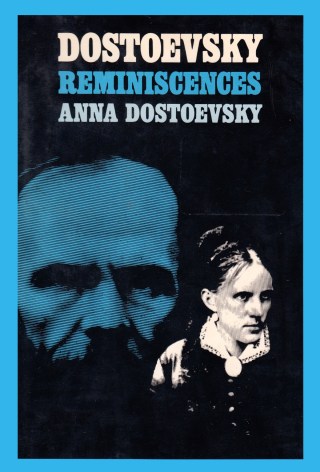
In her altogether spectacular memoir of marriage, Dostoevsky Reminiscences(public library), Anna recounts a prescient exchange that took place during one of their tea breaks:
Each day, chatting with me like a friend, he would lay bare some unhappy scene from his past. I could not help being deeply touched at his accounts of the difficulties from which he had never extricated himself, and indeed could not.
[…]
Fyodor Mikhailovich always spoke about his financial straits with great good nature. His stories, however, were so mournful that on one occasion I couldn’t restrain myself from asking, “Why is it, Fyodor Mikhailovich, that you remember only the unhappy times? Tell me instead about how you were happy.”
“Happy? But I haven’t had any happiness yet. At least, not the kind of happiness I always dreamed of. I am still waiting for it.”
Little did either of them know that he was in the presence of that happiness at that very moment. In fact, Anna, in her characteristic impulse for dispelling the darkness with light, advised him to marry again and seek happiness in family. She recounts the conversation:
“So you think I can marry again?” he asked. “That someone might consent to become my wife? What kind of wife shall I choose then — an intelligent one or a kind one?”
“An intelligent one, of course.”
“Well, no… if I have the choice, I’ll pick a kind one, so that she’ll take pity on me and love me.”
While we were on the theme of marriage, he asked me why I didn’t marry myself. I answered that I had two suitors, both splendid people and that I respected them both very much but did not love them — and that I wanted to marry for love.
“For love, without fail,” he seconded me heartily. “Respect alone isn’t enough for a happy marriage!”
Their last dictation took place on November 10. With Anna’s instrumental help, Dostoyevsky had accomplished the miraculous — he had finished an entire novel in twenty-six days. He shook her hand, paid her the 50 rubles they had agreed on — about $1,500 in today’s money — and thanked her warmly.
The following day, Dostoyevsky’s forty-fifth birthday, he decided to mark the dual occasion by giving a celebratory dinner at a restaurant. He invited Anna. She had never dined at a restaurant and was so nervous that she almost didn’t go — but she did, and Dostoyevsky spent the evening showering her with kindnesses.
But when the elation of the accomplishment wore off, he suddenly realized that his collaboration with Anna had become the light of his life and was devastated by the prospect of never seeing her again. Anna, too, found herself sullen and joyless, her typical buoyancy weighed down by an acute absence. She recounts:
I had grown so accustomed to that merry rush to work, the joyful meetings and the lively conversations with Dostoyevsky, that they had become a necessity to me. All my old activities had lost their interest and seemed empty and futile.
Unable to imagine his life without her, Dostoyevsky asked Anna if she would help him finish Crime and Punishment. On November 20, exactly ten days after the end of their first project, he invited her to his house and greeted her in an unusually excited state. They walked to his study, where he proceeded to propose marriage in the most wonderful and touching way.
Dostoyevsky told Anna that he would like her opinion on a new novel he was writing. But as soon as he began telling her the plot, it became apparent that his protagonist was a very thinly veiled version of himself, or rather of him as he saw himself — a troubled artist of the same age as he, having survived a harsh childhood and many losses, plagued by an incurable disease, a man “gloomy, suspicious; possessed of a tender heart … but incapable of expressing his feelings; an artist and a talented one, perhaps, but a failure who had not once in his life succeeded in embodying his ideas in the forms he dreamed of, and who never ceased to torment himself over that fact.” But the protagonist’s greatest torment was that he had fallen desperately in love with a young woman — a character named Anya, removed from reality by a single letter — of whom he felt unworthy; a gentle, gracious, wise, and vivacious girl whom he feared he had nothing to offer.
Only then did it dawn on Anna that Dostoyevsky had fallen in love with her and that he was so terrified of her rejection that he had to feel out her receptivity from behind the guise of fiction.
Is it plausible, Dostoyevsky asked her, that the alleged novel’s heroine would fall in love with its flawed hero? She recounts the words of literature’s greatest psychological writer:
“What could this elderly, sick, debt-ridden man give a young, alive, exuberant girl? Wouldn’t her love for him involve a terrible sacrifice on her part? And afterwards, wouldn’t she bitterly regret uniting her life with his? And in general, would it be possible for a young girl so different in age and personality to fall in love with my artist? Wouldn’t that be psychologically false? That is what I wanted to ask your opinion about, Anna Grigoryevna.”
“But why would it be impossible? For if, as you say, your Anya isn’t merely an empty flirt and has a kind, responsive heart, why couldn’t she fall in love with your artist? What if he is poor and sick? Where’s the sacrifice on her part, anyway? If she really loves him, she’ll be happy, too, and she’ll never have to regret anything!”
I spoke with some heat. Fyodor Mikhailovich looked at me in excitement. “And you seriously believe she could love him genuinely, and for the rest of her life?”
He fell silent, as if hesitating. “Put yourself in her place for a moment,” he said in a trembling voice. “Imagine that this artist — is me; that I have confessed my love to you and asked you to be my wife. Tell me, what would you answer?”
His face revealed such deep embarrassment, such inner torment, that I understood at long last that this was not a conversation about literature; that if I gave him an evasive answer I would deal a deathblow to his self-esteem and pride. I looked at his troubled face, which had become so dear to me, and said, “I would answer that I love you and will love you all my life.”
I won’t try to convey the words full of tenderness and love that he said to me then; they are sacred to me. I was stunned, almost crushed by the immensity of my happiness and for a long time I couldn’t believe it.
Fyodor and Anna were married on February 15, 1867, and remained besotted with one another until Dostoyevsky’s death fourteen years later. Although they suffered financial hardship and tremendous tragedy, including the death of two of their children, they buoyed each other with love. Anna took it upon herself to lift the family out of debt by making her husband Russia’s first self-published author. She studied the book market meticulously, researched vendors, masterminded distribution plans, and turned Dostoyevsky into a national brand. Today, many consider her Russia’s first true businesswoman. But beneath her business acumen was the same tender, enormous heart that had made loving room within itself for a brilliant man with all of his demons.
In the afterword to her memoir, Anna reflects on the secret to their deep and true marriage — one of the greatest loves in the history of creative culture:
Throughout my life it has always seemed a kind of mystery to me that my good husband not only loved and respected me as many husbands love and respect their wives, but almost worshipped me, as though I were some special being created just for him. And this was true not only at the beginning of our marriage but through all the remaining years of it, up to his very death. Whereas in reality I was not distinguished for my good looks, nor did I possess talent nor any special intellectual cultivation, and I had no more than a secondary education. And yet, despite all that, I earned the profound respect, almost the adoration of a man so creative and brilliant.
This enigma was cleared up for me somewhat when I read V.V. Rozanov’s note to a letter of Strakhov dated January 5, 1890, in his book Literary Exiles. Let me quote:
“No one, not even a ‘friend,’ can make us better. But it is a great happiness in life to meet a person of quite different construction, different bent, completely dissimilar views who, while always remaining himself and in no wise echoing us nor currying favor with us (as sometimes happens) and not trying to insinuate his soul (and an insincere soul at that!) into our psyche, into our muddle, into our tangle, would stand as a firm wall, as a check to our follies and our irrationalities, which every human being has. Friendship lies in contradiction and not in agreement! Verily, God granted me Strakhov as a teacher and my friendship with him, my feelings for him were ever a kind of firm wall on which I felt I could always lean, or rather rest. And it won’t let you fall, and it gives warmth.”
In truth, my husband and I were persons of “quite different construction, different bent, completely dissimilar views.” But we always remained ourselves, in no way echoing nor currying favor with one another, neither of us trying to meddle with the other’s soul, neither I with his psyche nor he with mine. And in this way my good husband and I, both of us, felt ourselves free in spirit.
Fyodor Mikhailovich, who reflected so much in so much solitude on the deepest problems of the human heart, doubtless prized my non-interference in his spiritual and intellectual life. And therefore he would sometimes say to me, “You are the only woman who ever understood me!” (That was what he valued above all.) He looked on me as a rock on which he felt he could lean, or rather rest. “And it won’t let you fall, and it gives warmth.”
It is this, I believe, which explains the astonishing trust my husband had in me and in all my acts, although nothing I ever did transcended the limits of the ordinary. It was these mutual attitudes which enabled both of us to live in the fourteen years of our married life in the greatest happiness possible for human beings on earth.
That is the title of one of Hannah Arendt books, a great political philosopher in the 20th century.
Hannah Cohn Arendt
She just made me think how we look at the history; our history, and mark the special personalities with some especial paraphrase name; such as The angel or rescuer or as devil or evil and with these we distance ourselves from them as we had have nothing to do with.
Hannah Arendt discussed in her book about the Eichmann as a functional object in the system as everyone else might try to do its best! it is the matter of system which we are involving more and more in our modern life. that is the systematic function in society. in the development of our civilisation, just do it as best as you can. we are almost unconsciously trying to be more functional and fitter into our environment (Jobs, Neighbourhood, etc.) as we might win the cup!
As she explains; We call them (Hitler or Eichmann or…) Devils and Evils but in reality, for example, Eichmann, had got his job to vanish the Jews, he had tried to give his best! it might sound brutal but it’s just the bitterness of the truth. the main thing as we truly consider and look deeply in our society especially in politics, we are (I do the accent on “WE”) all trying to be functional. without thinking twice what for we are engaged to do. believe me that there are many peoples who, with no concern, just try to get the best result of their doing.
As my brother and me, escaped from Iran to Germany, we both wanted to work and earn the money by ourselves, my brother was a writer, from the head down to the feet, I since a long time ago, already decided nothing to do but just help brother to catch his aim. although in Germany, I didn’t want to get social help from the government as it’s usual here, therefore, tried to find a job. at first, began to play on the streets; it took a while; me and my guitar travelling through the cities and playing here and there to make people happy but the life was going more expensively and therefore, I had to try another one; become a taxi driver! that was an idea by a friend who knew me how I loved driving. anyway, I became one of them but a special one; you know why, because, I am not just transporting people from A to B, I try to help them to have a nice time in the taxi with me, listening to and have an understanding. I just want to say that I take the job consciously to make it better as it once was and not only to be functional in this business! I try just to listen to them and understand their dilemma.
In any case, I’d never want to show off myself, just to say about the way we do our jobs; functional or by their own creations.
At last but not least; reading the books by Hannah Arendt helped me to understand not only about me but the whole society around this planet.
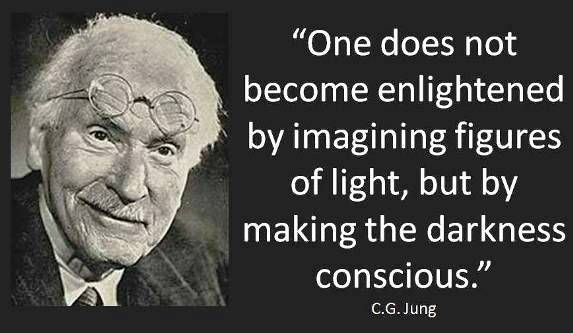
as Dr Jung says;
Cheers all dear friends and have a wonderful Weekend ❤ ❤
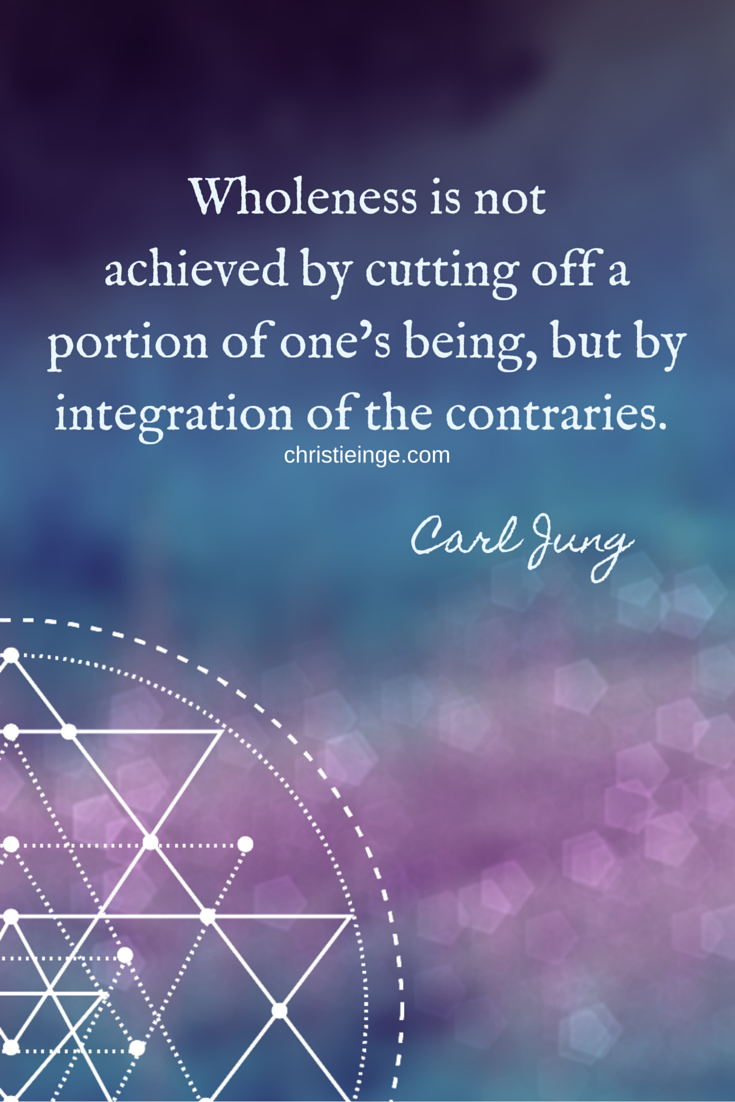
A Symposium which we must ever learn to know at least the mining of life. I mean, the main thing in our existence is these both poles; the Body and the Soul. Or as Dr C. G. Jung said;
Or as we might know about Cathars and Catharism, or Mani; the painter or the prophet; a revolutionary in the Zarathushtrian time in the old Persians. . They all are talking about these two part of us. and if we get to know both functions, we might find out the truth of our being here… or at least a part of it. 🙂 🙏💖
The craving for reproduction is yet another element of love. There are two ways of reproducing: physical and mental. The loved ones join their bodies to reproduce. Intercourse is a divine thing, says Diotima, but the mental model of reproduction is superior because the soul gives birth to another indestructible ideas and feelings. Those who are pregnant in the soul are arrested by thought.
They are the poets, the artists, the wise men and, finally, the legislators who teach wisdom and righteousness. Thus, a lover can bring to the soul of the mistress the knowledge, virtue, respect for the good, the law and the good. The beauty, the truth and the virtue are three concepts and at the same time one. They are aspects of the same reality. Love is “the way to the more beauty”. This is the path of immortality. PLATONOS ‘SYMPOSIUM’ ABOUT THE PROJECT LIBRARY OF ANCIENT GREECE
Carl Jung wrote of the psyche as that aspect of each of us which incorporates the conscious, the unconscious and also the collective unconscious – that realm beyond our individual self, the realm of the archetypal.
That is one of his many topics which we can learn from; though, some people, as I noticed now and then, make mistake with the word: Collective, and think that Dr Jung meant the whole human has a one with a common Consciousness/Unconsciousness; but it is wrong!
He actually speaks about the Individual and somehow: I, Me, Mine, with the whole history behind me. There again his topic with the “Synchronicity” shows us the connections between two Individuals and the chemy inbetween.
Here is a wonderful explanation which hit my heart and soul when I read this: With a great Thank to my friend and master Craig Nelson 🙏 ❤
The collective unconscious is “the world of water’.. “It is the world of water, where all life floats in suspension; where the realm of the sympathetic system, the soul of everything living, begins; where I am indivisibly this and that; where I experience the Other in myself and the Other-than-myself experiences me. […] The unconscious no sooner touches us than we are it –we become unconscious of ourselves. That is the age-old danger, instinctively known and feared by primitive man, who himself stands so very close to this pleroma.” CGJ, CW9,parar 45-47
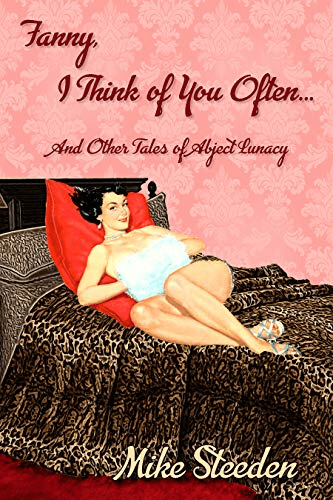
Good Lord, I’m quite taken aback. My latest book has only just this minute been listed on Amazon and look at all these fabulous reviews and messages I’ve received from the fabled and the famous. These are just a mere sample.
Marilyn Monroe: “I can’t thank you enough, Michael. It’s about time the truth was told. Yes, to my shame my life was blighted by flatulence, although in fairness such gusts of malodorous wind emanating from my BTM did ensure me iconic status when I released a smelly humdinger of colossal proportions and as a result my little white dress blew up while I was standing over an ineffectual subway grate in New York on the set of ‘The Seven Year Itch’ movie. I can’t thank you enough for including the tale of my dire plight when writing this book, a frankly outstanding piece of modern English literature.”














 lampmagician
You must be logged in to post a comment.