The (Wel)coming of Christian Copt;The Chapel of Peace.

Standard

“When he arose, he took the young Child and His mother by night and departed for Egypt, and was there until the death of Herod the Great, that it might be fulfilled which was spoken by the Lord through the prophet, saying, Out of Egypt I called My Son” (Matthew 2:12-23). The Bible identifies Egypt as the refuge the Holy Family sought while fleeing Judea.

According to Coptic tradition, St. Mark is believed to have brought Christianity to Egypt around 50 CE. A small Christian community began to form in Alexandria during the late first century and expanded significantly by the end of the second century. Certain similarities in beliefs aided the acceptance of Christianity among Egyptians, including the dual nature of the Egyptian god Osiris as both human and divine, the resurrection of Osiris, and the divine triad consisting of Osiris, Isis, and Horus.

Paradise landscape with the animas entering Noah’s ark.*oil on copper.*26.5 x 35.6 cm.*signed verso: 1596 / Brueghel (Wikimedia Common)

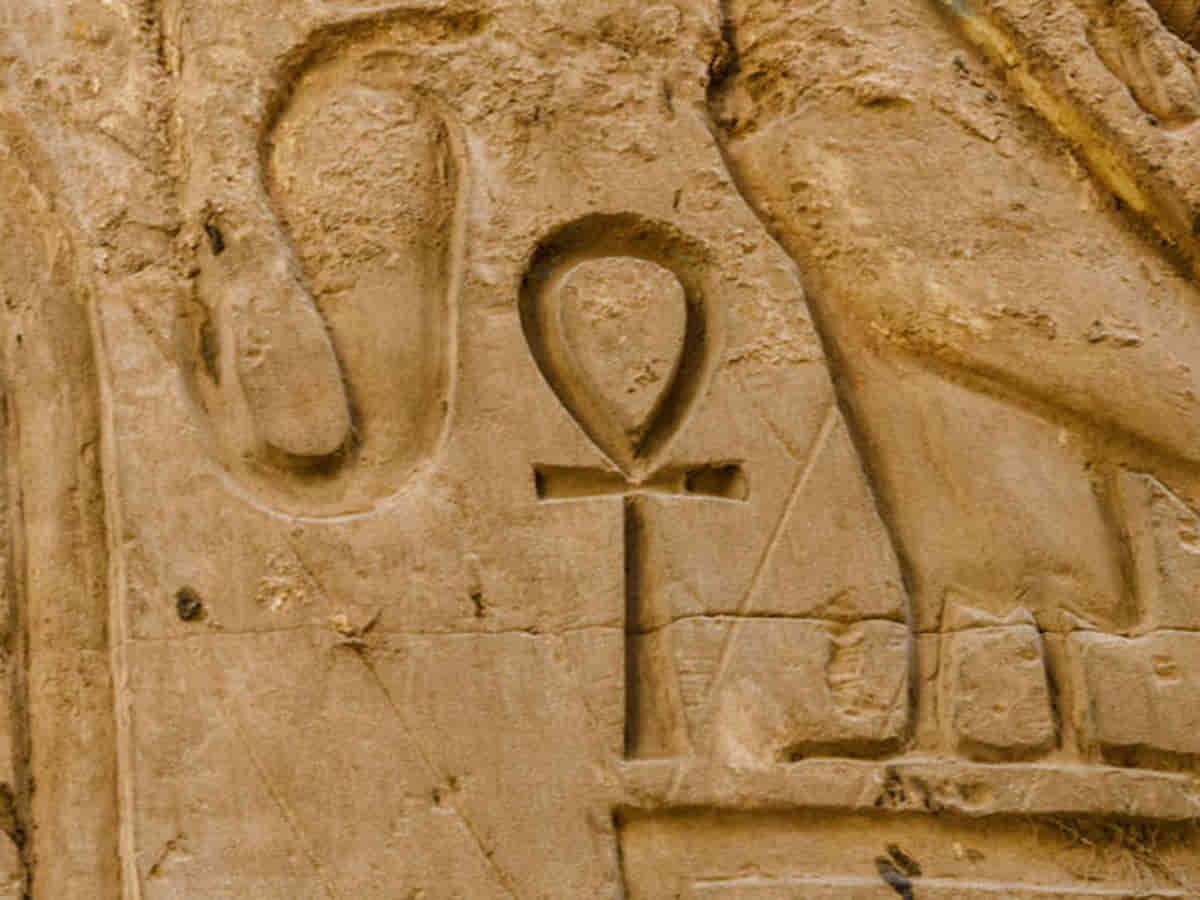
The ancient Egyptians, classical Greeks, and Romans primarily shaped the Coptic period in Egypt. This influence is evident in Coptic art, particularly in textiles that often feature ancient Egyptian symbols and motifs, such as the ankh, representing life. The ankh served as an alternative to the Christian cross; certain textiles display both symbols. Nevertheless, Coptic art predominantly reflects the more substantial impact of Greek and Roman traditions.
I’ve been unwell and facing difficulties lately (wearing out my apparatus and equipment in old age!), so I haven’t been able to post regularly. However, now that my illness is in a stillstand modus, I’m giving it a try!

Here, I present Marie Grillot‘s captivating account of the Christian Copts’ arrival in Egypt, their artistry, and their harmonious, peaceful way of life.

The Christian Necropolis of Bagawat

via égyptophile

Mary, Noah’s Ark and Jacob, depicted on the dome of the Chapel of Peace in Bagawat.
“The central image shows the patriarch and his family in the ark. Two doves overlap between the praying Mary and the ship.
The alliance with Noah finds its fulfilment with the Annunciation” – Christian necropolis of Bagawat – Kharga Oasis – 5th – 6th centuries.

A little over a kilometre northwest of the temple of Hibis, in the oasis of Kharga, stretches a ridge about twenty meters high on the edge of the desert. It is the remains of a site from the very beginning of Christianity in Egypt.

This is the Bagawat necropolis, which was active from the 2nd to the 7th century. It is so unique that it is sometimes referred to as Coptic, Roman, Byzantine, or even Greco-Coptic or Romano-Byzantine.

Christian necropolis of Bagawat – Kharga Oasis – 2nd – 7th centuries

The middle of the first century of our era witnessed the arrival of Christianity, which caused proselytism to spread along the Nile… The edicts of Theodosius I, promulgated in 380 and then 391, led to the banning of pagan rites and the official closure of temples. The Copts, the first Christians in Egypt, affirmed their new faith and beliefs, engendering a new iconography and architecture… From its beginnings, Coptic art would draw inspiration from different cultures: Roman, Byzantine, Greek, and even Pharaonic.

During its 500 years of “activity,” in addition to digging hundreds of scattered pit tombs, the necropolis will see the construction of 263 chapels, examples of proto-Coptic art, surrounding a church built around the 4th century. As in Roman and Byzantine cemeteries, they are arranged along streets. Although they differ in size and specific details of their architectural structure, they restore an extremely harmonious overall unity.

Christian necropolis of Bagawat – Kharga Oasis – 2nd – 7th centuries

“The funerary chapels are built of mud brick, in most cases originally covered with white plaster on the outside and inside. Externally, they present an architectural mixture of classical and ancient Egyptian motifs, often with a “cavetto” type cornice and classical forms of engaged columns with Corinthian capitals. They are generally square and covered with domes on pendentives or, less frequently, rectangular with barrel vaults. In a few cases, the remains of wooden roofs are visible. On each of the three walls of the Chapel, except the entrance wall, there is usually a niche, while a few chapels have a projecting apse at the eastern end. These apsidal ends are either circular or octagonal. Some of the larger buildings consist of a double Chapel of two square compartments, while a few have front courts surrounded by a wall of columns and engaged arches,” analyzes Albert M. Lythgoe in “The Oasis of Kharga”.

In “Enciclopedia dell’ Arte Antica” (1973), H. Torp describes “two basic types of construction. The first is very simple, with a square or rectangular plan and with a roof of wooden beams. The other type is square, covered with a dome. Of the first type, there are a little over a hundred tombs; of the second, a little less. The other mausoleums are variants or combinations of these two types, except for a limited number of circular or rectangular mausoleums with a barrel vault, as well as five large structures composed of several rooms, partially covered with vaults or a roof”.

The painters who worked in Bagawat were the vectors of diverse influences, which they combined, adapted and enriched, thus making this necropolis an exceptional place.

In “The Necropolis of el-Bagawat in Kharga Oasis”, A. Fakhry indicates that twenty-two of these chapels have “painted decorations, but only seven contain figurative art, the others showing only painted crosses or the like”.

Three chapels are particularly notable for their paintings.
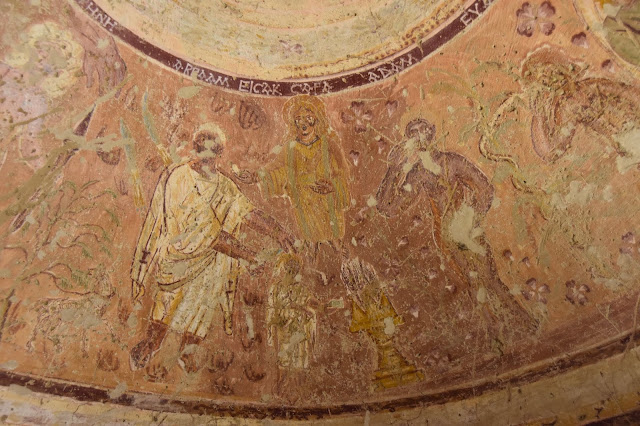
The Chapel of Peace – Christian Necropolis of Bagawat – Kharga Oasis – 5th-6th centuries

The Chapel of Peace (No. 30) dates from the 5th and 6th centuries. For experts, its decoration is unique in early Christian art. The biblical themes, with characters (from the front!), are treated in shades of ochre, purple and red while respecting the perspectives the dome-shaped structure certainly made difficult to execute. This is a “unique register of sophisticated representations of biblical figures ‘labelled’ Greco-Coptic which includes allegorical images of peace, prayers and rigour alongside Daniel, Jacob, Noah, Mary, …”

The style and quality of the paintings “reflect a level of technical skill far superior to that of other surviving decorations from the necropolis. The artist who painted them appears to have had formal training” (Matthew Martin).
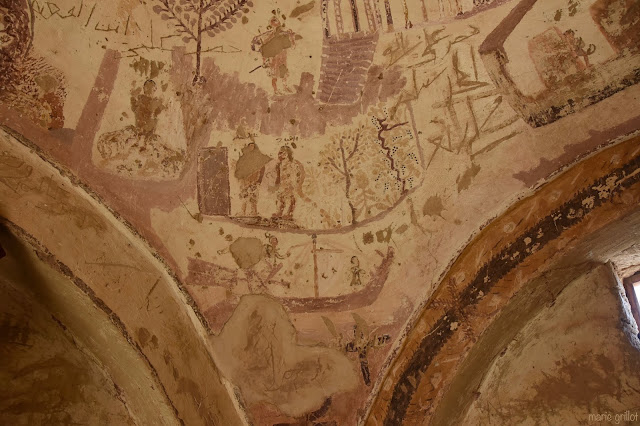
The Chapel of the Exodus Christian necropolis of Bagawat – Kharga Oasis – 5th-6th centuries

The Chapel of the Exodus (No. 80), whose centre of the dome is decorated with vine branches and filled with birds and naive trees, owes its name to its representations linked to the Hebrews’ departure from Egypt. It is declined in several scenes, such as Noah’s Ark, Daniel in the lion’s den, the three Jews in the furnace, the martyrdom of Isaiah, and episodes from the stories of Jonah and Job…

Chapel No. 25 – Christian Necropolis of Bagawat – Kharga Oasis – 5th-6th centuries

As for chapel no. 25, it offers magnificent white birds “standing on globes which support with their outstretched wings a solar disk covering the dome raised in the centre of the room.”

Thus, the domes and apses of the tombs and chapels contain “some masterpieces of Coptic painting, illustrating themes from the Old Testament and early Christianity, in a Hellenistic and Roman style. Wealthy Greeks certainly commissioned the paintings represented. Most of the frescoes are painted in red and purple tones, in a naive style but executed with great detail” (Hervé Beaumont, “The Necropolis of El-Bagawat” – Egypt: the guide to Egyptian civilizations, from the pharaohs to Islam).

Bagawat is an exceptional place, both architecturally and pictorially. It turns out to be, in a way, at the confluence of influences from the beginning of the Christian era…

It once again proves that religion is an immense source of inspiration for artists: to magnify their faith, they draw from the depths of themselves treasures of imagination and creativity to honour and glorify what is highest…

Marie Grillot

Sources:
Albert M. Lythgoe, The Oasis of Kharga, The Metropolitan Museum of Art Bulletin, 1908-11-01 https://archive.org/details/jstor-3253214/page/n1/mode/2up W. Hauser, The Christian Necropolis in the Khargeh Oasis, BMMA 27, March 1932, The Metropolitan Museum of Art https://www.metmuseum.org/pubs/bulletins/1/pdf/3255361.pdf.bannered.pdf?fbclid=IwAR1p4UODOMBAj8dYj_p9nCPa2fj6m7fZrNc7OXTinm8mJES3Tjgtr5fPp7s H. Torp, el BAGAWAT, Enciclopedia dell’Arte Antica, 1973 http://www.treccani.it/enciclopedia/el-bagawat_%28Enciclopedia-dell%27-Arte-Antica%29/ Hervé Beaumont, The Necropolis of El-Bagawat, Egypt: the guide to Egyptian civilizations, the pharaohs to Islam, Gallimard, 2000 Matthew Martin, Observations on the Paintings of the Exodus Chapel, Bagawat Necropolis, Kharga Oasis, Egypt, Byzantine Narrative, Papers in Honour of Roger Scott, Australian Association for Byzantine Studies, Byzantina Australiensia 16, John Burke, Ursula Betka, Penelope Buckley, Kathleen Hay, Roger Scott & Andrew Stephenson, Melbourne, 2006 https://www.academia.edu/364953/Observations_on_the_Paintings_of_the_Exodus_Chapel_Bagawat_Necropolis_Kharga_Oasis_Egypt

Confronting the Beyond through the Reflection of Existence

Standard

As I have done for the past few days, I sit calmly in front of my monitor, relishing the peace of having nothing to do. Yet, somewhere in my mind, someone offers me the challenge of taking on something!

I would rather resist the temptation to write, as I recognize that I lack the energy and concentration needed to compose a lengthy story—particularly about my struggle with the sudden changes brought on by ageing. (Reflecting on my seventy years of living, I see that my worst illness was a bad cold!), and now it happens such a big thing!!

However, I have often contemplated death, and this time, I find myself reflecting on it more deeply and with a sense of respect. I believe this is an important issue.

It is good to know there is an end, at least in this form as we live, and to let close friends and family accept once there is a farewell.

To hear from Dr Carl Gustave Jung how he tells us:

In 1944, Jung suffered a heart attack and experienced what he then claimed to be an experience ‘after death’: ‘What happens after death is so unspeakably glorious that our imagination and our feelings do not suffice to form even an approximate conception of it’ (Letters, Vol. 1,343, cited by Yates 1999:6).
… He addressed this issue on different occasions, notably in a letter addressed to Kristine Mann in 1945, in which he argued that this experience gave him a ‘glimpse behind the veil’ (Letters Vol. 1, 358-359, cited by Yates 1999:7).

From Carl Jung Depth Psychology

Of course, I don’t intend to say farewell—not yet! But in my new situation, I can consider it.

As you may know, I am not religious, and yet, I no longer identify as an atheist. I believe that once our bodies have fulfilled their purpose and naturally fade away, some unearthly energy hidden within our unconscious will be released into an unknown realm. If we can understand our dreams, we might provide insight into where this energy goes.

By the way, my condition is relatively stable, and I must maintain this until April when I am scheduled for another surgery, provided that everything remains the same or improves!? Thank you all for your support.💖🤗🙏

The image on the top by 1dontknows

And God Said: `Let there be Light!’

Standard

The coming of consciousness was probably the most tremendous experience of primaeval times, for with it, a world came into being whose existence no one had suspected before ~Carl Jung, CW 9i, Para 284

“And God said: `Let there be light!’” is the projection of that immemorial experience of the separation of the conscious from the unconscious. ~Carl Jung, CW 9i, Para 284

Even among primitives today, the possession of a soul is a precarious thing, and the “loss of soul” is a typical psychic malady which drives primitive medicine to all sorts of psychotherapeutic measures ~Carl Jung, CW 9i, Para 284

The quotes above are extracted from “Carl Jung Depth Psychology.“🙏🙏

This is a brief essay that simply says hello! My condition remains unchanged: when someone asks how I am, I reply that, as a patient, I am doing well! I wish you all a healthy and delightful time.🤗💖🌹

Title illustration: Ultimate Upscale

There’s also a Dark Side to Ageing!

Standard

First, the good news: We have had a new heating system since yesterday, and the place is slowly but surely heating up.
Now, the bad news: I have to sign off and make a break! Yesterday, I also went to the doctor, and I found out that I have a kidney problem and need treatment (I am not only mentally but also physically limited). So, I’m taking a break to see what happens next. I’m sorry if I am not as present as usual. Unfortunately, this year has not started well for us.
Health is valuable; take care of yourselves.🤗💖

Fifty + Years Loneliness XIII, Or Desperate Or Might Being Frantic Sometimes! (Just an add!)

Standard

A Foreword and Update!

Today (on Saturday!😮), I had to take my boss’s place, and I have just got back home, but I need to head out again soon!😜 I hadn’t planned to post anything but came across an old article I wrote years ago. So, I thought I’d share it with you before it goes stale. I hope you enjoy it somehow!🙏💖

Please don’t be shocked; this will not be an endless story! I have just a feeling that my last post about my yelping was, after all, too emotional and not clear enough.

To contemplate thereabout, I have to look at my past and review my life, but to avoid the immense length, I try to write it in a list form. First, I thank all my dear friends for their feedback, and especially among them, for their valuable suggestions.

My life is like a labyrinth; explaining this with my broken tongue (pen) is difficult.

1- It might be because of our mother’s lie to Al and me about our father’s death, which I had to carry for almost two months till I found it out by myself.

2- The next point is that Al and I were almost alone in our childhood. Our mother had to find a job to pay our father’s debt; though he was a famous writer and could be rich, he could never be a moneymaker. We had a big house with a broad yard, and you could imagine how frightening it would be for two children, nine & eleven-year-old to stay home in the evening, waiting for their mother to come home.

3- There, eternity loneliness develops, don’t you think? We have kept each other like the guardian angel, especially Al, because he was older than me, older in the year, and significantly older in mind.

4- The years passed, and we, Al and I, had made a wall to protect us. A wall, but not against our mother, a wall against the society in which we lived. That was a must, to avoid the stranger in our world. Oh yes, we have made a world just for us and nobody else. And it made us like foreigners in our own country.

5- It went all through our age of puberty, and there came the time of our mother’s death. She was married to another man then, and we (unfortunately) couldn’t accept him as a replacement for our father. Therefore, the wall grew taller and taller. The solitude casts our life.

6- We had a lot of experiences those days, so you might think twice about looking for people with walls around. I might tell you that in such countries under dictatorship and also the pressure of its traditions, the only way to escape to freedom is drugs. We had tried all possible and impossible stuff for many, many years. I can be proud to announce that I had all the drops in my veins, and now I am free of all.

7- Now about me: I have learned from my parents’ way of life that there had to be a genius to live with (in the form of a Couple. Two genius to live together… I don’t think that it might be advisable. I felt so because I had noticed how genius Al was. Therefore, I dedicated all my energy to my brother Al because I was convinced of his ability to create art. In Iran, I worked to earn money, managed a house, and all that was needed. It was, for me, a matter of course, even in our addiction period. (I was the one who could get the stuff.)

8- In all these happenings, I have forgotten to find my own identity! I know many people out there want to show me how to find it, but please stop! You have no idea!! I noticed that people, especially these days, want to give advice. (That is always calming to show the way to others) Thank you so much, but I think I am too far to see further. I might not know where I am going, but I am on my way.

9- Just to keep it short, since I lost my brother to serve him, I had to find my identity and what I am good for: I could be a musician, I could be an actor, I remember, as I gave up to make music and worked as a taxi driver, Al told me; Hey, don’t you want to continue composing? Then try writing! I thought, oh god, writing… how can I do that! I know that he knew we were both the offspring of artists. Therefore, we had to do art!

Buy me a Coffee!😁🙏

Choose an amount

€5.00
€15.00
€100.00

Or enter a custom amount


Your contribution is appreciated.

(Buy me a Coffee!)

On the Following Night, However, I Had a Vision.

Standard

Hi everybody. Since Wednesday, our furnace has broken down, and my plans have been disrupted! I wanted to write some posts, but my brain is almost frozen! That’s why I took an old post from my other site (I really don’t know who created it; I didn’t!), which I also took from my valued friend, Lewis Lafontaine and his blog.🙏

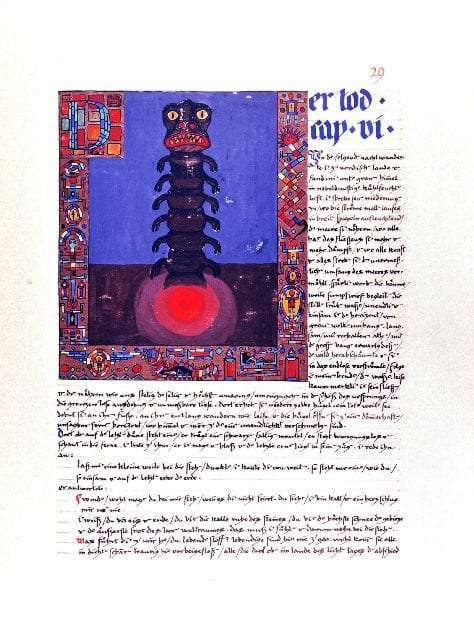
So, here is an extraordinary vision from Carl Jung’s remarkable book, The Red Book. I hope you will enjoy it, and I wish you all a thrilled New Year.

Title image: Angel by Samuel Bak

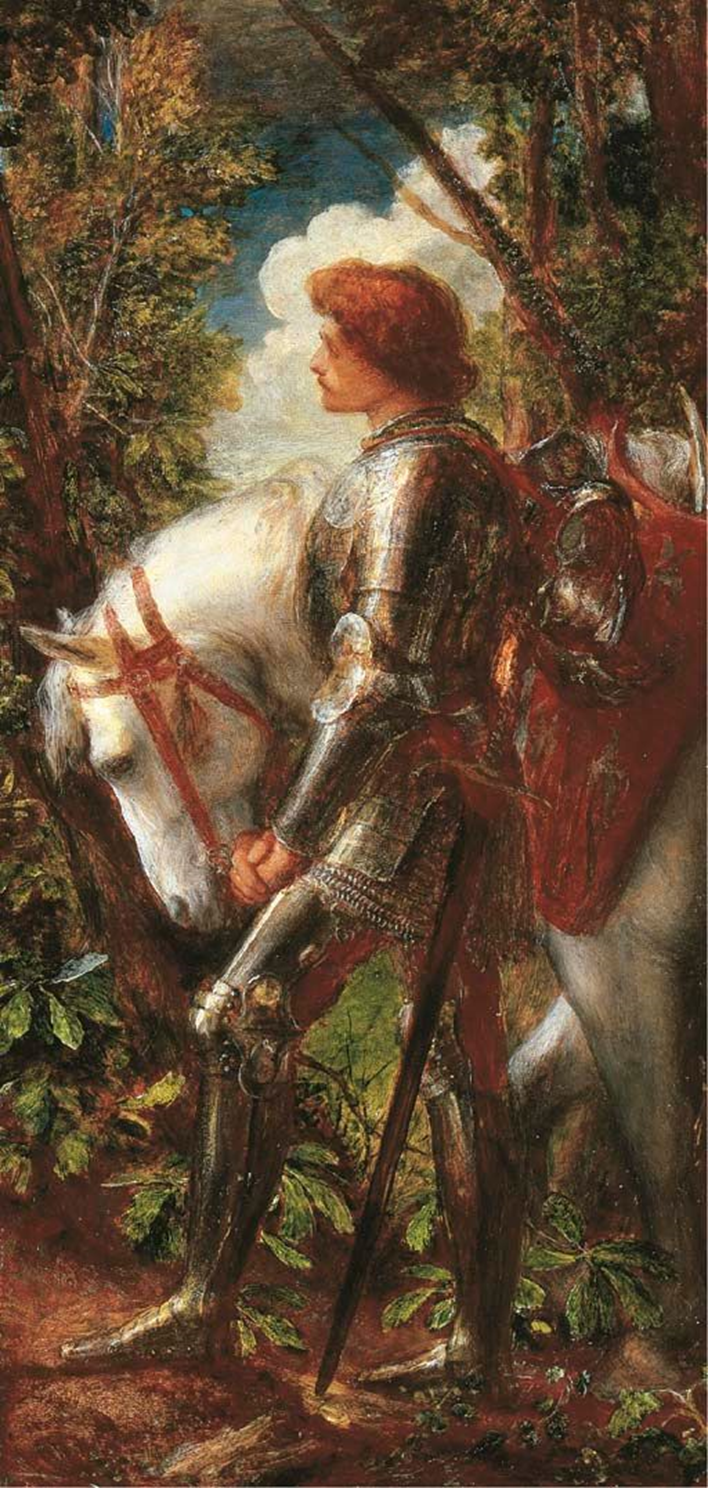
Sir Galahad, source: George Frederic Watts

As he came around the following night, however, I had a vision: I was with a youth in the high mountains. It was before daybreak, and the Eastern sky was already light.

Then Siegfried’s horn resounded over the mountains with a jubilant sound. We knew that our mortal enemy was coming.

We were armed and lurked beside a narrow rocky path to murder him. Then, we saw him coming high across the mountains on a chariot made of the bones of the dead.

He drove boldly and magnificently over the steep rocks and arrived at the narrow path where we waited in hiding.

As he came around the turn ahead of us, we fired at the same time, and he fell slain. Thereupon, I turned to flee, and a terrible rain swept down.

But after this, I went through a torment unto death, and I felt certain that I must kill myself if I could not solve the riddle of the murder of the hero.

Then the spirit of the depths came to me and spoke these words:

“The highest truth is one and the· same with the absurd.” This statement saved me, and like rain after a long, hot spell, it swept away everything in me which was too highly tensed.

From The Red Book, via Carl Jung Depth Psychology

Then I had a second vision: I saw a merry garden clad in white silk, with forms walked, all covered in coloured light, some reddish, the others blueish and greenish.

I know; I have stridden across the depths. Through guilt, I have become a newborn.

We also live in our dreams; we do not live only by day. Sometimes, we accomplish our greatest deeds in dreams. On that night, my life was threatened since I had to kill my lord and God, not in single combat, since who among mortals could kill a God in a duel? You can reach your God only as an assassin if you want to overcome him.

But this is the bitterest for mortal men: our Gods want to be overcome since they require renewal. If men kill their princes, they do so because they cannot kill their Gods and because they do not know that they should kill their Gods in themselves.

If God grows old, he becomes a shadow, nonsense, and he goes down. The greatest truth becomes the greatest lie, and the brightest day becomes the darkest night. As day requires night and night requires day, so meaning requires absurdity, and absurdity requires meaning.

Day does not exist through itself; night does not exist through itself.

The reality that exists through itself is day and night.

So, the reality is meaning and absurdity.

Noon is a moment, midnight is a moment, morning comes from night, evening turns into night, but evening comes from the day, and morning turns into day.

So meaning is a moment and a transition from absurdity to absurdity, and absurdity is only a moment and a transition from meaning to meaning.

Oh, the German hero, Siegfried, blond and blue-eyed, had to fall by my hand, the most loyal and courageous!

He had everything in himself that I treasured as the greater and more beautiful; he was my power, my boldness, my pride.

I would have gone under in the same battle, and so only assassination was left to me. If I wanted to go on living, it could only be through trickery and cunning.

Judge not! Think of the blond savage of the German forests, who had to betray the hammer-brandishing thunder to the pale Near-Eastern God nailed to the wood like a chicken marten.

The courageous were overcome by a certain contempt for themselves.

But their life force bade them go on living, and they betrayed their beautiful wild Gods, their holy trees and their awe of the German forests.

What does Siegfried mean for the Germans! What does it tell us that the Germans suffer Siegfried’s death!

That is why I almost preferred to kill myself in order to spare him. But I wanted to go on living with a new God.

After death on the cross, Christ went into the underworld and became Hell. So he took on the form of the Antichrist, the dragon.

The image of the Antichrist, which has come down to us from the ancients, announces the new God, whose coming the ancients had foreseen.

Gods are unavoidable. The more you flee from God, the more surely you fall into his hand.

The rain is the great stream of tears that will come over the people; the tearful flood of released tension after the constriction of death had encumbered the people with horrific force.

It is the mourning of the dead in me, which precedes burial and rebirth.

The rain is the fructifying of the earth; it begets the new wheat, the young, germinating God. ~Carl Jung, The Red Book, Pages 241-242

A Merry Christmas to All beloved Friends!

Standard

Germans say, “Humans are creatures of habit” (Gewohnheitstier); therefore, I couldn’t stop posting my second one! And, of course, I didn’t want to fail to send my heartfelt wishes for a Merry Christmas to my friends.
We all age, whether we want to or not, so here’s a satire I once saved many years ago from a Facebook friend whose I don’t remember, just to cheer up the mood.

Aged!

  1. When one door closes and another door opens, you are probably in prison.
  2. To me, “drink responsibly” means don’t spill it.
  3. Age 60 might be the new 40, but 9:00 pm is the new midnight.
  4. It’s the start of a brand new day, and I’m off like a herd of turtles.
  5. The older I get, the earlier it gets late.
  6. When I say, “The other day,” I could be referring to any time between yesterday and 15 years ago.
  7. I remember being able to get up without making sound effects.
  8. I had my patience tested. I’m negative.
  9. Remember, if you lose a sock in the dryer, it comes back as a Tupperware lid that doesn’t fit any of your containers.
  10. If you’re sitting in public and a stranger takes the seat next to you, just stare straight ahead and say, “Did you bring the money?”
  11. When you ask me what I am doing today, and I say “nothing,” it does not mean I am free. It means I am doing nothing.
  12. I finally got eight hours of sleep. It took me three days, but whatever.
  13. I run like the one winded.
  14. I hate when a couple argues in public; and I missed the beginning and don’t know whose side I’m on.
  15. When someone asks what I did over the weekend, I squint and ask, “Why, what did you hear?”
  16. When you do squats, are your knees supposed to sound like a goat chewing on an aluminium can stuffed with celery?
  17. I don’t mean to interrupt people. I just randomly remember things and get really excited.
  18. When I ask for directions, please don’t use words like “east.”
  19. Don’t bother walking a mile in my shoes. That would be boring. Spend 30 seconds in my head. That’ll freak you right out.

Though there is no Vietnam War anymore, Simon & Garfunkel’s Christmas song is still relevant, I am afraid! We might just keep praying for the end of any brutalities from the mighties! Peace and love to you all.🙏🦋💖🌹

The Ancient Craftsmanship and Artisans’ Fine Woodwork.

Standard
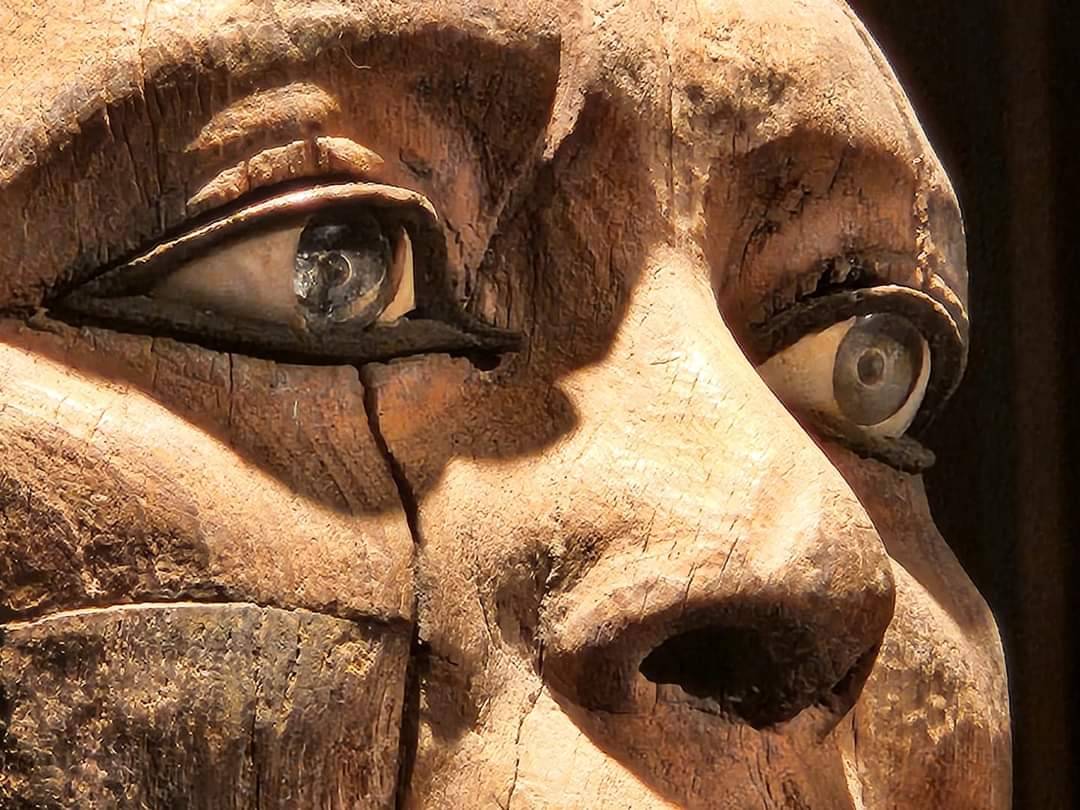
The lifelike statue of Ka’aper the Scribe is the oldest life-size wooden statue from Ancient Egypt.

Today, I am sharing this invaluable fine art from ancient Egypt with you. Kaaper or Ka’aper (fl. c. 2500 BC), also commonly known as Sheikh el-Beled, was an ancient Egyptian scribe and priest who lived between the late 4th and early 5th Dynasties. Although his rank was not among the highest, he is well known for his famously exquisite wooden statue. A wooden statue of a woman, commonly considered to be Kaaper’sKa’aper wife, also came from the same mastaba (CG 33). Wiki.

Although the statue of that priest is famous enough, there is another tiny masterpiece: a statue of a woman, a noble lady, from the same mastaba. This is also a wooden statue, commonly considered to be Kaaper’s wife (CG 33).

Here is a report by the brilliant Marie Grillot about the delicate artistry of this statue. Enjoy reading, and Merry Christmas!

Ka-Aper’s wife: a noble lady of the Old Kingdom …

via égyptophile

Statue of the wife of Ka-âper (Kaaper – Sheikh el-beled) – wood – Old Kingdom – 5th Dynasty (2513 – 2506 BC)
discovered by Auguste Mariette in 1860 at Saqqara, in the Mastaba C8
Egyptian Museum of Cairo CG 33 – photo of the museum

Wooden statuary was only beginning at the end of the 4th Dynasty, and this Statue is undoubtedly among the very first referenced female representations…

Carved in the round, dark brown wood, it was initially covered with a “fine patina of painted stucco”, which has now disappeared.

The face of the noble lady is rather round; her eyes are stretched, and her mouth is closed.

She wears a mid-length hairstyle covering her ears. As Mohamed Saleh and Hourig Sourouzian explain in their “Official Catalogue of the Egyptian Museum in Cairo”, it is “streaked with locks that end in small curls, and divided by a middle parting”. They also specify that “this wig is commonly found in female representations of the Old Kingdom”.

Statue of the wife of Ka-âper (Kaaper – Sheikh el-beled) – wood – Old Kingdom – 5th Dynasty (2513 – 2506 BC)
discovered by Auguste Mariette in 1860 at Saqqara, in the Mastaba C8
Egyptian Museum of Cairo CG 33 – photo of the museum

Her neck is adorned with a wide necklace of the usekh type, with some traces of colour remaining. The torso, with its marked chest, is thin and straight. Amputated by the upper limbs, it stops at the base of the shoulders. The statues were, in fact, made in several parts, and, in this case, the arms were added and attached to the bust using tenons. We can observe this “assembly” on multiple examples of wooden statuary…

The legs are also missing, but her attitude shows that she was depicted standing.
She is wearing a long, tight dress held up by two wide, sculpted straps “slightly projecting”.

The wood, with its visible veins, has worked and cracked over the course of more than 4,500 years. In particular, we notice an apparent crack that goes down from the neck to the navel and two more discreet ones, starting from the top of the skull towards the chin and the other from the left eye towards the chin. At the level of the right groin, we also note a considerable lack of triangular shape.

Despite these injuries, this lady retained the nobility and dignity pertaining to her rank, and the sculptor took care to render and respect her.

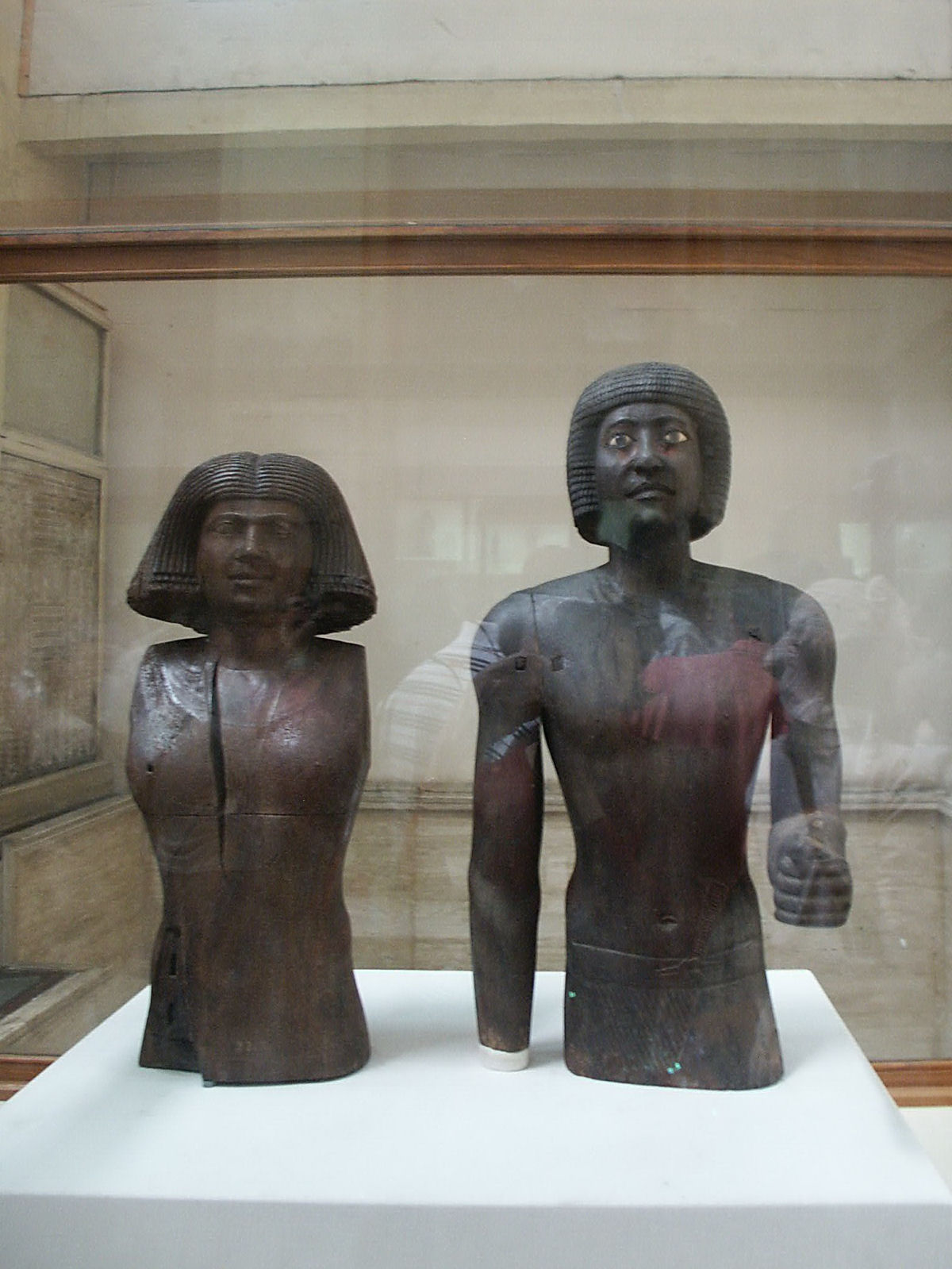
Wooden statues of Ka-Aper – Sheikh el-beled and his wife – Old Kingdom – 5th Dynasty (2513 – 2506 BC)
discovered in 1860 by Auguste Mariette at Saqqara in Mastaba C8
Egyptian Museum of Cairo – CG 34 and CG 33

In the “Guide du visiter au musée de Boulaq” (1883), Gaston Maspero describes it as number 1044: “Statue of a woman of which only the head and the torso remain. It was discovered in the same tomb as the Statue of Sheikh el-beled and is said to represent this character’s wife. In any case, it was wonderful and could be compared with Sheikh el-beled if it were not unfortunately so mutilated.”

Auguste Mariette, then the director of Egyptian antiquities, discovered the two statues in Saqqara in 1860.

Excerpt from the book: “Les Mastabas de l’ancien empire”, Paris, 1889, Mariette Auguste, Maspero, Gaston
concerning the discovery of the wooden statues of Ka-âper (Kaaper) – Sheikh el-beled – and his wife
discovered by Auguste Mariette in 1860 at Saqqara, in the Mastaba C8 Egyptian Museum of Cairo CG 34 and CG 33

In the book Les Mastabas de l’ancien Empire, published in 1889 and co-signed with Gaston Mapero, he presents the site and details the circumstances of the discovery.

“The oldest, the most extensive, the most important of the necropolises of Memphis is the one to which the village of Saqqara gave its name. The necropolis of Saqqara is located in the middle of the sand, just at the point where the desert begins and where the cultivated land ends; it is a sandy plateau which dominates by about forty meters the green plain extended at its feet. At the top of the plain, we find the necropolis…” He will uncover a huge number of tombs and mastabas there.

Excerpt from the book: “Les Mastabas de l’ancien Empire”, Paris, 1889, Mariette Auguste, Maspero, Gaston
concerning the discovery of the wooden statues of Ka-âper (Kaaper) – Sheikh el-beled – and his wife
discovered by Auguste Mariette in 1860 at Saqqara, in the Mastaba C8 Egyptian Museum of Cairo CG 34 and CG 33

Among these latter is the one that will be referenced, C 8 (the letter C corresponds to those of the second half of the 5th dynasty), discovered near the pyramid of Userkaf.

It will turn out to belong, according to Mariette’s transcription, to Khou-hotep-her (Ka-âper – Kaaper), a high official, chief priest. He was responsible for reciting prayers for the deceased in the temples and mortuary chapels where he officiated during the 5th dynasty (2465 -2458 BC).

“It was at the bottom of niche B, belonging to the small room, that the precious wooden statue was found… The head, the torso, and even the stick were intact, but the legs and the base were irremediably rotten, and the statue was only standing because of the sand which pressed on it from all sides. At the door C. of the small room, in the sand, and overturned in the place where it had obviously been thrown, was the other wooden statue,” he relates.

Statue of Ka-âper (Kaaper) – Sheikh el-beled – sycamore wood – Old Kingdom – 5th Dynasty (2513 – 2506 BC)
discovered by Auguste Mariette in 1860 at Saqqara, in the Mastaba C8
Egyptian Museum of Cairo CG 34

The statue of Ka-âper is so realistic that, upon discovery, the workers struck by its resemblance to the “chief of their village” gave it the name “Sheik el-beled”. It is undoubtedly one of the most emblematic statues of the Fifth Dynasty… That of his wife, because of her “amputations”, will remain more “confidential” and will not know the notoriety of her famous spouse…

It is exhibited at the Egyptian Museum in Cairo, Tahrir Square, under reference CG 33.

Marie Grillot

Sources:

Gaston Maspero, Visitor’s Guide to the Boulaq Museum, 1883 edition, Typ. Adolphe Holzhausen, Vienna, 1883 https://gallica.bnf.fr/ark:/12148/bpt6k6305105w.texteImage Auguste Mariette, Gaston Maspero, The Mastabas of the ancient empire, Paris, 1889 http://digi.ub.uni-heidelberg.de/diglit/mariette1889/0033?sid=02fcf46a77d8eaf4a9cd67e6974f1cc1 Ludwig Borchardt, General catalogue of Egyptian antiquities from the Cairo Museum – Statuen und Statuetten von Königen und Privatleuten im Museum von Kairo, Nr. 1-1294, Berlin Reichsdruckerei, 1911 https://archive.org/details/statuenundstatue53borc Gaston Maspero, Essays on Egyptian Art, E. Guilmoto Editeur, Paris, 1912? https://archive.org/details/essaissurlartg00maspuoft https://archive.org/stream/essaissurlartg00maspuoft/essaissurlartg00maspuoft_djvu.txt Gaston Maspero, Ancient History of the Peoples of the Classical Orient. I, Librairie Hachette et Cie, Paris, 1895-1899 http://gallica.bnf.fr/ark:/12148/bpt6k6134639f/f8.item.r=beled.langFR Elisabeth David, Mariette Pacha 1821-1881, Pygmalion, 1994
Mohamed Saleh, Hourig Sourouzian, Official Catalogue of the Egyptian Museum in Cairo, Verlag Philippe von Zabern, 1997

Friedrich Nietzsche’s Political View; A Look at the State.

Standard

Recently, I saw a critical performance of Richard Wagner on German TV about his racism, presented by an Italian or Spanish artist whose name I have forgotten. However, this reminded me of Nietzsche’s distancing himself from Wagner due to his disgust towards specific individuals, even though Nietzsche was in love with his sister, Cosima. (The reason may also be that Nietzsche had a very close relationship with a man named Paul Rée, who was Jewish.)
For Nietzsche, the Tribschen period was far from idyllic. It was challenging as he constantly tested himself to meet Wagner’s expectations. He began writing his first book while regularly visiting the Wagners’ home in Tribschen, anxious about whether his work would satisfy Wagner. This era was marked by aspiration, vulnerability, and self-testing for Nietzsche. He was essentially an apprentice to a genius, experiencing a vital rite of passage in his creative journey.

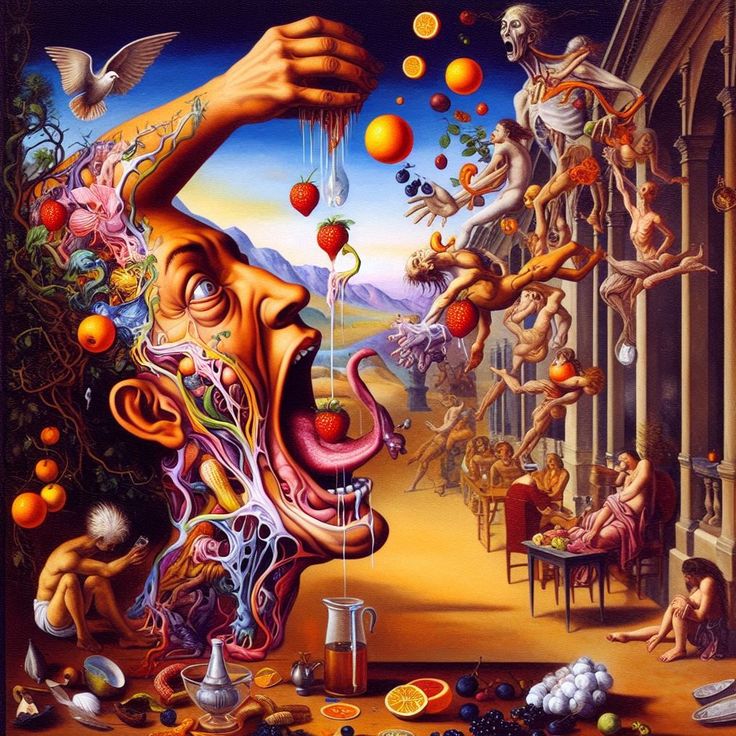
Free AI Art
(On the top: Surreal Abstract Painting.)

Neither Nietzsche nor Wagner understood one another realistically. Nietzsche saw Wagner as a benevolent father but felt disappointed by his egotism. Conversely, Wagner viewed Nietzsche as a loyal son who became a rebellious thinker. Both pursued psychological needs that overshadowed their friendship and intimacy.

Anyway, I found two paragraphs I’ve translated from one of his books, Menschliches, Allzumenschliches (Human, All Too Human). I present them to you because I believe they are very relevant to our “political” society today.

From the Book “Human, All Too Human”, Volume One

(No. 458) Guiding Spirits and their Tools.

We see great statesmen and generally all those who have to use many people to carry out their plans, sometimes proceed in this way, sometimes in that way: either they select very finely and carefully the people who suit their plans and then give them relatively great freedom because they know that the nature of these chosen people will lead them to where they themselves want them to go, or they choose poorly, even take what comes to hand, but form something suitable for their purposes out of every ton. This last type is the more violent; it also requires submissive tools, its knowledge of human nature is usually much less, and its contempt for human nature is greater than that of the first-mentioned minds. Still, the machine they construct generally works better than the machine from the workshop of the former.

Spiral to the Hole

(No. 460) The Great Man of the Masses.

The recipe for what the masses call a great man is easy to give. Whatever the circumstances, get them something they find very pleasant, or first put it into their heads that this and that would be very pleasant, and then give it to them. But not immediately at any price: you have to fight for it with the greatest effort or seem to be fighting for it. The masses must have the impression that there is a powerful, even indomitable willpower; at least, it must seem to be there. Everyone admires a strong will because no one has it, and everyone says to themselves that if they had it, there would be no limits to them and their egoism. If it turns out that such a firm will achieve something that the masses find very pleasant, people admire it once again and wish themselves luck instead of listening to the wishes of its greed. Moreover, he has all the qualities of the masses: the less they are ashamed of him, the more popular he is. So, He is violent, jealous, exploitative, scheming, flattering, grovelling, conceited (narcissist) or anything, depending on the circumstances.


A brief update: My challenging circumstances remain the same, but I’m relieved that my boss has exited the hospital. His blood tests are standard, yet he still cannot return to work. Therefore, I must continue managing things as the acting boss!
I am always grateful for your support and companionship, and I wish you all a lovely weekend.🙏💖

“Celebrating a New Birthday, While Still Embracing the Good Old Days.”

Standard

Jai guru deva, OM (Nothing’s Gonna Change My World!)

Foreword!
This year is a leap year, which makes the Gregorian calendar a bit confusing compared to the Persian calendar. While the Persian calendar also includes a leap year, the extra day falls at the end of the last month of the Persian year and marks the end of (next) winter. In contrast, the extra day in the Gregorian calendar has already transitioned by February, when we reached the leap year.
After researching, I discovered that my brother Al’s birthday is tomorrow. Unfortunately, I won’t have time to celebrate it then. So, I’ve decided to post this celebration today, and I’m sure Al won’t mind!

If we consider earthly time, he would be seventy-two; however, if one leaves the earth, time (and place)—at least in this variant—will no longer exist. However, as I still hear these tiktoks of the erosive passage of earthy time and count them, I return to these events to refresh my memories.

One of the memories that lingers in my mind is undoubtedly the Beatles. We grew up with them, and I clearly remember how, in the early sixties, we eagerly collected every new poster of theirs to hang on our room walls. This was somewhat unusual in Iran then, as most other youths listened to Iranian music. So, in our own way, we were odd!!!

Later, one of their songs, “Two Of Us,” became one of our favourites because it was about the “two” of us. I believe every lost child wants to find their way back home.

And I still hold onto those memories, learning from his wisdom; he was always a few steps ahead of me.

Honestly, I didn’t plan to post anything this weekend because I didn’t have time to come up with an idea. However, Al’s birthday inspired me to write a post. Additionally, tomorrow marks the anniversary of John Lennon’s shooting, so I’ve combined these two events in my thoughts. I believe Al and John share many points in common.

May their souls rest in peace.
Nothing’s gonna change your worlds!
Happy earthy birthday, dear peculiar brother.