Hermann Hesse: What His Life Teaches Us

Standard

There is a man who talks from my soul; as he feels the solitude so do I.

I can understand what he’d gotta fight through his childhood and always confronted with the questions which hardly could be answered. And how could a child to do so!

He is one of my favorite person on this planet.

A great article by a signora, what else. just enjoy reading 😊🧡🙏

Translated from Italian.

By  Sandra Saporito https://www.eticamente.net/author/sandra

via https://www.eticamente.net/

“I was a birth of nature launched towards the unknown, maybe towards something new or even towards nothing, leave it to develop from the deep, obey my destiny and do my own will, this was my task.”
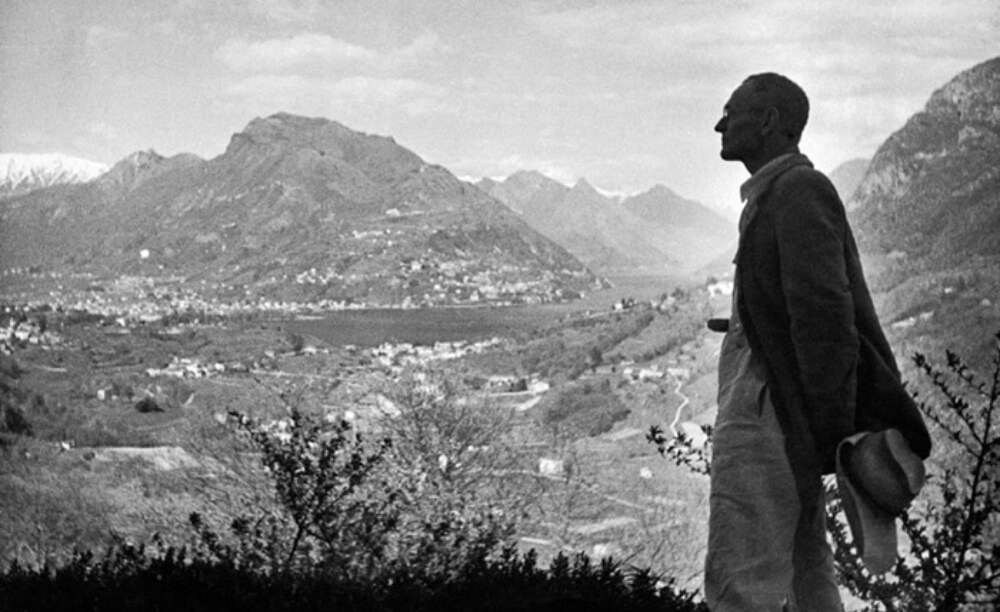
Vita di Hermann Hesse
Hermann Hesse: Cosa Ci Insegna La Sua Vita

Di Sandra Saporito -14 Luglio 2019

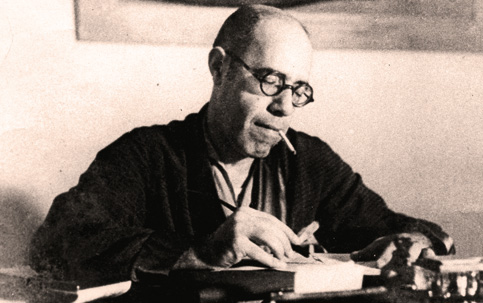
Hermann Hesse, artist and Nobel Prize winner for literature, was born on July 2, 1877, in Germany, in a pietist family who gave him a very rigid education, where art did not have its place and was considered superficial.

Hermann Hesse wrote one day to his sister Adelaide: “It often happened that mom and dad expressed approval for a poem or a musical composition, adding however immediately that all this, of course, was only atmosphere, only empty beauty, only art, without ever to draw on a high value such as morality, will, character, etc. This theory ruined my existence and I detached myself from it with no possibility of return. “
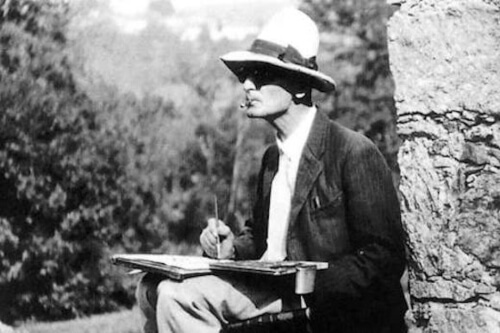
This did not prevent him from becoming an artist, with a capital “A”, not so much because he was a writer, poet, aphorist and painter at the same time but because his art was rich in meanings that went far beyond the purely aesthetic aspect of the work: imbued with moral, philosophical and psychological meanings that exalted both the disturbances and the profound transformations with which his inner life was rich, some of his works, markedly influenced by his psychoanalytic sessions with CG Jung, described the inner journey to discovery of the Self and the mysteries of existence.

His works are rich in teachings but today I would like to talk to you about the life of this great writer and the lessons that his life has left us as a legacy.

Look for your identity, your vocation: it is what elevates the human being.

“THE REAL VOCATION OF EVERYONE IS ONE, THAT OF ARRIVING TO HIMSELF.”

Hermann Hesse developed a totally different vision of art from that of his parents, to the point of making it the pillar of his life. Although he had little hope that art could change society, he felt that it could profoundly change man.

“Art, the fulfillment of inner satisfaction, meant connecting with a profound and essential sense associated with the term” home “. But this house was not his parents’ house. It was rather a return to something intangible, tied to an intuition, but unique to each individual. It was a return and a journey at the same time and could only be achieved through art, or through the hard training of oneself. “Writes Barbara Spadini on the relationship between Hermann Hesse and art.
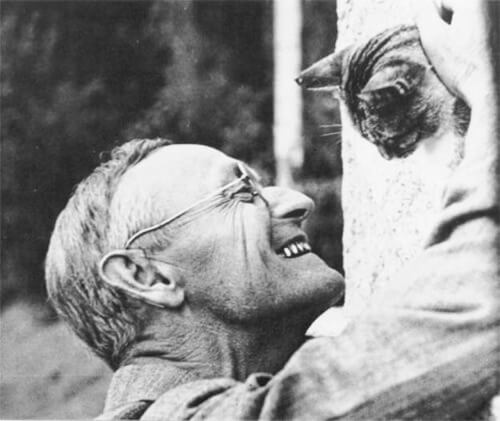
It was through this means repudiated by his family that Hermann Hesse developed a visceral desire to discover his identity and discover the mysteries of the world; which he did thanks to Jungian analytical psychology, the study of Buddhism, Hinduism and Gnosticism, art and philosophy.

Although he acted in stark contrast to his parents’ ideology, his family background had a great influence on him: he was aware of the influence his family tree had on his life.

He was in fact influenced by the life of his grandparents, whose name he bore: “To tell my story I have to start from the distant beginning. If it were possible for me, I would have to go back much further, to the very early years of my childhood, and even further into the distance of my origin. “

Art helps to become better human beings

Through his novels and poems, full of autobiographical elements, Hermann Hesse recalled the episodes of the past that had caused him pain by making writing an instrument of self-analysis, of reflection on the world and of inner evolution.

“I KNOW HOW MUCH INNER LIFE AND HOW MUCH RED BLOOD I LIVE EVERY SINGLE TO GENUINE MUST BE DRINKING, BEFORE I CAN STAND UP AND WALK ALONE.”

Its protagonists lived in the imagination what the author had experienced: fears about the future related to war and violence perpetrated on human beings in the name of ideologies of power, internal tensions related to religion and its prohibitions, existential questions on the meaning of life and the search for inner peace despite the inner evils that did not give him peace: he had suffered from years of depression.

The plot of his works often highlighted how much the individual and the collective were linked, the reflection on identity moved back and forth towards a collective dimension that in turn influenced the individual for better or worse, bringing him both to virtue and vice, with the awareness that life is made up of these two antagonistic forces.

The most beautiful works can arise from the crisis

“I WAS A BIRTH OF NATURE LAUNCHED TOWARDS THE UNKNOWN, MAYBE TOWARDS SOMETHING NEW OR EVEN TOWARDS NOTHING, LEAVE IT TO DEVELOP FROM THE DEEP, OBEY MY DESTINY AND DO MY OWN WILL, THIS WAS MY TASK.”

Through art and writing, in particular, Hermann Hesse gave voice to those inner storms that he managed to govern thanks to the movement of his feather: writing became a tool to express the hidden side of identity, art was transformed into a bridge between invisible and manifest that allowed to channel and sublimate the impulses of the unconscious: pain was transmuted into art thanks to ink.

In Demian, a training novel, written in 1919, Hermann Hesse wrote some passages of his conversations with Dr. Lang, collaborator of C. G. Jung with whom he made a psychoanalytic path to get out of a state of deep crisis. This path gave him the inspiration to write the novel: “But all [the conversations], even the most humble ones, hit the same point inside me with light and constant hammering, all contributed to form me, to break eggshells from everyone of which I raised my head a little higher, a little freer until the yellow bird with the beautiful head of a bird of prey erupted from the shattered shell of the world. “

This pained feather allowed him to develop a literary style that earned him a Nobel Prize in 1946 “For his inspired writing which in growing boldness and penetration exemplifies classical humanitarian ideals, and for the high quality of the style”.

In hindsight it is curious to note how much his works have influenced the minds of his readers, debunking his initial belief: art, in reality, changing men, can really help change society. A tree will certainly not be able to change the face of a forest but its fruits, trees in power, will certainly be able to do so with the passing of many seasons.

by Sandra “Eshewa” Saporito
Autrice e operatrice in discipline bio-naturali
www.risorsedellanima.it

The Frontiers Are My Prison

Standard

Hi, Friends. I’m just full in my mind these days; There are many things in front of me, or better to say; I have a lot of plan to do!

At first, the gum has been survived and the surgery had been succeeding. But the soul has an injury which is more important and pains more than the buddy’s pain;

My main plan is to fly to the USA to meet my brother in law and his all daughters+son for maybe the last time in my life, because, my brother; Soroosh, is some older than me and it is our last chance to see each other.

Therefore, I thought it is possible;

I had to do this since many years ago but because of my full-hours work, I couldn’t plan a long trip, but now, as I am going to be retired in this year, I have thought to make it now, or never.

But as I tried to get the visa for the Us, I feel like I’m locked out from the normal visitors; as my wife got her visa already through ESTA. and I’m not authorized in this way.

It might sound not so terrifying but for me it is because, we; my wife and me, have sent our applications in the same manner at the same time, the only difference in between, it was the born country, my wife; Germany and mine, Iran.

Anyhow, I will try to make an appointment to the embassy in Berlin and try to do my best. My love for America stays tuned, only I must ponder what happened to this root of freedom.

You might remember how it was once in those days, good days 😊🙏💖😊

Freedom… Freedom… Freedom… Freedom Sometimes, I feel, like I’m almost gone. Sometimes I feel, like I’m almost gone.

* My soul is in a hurry. *

Standard
Facebook

That is a Poem by Mario de Andrade (San Paolo 1893-1945) poet, writer, essayist and musicologist.
One of the founders of Brazilian modernism. https://en.wikipedia.org/wiki/M%C3%A1rio_de_Andrade

I’ve received it occasionally by What’App messenger and profoundly touched. 💖

ISTOÉ Independente

* My soul is in a hurry. *

I counted my years and found that I have less time to live than I have ever lived.

I feel like this kid who won a box of candies: he eats the first ones with pleasure, but when he realizes that there are only a few left, he really begins to enjoy them.

I don’t have time for endless conferences to discuss statutes, rules, procedures and internal regulations, knowing that nothing will be achieved.

I no longer have time to endure absurd people who, regardless of their age, have not grown.

I no longer have time to struggle with mediocrity.

I don’t want to be in meetings where inflated egos are marching.

I don’t tolerate manipulators and opportunists.

I am bothered by the envious people who try to discredit the more able to seize their positions, talents and achievements.

My time is too short to discuss headings. I want the essentials because my soul is in a hurry, without lots of sweets in the package.

I want to live with people who are very human.

People who can laugh at their mistakes, who don’t imagine their success.

Who do not feel called ahead of time and who do not flee from their responsibility.

Who defend human dignity and who only want to go alongside truth and righteousness.

It is what makes life worth living.

I want to surround myself with people who know how to touch the hearts of others.

People who learned through the hard blows of life to grow through gentle touches of the soul.

Yes, I’m in a hurry, I’m in a hurry to live with the intensity that only maturity can give.

I try not to waste any of the candy I have left.

I am sure that they will be more delicious than the ones I have already eaten.

My goal is to reach the end contentedly, in peace with myself, my loved ones and my conscience.

We have two lives and the second begins when you realize that you only have one.

The Heartbreak of Hans Christian Andersen

Standard

Of turning sorrow into song.

How I love this man as he opened my mind-eyes to the world of fairy tales and magic. Of course, the magic followed me all in my life as my name: Aladin.

My father had chosen the name not because of “the magic-lamp” unfortunately, but just as he was a master of the Arabic language, wanted to give me the best piece of ritual, as this name means.
Because “Ala” means the best and “Din” means the ritual also, the best of the rituals!!

But as you know, and everybody knows, the name goes into the story or better to say, to the tails of the Aladdin with the magic lamp.

VectorStock

I have nothing against it. though in Iran the peoples around had shortened it in Ala, therefore, no chance about dragging the magic lamp after but as I came in Europe and finally in Germany, the name became the Name! Everywhere I go and introduce myself there comes my lovely inspiration: Ah! With the magic lamp!

I have nothing against it, You know; it works well, though I have not found the lamp yet 😉

Anyway, let’s now have a look at this wonderful article about the love, the love of the great writers whom we loved but might never know of their “surprising love stories.

via https://www.brainpickings.org/wp

BY MARIA POPOVA

The Heartbreak of Hans Christian Andersen

Harriet Hosmer — whose remarkable forgotten story I tell in Figuring (public library), from which this essay too is adapted — was not yet thirty when she became the world’s first successful female sculptor, claimed a place for American art in the European pantheon, and furnished queer culture with a bold new vocabulary of being. Her studio in Rome became a pilgrimage site for royalty and luminaries, drawing such esteemed admirers as Nathaniel HawthorneMaria Mitchell, the Prince of Wales, the Crown Princess of Germany, and the exiled queen of Naples (who would become Hosmer’s lover).

Among her famous visitors was Hans Christian Andersen (April 2, 1805–August 4, 1875) — a man of supreme storytelling genius and aching self-alienation, which Hosmer instantly intuited. In a letter home, she described Andersen as “a tall, gaunt figure of the Lincoln type with long, straight, black hair, shading a face striking because of its sweetness and sadness,” adding that “it was perhaps by reason of the very bitterness of his struggles, that he loved to dwell among the more kindly fairies in whose world he found no touch of hard humanity.”

Hans Christian Andersen (Portrait by Christian Albrecht Jensen, 1836)

Andersen’s struggles were ones of a heart unsettled, ambivalent, at war with itself. By all biographical evidence, he died a virgin. For years, he was infatuated with the Swedish opera diva Jenny Lind, but his great erotic love was reserved for Edvard Collin — a boyhood beloved who remained the single most intense emotional relationship throughout Andersen’s life. “The femininity of my nature and our friendship must remain a mystery,” he wrote to Edvard, who left in his memoir a forlorn record of the dual heartbreak that scars all such relationships between people who love each other deeply but differently: “I found myself unable to respond to this love, and this caused the author much suffering.” Andersen was unambiguous about both his feelings and his suffering, writing to Edvard with heart-rending plaintiveness:

I languish for you as for a pretty Calabrian wench… my sentiments for you are those of a woman.

Jenny Lind, on the other hand, was a woman of the highest caliber of femininity, and one of the most successful women artists of her time. Andersen sent her passionate, pouting letters, then wrote his classic story “The Nightingale” out of his frustrated reverence shortly before making an awkward marriage proposal in a letter handed to her on a train platform. The tale didn’t earn him Lind’s reciprocity, but it earned her the monicker “the Swedish Nightingale.”

Jenny Lind (Portrait by Eduard Magnus, 1862)

To make art out of heartache is, of course, the most beautiful thing one could do with one’s sorrow, as well as the most generous — no artist knows how the transfiguration of their pain into beauty will salve another heart, give another sorrower the language of their own truth, the vessel for navigating their own experience.

Across the Atlantic, Andersen’s heartbreak-fermented fairy tales furnished the language of understanding between two other deeply entwined hearts. Susan Gilbert — the love of Emily Dickinson’s life, to whom the poet had written those electrifying love letters — had married Emily’s brother to be near her. Having managed marital celibacy for an impressive five years, Susan eventually gave birth to her first child. That season, Dickinson sent to her editor a famed cryptic letter on the meaning of which biographers would speculate for centuries to come, telling him of some great unnamed and perhaps unnameable hurt:

I had a terror… I could tell to none, and so I sing, as the Boy does by the Burying Ground — because I am afraid.

Illustration for Hans Christian Andersen’s “The Nightingale” by Ukrainian artist Georgi Ivanovich Narbut, 1912.

Not a “fright,” not a “shock,” but a terror. Whether or not she was the cause, Susan knew of Emily’s suffering and suffered in consonance, for any two hearts bound by love are also bound to share in sorrow. Drawing on an image from Andersen’s fairy tale “The Nightingale and the Rose” — which in turn drew, as most of his fairy tales did, on the terrors of his own unmet heart — Susan captured the parallel heartbreak of their impossible love in a letter apologizing for turning away from Emily’s kiss:

If you have suffered this past Summer — I am sorry — I Emily bear a sorrow that I never uncover — If a nightingale sings with her breast against a thorn, why not we?

Emily Dickinson and Susan Gilbert

Complement this fragment of Figuring with Andersen’s arresting account of climbing Vesuvius during an eruption and the most beautiful illustrations from 150 years of his fairy tales, then revisit Herman Melville’s passionate and heartbreaking love letters to his friend and neighbor Nathaniel Hawthorne, penned in the same era and pained with the same sorrow.

https://www.brainpickings.org/2020/01/31/the-heartbreak-of-hans-christian-andersen/

It’s getting better all the time

Standard

Hi Friends, yes I’m still alive and want to try to update my mood right now, though it’s hard to type with one hand as the other one is holding the compressor bag to cool down my thick cheek!

www.pinterest.ca

Anyway, I must confess that I had somehow feared to get under this surgery, of course, I had many moments in my life to learn how to win the anxiety which everybody might have in her/his life.

Especially, I can well remember how I learned to get down my fear to go to the dentist! Yes, it’s surely a common sense in many people and mine was because of my whole-life problems with my teeth.

It is, as I believe, a genetic matter of fact; my mother had to get a complete denture when she was just twenty-five!

But I got loose of this fear as I was a late teen and I had to decide to go or not to go to the dentist and I went! As I remember; I was shivering and the doctor said: Don’t you shame?! You are a grown-up man, pull yourself together! From that time I understood how to get down the fear and it was much necessary because I had to let many teeth pull out several times in my life.

www.dreamstime.com

Now as I had to go to the surgery and this was a very new adventure, therefore, not exactly fear but something such as worry or excitement which I had in my belly. But some words were in my mind saying; Fear and only the fear in my great enemy.

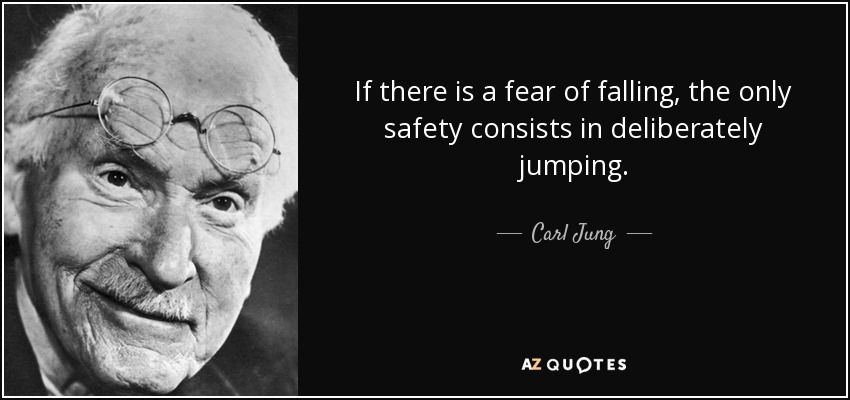
Or as the great Master Dr. Jung says;

Pinterest

Okay, enough said; I think it is over now and I feel just better and better again. As the Beatles song: “Getting better, “Cause you’d be mine (this “you” means, of course, my pine implants) 😉

Have a great weekend everyone 💖💖🙏

dental implant

Standard
Consumer Guide to Dentistry
das ist nett, oder?

Oh my dear friend, I wanna just to warn your oldness; the dental Implanting is on the way,,, 😄🤣😂😁😀😨🤑

Anyway, I will be get in to under the knife of the dental surgery next week and I have the choice to drink myself!!

God save the animals, I wish you all the best.

The “legendary” Winlock: excellent investigator and … prolific discoverer

Standard
Herbert Eustis Winlock, American Egyptologist (1-2-1884, Washington DC – 26-1-1950, Venice, Florida)
and one of the carriers of offerings from the tomb of Meketre (TT280) he discovered in February 1920

We can always be thankful by, I’d say, some few researchers in the Egyptology’s world for their open and honestly investigations in the mystery of the magic Egypt.

via https://egyptophile.blogspot.com/ by Marie Grillot translated from French.

An excellent report about a Legendary Man. by Marie Grillot 🙏💖🙏https://egyptophile.blogspot.com/

The great American Egyptologist Herbert Eustis Winlock was born on February 1, 1884, in Washington DC. He followed brilliant studies in prestigious universities, like Yale or Harvard, from which he graduated. At the age of 22, he undertook his first excavations in Egypt. It is the start of a career, of exceptional quality and richness, punctuated by discoveries that will make ‘date’ in Egyptology.

From 1906 and 1931, he led numerous campaigns there on behalf of the Metropolitan Museum.

Head of female statue – painted wood with gilding – Cairo Egyptian Museum – I 39380
Middle Kingdom – XIIth dynasty – Provenance: Licht
Excavations of the Metropolitan Museum of Art in New York under the direction of HE Winlock – 1907

In 1907, in Lisht, between Daschour and Meidoum, he made excavations on the site of the pyramid of Amenemhat. He found there, in particular, a magnificent female head in painted wood, with a heavy black wig decorated with touches of gold (it will often be reproduced to symbolize Egyptian beauty).

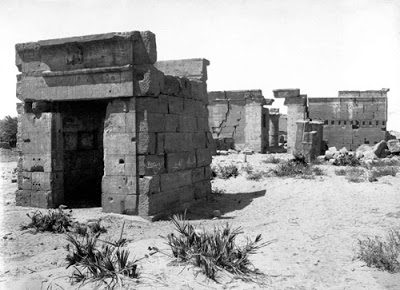
Temple of Hibis in the Kharga oasis

He then worked on the temple of Hibis in Kharga, then on the palace of Amenophis III in Malgatta, on the west bank of Luxor.

Around 1910, he obtained from Gaston Maspero the concession for the Theban mountain, Gurnet Murai, Assassif (with German Egyptologists) and a sector of Deir el-Bahari (with the French) where he notably cleared part of the temple of Mentouhotep.

Then began twenty years of discoveries and restorations carried out by the “legendary Winlock”.

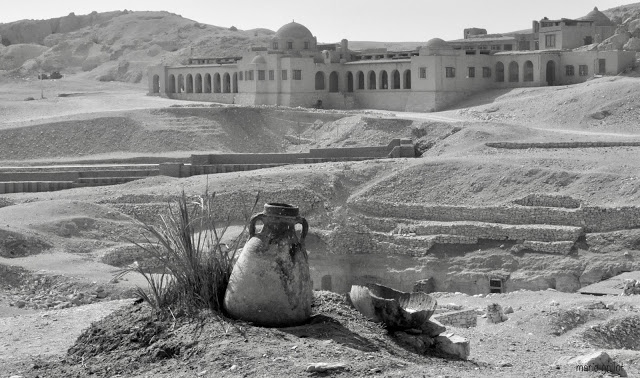
The house of the Metropolitan Museum excavations (now known as the “Polish House”)
was built between 1912 and 1914 on the plans of Herbert Eustis Winlock

On October 26, 1912, in Boston’s “Trinity Church”, he married Hélène Chandler from an old family in that city. They will have three children: Frances, William and Barbara. They will share their life between New York, North Haven, an island off the coast of Maine and Egypt.

It is on his own plans that were built in Assassif, between 1912-1914, the magnificent excavation house of the Metropolitan, known today as the “Polish House”.

During the First World War, he returned to the United States; he did not return to Thebes until 1920.

Tomb Meketre – TT 280 – Deir el-Bahari
discovered in February 1920 by the mission of the Metropolitan Museum of Art in New York led by Herbert Eustis Winlock
(photo Harry Burton)

It was at the end of February of that year that, under his direction, the Egyptologists Ambrose Lansing and Harry Burton discovered the tomb of Meketré (TT280). For more than three weeks, 200 fellahs recruited from the village cleaned and cleared the site when, on March 17, one of the workers noticed that small pieces of stone were sliding into a crack in the rock. “We had already looked in so many empty holes, told Mr Winlock, that the news hardly moved me. No matter! I lay on my stomach, slipped the torch into the hole, pressed the button and stuck my eye against the opening. Instantly the electric beam lit up a whole world of four thousand years old! Hundreds of Lilliputians came and went on their business. Several brandishing sticks pushed oxen with spotted coats before them. Others, bracing themselves on their oars, manoeuvring a flotilla of boats. A large ship, the bow in the air was about to sink. ” Objects – as incredible as they are exceptional! – will then be shared between the Met and the Cairo museum.

http://www.metmuseum.org/art/collection/search/545445
In 1921, in the tomb of the tomb and Ipy Meseh at Deir el Bahri,
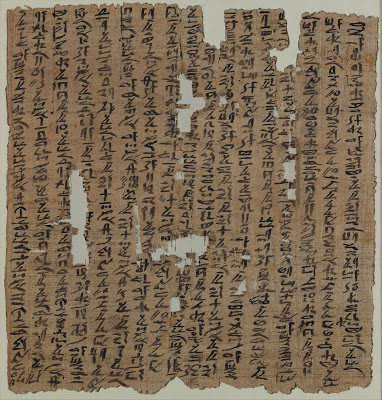
Herbert Eustis Winlock discovered the “Letters Heqanakht”
here, “Letter I” – Metropolitan Museum of Art in New York – Accession Number: 22.3.516 (Museum photo)

In 1921, in the tomb of Meseh at Deir el Bahari, he found the “Letters of Heqanakht”, a scribe of the XIIth dynasty: they constitute an exceptional testimony on the life of this period … Agatha Christie will be inspired by elsewhere, in 1944, to write “Death is not an end – Death comes as the end”, signing there his only novel not to take place in the twentieth century.

In 1922 Winlock was among the first to enter the tomb of Tutankhamun. In February, for the opening of the third sealed door, he was in the “happy few”, as Howard Carter himself reports in “The fabulous discovery of the tomb of Tutankhamun”: “Friday the 17th, at two o’clock, those who were to have the privilege of attending the ceremony met at the entrance to the tomb. Lord Carnarvon, Lady Evelyn Herbert, Her Excellency Abd el-Halim Pasha Souleman, Minister of Public Works, Mr Lacau, were present Director-General of the Antiquities Service, Sir William Garstin, Sir Charles Cust, Mr Lythgoe, the Curator of the Department of Egyptian Antiquities at the Metropolitan Museum, Professor Breasted, Dr Alan Gardiner, Mr Winlock, – about twenty people in all “… The relations between Winlock and Carter will prove to be warm and cordial and the American will not fail to support the British, especially in the face of the problems he will encounter in 1924.

In 1941, Herbert Eustis Winlock devotes a book to
“Materials used at the embalming of King Tut-Ankh-Amun”.
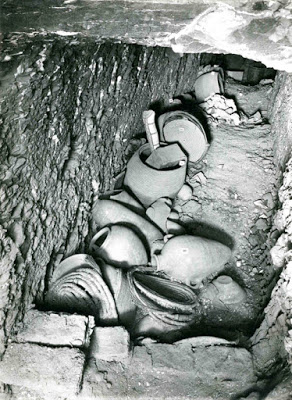
Here, some of the pots found in KV 54 (Tutankhamun’s Embalming Cache)
discovered in 1907 by Edward Russell Ayrton on behalf of Theodore M. Davis
Presentations at the Metropolitan Museum of Art in New York

In 1941, he devoted a book to “Materials used at the embalming of King Tut-Ankh-Amun”. His work will be based on what he was able to “recover” from the excavations of Davis carried out in 1907 in KV54 (Tut-Ankh-Amun cache).

The tomb of Merytamun (DB 3258) when discovered by Herbert Eustis Winlock

Herbert Winlock will also update the tomb of Neferhotep (DB316 or TT316), that of Merytamon (DB358), daughter of Queen Ahmès Nefertari, whose cedar sarcophagus is 3.13 m high, and that of Senenmut ( TT71).

After being the director of the Metropolitan Museum’s Egyptian expedition from 1928 to 1932, he was appointed curator of the Egyptian department of the museum, then director, a post he held from 1932 to 1939. He was then director emeritus until his death, January 26, 1950, in Venice, Florida, at the age of 66.

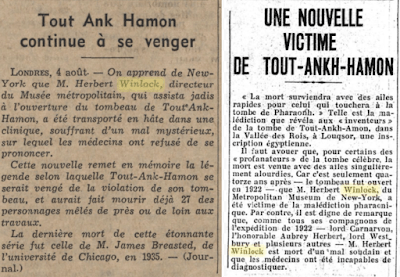
In 1937, the press announced prematurely, the death of Herbert Eustis Winlock,
saying the victim of the curse of Tutankhamun

For the anecdote, it should be noted that his death had been announced in the press … as early as 1937, the so-called victim of the curse of Tutankhamun! Thus “Le Figaro” of August 6, 1937, under the title “Victim of All-Ankh-Amon” thus introduced a snippet “Death will occur with fast wings for those who touch the tomb of the pharaoh …” thus concluding “Mr Herbert Winlock died of a sudden illness that doctors were unable to diagnose. ” In fact, it was a stroke, which left him with after-effects but did not cost him his life…

The work carried out by Winlock has always been of high quality, praised and appreciated by the Egyptologists who rubbed shoulders with him, such as William Matthew Flinders Petrie or even Arthur Weigall. His excavation books are very documented. They constitute an extraordinarily rich testimony of the way in which the excavations were carried out at that time.

To understand, to approach the truth, he knew how to use all possible means of investigation: exchange of photos casts between different museums, chemical analyzes, medical studies, radiographic … “This taste for integral investigation led Mr Winlock has multiple discoveries, but, without taking into account the details and additions made to the interpretation of the monuments of Deir el-Bahari, that of art or funeral rites, the author’s investigations throw a bright light on the daily existence of a people whose history he tried to reconstruct. “

Marie Grillot

sources

The Path to Tutankhamun, Howard Carter,   TGH James TPP 1992
Who Was Who inEgyptology, Bierbier, M., London, Egypt Exploration Society
The complete Valley of the Kings, Nicholas Reeves, Richard h. Wilkinson, The American University in Cairo Press, 2002

History of the Valley of the Kings, John Romer, Vernal – Philippe Lebaud 1991

The fabulous discovery of Tutankhamun’s tomb, Howard Carter

” The Journal of Egyptian Archeology “, volume 36, 1950

” Excavations Met Throughout History “, 1870

Michel Laurence, Fabulous discovery in Egypt

Terry Jones the Genius ❤

Standard

Let’s have another break in my work to give a short tribute to a great genius in, I would say, all kind of Arts.

Actually, I didn’t know him from Monty Python’s movies first, I knew him by his fascinating TV series; Medieval Lives.

And of course, his proof of concept has been clearly seen in the Python’s films.

I’ve heard that he has cancer and also Alzheimer and now his death can be a salvation for him but it is surely a great loss for the world of Arts. Our world. 😔

I want just to imagine how he and Graham Chapman make an chaotic in heaven there above 🤗❤

Rest in Peace and thanks for the wonderful and joyful moments in our lives 🙏❤🙏❤🙏❤

Doing what a Grandpa must do!

Standard

Hi lovely friends. It’s a short announcement for my absence today as I must do my duty!

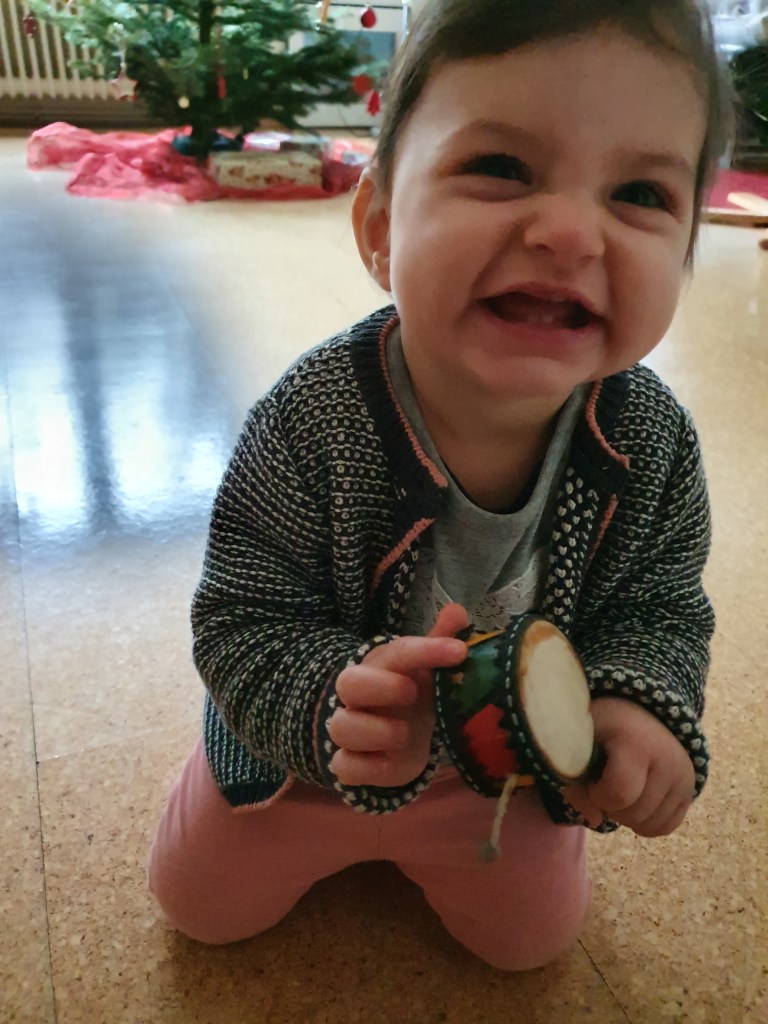
Yes I know that you know it is Saturday and m loveliest day but there is someone who is my loveliest on too; Mila, My granddaughter 😊

And she is one year young now, therefore, I must get to my son’s for the celebration.

Just look at her, how can I ignore this cute girl 😉😊

😘💖😘

Have a wonderful Saturday everyone 💖💖

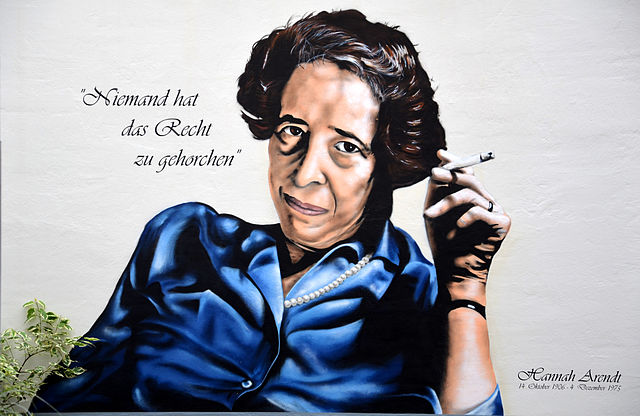
Hannah Arendt, (An Eternal Flower) eine ewige Blume 💖

Standard

No chance men! You can’t just easily pass by.

Image by Bernd Schwabe, via Wikimedia Commons
oder zu schweigen! 😉
has the right to obey (in photo) or
has the right to remain silent!

This woman makes me crazy! It is not surely something new for the whole world; She can make everybody crazy; even the Nazis. and she was a jew.

The Philosophers’ Magazine

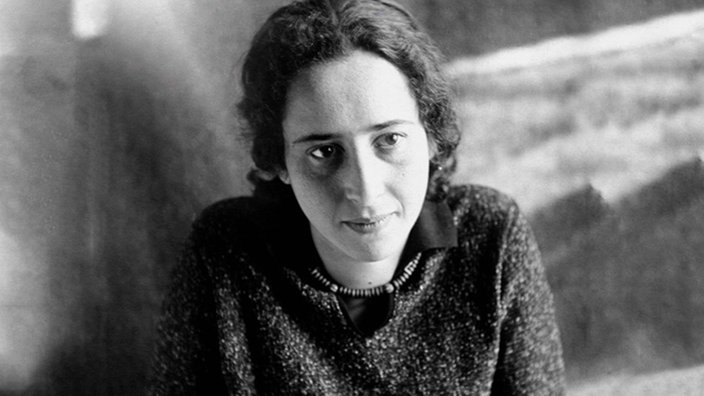
Just look at her, into her eyes if you dare as a man; I’d consider myself! Theses eyes are very dangerous for the muscular, if you have heard about infinity well that’s it. I will never stop you to be drown in, but just to know you’d never want to come back again. 😊👽💖

She is really one of the highest human (actually Hu-Woman) as I can remember ever seen in my memories; her eyes are hypnotizing; aren’t they?

www1.wdr.de

I have actually once noticed her as a genius philosopher but newly I’ve heard about her again in the radio how she made all the Nazi men confused, I’d just thought; there she is; the Goddess. Why not, what have we, humans got less than Gods? In the all holly books it’s written; God made hu-wo-man as reflection her/himself. or as Shakespeare says as Hamlet;

What a piece of work is man, How noble in reason, how infinite in faculty, In form and moving how express and admirable, In action how like an Angel, In apprehension how like a god, The beauty of the world, The paragon of animals. And yet to me, what is this quintessence of dust? Man delights not me; no, nor Woman neither; Hamlet (1599-1602), Act II, Scene 2,)

Anyway, the Women rock, no doubt! here I present a nice article about this magic woman 😊 I hope you’d enjoy 💕🙏💖🙏

Hannah Arendt Explains Why Democracies Need to Safeguard the Free Press & Truth … to Defend Themselves Against Dictators and Their Lies

Two of the most trenchant and enduring critics of authoritarianism, Hannah Arendt and Theodor Adorno, were also both German Jews who emigrated to the U.S. to escape the Nazis. The Marxist Adorno saw fascist tendencies everywhere in his new country. Decades before Noam Chomsky coined the concept, he argued that all mass media under advanced capitalism served one particular purpose: manufacturing consent.

Arendt landed on a different part of the political spectrum, drawing her philosophy from Aristotle and St. Augustine. Classical democratic ideals and an ethics of moral responsibility informed her belief in the central importance of shared reality in a functioning civil society—of a press that is free not only to publish what it wishes, but to take responsibility for telling the truth, without which democracy becomes impossible.

A press that disseminates half-truths and propaganda, Arendt argued, is not a feature of liberalism but a sign of authoritarian rule. “Totalitarian rulers organize… mass sentiment,” she told French writer Roger Errera in 1974, “and by organizing it articulate it, and by articulating it make the people somehow love it. They were told before, thou should not kill; and they didn’t kill. Now they are told, thou shalt kill; and although they think it’s very difficult to kill, they do it because it’s now part of the code of behavior.”

This breakdown of moral norms, Arendt argued, can occur “the moment we no longer have a free press.” The problem, however, is more complicated than mass media that spreads lies. Echoing ideas developed in her 1951 study The Origins of Totalitarianism, Arendt explained that “lies, by their very nature, have to be changed, and a lying government has constantly to rewrite its own history. On the receiving end you get not only one lie—a lie which you could go on for the rest of your days—but you get a great number of lies, depending on how the political wind blows.”

Bombarded with contradictory and often incredible claims, people become cynical and give up trying to understand anything. “And a people that no longer can believe anything cannot make up its mind. It is deprived not only of its capacity to act but also of its capacity to think and to judge. And with such a people you can then do what you please.” The statement was anything but theoretical. It’s an empirical observation from much recent 20th century history.

Arendt’s thought developed in relation to totalitarian regimes that actively censored, controlled, and micromanaged the press to achieve specific ends. She does not address the current situation in which we find ourselves—though Adorno certainly did: a press controlled not directly by the government but by an increasingly few, and increasingly monolithic and powerful, number of corporations, all with vested interests in policy direction that preserves and expands their influence.

The examples of undue influence multiply. One might consider the recently approved Gannett-Gatehouse merger, which brought together two of the biggest news publishers in the country and may “speed the demise of local news,” as Michael Posner writes at Forbes, thereby further opening the doors for rumor, speculation, and targeted disinformation. But in such a condition, we are not powerless as individuals, Arendt argued, even if the preconditions for a democratic society are undermined.

Though the facts may be confused or obscured, we retain the capacity for moral judgment, for assessing deeper truths about the character of those in power. “In acting and speaking,” she wrote in 1975’s The Human Condition, “men show who they are, reveal actively their unique personal identities…. This disclosure of ‘who’ in contradistinction to ‘what’ somebody is—his qualities, gifts, talents, and shortcomings, which he may display or hide—is implicit in everything somebody says and does.”

Even if democratic institutions let the free press fail, Arendt argued, we each bear a personal responsibility under authoritarian rule to judge and to act—or to refuse—in an ethics predicated on what she called, after Socrates, the “silent dialogue between me and myself.”

Read Arendt’s full passage on the free press and truth below:

The moment we no longer have a free press, anything can happen. What makes it possible for a totalitarian or any other dictatorship to rule is that people are not informed; how can you have an opinion if you are not informed? If everybody always lies to you, the consequence is not that you believe the lies, but rather that nobody believes anything any longer. This is because lies, by their very nature, have to be changed, and a lying government has constantly to rewrite its own history. On the receiving end you get not only one lie—a lie which you could go on for the rest of your days—but you get a great number of lies, depending on how the political wind blows. And a people that no longer can believe anything cannot make up its mind. It is deprived not only of its capacity to act but also of its capacity to think and to judge. And with such a people you can then do what you please.

via Michio Kakutani

http://www.openculture.com/

Related Content:

Hannah Arendt on “Personal Responsibility Under Dictatorship:” Better to Suffer Than Collaborate

Hannah Arendt Explains How Propaganda Uses Lies to Erode All Truth & Morality: Insights from The Origins of Totalitarianism

Enter the Hannah Arendt Archives & Discover Rare Audio Lectures, Manuscripts, Marginalia, Letters, Postcards & More

Josh Jones is a writer and musician based in Durham, NC. Follow him at @jdmagness