Hi, my dear friends. I must apologize for my failures in the last post, as I noticed them in the night in bed!! Anyway, I have a serious situation this time as I have to work and coordinate my household; my wife is a woman of the world. Just let’s begin.
As I mentioned in the first part, it’s not easy to be born and grow up by sensible parents; a writer as a father with a lot of wishes and dreams and a bookworm as a mother whose biggest wish was to be left alone in a room fulfil with books and glass water and a loaf of bread would be enough for her!
Mother in everlasting position, Dreaming.
Here, man can say that God saves the soul! And yes, my childhood was based on a lot of trauma. Especially after my father died, it became much more complicated, but the very beginning;
It is, of course, not so much to explain; I have written there about in my some memories a time of love, happiness, a time of also, strike, strife, discord and again love and forgiveness.
You might read my post, “A CHARACTERISTIC LOVE STORY.” There, I have described the crazy beginning of this family’s foundation, which can result in mostly chaotic high-spiritual tensions in our lives.
Let’s begin after the father’s death because I can remember better. I don’t know why; maybe because I had to work on this. My father died the night after we returned from a wedding ceremony very late at night, and both “Al and I” knew nothing about what happened. In the morning, Mother told us he had travelled (He did travel often, but surely not after a party where he was almost drunk!). This wrong announcement was acceptable to me, but for Al, it wasn’t enough. He was a thinker even 9 at age ( I was 7 when my father left this Earth.), but of course, we both took it as a fact and, according to the mother’s order, went to the uncle’s house with a pool a big garden and so on and on. It was an offer which no child could refuse.
Those were the days, I’d bet! 😉
The main tension began after this time because Al was almost sure there was something wrong with this and me, the bloody child; I might have mentioned something but surely wanted rather ignore it! Therefore, it began a funny, and it might be better to say a tragic play between us three: Mother, Al and Me, and it was and still remains a trauma, which I will try to tell you about next. Thank you to all who read this, and forgive me for my failure. Take care and be safe. 🙏💖🙏
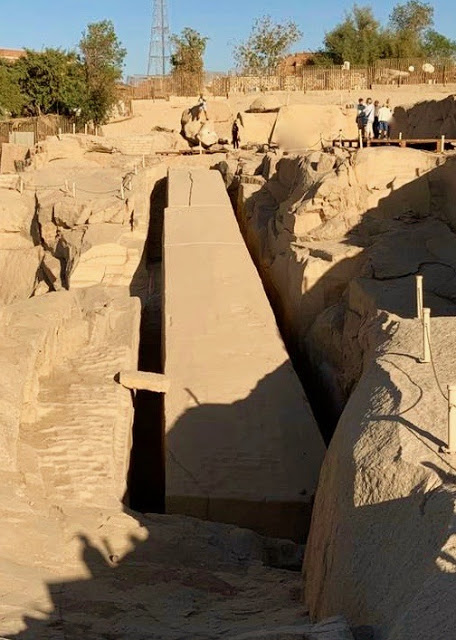
To pay homage to a broken destiny, to hope of shattered greatness, you have to go to the quarries of Aswan, about 2 km south of the city, near the Fatimid cemetery…
In this place lies the one that could have been the highest obelisk in Egypt,… Wearing its sparkling pyramidion, it would then proudly bear the name and the cartouches of the pharaoh who ordered its execution…
But, “in Antiquity, at the time of the extraction, the team in charge of the operation discovered cracks on the block and tried several times to reduce its size. These attempts were unsuccessful and the monument was abandoned “(Nessim Henry Henein – BIFAO 109).
Cracks on the block of the unfinished obelisk in one of Aswan granite quarries, about 2 km south of the city, near the Fatimid cemetery
Florence Maruéjol reminds us of all the symbolism of the obelisks: “Like most elements of religious architecture, they are loaded with symbols. They materialize the Benben, the sacred stone venerated in antiquity in the temple of Heliopolis. They also embody the primordial hill on which the sun landed at the beginning of the world. They are also assimilated to petrified sunbeams “.
Giving up all hope of embodying this, he remained forever “fused” connected by one side to this stone bench of Syene, name of the ancient city of Aswan.
Overview of the Aswan granite quarry, located approximately 2 km south of the city near the Fatimid cemetery
Clot Bey informs us about the mineralogical and geological composition which gave it its name: “Around Aswan, there are these varieties of granite, so famous in antiquity, known as syenite. We find in this mineralogical bench syenites pink, porphyritic, pink and yellow, grey, white and black, grey and pink, veined and black; porphyritic gneiss, white and quartz granites. Most of the huge monoliths left to us by the Egyptians, the obelisks, the colossi, are red syenite; we also see many statues and emblematic monuments of a smaller volume in black or grey syenite “.
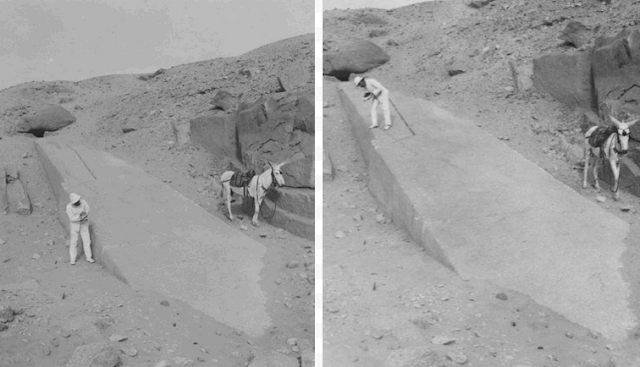
Unfinished Obelisk is one of Aswan granite quarries, about 2 km south of the city, near the Fatimid cemetery Photo dated 1890 Aswan, half of the year obelisk in quarry – circa 1890
Jean-Jacques Ampère, in his “Travel and Research in Egypt and Nubia” published in 1848 describes his visit thus:
We wandered curiously in the quarries of Syene. These quarries are a plain of granite cut in the open air for the needs of Egyptian architecture and especially sculpture. Egypt offers, in fact, very few monuments built in granite, but all the obelisks, many statues and sphinxes are of granite and of this pink granite peculiar to Syene, from where it took the name of syenite. It is from here that these famous monoliths came out, which, after decorating Thebes or Heliopolis, now embellish the squares of Rome and Paris. We understand how these masses could be detached. Holes that can still be seen arranged along with a horizontal slit show how large pieces of granite were separated from the rock. In these holes, the corners were used to break the rock.
We even see in Syene’s quarry an obelisk which has not been entirely detached; it is there lying on the ground, to which still holds by one side. By contemplating this living testimony of a work which has stopped for so many centuries, it seems that we are witnessing this work and that we see it being interrupted. One can believe that the workers, after taking their nap, will come back and finish their work; the unfinished work still seems to last. “
For many years this notion of the use of “corners” persisted, even Marcelle Baud in his Blue Guide will echo it: “They (the old quarries) show the process used by the Egyptians for the extraction of These notches, which delimited the surface to be extracted, received wooden wedges which were then wet. The swelling wood caused the block to burst in the delimited places and this obtained roughly smooth surfaces ready for polishing”…
In the 1920’s, Reginald – Rex – Engelbach, Egyptologist English, devoted several seasons to study the unfinished obelisk Aswan and restore its findings in three reference books
But the truth about the exact technique used will emerge from 1920 – 1921, thanks to Pierre Lacau, then head of the Antiquities Service, which entrusted the study of the unfinished obelisk to Réginald Engelbach.
In his Report on the works carried out during the winter of 1920-21, he made the following observation:
“In Aswan, all the tourists knew the unfinished obelisk which still lies in place in the granite quarry. The sand had invaded it and it had to be cleared again. I took the opportunity to try to clear it in a complete way, in order to examine closely the technical procedures of the Egyptian quarrymen. M. Engelbach, the chief inspector for Upper Egypt, was charged with the work and he was pleasantly surprised to see the enormous needle stretch out in a disproportionate way; the part currently cleared of the debris which covered it is already 36 meters long, and the work is not finished. It is therefore already the largest of the known obelisks (we have one of thirty and one meters only). One cannot help but think of the well-known text by Deir el Bahari which tells us about obelisks of fifty-two meters; this surprising figure is much less likely now to be only an exaggeration. “
Rex Engelbach, an English Egyptologist of Alsatian origin, remembers: “Although its existence has been known for centuries, the unfinished obelisk had never been cleared until the end of this winter of 1922 when my department allocated the sum of LE 75 to do it. In this work, I was assisted by Mahmûd Eff. Mohamed and Mustafa Eff. Hassan of the department of antiquities who supervised the workers”.
He initially trained as an engineer and finds there a very interesting subject of study: he seeks to understand why this immense long-form mass carved in granite, this monument of more than 1100 tonnes was abandoned there in the New Empire.
Unfinished Obelisk in one of Aswan granite quarries at about 2 km south of the city, near the Fatimid cemetery Partially quarried “Unfinished Obelisk”; 18th Dynasty 1539-1292 BC gold. (Underwood & Underwood Co .; entre pictures taken in 1900 and 1920). These photos show the obelisk as it was when Engelbach began to study
He senses that what in antiquity might have appeared as a catastrophe, a waste of time for workers and sponsors, contains a wealth of information, a source of knowledge and understanding of the work and extraction of these materials. monoliths from the Pharaonic eras.
He devotes several seasons to exploring the site, he excavates, clears, clears the pit that surrounds the obelisk, drawing information, remarks and conclusions which he will reproduce in three works.
In “The Aswân Obelisk”, “he provides a complete and detailed description of the obelisk. Far from being limited to a description of the boulder, the trenches surrounding it, the wells and certain details which struck it on the site, he develops hypotheses and tries to elucidate the way in which the various operations relating to obelisks were to be conducted, from the marking on the surface of the granite hill of the quarry to their erection in front of the pylons of the temples. “
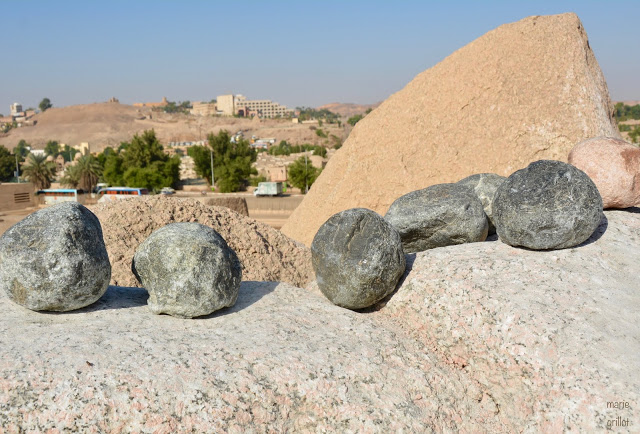
Dolerite balls made near the obelisk incomplete in one of Aswan granite quarries about 2 km south of the city, near the Fatimid cemetery
In “The Problem of the Obelisks”, “he explains the stages in the production of the obelisk in four points: – equalization of the upper layer of the block obtained by thermal shock; – use of Dolerite balls to equalize the surfaces; – drawing of the contours of the obelisk traced on the upper surface after levelling; – realization of the trench which surrounds it “.
He came to this staggering observation in particular: “We used neither scissors nor wedges to detach the obelisk from the quarry; the dolerite balls were the only tools used. In other words, the obelisk was not cut but excavated … Not only the sides but also the underside of the obelisk were detached by percussion. “
And finally, in “The Wonder of the Obelisk”, he summarizes all the knowledge acquired during his excavations.
If this obelisk did not illuminate a temple with its presence, it served many other functions. Thanks to Engelbach, he shed light on the “making” of his fellows. He also brought to our attention the excellent level of technicality enjoyed by tailors, and he always recalls the almost philosopher’s relationship that the ancient Egyptians had with stone…
He had always won though rather mentally and not physically! (in the background; cousin, and mother wash the dishes).
Yes, I dare! You, I mean some of you my friends here, who intensive were interested in me as an individual person, were much interested in my life story somehow, but to put it bluntly, as I am, somewhat, a humble person, it was very difficult for me to write about it, though, I have a memorial note with the same title on work.
But, what else!, I thought I begin here with you all (who interested of course) to tell my story;
A big head but remains raw for too long!
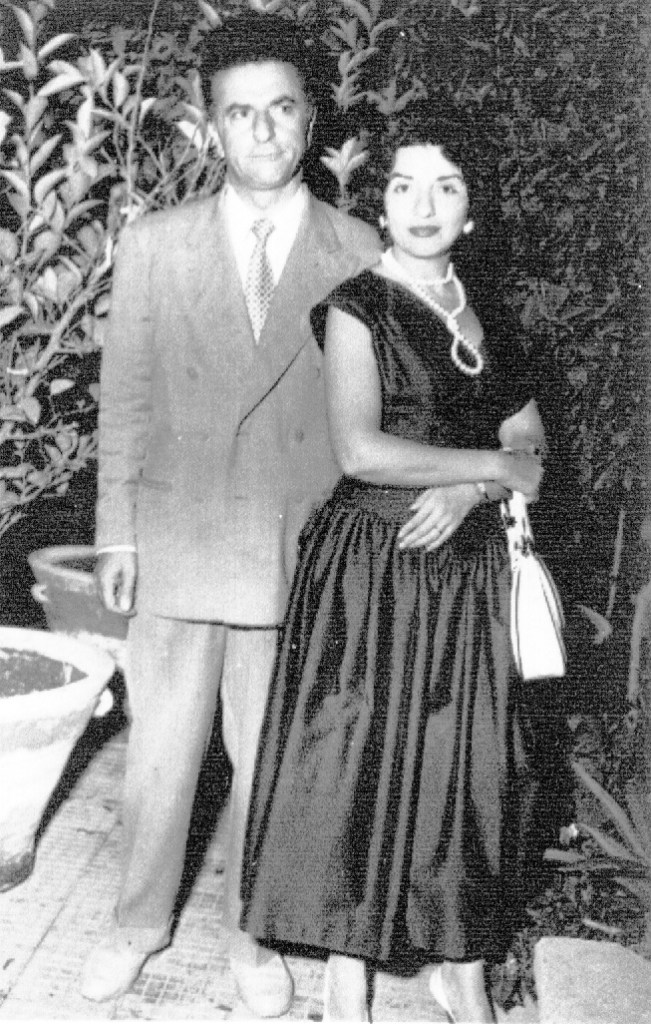
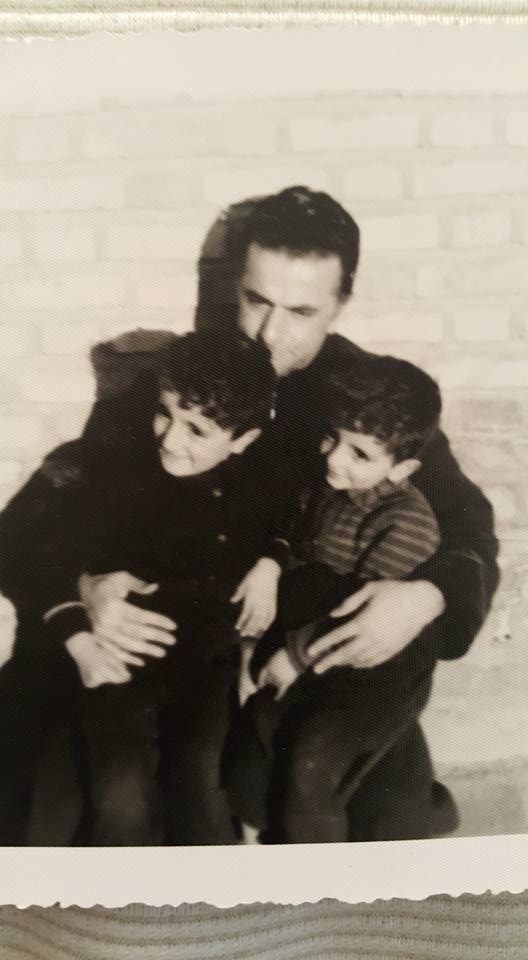
I have begun the story with the picture of me and my brother Al, no chance without him. He is a part or better to say; a huge part of my life… no doubt.
Okay, let’s begin with a daisy lazy vision in front of my tired old eyes and dig into my memory; I can see into a foggy scene a large yard and a big house in there we’re both born or may re-born.
I see at first, a gate for driving in and a veranda for parking lot and after you walked into the yard and passed a pool which rests between two big rose garden with some trees of peach and apples, you’d reach the main door to enter into the house.
I regret not to have a pic of my birthplace, I had it surely but it’s out of hand!
It sounds all big and great, of course, it was because of my father’s lucky goal after his success in publishing a book in which he had not only made a difference between Persians and Arabs way in their religion but also he put an old costume called Sufi’s with his translation or better to say a gathering of the quotes by the first Imam in Shiites; Ali. It was more a sanctify about Ali as an Imam, he made him as a legendary.
Therefore, he became famous in a night (I think it is a wish of every writer) though I am sure that he was not even religious; he was all in his life against mullahs and their teachings in the Mosque, he was never welcome there! that was his chance to hit the goal and did it.
Therefore, we were born in a big house with a big garden a great yard and rich building without any religious influences.
It is not easy to be born in a family with so many sensibilities, as an artist can have, I tell you, the children take it most!
I must end this part and look for the next, hopefully you too 😊 Be safe and have a nice WE🙏💖🙏
First I must say; Yes, I am at home! Because I have not a full-time job anymore but am a short-time worker. 😁
The reason why is that everything is in a still-stand or interruption modus as you’ve surely known it.
Anyway, today at nine o’clock the Spring has begun and in old Persian, it was and still is, the beginning of a new year, but I have put a question mark after the word “happy” that I think it might be really under a question while in these days it is hard to be.
Nevertheless, I gave the title also the Persian words; (translated) “New Year be Succeed” that is much fitter than” be happy” and could be a wish for the new one.
Then let me say;
Happy New Year to all #Persian allover Earth. Though it’d not be so happy as it’d be! somebody might say last years; what could be worse than this?! Now we see it can be worse!! But anyhow, stay strong and together (with distance😁 ) as we know; this too shall pass 😏Hoping for a better year 💖🙏
سال نو مبارک به همه #پارسیان روی کره زمین. گرچه آنقدر مبارک نمیتواند بود! ممکن است کسی سالهای گذشته بگفت؛ چی ممکنه بدتر از این پیش بیاد! حالا می بینیم که می تواند بدتر شود !! اما به هر حال ، قوی و در کنار هم باشید (با فاصله 😁). همانطور که می دانیم این نیز بگذرد 😏به امید سالی بهتر
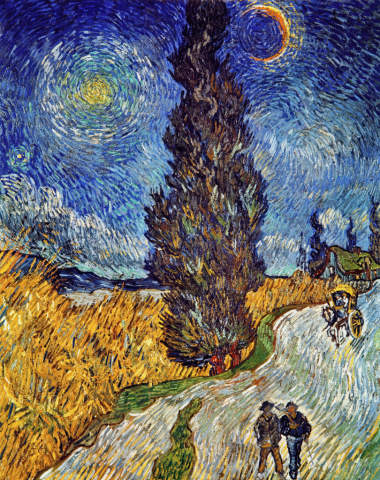
I think Vincent van Gogh, as he belongs to genius artists in this world, was one of the rare ones who had mostly suffered in his short life.
I might have a half-dozen art in me but as I have been among to a family of artists, I know how they suffer as ingrained artists and trying all in their life to bring out all these energies to create in the form of books, paintings or music etc.
Some months ago I saw in a TV magazine an announcement over this movie; Loving Vincent, and I have recorded it. But I had got barely time to watch it and almost forgotten. two days ago in the evening, my wife asked me if I still have kept the movie and could we watch it. Of course, I have responded!
This is an amazing product because it isn’t fixed on van Gogh personally, even it shows him almost as a third person. The most weight of the movie is on his suffer and in a fascinating form by his own works.
Now I understand What you tried to say to me And how you suffered for your sanity And how you tried to set them free They would not listen, they did not know how Perhaps they’ll listen now
To commemorate the 131st anniversary of the discovery of the tomb of Sennedjem (TT 1) at Deir El-Medineh, a conference was organized by the Ministry of Antiquities on Sunday, February 5, 2017, at the Mummification Museum in Luxor. The communications were made by Dr. Moustafa Waziri, director general of Antiquities of Louqsor, Dr. Moustafa el-Saghir, of the Department of Antiquities, Dr. Laurent Bavay, director of the French Institute of Oriental Archeology as well as Drs. Anne-Claire Salmas and Cédric Larchet, from the same Institute, and finally, John Shearman from the American Research Center in Egypt (ARCE). The interventions are unfortunately not available at the moment.
The scientific conference of February 5, 2017. On the left, some of the speakers: Laurent Bavay, Mostafa al-Saghir, Mostafa al-Wazery (photos Ayman Amer)
The village of Deir el-Medineh – then known as Set Maât (the “Place of Truth”) – was founded at the beginning of the 18th dynasty under the reign of Thutmosis Iᵉʳ, and then expanded and enlarged several times, especially under the reigns of Thutmosis III and early ramessids.
There lived, sheltered by high walls, the community of artisans who worked on the digging and decoration of the eternal dwellings of the Valley of the Kings and of the Valley of the Queens. He remained active until the reign of Ramesses XI.
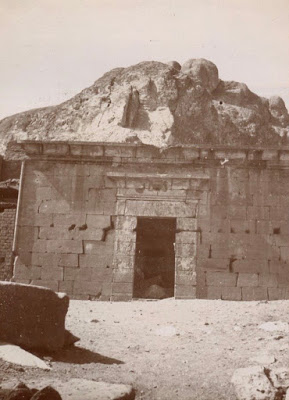
Ptolemaic temple of Deir el-Medineh in 1900
“Rediscovered” in the 19th century, he saw “scroll” many “researchers” then Egyptologists: Bernardino Drovetti, Henry Salt, Karl Richard Lepsius, Auguste Mariette, Gaston Maspero … Ernesto Schiaparelli will undertake excavations there in 1905, then the German Georg Christian Julius Möller. The site concession was then definitively awarded to Ifao in 1917; for thirty years, from 1922 to 1951, Bernard Bruyère methodically explored the site and made wonderful discoveries.
The Door to the tomb of Sennedjem Egyptian Museum in Cairo
The tomb of Sennedjem was discovered in January 1886 by ‘gournawis’. Indeed, “in 1886, Salam Abu Duhi, a villager from Gournah was granted a concession in an area of Deir el-Medineh close to his home. After only a few days of excavations, Salam and three of his friends made a spectacular discovery : at the bottom of a still unexplored burial well, they found a wooden door whose ancient seals were intact. Salam immediately informed Maspero, who happened to be in Luxor for his annual inspection visit. ” (Hidden treasures of Egypt, Zahi Hawass).
Gaston Maspero’s correspondence with his wife Louise (Gaston Maspero – Lettres d’Égypte) gives us the extraordinary adventure “live” … So the great Egyptologist wrote to him on February 2, 1886: “They come to get me to go to the mountain: a tomb that we have been working on for eight days has finally been opened. It is virgin! It is a tomb of the XXth dynasty: the wooden door is still in place, and we have already counted eleven mummies. is a big find. I probably won’t have time to write before the post boat leaves because I don’t think we can be back before ten o’clock. ”…
He continues his story on February 3: “The cellar is about 5 m long by 3 wide. It is vaulted, with a very low vault and painted in the most vivid colors; unfortunately, the paintings and texts are only extracts from the Book of the Dead. It was filled to the top with coffins and objects: eight adult mummies, two children’s mummies, a family of those cemetery priests I told you about in the letters I wrote from Turin in 1880 (?) The mummies are superb, of a beautiful red varnish with very neat representations, but they are only the least interesting part of the find.
sarcophagus of Khonsu, son of Sennedjem
You know that we carried the mummies to the tomb on sledges, carried by men or dragged by oxen. Our tomb contains two of these complete sledges: first the floor, with the rings intended to pass the sticks, when we wanted to carry, then the movable panels of the catafalque in which we locked the coffin, then the ledge cover … and it is how we will exhibit everything at the Boulaq Museum. Besides that, the complete furniture: eight large canopic jars, forty small boxes with funeral statuettes, a hundred charming limestone figurines, twenty painted earthenware vases, a new different bed for the shape of the first two … In addition, a beautiful armchair with a canvas background imitating the tapestry; two stools with canvas bottom imitating red leather, a folding chair, bouquets of flowers, a cubit, an ostracon containing a very curious, although very short, historical novel. Insinger and Toda photographed the magnesium chamber and will photograph some of the objects. “
Masks of the mummies of Sennedjem and his wife Egyptian Museum in Cairo
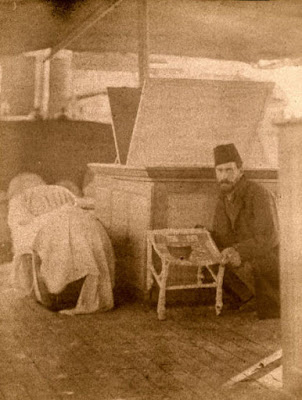
Jan Herman Insinger is a banker from the Netherlands who came to Luxor in order to benefit from a climate which can soothe his tuberculosis. Before having a castle built a little flashy on the edge of the Nile, he lives on board his dahabieh “Meermin” (the siren). He became close to Maspero and, during his inspections, offered him his services as a photographer. As for Eduard Toda I Güell, Consul General of Spain in Egypt from 1884 to 1886, real friendship and a relationship of trust linked him to Maspero, which led him to entrust him with important responsibilities within the archaeological mission. This is how he is at his side during the event which we relate and which is described by Jules Daressy as “one of the most interesting events in the history of excavations in Egypt”. Better still, the diplomat-archaeologist is entrusted, by the director of Antiquities called to another excavation site, with the “immediate responsibility” for clearing the tomb.
Box of oushebtis and oushebtis from the tomb of Sennedjem Met museum
It should be noted that, in the letter previously quoted, Gaston Maspero specifies: “It goes without saying that we bought from the fellahs the half that was due to them: it cost us 46 guineas. Once we have chosen all that is good for the museum, the sale of mummies and superfluous objects will bring us at least 60 guineas, maybe eighty who will go to the excavations of Luxor and the Sphinx. It will have been a good deal in all ways, good from a scientific point of view, since it gave us monuments of which we had no specimen, good from a financial point of view, since not only will the objects end up costing us nothing, but that we will have gained enough money for new excavations. “
Eduard Toda, with objects from the tomb of Sennedjem, on the boat “Boulaq”, en route to Cairo (1886) Toda Fund Library Víctor Balaguer Museum (Vilanova)
In the “Bulletin of the French Society of Egyptology” – 1988, Josep Padro reports: “In three days and with seven workers, (Toda) completely excavated the tomb and carried out the transfer of its contents on-board the ‘Boulaq’, the vessel of the Antiquities service. Once the transfer was completed, (he) drew up an inventory of the funeral furniture on the boat, with the objects collected and the mummies before his eyes. Toda also took 15 photos himself in the tomb, with the technical assistance of Insinger, which are engraved after the plates which illustrate his memoir; and he copied and translated the hieroglyphic texts, with the help of Bouriant. “
According to Bernard Bruyère: “Tomb No. 1 is not only one of the most beautiful and best-preserved in Thebes; but it is also a perfect, complete and typical example of a large family tomb comprising the four components regular, the courtyard and chapels accessible to the living, the well and the vault reserved for the dead. “
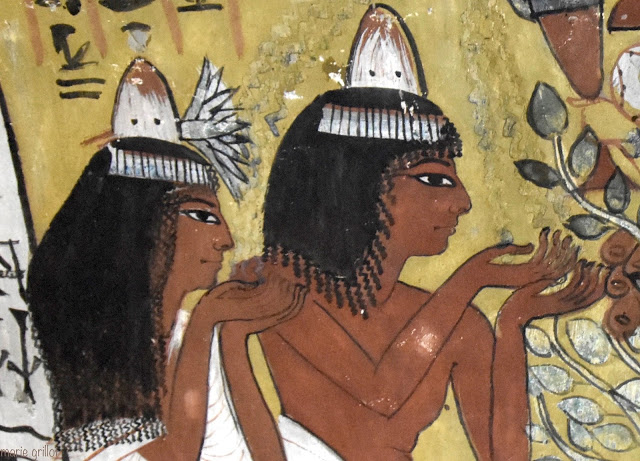
Sennedjem in adoration in front of Horus with the head of a falcon, followed by two of the four fis of Horus, Amsit and Hapy (Osirisnet.net)
The eternity home of Sennedjem is one of those open to the public in Deir el-Medineh: by the scenes and colours that cover its walls, his visit leaves an unforgettable memory!
Sources :
Gaston Maspero, “Lettres d’Égypte, Correspondance avec Louise Maspero”, Elisabeth David, Seuil, 2003
The title is a good question; I am not an interpreter as I have always wished to be. I can’t even remember my dreams in the latest years as I did in my youth.
Yes, the Master tells the truth. My brother Al had the talent of the interpretation, as one of my aunts; Rakhshi. When someone talked about her/his dream, they could analyse it so well that one could be agreed immediately.
Now I want to share here with you a great article by Dale M. Kushner MFA, who is founder of The Writer’s Place, a literary center in Madison, Wisconsin. She has an MFA in poetry from Vermont College and has served as poetry editor for The Journal of Pastoral Care & Counseling. http://dalemkushner.com/about/ It is much worthy to read.
Can Dreams Be Prophetic? How might you tell if your dreams are predicting something?
Posted Feb 28, 2020
Cover of the last issue of The Strange World of Your Dreams (1953) by Joe Simon and Jack Kirby Source: Prize Publcations/Public Domain
In September of 1913, Carl Jung, the great pioneer of depth psychology, was on a train in his homeland of Switzerland when he experienced a waking vision. Gazing out the window at the countryside, he saw Europe inundated by a devastating flood. The vision shocked and disturbed him. Two weeks later, on the same journey, the vision reoccurred. This time an inner voice told him: “Look at it well; it is wholly real and it will be so. You cannot doubt it.”
Years later, in his memoir, Memories, Dreams and Reflections, he recalls the event and his concern that he was having a psychotic break.
“I was suddenly seized by an overpowering vision: I saw a monstrous flood covering all the northern and low-lying lands between the North Sea and the Alps. When it came up to Switzerland I saw that the mountains grew higher and higher to protect our country. I realized that a frightful catastrophe was in progress. I saw the mighty yellow waves, the floating rubble of civilization, and the drowned bodies of uncounted thousands. Then the whole sea turned to blood.”
The following spring of 1914, he had three catastrophic dreams in which he saw Europe was deluged by ice, the vegetation was gone, and the land deserted by humans. Despite his awareness that the situation in Europe was “darkening,” he interpreted these dreams personally and feared he was going mad. However, by August of that year, his dreams and visions were affirmed: World War I had broken out.
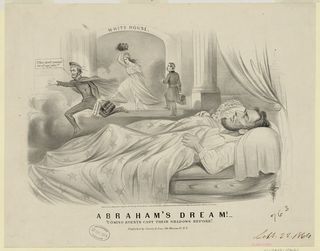
Some fifty years earlier, President Abraham Lincoln had a prophetic dream. Three days before he was assassinated, Lincoln conveyed his dream to his wife and a group of friends. Ward Hill Lamon, an attending companion, recorded the conversation.
“Abraham’s Dream! Coming Events Cast Their Shadow Before.” Lithograph by Currier & Ives (1864)Source: Library of Congress/Public Domain
“About ten days ago I retired very late. I had been up waiting for important dispatches from the front. I could not have been long in bed when I fell into a slumber, for I was weary. I soon began to dream. There seemed to be a death-like stillness about me. Think I heard subdued sobs, as if a number of people were weeping. I thought I left my bed and wandered downstairs. There the silence was broken by the same pitiful sobbing, but the mourners were invisible. I went from room to room; no living person was in sight, but the same mournful sounds of distress met me as I passed along. It was light in all the rooms; every object was familiar to me; but where were all the people who were grieving as if their hearts would break? I was puzzled and alarmed. What could be the meaning of all this? Determined to find the cause of a state of things so mysterious and so shocking, I kept on until I arrived at the East Room, which I entered. There I met with a sickening surprise. Before me was a catafalque, on which rested a corpse wrapped in funeral vestments. Around it were stationed soldiers who were acting as guards; and there was a throng of people, some gazing mournfully upon the corpse, whose face was covered, others weeping pitifully. ‘Who is dead in the White House?’ I demanded of one of the soldiers. ‘The President,’ was his answer; ‘he was killed by an assassin.’ Then came a loud burst of grief from the crowd, which woke me from my dream. I slept no more that night; and although it was only a dream, I have been strangely annoyed by it ever since.” (Recollections of Abraham Lincoln, 1847-1865 by Ward Hill Lamon, published 1911.)
Two weeks later, on April 14, 1865, Lincoln was assassinated by John Wilkes Booth. As in his dream, his casket was put on view in the East Room of the White House and guarded by soldiers.
These are two chilling examples of dreams that occurred during periods of collective crisis which accurately predicted historical turning points. Do prophetic dreams occur more often during turbulent times? How does the dreamer know if a dream is to be interpreted personally and symbolically or as a warning for others and the world at large?
I asked these questions to Dr. Murray Stein, a renowned author and Jungian analyst at the International School for Analytic Psychology in Zurich, Switzerland. Dr. Stein replied that he had no statistics on whether people have predictive dreams more frequently in times of crisis than at other times. In his experience, one can’t know if a dream is precognitive until after the event. After 9/11, he told me, people reported precognitive dreams that foretold the disaster. He said people also reported that dreams foretold the financial crisis of 2008, which he called, “a black swan event.” According to Investopedia:
“A black swan is an unpredictable event that is beyond what is normally expected of a situation and has potentially severe consequences. Black swan events are characterized by their extreme rarity, their severe impact, and the practice of explaining widespread failure to predict them as simple folly in hindsight.”
The recent outbreak of the coronavirus might be considered a black swan event, and perhaps we will soon hear about people who have had prophetic dreams of its manifestation.
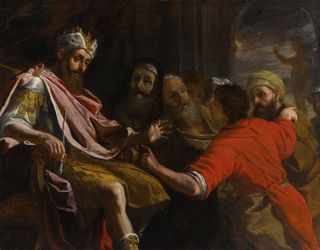
Daniel Interpreting Nebuchadnezzar’s Dream (c. 1670) by Mattia Preti (1613-1699)Source: Sothebys/Public Domain
While there is no simple answer or proven method to discern whether a dream should be interpreted personally or more broadly, we can go about exploring its contents with both aspects in mind. For example, if I have a dream in which I am a child who has been put into a cage. I might ask: What aspect of me feels “caged” right now? Noting that I am a child in the dream, I might further inquire: Is there something from my childhood that is still confining and constricting me? I might try to estimate the age of the child in the dream and reflect back to when I was that age and try to remember if something significant happened then. Maybe my parents had begun to think about divorce at that time and I felt caged by their emotions. I might then inquire if there is something similar going on in my life right now, not necessarily a divorce, but an imminent disruption or the loss of a treasured relationship. When we go back into a dream to amplify it, each question generates other questions that can lead to deeply buried insights. (For a more complete explanation of Jung’s use of amplification as a technique, please see Michael Vannoy Adams’ description on JungNewYork
But what if I dream that I am a child that has been put into a cage, and a few days later, I discover that children of immigrants are actually being held in cages in detention centers? My dream, while personally relevant, would carry a collective, or more public meaning, as well. This collective meaning of the dream attests to the interconnectedness of our species, to our capacity for empathy (we see a horror on the news and we feel it enter us) and to the common values we share about the quality of human life.
If we had lived during the early part of the last century, or in an Indigenous culture, or in ancient Mesopotamia, we might examine our dreams for deep wisdom and as augurs for the future. These days we are more likely to look to neuroscience to understand our dreams. Neurobiology tells us that sleep is a complex neural activity of the brain that stays busy activating and deactivating complicated neuro-systems while we doze, including consolidating memories, regulating mood, restoring immune function, and many other important utilitarian tasks. But neuroscience tells us nothing about the meaning of dreams or why our dreaming life has carried significance for humans since we first walked the planet.
Gilgamesh and Enkidu fight the Bull of Heaven. Gilgamesh cylinder seal, Assyria, c. 7th century BCE.Source: British Museum/Public Domain
About thirty thousand years ago, toward the end of the Paleolithic Era, our hunter-gather forebears descended into the subterranean darkness of caves to enact rituals of trance and dreaming. Recently, archaeologists and ethnographers have speculated that the artifacts found in the caves of southern Europe—bone flutes, whistles, and types of drums—and the now-famous discovery of cave wall paintings indicate that ancient shamans may have used these caves for ceremonial dream retreats (See in particular the work of David Lewis-Williams). We can speculate that the depictions of bison and large and small game along with scenes of hunting painted on the walls may reflect shamanic dream content. Perhaps the shaman ascended from his retreat having had visions about the abundance and location of prey, which would be crucial information for the clan.
Later human societies continued to transcribe their dreams. The oldest written dream recorded is in the Sumerian epic poem of Gilgamesh (2100 BCE). Not unlike King Nebuchadnezzar’s frightening dream in the Book of Daniel, Gilgamesh, the king of the Sumerian city Uruk, has violent nightmares about death, which shake him to the core and send him on his quest for immortality. But Gilgamesh cannot interpret his own dreams, and like many of the dreamers in the Old Testament, he is in need of an interpreter. How telling that from ancient times the one who receives the dream and the one who knows its significance are different people.
Nicholas Black Elk with his daughter Lucy Black Elk and wife Anna Brings White.Source: Wikimedia Commons, public domain
In some contemporary cultures, dreams are thought to be a way of receiving messages from the spirit world. A holy man or medicine woman, an elder or shaman is the receiver of the prophetic dream, which is given for the benefit of all and linked to the survival of the tribe or people. Black Elk, the holy medicine man of the Lakota Sioux, stated this when he said a dream is worthless unless it is shared with the tribe.
How can we relate to the dreams that pursue us? Are they simply the result of complex neurological activity and without real meaning, just as we know the moon is no enchanted sphere but a mere rock in space? What might we miss if we cast our lot with a viewpoint based wholly on the material world? Is it possible to consider the two worlds as being equally meaningful, the world of science and—to borrow the phrase John Keats used to characterize adventurers on the threshold of a new frontier—the world of “wild surmise”? Can we think of ourselves as vessels open to receiving wisdom through non-ordinary means? Can we be our own shamans?
I don’t know if you have ever think about it? I do! Maybe because of the age… or maybe because I have a lot of loose (death) in my small family that I just can hardly wait for my turn.
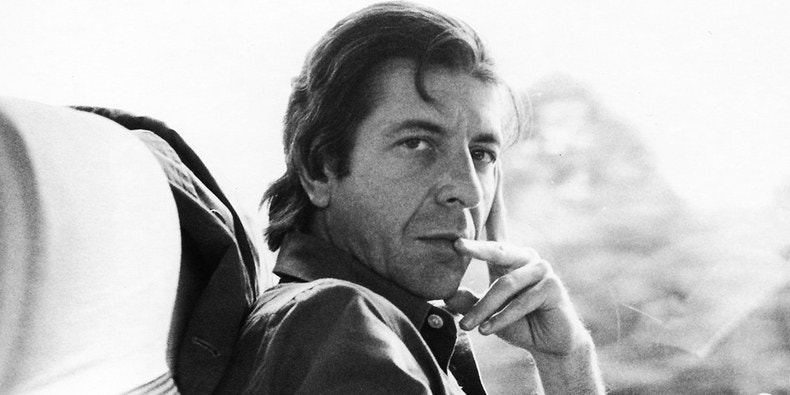
Sorry for not dying! He said; in one of his latest concerts. Yes, Leonard Cohen had a feeling of it. Mike Steeden – MIKE STEEDEN – surely can sing a perfect song on him and his life but I do it as well.
I don’t believe in life after death though, the whole energy which we still have, in my opinion, is a miracle, and would certainly do it’s best to survive!
First, we take Manhattan, then We take it All.
Now let’s again have a nice trip on the master to describe his thoughts on this unknown… position…
A month before Leonard Cohen died in November, 2016, The New Yorker‘s editor David Remnick traveled to the songwriter’s Los Angeles home for a lengthy interview in which Cohen looked both forward and back.
As a former Zen monk, he was also adept at inhabiting the present, one in which the shadow of death crept ever closer.
His former lover and muse, Marianne Ihlen, had succumbed to cancer earlier in the summer, two days after receiving a frank and loving email from Cohen:
Well, Marianne, it’s come to this time when we are really so old and our bodies are falling apart and I think I will follow you very soon. Know that I am so close behind you that if you stretch out your hand, I think you can reach mine. And you know that I’ve always loved you for your beauty and your wisdom, but I don’t need to say anything more about that because you know all about that. But now, I just want to wish you a very good journey. Goodbye old friend. Endless love, see you down the road.
The New Yorker has never shied from over-the-top physical descriptions. The courteous, highly verbal young poet, who’d evinced “a kind of Michael Corleone Before the Fall look, sloe-eyed, dark, a little hunched” was now very thin, but still handsome, with the handshake of “a courtly retired capo.”
In addition to an album, You Want It Darker, to promote, Cohen had a massive backlog of unpublished poems and unfinished lyrics to tend to before the sands of time ran out.
At 82, he seemed glad to have all his mental faculties and the support of a devoted personal assistant, several close friends and his two adult children, all of which allowed him to maintain his music and language-based workaholic habits.
Time, as he noted, provides a powerful incentive for finishing up, despite the challenges posed by the weakening flesh:
At a certain point, if you still have your marbles and are not faced with serious financial challenges, you have a chance to put your house in order. It’s a cliché, but it’s underestimated as an analgesic on all levels. Putting your house in order, if you can do it, is one of the most comforting activities, and the benefits of it are incalculable.
He had clearly made peace with the idea that some of his projects would go unfinished.
You can hear his fondness for one of them, a “sweet little song” that he recited from memory, eyes closed, in the animated interview excerpt, above:
Listen to the hummingbird
Whose wings you cannot see
Listen to the hummingbird
Don’t listen to me.
Listen to the butterfly
Whose days but number three
Listen to the butterfly
Don’t listen to me.
Listen to the mind of God
Which doesn’t need to be
Listen to the mind of God
Don’t listen to me.
These unfinished thoughts close out Cohen’s beautifully named posthumous album, Thanks for the Dance, scheduled for release later this month.
” To live means to be sick for a long time: I owe a bird to the saviour Asclepius.” Socrates.
No doubt I am a pessimist, but I’d never give up questioning! In all through my life, I was in the search of finding answers and with every step, I had to suffer more and my pain increased.
There I have understood that there is no knowledge without pain, but I am happy to suffer than be ignorant!
Now let’s read this wonderful post by SearchingTheMeaningOfLife about one of the greatest philosopher of all time by another greatest one. I try to translate from Greek. with thanks 🙏
The wisest people of all time have come to the same conclusion about life: it’s worth nothing … Everywhere and always one hears the same sound from their mouths – a sound full of doubt, of melancholy, of tiredness of life, of resistance to Zoe. Even Socrates said when he died: ” To live means to be sick for a long time: I owe a bird to the saviour Asclepius.” Even Socrates was tired of life. – But what does this prove? What does it mean?
Sometimes one would say (oh, it has been said, and even loudly, and especially by our pessimists!): “Something like that must be true! The Consensus Sapientium (consent of wise) indicates the truth. ” – Can we talk like that today? Should we talk like that? “Something like that must be sick,” we answer: we must scrutinize these wisest people of all time! Did they not get on their feet well? Were they late? deceivers? decadents; Does wisdom on earth appear as the crow that the odour draws from the crow?
This perverse thought that the great wise men are types of decadence was born in exactly one case where the prejudice of both intellectuals and others is very strong: I saw Socrates and Plato as symptoms of degeneration, as instruments of Greek disintegration, as Pseudo-Greeks, as anti-Greeks (Birth of Tragedy, 1872). This consensus sapientium – as time goes by I understand it better – does not prove at all that they were right in agreeing: it seems rather that they themselves, the wisest of men, were in some natural agreement and so they had – they had to take – the same negative attitude towards life. Judgments, judgments about life, for or against, can never be true: they only have value as symptoms, they deserve attention only as symptoms; We need to stretch our fingers and try to grasp this amazing finesse (finesse of character, refinement) that says he can not estimate the value of life. It cannot be appreciated by a living person because he is an interested party or an apple of contention rather than a judge – not even a dead man, for other reasons. Seeing a philosopher as a problem in the value of life is, therefore, an objection to himself, a question mark for his wisdom, a complete lack of wisdom. – How? And were all these great wise men not only decadents but also no wise men at all? – But I return to the Socrates problem.
By Socrates’ descent, he belonged to the lower people: he was a virtuous man. We know, we can still see, how ugly he was. But the ugliness, in itself, was a defect for the Greeks, almost a denial. So was or not Socrates Greek? Ugly is often the expression of a junction, a junction fractured by evolution. In other cases, it appears as a downward trend. Those who are anthropologists forensics tell us that the typical criminal is ugly: monstrum in front, monstrum in Animo (Animus). ” But the criminal is a decadent. Was Socrates a typical criminal? – At least that would not disprove the famous judgment of the physiognomist who so badly sounded at Socrates’ friends. A stranger who knew how to read physiognomy, he once passed through Athens and told Socrates how he was a monstrum – that he hid all the bad appetites and appetites within him. And Socrates simply replied, “You know me very well sir!”
The decline in Socrates is not only indicated by the admitted Achaemenidism and anarchy of his instincts, but also by the hypertrophy of logical ability and the malice of the militant that distinguishes him. Let us also not forget those acoustic hallucinations that, as a “demon of Socrates,” were interpreted religiously. Everything in it is overdone, buffo, caricature – at the same time everything is hidden, post-bulky, hypochondriac.
I try to understand what temperament gives this Socratic equation of rationality, virtue, and happiness: this equation the most curious of all, which has, in addition, all the instincts of the older Greeks against it.
With Socrates, Greek tastes turn to dialectics: so what exactly happened? First of all, a gentle taste was lost – with the dialectic the blade rises to the top. Before Socrates, dialectical ways were rejected by good society: they were considered bad ways, they were dangerous. They were warning young people about these ways. They also distrusted those who presented their arguments in such ways. Honest things, like honest people, do not offer their arguments manually. It is inappropriate to point at all five fingers. It is not worth much to prove it first. Everywhere where authenticity is still a part of good behaviour, wherever one develops arguments but gives orders, the dialectic is a kind of a jerk: they laugh at him, they don’t take him seriously. Socrates was the jerk who managed to take him seriously: so what happened then?
One only chooses dialectics when he has no other means. He knows that this causes distrust, that he is not very convincing. Nothing is easier to erase than the resonance of the dialect: it is demonstrated by the mere observation of each meeting that is being discussed. The dialectic can only be self-defence in the hands of those who no longer have any other weapons. One has to reinforce his law: once he succeeds, he no longer uses it. The Jews were dialectic for this reason Reineke Fuchs was dialectic: how? Was Socrates dialectical too?
Is Socrates’ irony an expression of rebellion? Disillusioned? Does he, as an oppressor, enjoy his own wilderness with the knives of his reasoning? Is he revenging the nobles whom he charmed? – As a dialectic one holds a ruthless tool in his hands; he can become a tyrant thereby endangering those he conquers. The dialectician leaves to his opponent the care to prove that he is not an idiot: he leaves the other angry and at the same time helpless. The dialectic renders his opponent’s intelligence invalid. – How? Is Socrates’ dialectic just a form of revenge?
I have given you an insight into how Socrates could be disliked: that is why it is now more than necessary to explain his charm. Here’s the first reason: he discovered a new kind of struggle and became his first teacher in the noble circles of Athens. He was fascinated by irritating the racing impetus of the Greeks – introduced a variation on the boxing match between young men and teenagers. Socrates was also great in eroticism.
Socrates, however, fought even harder. He looked behind his noble Athenians; he realized that his case, his temper, was no longer an exception. The same kind of degeneration was developing silently everywhere: old Athens had come to an end. – And Socrates understood that the whole world needed him – they needed his means, his healing, his own art of self-preservation … Everywhere the instincts were in anarchy; everywhere everyone was five steps from exaggeration: the monstrum in Animo was common danger. “The impulses want to become a tyrant we must find a stronger anti-tyrant” … When the physiognomist revealed to Socrates what it was – a cave full of bad appetites – the great ironic let another word that was key to his character escape. “This is true,” he said, “but I control them all.” How could Socrates become the master of himself? – In-depth his case was merely the extreme case, just the most striking example of what was beginning to become a common concern: no one was master of himself anymore, the instincts were turning against each other. Socrates was fascinated by the extreme case; his dreadful ugliness made it known to all eyes: it is obvious that he was still fascinated by the answer, the solution, the apparent cure for this case.
‘When one finds it necessary, as Socrates has done, to turn the rational into a tyrant, there is little risk that something else will become a tyrant. Then rationality was discovered as a saviour neither Socrates nor his “patients” were free to choose rationality: this became “de rigueur”, their last refuge. The fanaticism in which all Greek thought is cast into rationality betrays the existence of a hopeless situation; there was danger, there was only one choice: either to lose or to become unreasonably rational … Greek morality is pathologically defined, as is their appreciation of dialectics. The equation rational = virtue = happiness simply means: one has to imitate Socrates and permanently set against the dark appetites daylight – the daylight of the rational. One has to be in every way intelligent, clear, brilliant: every concession to instincts, to the unconscious, leads downwards …
I explained how Socrates was fascinated: he seemed to be a doctor, a saviour. Do we still need to point out the mistake he made in his belief in “rationality in every way”? Philosophers and moralists deceive themselves when they believe that they are free from decline by simply declaring war on it. Discharge is beyond their power: what they choose as a means, as salvation, is but another expression of decline – they change its expression but are not discharged from the decline itself. Socrates was a misunderstanding of the whole morality of improvement, including Christianity, was a misunderstanding … The most glaring daylight – rationality in every way life, brilliant, cold, careful, conscious, without instinct, contrary to the instincts – all this was just another illness, another illness, and no return to “virtue”, “health”, happiness … The obligation to fight instincts – this is the recipe for the decline: as long as life sustains one on the upward path, happiness is identified with esteem etc.
Didn’t Socrates, the smartest of all those who fooled themselves, realize this? Did he finally confess it in the wisdom of his courage before death? Oh, Socrates wanted to die: the Cone chose him and not Athens; he forced Athens to condemn him to death … “Socrates is not a doctor,” he said in silence: “here the doctor is only death … Socrates was just sick for a long time! “ (or of a long Life!)
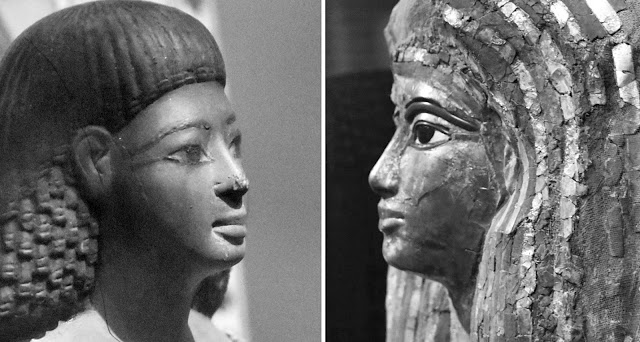
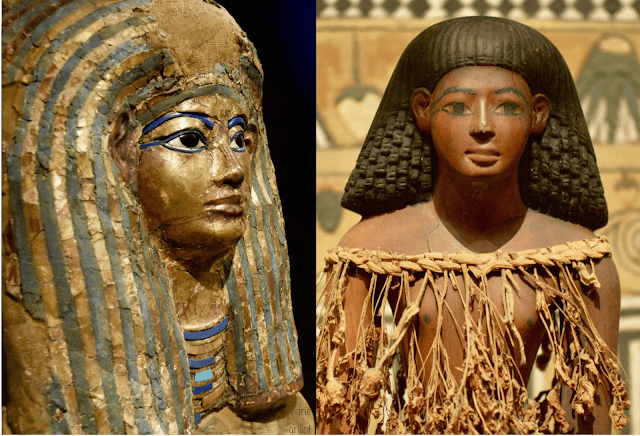
To the left statue of the architect Kha – Wood – Museo Egizio Turin – S 8335 Right, funeral mask of Merit, wife of Kha – Stucco golden – Museo Egizio Turin – S 8473 New Kingdom – Eighteenth Dynasty From their graves – TT 8 – Deir el-Medina discovered February 15, 1906 by the Italian Archaeological Mission headed by Ernesto Schiaparelli Photos Marie Grillot
We can surely never stop being amazed by this fantastic magical Egypt. And nowhere is another fabulous discovery to be stunned. With heartfelt thanks to Marie Grillot 🙏🧡🙏🧡
From 1903 to 1906, Ernesto Schiaparelli, at the head of the Italian archaeological mission, and his collaborator Francesco Ballerini, excavated in the Valley of the Queen’s necropolis of queens, princesses, princes of the New Empire. They will discover thirteen tombs, including those of the princes Amonherkhepshef and Khaemouaset which are open today to the public.
In 1905, they began excavations on the nearby site of Deir el-Medineh, the site “which presents the enormous interest of preserving important vestiges of the village and the graves of the workers who, in the New Empire, arranged the royal tombs in the Valley of the Kings and that of the Queen’s”.
“Set Maat her imenty Waset” – the “Place of Truth to the west of Thebes” of antiquity today is called artisans’ village of Deir el-Medina (photo Marie Grillot)
Founded at the beginning of the 18th dynasty under the reign of Thutmosis Iᵉʳ, then extended and enlarged several times, notably under the reigns of Thutmosis III and the first Ramessides, “Set Maât her imenty Ouaset” (the “Place of Truth in the West of Thebes “) was surrounded by high walls. For almost 500 years, “between 40 to 120 households” lived there in stone houses covered with a palm leaf roof, also have places of worship and a necropolis. The community members were mainly architects, scribes, painters, sculptors, ordinary workers, …
When the Italian mission arrives, it decides to conduct large-scale excavations, employing up to 250 workers! Schiaparelli first explores the northern part of the necropolis: he discovers there the chapel of the tomb of Maia, painter of the end of the 18th dynasty (after the reign of Akhenaten, around 1330-1320 BC). ).
On 15 February 1906, the Italian Archaeological Mission headed by Ernesto Schiaparelli discovered at Deir el-Medina, the tomb inviolate the architect Kha and his wife Merit (TT 8)
It is on February 15, 1906, after a month of intense work that is discovered “in the northern circus of the necropolis of Deir el-Medina, the untouched tomb of Kha”. If the mud-brick chapel of Kha was already known, it was a great surprise that the tomb was found “in the isolated cliffs which surround the village and not in the immediate vicinity of the chapel, as was usually the case”.
Sensing an important discovery, the Italian mission takes care to prevent the service of antiquities… Arthur Edward Pearse Brome Weigall was appointed shortly before by Gaston Maspero to replace Howard Carter as chief inspector of antiquities, responsible for the protection and the management of the antiquities of Upper Egypt. Based in Luxor, he will oversee the extraordinary event.
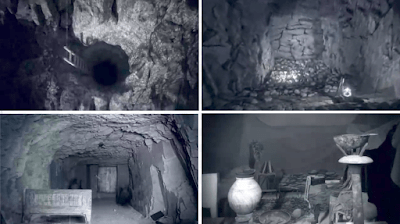
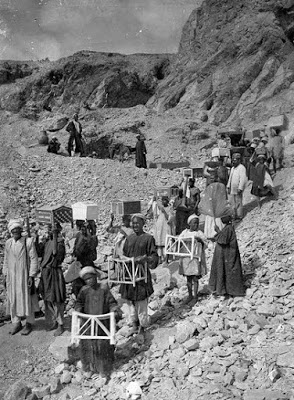
Different phases of the discovery of the tomb of Kha – TT 8 – Deir el-Medina updated February 15, 1906 by the Italian Archaeological Mission headed by Ernesto Schiaparelli
Photos from the film “A Torino per rivivere the scoperta della fell di Kha” (link at end of article)
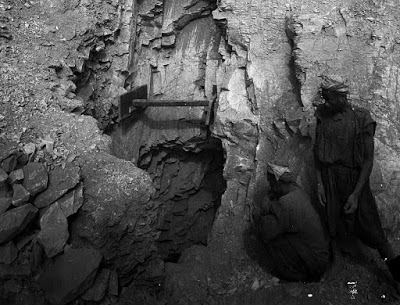
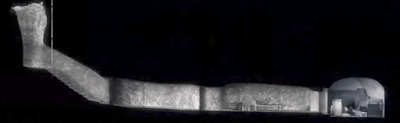
Here is part of his story: “We reached the entrance to the tomb by descending a flight of steep and steep steps, cluttered with debris. At the end of this entrance, we arrived on a passage oriented towards the hill which was blocked by a wall of large stones. After taking photographs and removing the stones, we found ourselves in a tunnel, long and low, then blocked by a second wall which was a few meters in front of us… These two walls being intact, we realized that we were about to see what no living man had ever seen before … “
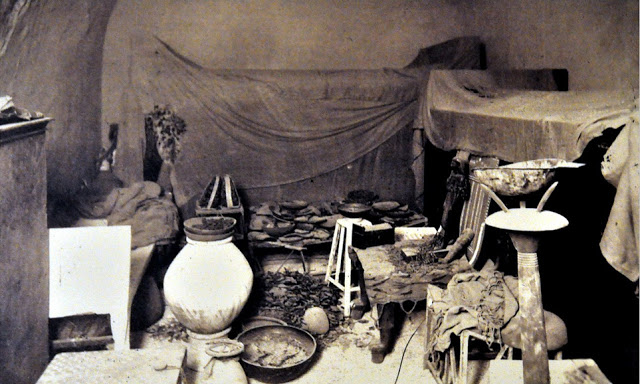
Inviolate tomb of Kha and Merit when discovered February 15, 1906 by the Italian Archaeological Mission headed by Ernesto Schiaparelli TT 8 – Deir el-Medina
Even if they expect to discover wonders, what is offered to them after opening the door takes their breath away … “All of the funeral equipment was perfectly ordered and positioned. The main elements were covered with dust that had solidified. The floor was carefully swept by the last to leave the place. A lamppost with a wooden papyrus column supporting a saucer made of copper alloy still contained the ashes of its last flames… The tomb and its contents reflected the personal wealth of the owners, their special position in society and the history of their lives. It suggested the vision of a prosperous house from the 18th dynasty, as “packaged” to be reused in the afterlife. “
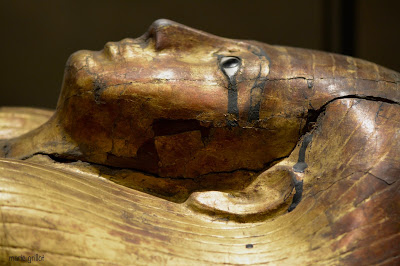
There is no doubt that the architect Kha, “director of works”, and his wife Mérit were, during their lifetime, eminent figures!”A tomb of such magnificence must have taken years of preparation, a process that Kha certainly oversaw in person while he was still alive.”It turned out that his dear wife Mérit lost her life before him. “The afflicted widower then assigned him his own sarcophagus.”
Coffin Merit – Museo Egizio Turin From the Tomb of Kha and Merit – TT 8 – Deir el-Medina discovered February 15, 1906 by the Italian Archaeological Mission headed by Ernesto Schiaparelli Photo Marie Grillot
In addition to the two coffins of Merit, and the three coffins of Kha – placed one inside the other – the tomb will deliver clothes, household linen, the instruments and tools of work of Kha, the toilet boxes, as well as the Merit wig, as well as its work-box…
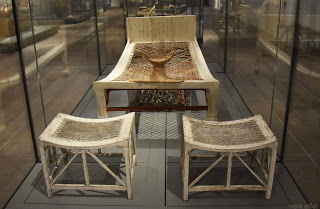
Some pieces of furniture of Kha and Merit From their graves – TT 8 – Deir el-Medina discovered February 15, 1906 by the Italian Archaeological Mission headed by Ernesto Schiaparelli Museo Egizio – Turin – Photo Marie Grillot
It is also a whole pantry for the afterlife which is revealed, thus providing important information on the food of the time: pieces of bread of different shapes, dishes of food, bags of ropes containing the doum palm fruits, a moving dish of carob compote, onions, salt blocks…
Food for eternity Kha and Merit From their graves – TT 8 – Deir el-Medina discovered February 15, 1906 by the Italian Archaeological Mission headed by Ernesto Schiaparelli Photo Marie Grillot
There is no shortage of dishes, as well as magnificent jars for storing liquids.
The senet game of Kha is particularly moving: in this context of the tomb, “the senet game was terribly serious because according to chapter XVII of the Book of the dead, the winner of the game came out like a living Ba spirit. “
The long list of the contents of the tomb cannot be exhaustive.
Right, funeral mask of Merit, wife of Kha – Stucco golden – Museo Egizio Turin – S 8473 To the left statue of the architect Kha – Wood – Museo Egizio Turin – S. 8335 New Kingdom – Eighteenth Dynasty From their graves – TT 8 – Deir el-Medina discovered February 15, 1906 by the Italian Archaeological Mission headed by Ernesto Schiaparelli Photos Marie Grillot
But it would be unforgivable not to mention three particularly touching pieces: the magnificent funerary mask of Merit, the lovely wooden statuette of Kha, as well as the papyrus from the Book of the Dead which takes place over 13 meters!
Artifacts exiting the tomb of Kha and Merit – TT 8 – Der el-Medina Discovery February 15, 1906 by the Italian Archaeological Mission headed by Ernesto Schiaparelli
The funeral treasure of Kha and Merit then takes the path to the Egyptian Museum in Turin, directed by Ernesto Schiaparelli since 1894.
Since then, it has never ceased to delight, to amaze and marvel the thousands of visitors.
A new museography space, perfectly studied, was dedicated to it in 2015. Enriched with photographic testimonies which relate the discovery, it is now fully highlighted.

























 lampmagician
You must be logged in to post a comment.