Heraclitus says: People are forgotten about their awakening and they are indifferent to what is happening around them, as in their sleep. Fools, though they hear it, are like the deaf. The adage matches that even if they are present, they are missing. No one should talk or act like he is asleep. One common thing is the world for the wake-up. The sleeping people live in their own world. Everything we see when we are awake is death and everything we see in our sleep is a dream.
[Extract from the book “Heraclitus: About Man” by Papadis I. Dim.)
Before I begin this post, I need to include a few disclaimers:
First, the Spanish Conquistadors were very effective in destroying Meso-American culture. Now, there were sympathetic Spaniards, often times clergy, who helped preserve the handful of codices (manuscripts) that have survived. However, far more was lost than was retained, which makes understanding Olmec, Mayan, Aztec and other pre-Columbian cultures as much an act of reconstruction as it is one of recovery. In other words, there’s a lot of educated guess work, and filling in of blanks.
This means that finding the original, definitive story, or what is sometimes called the ur-myth, is a difficult task at best. What scholars have found is often contradictory; my attempt here is tell an engaging story, based on the most prevalent versions of these myths. Any faults of omission or commission are mine.
The other disclaimer is that this tale is unapologetic in…
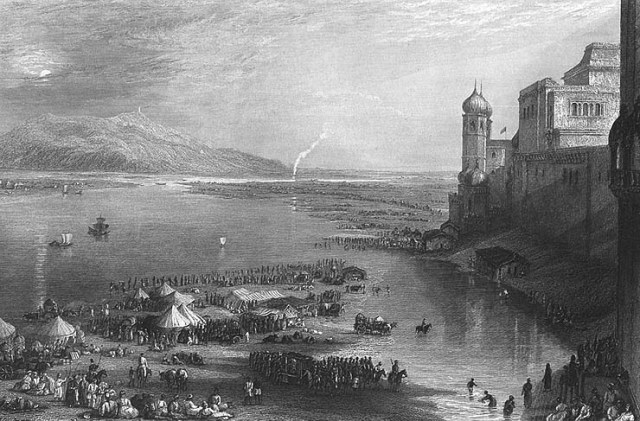
“I do not know much about gods, but I think that the river is a strong brown god,” so begins the third of T.S. Eliot’s Four Quartets. The divinity of rivers has been recognized by all mythologies since the beginning of time. For the Egyptians, the androgynous god Hapi personified the Nile and was called the Lord of the River Bringing Vegetation. In Hinduism the river is the goddess Ganga – she is the spout of water rising from Shiva’s hair. The Kumbh Mela, the largest religious gathering in the world (over 120 million people), is held in four locations along the Ganges. The belief is that at these spots Vishnu spilt nectar of immortality from an urn, or kumbh. It was written in the Puranas: “Those who bathe in the bright waters of the Ganga where they meet the dark waters of the Yamuna during the month of Magh [roughly January/February] will not be reborn, even in thousands of years.”(quoted after The Guardian). The dates of celebrations are calculated according to the zodiacal positions of the Sun, the Moon and Jupiter. The incredible photos can be viewed here. Similarly, death and rebirth were also associated with rivers in Christian faith. Early Christians were baptized by total immersion in rivers, while in Judaism immersion is used as a rite of passage for converts.
Ganga and Shiva
Looking at the photos from India, one has to marvel at the symbolic power of the river, which stands for life itself, constantly changing, passing, flowing, moving forward, and yet somehow remaining the same – changing in time and timeless at the same time. Looking at a river, it is natural to fall into reverie and be transported to the other side of reality, like the dead were transported in Charon’s boat across the Styx.
John Roddam Spencer Stanhope, “Charon and Psyche”
William Wordsworth thus begins Book 9 of The Prelude:
“Even as a river,—partly (it might seem) Yielding to old remembrances, and swayed In part by fear to shape a way direct, That would engulf him soon in the ravenous sea— Turns, and will measure back his course, far back, Seeking the very regions which he crossed In his first outset; so have we, my Friend! Turned and returned with intricate delay.”
Wordsworth’s words made me think of the famous Panta Rhei – yes, everything flows, but sometimes, like the river, we also meander, retracing our steps, revisiting the past, returning to the source.
Sebastião Salgado, the Eastern Part of the Brooks Range, Arctic National Wildlife Refuge, Alaska, USA,
In a famous photo by Sebastião Salgado, the river’s source is bathed in supernatural light. The first streams that will become the mighty river first quietly percolate among the lofty mountain peaks, hidden from view and growing in power. Origins of great civilizations are invariably bound to rivers. According to the Genesis story, there were four rivers that flowed out of Eden. As C.G. Jung explained in Mysterium Coniunctionis (par. 276):
“…because it was the abode of the originally androgynous Primordial Man (Adam), the Garden of Eden was a favourite mandala in Christian iconography, and is therefore a symbol of totality and—from the psychological point of view—of the self.”
A Turkish carpet depicting a walled garden with the Four Rivers of Paradise in the Museum of Islamic Arts, Istanbul
It seems that the combination of masculine and feminine characteristics informs the symbolism of rivers in many spiritual traditions. On the Theosophy Trust website the author draws attention to the etymology of the word:
”The name ‘river’ comes from rivus or rive, indicating ‘a splitting asunder,’ a process not only recorded in geological history but in mythology as well. For if the river literally divides the earth and creates the canyon depths, symbolically it divides the world of the living from that of the dead.”
Hence the ambivalence of the symbol – the river brings life but also reminds us of change leading to death. In his seminal work “Fundamental Symbols: The Universal Language of Sacred Science” Rene Guenon relates the Pilgrim’s Way to the symbolic river of life and death:
“The journey can be accomplished either by going upstream towards the source of the waters, or by crossing over the waters to the other shore, or by going downstream towards the sea.”
He then proceeds to discuss each type of symbolism. In the case of going upstream, the river is identical with the World Axis. The celestial river such as Ganga descends to the world from celestial realms; in this way “the influences of the ‘world above’ are transmitted to the ‘world below’.” The four rivers of Paradise had their source at the foot of the World Tree, which itself is synonymous with the World Axis that links heaven and earth. These four rivers “spread the celestial influences” that concentrated at the source into the whole world.
When it comes to the symbolism of crossing the river, it is conceived either as an important transformation or transition in life, as death, as mentioned before, or as reaching Nirvana (“Gone, gone, gone all the way over, everyone gone to the other shore, enlightenment, hail!” – as the famous last words of the Heart Sutra translate). Guenon also compares descending with the current of the river towards the ocean as a journey towards Enlightenment. In The Book of Symbols, edited by Ami Ronnberg and published by ARAS, I found a passage from The Upanishads, which seems to enrich the symbolism of floating down the river of life:
“As a great fish travels along both banks, the nearer and the farther, even so a person travels along both states, the dream state and the waking state.”
The river seems to be an all-encompassing symbol, including life and death, wakefulness and sleep, language and silence, the upper world and the lower world, time and eternity, since everything, which lives and dies “partakes of the quality of riverness,” as The Book of Symbols summarizes.
James Abbott McNeill Whistler, “Nocturne; Blue and Silver – Chelsea” James Whistler, “Nocturne; Blue and Silver – Cremorne Lights”
Carl Jung wrote of the psyche as that aspect of each of us which incorporates the conscious, the unconscious and also the collective unconscious – that realm beyond our individual self, the realm of the archetypal.
That is one of his many topics which we can learn from; though, some people, as I noticed now and then, make mistake with the word: Collective, and think that Dr Jung meant the whole human has a one with a common Consciousness/Unconsciousness; but it is wrong!
He actually speaks about the Individual and somehow: I, Me, Mine, with the whole history behind me. There again his topic with the “Synchronicity” shows us the connections between two Individuals and the chemy inbetween.
Here is a wonderful explanation which hit my heart and soul when I read this: With a great Thank to my friend and master Craig Nelson 🙏 ❤
The collective unconscious is “the world of water’.. “It is the world of water, where all life floats in suspension; where the realm of the sympathetic system, the soul of everything living, begins; where I am indivisibly this and that; where I experience the Other in myself and the Other-than-myself experiences me. […] The unconscious no sooner touches us than we are it –we become unconscious of ourselves. That is the age-old danger, instinctively known and feared by primitive man, who himself stands so very close to this pleroma.” CGJ, CW9,parar 45-47
It’s always interesting for me to know how similar is the Mythology between the East and the West, as a matter of Indo-European culture 🙂 #Mythology #Irland #Culture
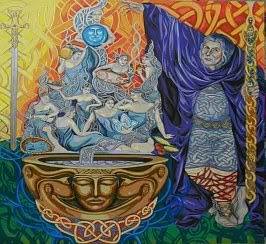
According to Irish mythology the Dagda represent the High Priest Druid class. They were from the tribe of the Tuatha de Danaan. He was linked to druidry, agriculture, magic, fertility, strength and wisdom. Legend has it he had governance over the weather, crops life and death as well as seasons and time.
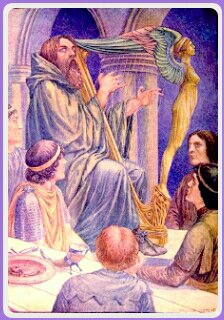
He was a large burly bearded man wearing a hooded cloak carrying a magic Shillelagh Batathat can slay a person on one end and bestow life on the other end. Dagda owns a large cauldron one of the 4 treasures of the Tuatha de Danaan called core ansic that continually replenishes itself with tasty food. His magic harp or Uaithne was dubbed Daur da Bláo it dictates a person’s emotions and transitions the seasons. His homestead is in Brú na Bóinne (Newgrange) where he dwells with his partners the Morrigan and Boann.
Gave, once, her flowers to love, her ways to roam;
A body of England’s, breathing English air,
Washed by the rivers, blest by suns of home.
And think, this heart, all evil shed away,
A pulse in the eternal mind, no less
Gives somewhere back the thoughts by England given;
Her sights and sounds; dreams happy as her day;
And laughter, learnt of friends; and gentleness,
In hearts at peace, under an English heaven.
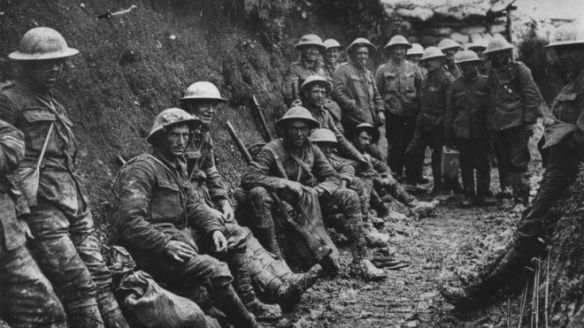
“If I should die” …. a thought that must have crossed the minds of soldiers several times. Fear, sense of loss, homesickness are the common feelings that follow that painful moment of awareness…
Good Lord, I’m quite taken aback. My latest book has only just this minute been listed on Amazon and look at all these fabulous reviews and messages I’ve received from the fabled and the famous. These are just a mere sample.
Marilyn Monroe: “I can’t thank you enough, Michael. It’s about time the truth was told. Yes, to my shame my life was blighted by flatulence, although in fairness such gusts of malodorous wind emanating from my BTM did ensure me iconic status when I released a smelly humdinger of colossal proportions and as a result my little white dress blew up while I was standing over an ineffectual subway grate in New York on the set of ‘The Seven Year Itch’ movie. I can’t thank you enough for including the tale of my dire plight when writing this book, a frankly outstanding piece of modern English literature.”
By my one of very worthy friend; SearchingTheMeaningOfLife (I’d hope I’d be recognized and confirmed 🙂 )
I’m born in the time of “Radio Day’s” as Woody Allen might call it, in that time in which there wasn’t TV and the only general communication was the radio in that times. Therefore, I’ve got a whole experiences to listen to the radio and the young friends might not believe it, it was a fascinating experience. it had helped me to learn to imaginate.
Anyway, when I was young and still listening to radio, there were a many theatre plays in it, you might not believe but those days there were writers for the Radio Piece. Theater in the radio, and they were wonderful acts happened: one of them it was written by a very famous writer (that I have unfortunately forgotten his name) about the wandering souls, our souls which go to nowhere land and waiting for the nxt act. there were four souls who met each others and sat and talked in the waitings time, and in between, they began to like each others, two men and two women.
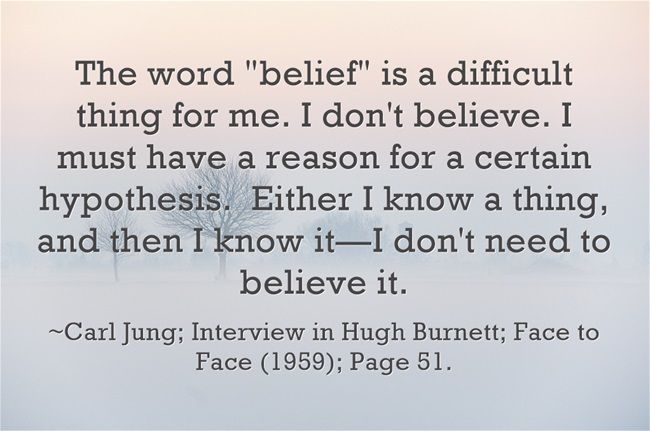
one of the men said that he’d know that they’d all go into the new life on the Earth, the have begun to definite and wish how they could be in this new phase, they have liked each other in this very short time and they’d hope to get a nice life on the Earth in the new life, but exactly, at the time of reincarnation, they find out that they will have a tragic life; It’d mean that they married in pair and one of the men felt in love with the other’s wife and at the end there in murder! very sad story anyhow, there’s not a matter of believe in or not, C. G. Jung once said: I don’t believe in what I don’t really know about it. the main thing is that we all as humans when the time comes and we died, there will be something that’d surely remains, if we are here on this Earth to get through an examination as Graham Hancock once stated.
Anyway, it’s a highly recommended issue here to read and spend a thought on it.
“We come from a dark abyss, we end up in a dark abyss: in the bright space we call it Zoe. As soon as we are born, the return begins. At the same time the beginning and the return. Every moment we die. This is why many have said: The purpose of life is death. But as soon as we are born, the effort to create, to compose, to make the matter of life begins. Every moment we are born. That’s why many have said: “The purpose of ephemeral life is immortality”
Assketika N. Kazantzakis
Life and death are the two sides-poles of the same coin, THE LIFE, as the ancient wise men said. We, as lovers of wisdom, suffice to accept their views in order to realize the very course of evolution.
But what is death? Is there something after the end of earthly life? Why are we born? Who we are; Where do we go from and where do we go?
All of the above questions call philosophy, religions in their essence, and the very science of psychology to answer.
Let’s try to unroll the skein. Let’s take things in a row.
“Death, in my opinion, is nothing but the separation of two things that were previously united. Of soul and body, “said Uncle Plato.
All ancient peoples, Sumerians, American Indians, Egyptians, Indians, Chinese, Japanese, and Greeks believed in reincarnation. Large personalities such as Pythagoras, Plato, Aristotle, Confucius Lao Tse, Buddha and more modern, such as Nietzsche, Schopenhauer and others have confirmed this old theory.
Reincarnation, then, is a very old teaching, which shows us the succession of life and death in human existence. Before proceeding, let us meditate by observing the nature itself, which teaches us the existence of circles … Each new spring succeeds in the winter … every new day at night … Man, as an integral part of nature, participates in his rhythms and, following them rhythms, lives, dies and resuscitates in this world.
Reincarnation teaches us that the human soul, or spiritual energy, changes body. It changes physical presence every time and so lives various lives in the flow of evolution. Moreover, the very purpose of the Reincarnation Law is to perfect the being. Through the successive reincarnations, the human spirit is perfected, acquiring the necessary experience and knowledge, and thus rising more and more to the source of the spiritual light from which it originated.
But what is it that is unchanging, reincarnated, and what is it that changes with every life? Again, we will turn to the depths of antiquity, collecting all these elements that humanity has inherited. Thus, the inner traditions impart that man, as an evolving being, has an Eternal and indestructible part of Heavenly origin, the Spirit, or the Ego, and another perishable, moral and earthly part, subject to changes in life. This second part we call it personality (does the word “persona” do not mean the mask of the ancient Greeks? Remember the masks that Khalil Gibran mentions in his work “the madman”). So the ancient wise men were saying that man consists of a perishable personality, which is quadruple, with four “masks” of material substance and an immortal spirit, which does not wear out if it is not material. The Ego or the Self of the ancient Greeks (remember again the delphic saying “know him” that reminds us to know our true self beyond the “masks”).
So we said that what the traditions say is reincarnated is the Spirit, which each time acquires a new personality (or else changes the worn-out clothes, as Krishna tells Arjuna in Bhagavad Gita, a project of great importance to the Indians ) that will allow him through his own life to acquire new experiences, knowledge and experiences, which will enrich and will help to develop the consciousness of the individual ego.
Every personality (which is to say that it includes our physical body, our vital energy, our emotions and the subjective mind) in every life has a certain duration. Sometime he is born and sometime he dies. So the soul “rises” into another world, in another dimension. In the east, this dimension is called Devachan and can be paralleled with Paradise, the Chalices of the Ancient Greeks, the Valhalla of the Scandinavian, the Egyptian Emperor … There the human entity spends a certain period of resting and processing everything learned from ” school of life “until it is forced to” rewind “(I go up and down is relative, but these meanings have always been used, which suggest the passage from one dimension to another) on the earth, in the material world,
In general this describes the process of reincarnation. Whether there are several “levels” in which souls are sent or else gone (Dante described these spaces as multi-storey universes) is a very big issue.
Moreover:
“Birth is sleep, forgetfulness
and the soul within us is born,
the star of life but the brilliant,
else he has gone to set,
and its east is elsewhere.
Not even naked,
Not completely into oblivion,
we are born into this life,
but like wind clouds,
sent from God, our first source. ”
“Feelings of Immortality Through the Reminders of Childhood”
William Gordworth
Following those who have realized all of the above we understand:
“My children, death and birth,
a pain of heart and sweetness,
one I leave it, and I come,
one hello and I found it well. ”
“Report to Greco” N. Kazantzakis.
BIBLIOGRAPHY
• KARMA, ANNIE BESANT, THESSALONIKI PUBLICATIONS
• ASKITIKI, N. KAZANTZAKIS, EDITIONS E. KAZANTZAKIS
• REFERENCE TO GREKO, N. KAZANTZAKIS, EDITIONS E. KAZANTZAKIS
• METENSARKOSIS, IRVING S. COOPER, THEOSPHIC EDITIONS
• CHOOSE CHILDREN IN NEW ACROPOLIS, GA PLANAS, NEW ACROPOLIS ISSUES
• THE 3 CENTERS OF THE MYSTERY, GA PLANAS, PUBLICATIONS NEW ACROPOLIS
LIFE AFTER LIFE, CAROL NEIMAN & EMILY GOLDMAN, EASTERN EDITIONS
• THE SILENT TEACHING OF PLATON, SAVVAS PATTAKOS, PUBLISHING NEW ACROPOLIS











 lampmagician
You must be logged in to post a comment.