
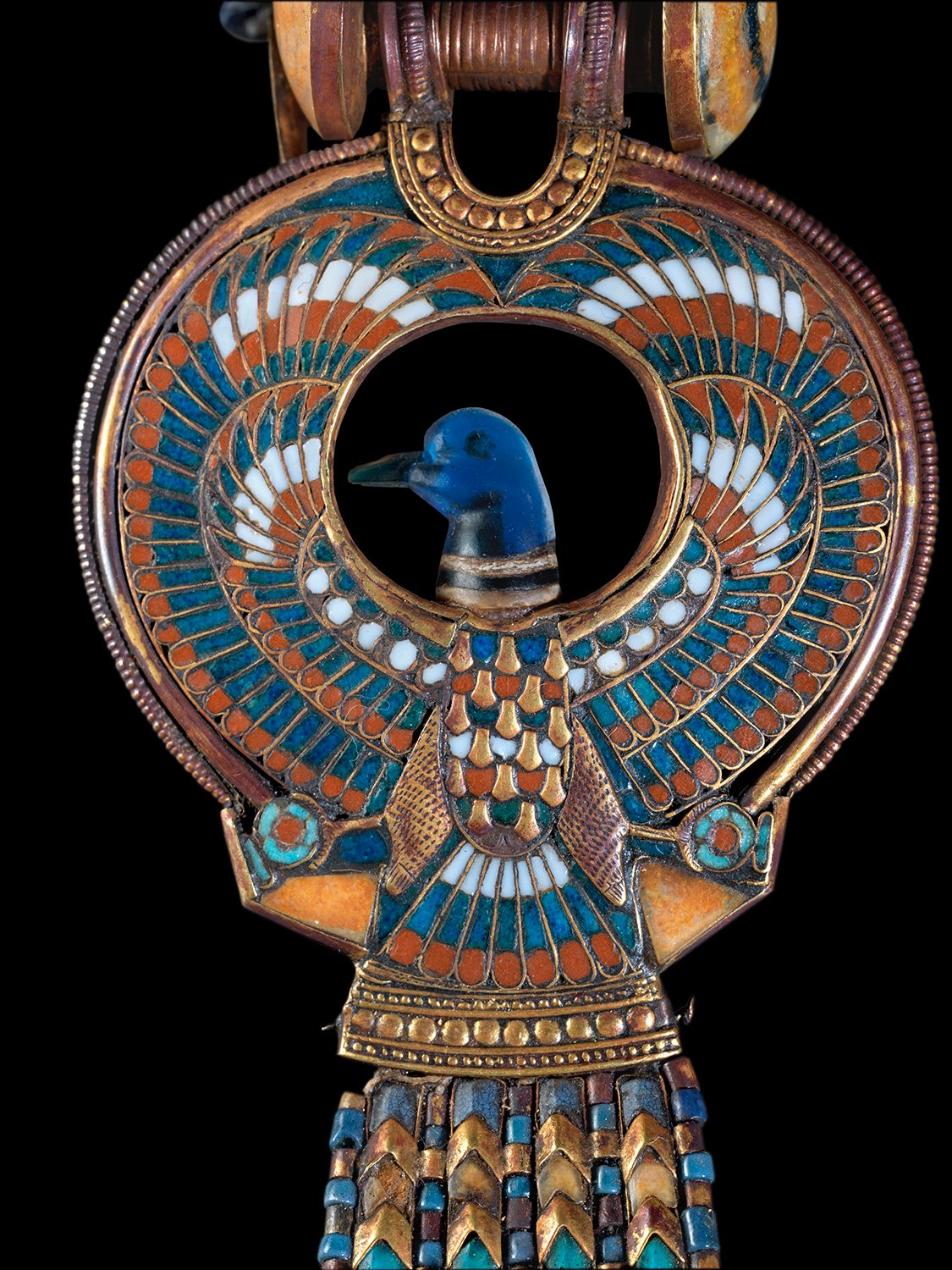
These earrings are the most striking of the four pairs found in Tutankhamun’s tomb. The ducks with outstretched wings create a circular shape, and their feet hold the shen symbol. The head is made of translucent blue glass, while the wing is crafted in cloisonné.

Hanging below the duck are gold and blue glass beads, each featuring five uraei (rearing cobras). The earrings show a high level of aesthetic sophistication, and the duck held a particular erotic significance.
Let’s appreciate and enjoy Marie Grillot‘s vivid portrayal of this captivating divine gem.
(It’s clear I am not happy about naming a character in this article, but I am committed to getting the translation right; just to mention!)
Tutankhamun’s Blue Bird Earrings
via égyptophile
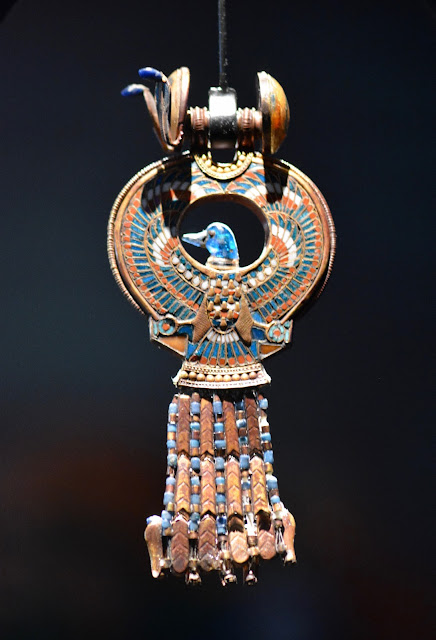
From the treasure chamber of Tutankhamun’s tomb, discovered in November 1922
by Lord Carnarvon and Howard Carter in the Valley of the Kings (KV 62)
Ref.: Carter 269a(1) – JE 61969-a – GEM 485
These “bluebird earrings,” as Christiane Desroches Noblecourt aptly called them, and these “gold-encrusted earrings in the shape of an ousekh necklace with a blue glass falcon,” as Zahi Hawass describes them, are one of five pairs found in Tutankhamun’s treasure.
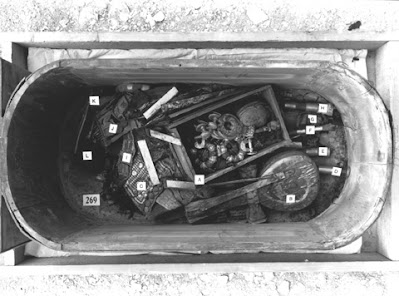

The “Blue Bird” Earrings – gold, glass, quartz, travertine, faience – 18th Dynasty
In the rectangular box 269a, placed in chest 269
From the treasure chamber of Tutankhamun’s tomb, discovered in November 1922
by Lord Carnarvon and Howard Carter in the Valley of the Kings (KV 62)
Ref.: Carter 269a(1) – JE 61969-a – GEM 485-a
The Griffith Institute – Tutankhamun: Anatomy of an Excavation
The Howard Carter Archives – Photographs by Harry Burton
They had all been deposited in a rectangular box (number 269a) placed in a charming wooden chest (number 269). Shaped like a cartouche, it is topped with a flat lid, decorated with the king’s birth name written in delicate colored hieroglyphs. It can be identified, “in situ”, in the photos taken by Harry Burton in the “Treasury Room” whose “official opening” took place on February 17, 1923.
With a height of 12.1 cm and a width of 4.4 cm, these earrings are made of “gold, glass paste, translucent blue glass and pale orange-white-blue melted glass” for Christiane Desroches Noblecourt. At the same time, Zahi Hawass sees, instead, in the gold inlays, besides the glass, quartz, travertine and earthenware…

From the treasure chamber of Tutankhamun’s tomb, discovered in November 1922
by Lord Carnarvon and Howard Carter in the Valley of the Kings (KV 62)
Ref.: Carter 269a(1) – JE 61969-a – GEM 485-a
Published here in the exhibition catalogue “Tutankhamun and His Time” (1963)
Their heavy and imposing suspension system consists of two tubes, one sliding inside the other, which are passed through the lobe involving an extensive “perforation”. These two elements “are decorated on both sides: at the rear, a hemispherical boss (0.85 cm, diam.) of translucent quartz lined with pigment; at the front, a hemispherical boss (0.95 cm, diam.) of translucent quartz supported by a pigment, forming a solar disk, with two uraei” specify Howard Carter and Alfred Lucas.
The central element consists of a bird with outstretched wings curved inwards, which makes them meet almost forming a circle. They are, like the body, worked according to the cloisonné method… For Zahi Hawass: “The wings of the falcon, and the details at the place where they meet, form a large collar called usekh”.
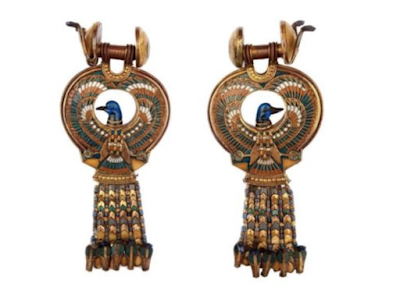
From the treasure chamber of Tutankhamun’s tomb, discovered in November 1922
by Lord Carnarvon and Howard Carter in the Valley of the Kings (KV 62)
Ref.: Carter 269a(1) – JE 61969-a – GEM 485-a
The bird’s head, which does not resemble that of a falcon, cannot but raise questions, just as it raised questions for Howard Carter: “It is interesting to note that the sun falcon, Herakhtes, has, for some inexplicable reason, the head of a mallard (Anas boscas) in semi-translucent blue glass”…
The bird’s legs are almost horizontal and the talons enclose a shen sign, a symbol of eternity…

The “Blue Bird” Earrings – gold, glass, quartz, travertine, faience – 18th Dynasty – at the time of their discovery
from the treasure chamber of Tutankhamun’s tomb, discovered in November 1922
by Lord Carnarvon and Howard Carter in the Valley of the Kings (KV 62)
ref.: carter 269a(1) – JE 61969-a – GEM 485-a
The Griffith Institute – Tutankhamun: Anatomy of an Excavation
The Howard Carter Archives – Photographs by Harry Burton
Under its tail, a slightly curved gold plate, decorated with pellets, serves as a hook for the lower part of the loops. It is composed of curious “flexible hanging appendages, composed of openwork plates with a geometric pattern interlaced by five rows of blue and gold cylindrical beads, ending in five uraei heads” (“Tutankhamun and his era”)… When discovered, as Harry Burton’s photos show, these “tassels” were fragmentary and in poor condition… A successful restoration has restored them to their original appearance.
Howard Carter noted that these ear ornaments had signs of wear, indicating that they had been worn, most likely until adolescence, by the young king… He did note, during the examination of Tutankhamun’s mummy, that his earlobes were pierced. In “The Tomb of Tutankhamun – The Annexe and Treasury”, he adds this interesting detail: “The gold mask that covered his head also had pierced earlobes, but the holes had been carefully filled with small discs of thin gold leaf, suggesting a desire to conceal this fact”…
Bluebird Earrings – Gold, glass, quartz, travertine, faience – 18th Dynasty
From the treasure chamber of Tutankhamun’s tomb, discovered in November 1922
by Lord Carnarvon and Howard Carter in the Valley of the Kings (KV 62)
Ref.: Carter 269a(1) – JE 61969-a – GEM 485-a
The Griffith Institute – Tutankhamun: Anatomy of an Excavation
The Howard Carter Archives – Photographs by Harry Burton

This pair of earrings, Carter 269a(1), has been transferred to the Egyptian Museum in Cairo, where it was recorded in the Journal of Entries under the reference JE 61969. Its new reference at the Grand Egyptian Museum in Giza is GEM 485-a.
It should be noted that one of the earrings was featured in the exhibition “Tutankhamun, the Pharaoh’s Treasure”, whose initial worldwide tour, which began in 2018, was reduced to Los Angeles, Paris, and London due to the pandemic.
Sources:
The Griffith Institute – Tutankhamun: Anatomy of an Excavation – The Howard Carter Archives – Description in Murray-Nuttall Handlist – Pair of ear-rings – JE 61969; Card/Transcription No.: 269a1-1
http://www.griffith.ox.ac.uk/gri/carter/269a(1)-c269a1-1.html
http://www.griffith.ox.ac.uk/gri/carter/269a(1)-p1471.html
Christiane Desroches Noblecourt, Life and Death of a Pharaoh, Hachette, 1963
Christiane Desroches Noblecourt, Tutankhamun and His Time, Petit Palais, Paris, 17 February-July 1967, Ministry of State for Cultural Affairs, 1967
Cyril Aldred, Jewels of the Pharaohs, ed. Thames & Hudson Ltd., London, 1978
Nicholas Reeves, Tutankhamun: Life, Death, and Discovery of a Pharaoh, Editions Errance, 2003
Howard Carter, The Tomb of Tutankhamun, Volume 3: The Annexe and Treasury, Bloomsbury, London, 2014
Marc Gabolde, Tutankhamun: Pygmalion, 2015
Zahi Hawass, Exhibition Catalogue “Tutankhamun: Treasures of the Golden Pharaoh,” IMG Melcher Media, 2018
 lampmagician
You must be logged in to post a comment.