

The naos of Kasa in the Turin Egyptian Museum is renowned for its elegance and uniqueness. It acts as a portable chapel for Anukis and the Elephantine triad gods—Khnum and Satis—who govern the Nile flood. The inscription: “Adoring Anukis, lady of Sehel, kissing the ground for Satis, lady of Elephantine. May she grant you life, strength, ability, favour, love, and a beautiful tomb after old age, along with a burial in the district of the chosen in the great West of Thebes—the district of the just—for the servant on the Seat of Truth, Kasa, justified.
A votive naos is a small, portable shrine made of wood or stone in ancient Egyptian religion, housing statues of gods. These miniature temples were placed at sacred sites, such as temples and tombs, for votive offerings—objects dedicated to gods as prayers or expressions of gratitude.
The image at the top: Votive naos of Kasa, via Wikimedia Commons
Let’s enjoy the incredible story about this magic box, thanks to the brilliant Marie Grillot.
The votive naos (shrine) of the House.
via égyptophile

Egyptian Museum of Turin – Cat. 2446 (by acquisition from the Drovetti Collection in 1822) – museum photo
Dating from the 19th Dynasty (1292 – 1190 BC) and coming from Deir el-Medineh, the charming “naos of Kasa” is 33.5 cm high, 18 cm wide and 33 cm deep. Made of stuccoed and painted wood, its façade takes the form of a temple with a portico with two columns. Inscribed with hieroglyphs, their “hathoric” capital offers a charming face of the goddess with large eyes surrounded by kohol and an imposing black wig. On her head is an abacus serving partly as a support for a coved cornice decorated with a series of vertical blue-green, blue-red bands. The “body” of the chapel is rectangular in shape: its lower part rests on a sledge while the upper part also takes the form of a coved cornice with painted bands.
The front reveals a charming double door painted in red ochre with black frames. The door is closed by two round black knobs located in the upper third. Above each knob is a “frame” containing four columns of hieroglyphs. The interior consists of two compartments of unequal height.

Egyptian Museum of Turin – Cat. 2446 (by acquisition from the Drovetti Collection in 1822) – museum photo
Both sides and the back of the chapel are covered with scenes painted in several registers. The majority of them are dedicated to the “Triad of the First Cataract,” or “Elephantine Triad,” associating the god Khnum with the goddesses Satis and Anuket (Anoukis). The latter is generally presented as “the daughter of the divine couple” or “the wife of the god.” In “Ancient Egypt and its Gods”, Jean-Pierre Corteggiani specifies that one of her titles is: “Mistress of To-Seti, that is to say of Nubia; she is sometimes called the Nubian, although there is no proof that she is really from this region, one of her functions is to guard the southern border of Egypt”… And he adds “If it is up to Satis, assimilated to Sothis, to make the beneficial flow rise, it falls to Anoukis the equally essential task of making it decrease and thus to allow, after the flood recedes, seeds to germinate and vegetation to grow on the land freed by the waters”.
Anouket’s primary attribute, which makes her immediately identifiable, is her tall and generous headdress made of ostrich feathers… As for Satis, she wears the white crown adorned with two antelope or gazelle horns…
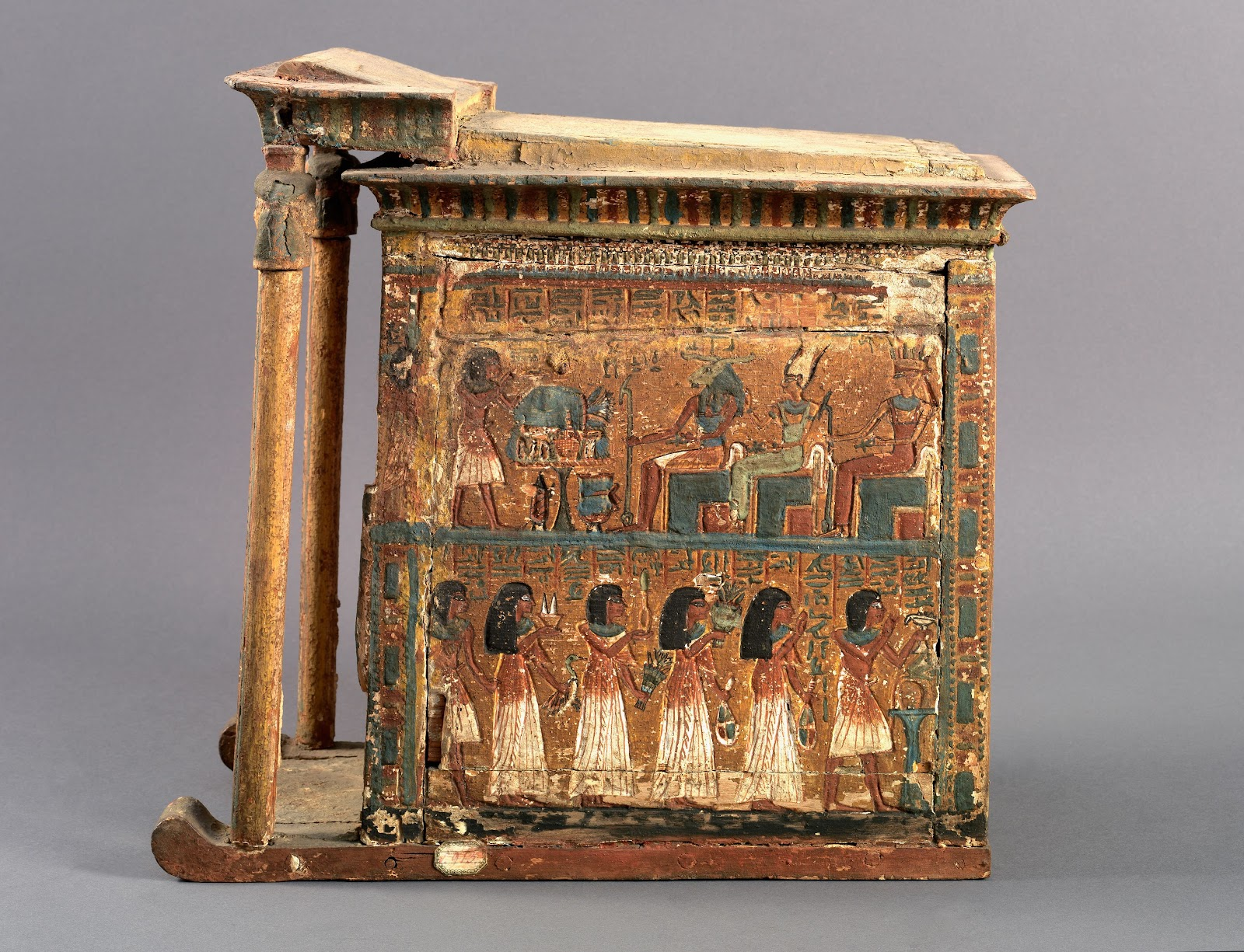
Egyptian Museum of Turin – Cat. 2446 (by acquisition from the Drovetti Collection in 1822) – museum photo
On this chapel is inscribed this powerful prayer: “Worship Anouket, mistress of Sehel, kiss the earth of Satis, mistress of Elephantine. May she grant life, strength, skill, favour, love, and a beautiful burial after old age and burial in the district of the praised in the great West of Thebes, the district of the righteous, to the servant of the Place of Truth, Kasa, justified.”
The back of the naos reveals Kasa, kneeling, arms raised in worship, a prevalent iconography in Deir el-Medineh… “The texts inscribed on this small chapel also cite the name of the god Amun, ‘the beloved god who listens to prayers, who helps the orphan, who saves from shipwreck'” specifies Marcella Trapani, in the “Catalogue of the Museo Egizio”. And she adds: “In all likelihood, this naos was originally placed in Kasa’s house”…

Egyptian Museum of Turin – Cat. 2446 (by acquisition from the Drovetti Collection in 1822) – museum photo
The question, of course, arises as to what it contained. In the study she devotes to it in BIFAO 72, Dominique Valbelle offers this analysis: “The original contents of this naos are also mysterious. The interior, as we have seen, is divided into two unequal compartments by a small shelf. There is therefore very little space left above to house a statuette or some other ‘ex voto’…”
Was Kasa originally from the First Cataract region? In any case, he was a member of the royal institution of “Set Maât her imenty Ouaset” (“the Place of Truth to the west of Thebes”, present-day Deir el-Medineh). Founded at the beginning of the 18th Dynasty under the reign of Thutmose I, this “corporation” brought together architects, scribes, painters, sculptors, quarrymen, etc., responsible for digging and decorating the eternal dwellings of the Valley of the Kings, the Valley of the Queens, and even more distant necropolises. They lived as a family in this “fortified” village, composed of stone houses with palm-leaf roofs, places of worship, and a hillside necropolis. “The fact that we often refer to them as ‘workers’ sometimes tends to give credence to the misconception that the community of the village of Deir el-Medineh was at the lowest level of Egyptian society. In fact, these men were artisans, most of them highly skilled and distinguished for their expertise,” explains Pierre Grandet in “The Artists of Pharaoh, Deir el-Medineh and the Valley of the Kings”…
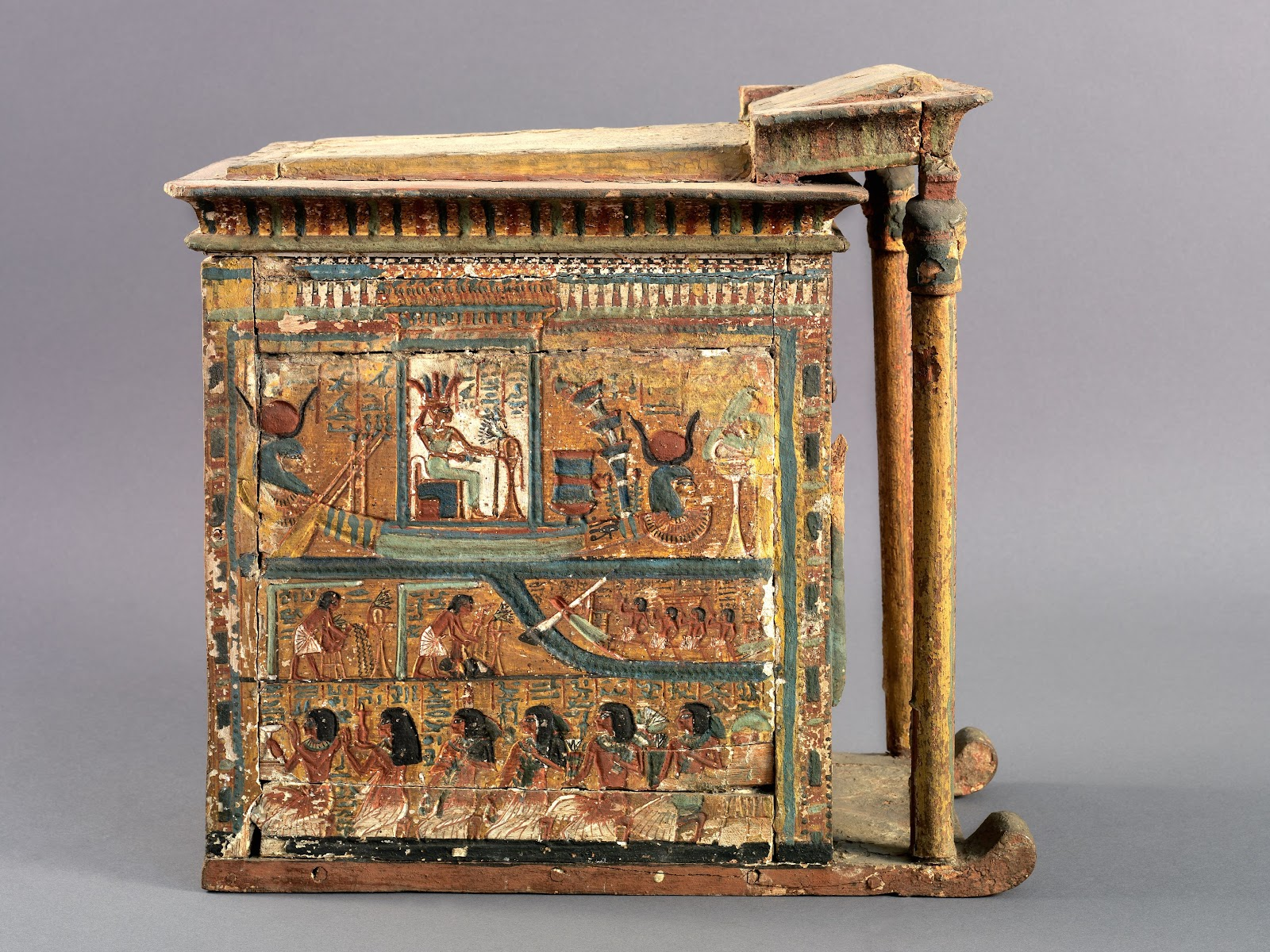
Egyptian Museum of Turin – Cat. 2446 (by acquisition from the Drovetti Collection in 1822) – museum photo
From its creation to its decline at the end of the Ramesside period, this “microcosm” left a wealth of evidence of considerable importance… It is expressed at various levels: daily life, society, architecture, art, writing, or even in the “intimacy” of the “repertoire” of their eternal homes and in the funerary trousseaux rich in lessons that they contained…
This naos, which is an exceptional piece, arrived at the Egyptian Museum in Turin in 1822, through the acquisition of the Drovetti Collection: it was registered under the inventory number Cat. 2446. In the work cited above, Marcella Trapani indicates that it came from tomb no. 10 of Deir el-Medineh, which “Porter & Moss” actually attributes to “Penbuy and Kasa” and dates from the reign of Ramses II…
Sources:
Votive naos of Kasa
https://collezioni.museoegizio.it/it-IT/material/Cat_2446/?description=Naos+votivo+di+Kasa&inventoryNumber=&title=&cgt=&yearFrom=&yearTo=&materials=&provenance=&acquisition=&epoch=&dynasty=&pharaoh=
Bertha Porter, Rosalind L. B. Moss, Topographical Bibliography of Ancient Egyptian Hieroglyphic Texts, Reliefs, And Paintings – I. The Theban Necropolis Part 1. Private Tombs, Second edition revised and augmented – Griffith Institute Ashmolean Museum Oxford, 1960, pp.19-21
http://www.griffith.ox.ac.uk/topbib/pdf/pm1-1.pdf
Ernest Scamuzzi, Egyptian art at the Turin Museum, Hachette, 1966
Dominique Valbelle, The Naos of Kasa at the Turin Museum, Bulletin of the French Institute of Oriental Archaeology 72, 1972, pp. 179-194
The Egyptian Museum, Turin, Federico Garolla Editore, 1988
Isabelle Franco, Dictionary of Egyptian Mythology, Pygmalion, 1999
Guillemette Andreu, The Pharaoh’s Artists, Deir el-Medina and the Valley of the Kings, exhibition catalogue, Turnhout, RMN, Brepols, 2002
Guillemette Andreu, Florence Gombert, Deir el-Medina: The Pharaoh’s Craftsmen, RMN, Hazan, 2002
Eleni Vassilika, Art Treasures from the Egyptian Museum, Allemandi & Co, 2006
Jean-Pierre Corteggiani, Ancient Egypt and its Gods, Fayard, 2007
Egyptian Museum Guide, Franco Cosimo Panini Editions, 2015
Hanane Gaber, Laure Bazin Rizzo, Frédéric Servajean, At work we know the artisan… of Pharaoh! – A century of French research in Deir el-Medina (1917-2017), 2018, Silvana Editoriale
Guillemette Andreu, Dominique Valbelle, Guide to Deir el-Medina. A village of artists, Cairo, French Institute of Oriental Archaeology, IFAO Cairo, 2022
 lampmagician
You must be logged in to post a comment.