
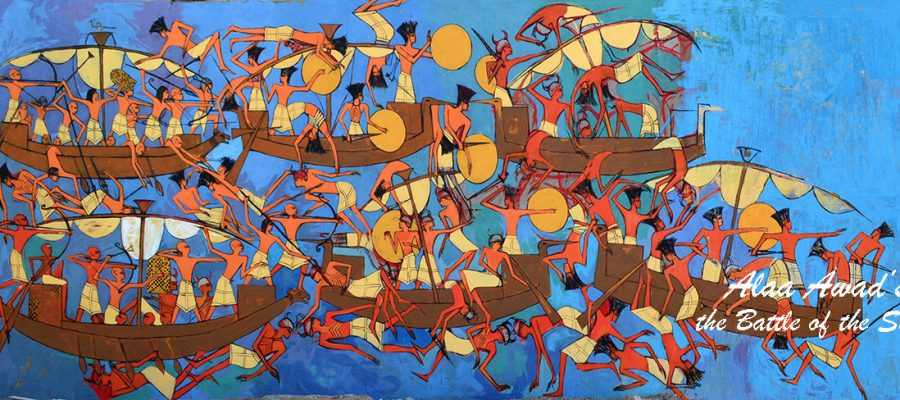
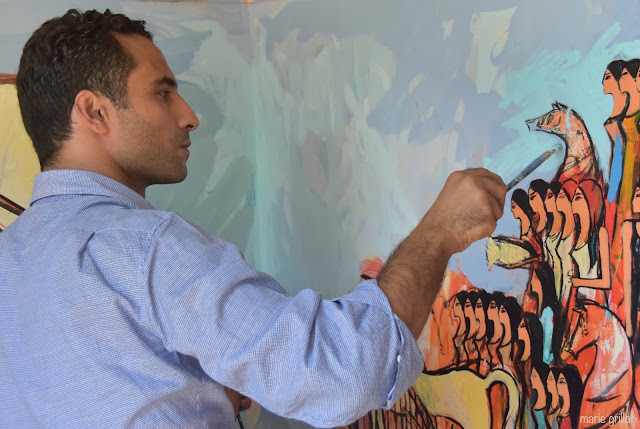
Today, I’m sharing an exceptional article by Marie Grillot about the excellent painter Alaa Awad, who combines the new age with the old style of ancient Egyptians.
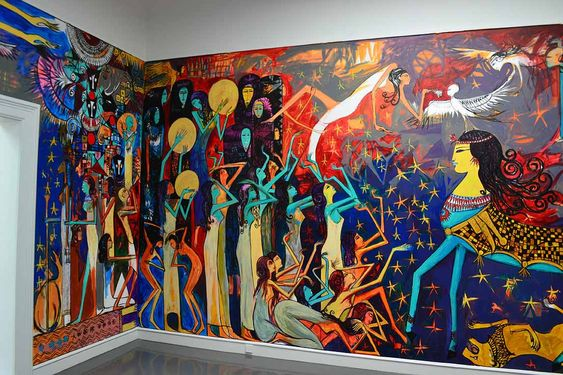
Awad is an Egyptian artist famous for his public murals in Cairo and Luxor. He gained recognition for his murals on Mohamed Mahmoud Street in Cairo, Egypt, during the 2012 Egyptian Revolution, which attracted significant media coverage. His public murals and paintings depict the Egyptian people’s history, dignity, and charisma. Additionally, he has showcased his oil paintings and outdoor public murals internationally in solo exhibitions.
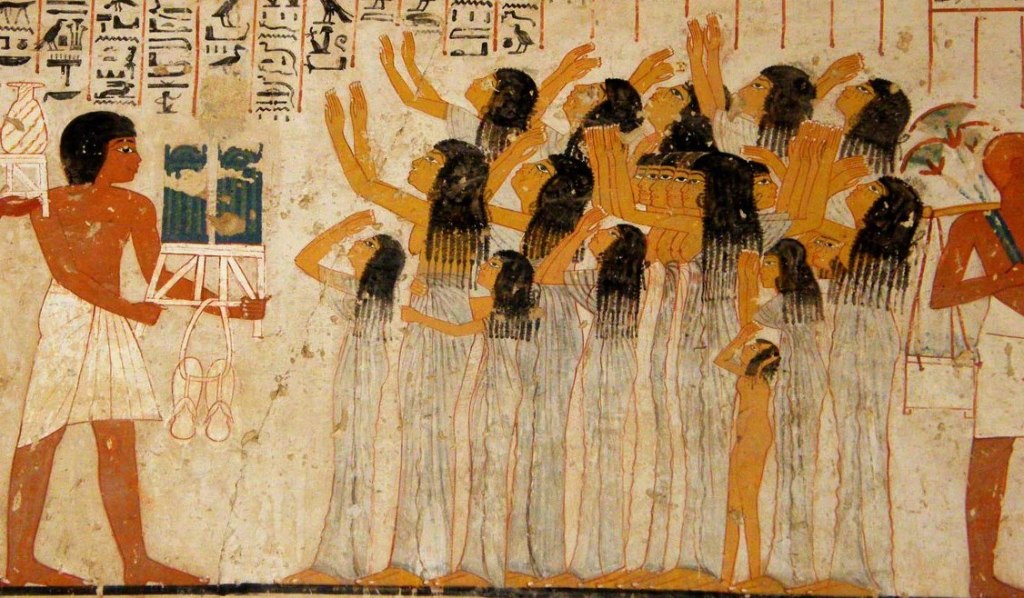
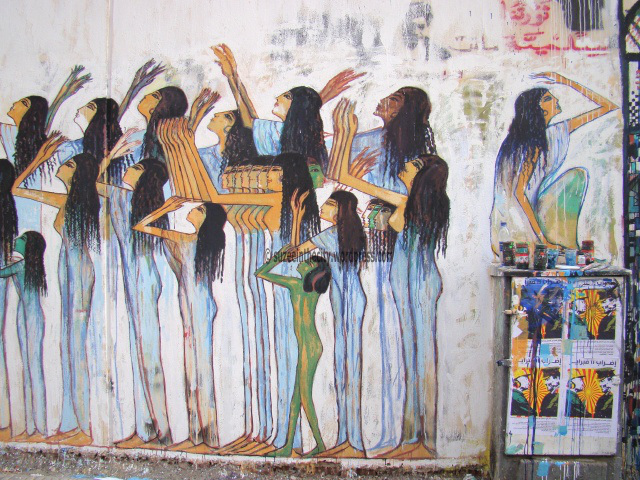
Above an ancient mural fresco, below an impressive perception by Awad.
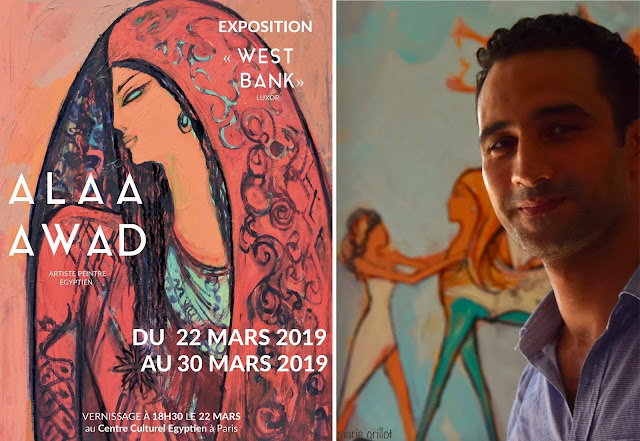
“The West Bank of Luxor” in Paris, with the paintings of Alaa Awad!
via égyptophile
“Alaa Awad, here is a new talent that Egypt offers us, and not the least. This young artist, who grew up in Mansoura and teaches at the Faculty of Fine Arts in Luxor, has been steeped since childhood in the prestigious heritage bequeathed by the Pharaonic civilization. By that, he will draw all his inspiration, developing his art where great finesse and extraordinary sensitivity are combined.” Could one dream of a more beautiful presentation than that of this other “Theban”? Christian Leblanc
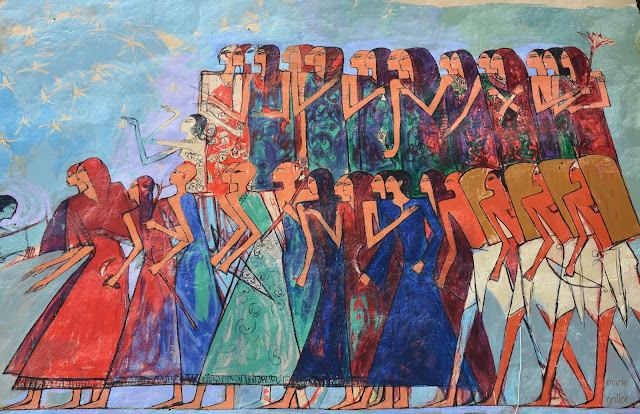
West Bank of Luxor (near the Messala Hotel)
Alaa has masterfully and grandiosely expressed his street art in Egypt, the USA, Germany, and Denmark. Whether he is painting a room at the Street Art City in Lurcy-Levis (France) or the Cairo windows of a “Bulgari” boutique, his art explodes as much as it fascinates.
In the old Gournah, on the west bank of Luxor (the “West Bank”), he set up his studio at the edge of the arable land, facing the Theban mountain. This environment is flooded with this exceptional light, which offers itself to him in an infinitely rich palette, ranging from the shades of the fields to the pink tones of the Theban peak, from the white Galabeyas of the Gournawis to the black dresses of the women.
A stone’s throw away rises the majestic temples of millions of years of the greatest Pharaohs. A stone’s throw away, the eternal homes of artisans, nobles, queens and sovereigns hide in their entrails the most beautiful scenes of funerary art…
So many sources of inspiration could kill inspiration by an excess of sensations, but NO, it is only sublimated!
If Alaa admires his “current” masters, the great Egyptian artists, and also Gauguin, Van Gogh and Rodin, he has unlimited respect and esteem for the Pharaoh’s artisans… For those who engraved the walls of temples, painted the walls of tombs in the faint light of oil lamps, decorated sarcophagi, or sculpted statues…
With his intelligent, deep and concentrated gaze, he seems to read all this, penetrate it, and, perhaps, finally, understand “the codes”…
And he restores it with his own sensitivity, with his personal interpretation imbued with his references to street art.
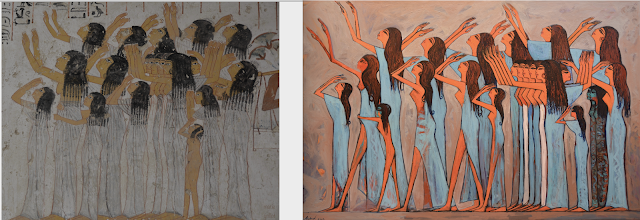
wonderfully reinterpreted by Alaa Awad, right
“From themes with a funerary consonance to those reproduced on the walls of temples, a whole repertoire will serve as a guide to reinterpret and even update these age-old scenes in a shimmering of colours and an exuberance of movements.” (Christian Leblanc)
The mourners at Ramose’s tomb are as thin and slender as top models. They are dressed in brightly coloured clothes; their legs are thin, and their arms and fingers are disproportionately long. Hairstyles like stars, their eyes made up in black sometimes let golden tears flow.
His “Isis”, the “mother” of the goddesses, against a backdrop of a starry sky, with eyes heavy with kohol and his “Hathor”, with their benevolent physiognomy, overflows with colour and vitality.
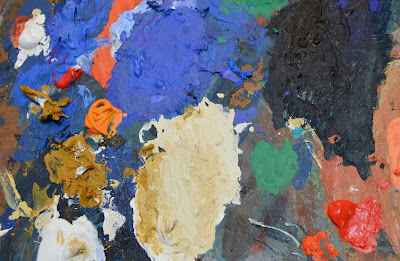
Alaa is an artist with a rich and powerful palette. Véronique Sedro, Egyptologist and writer, felt this very well: “The artisans and artists of Pharaonic Egypt used natural pigments: multiple ochres, black, but also white, solar yellow, celestial blues and deep blues and this inimitable turquoise like the stone that bears her name. When I entered Alaa Awad’s studio in Luxor, my eyes immediately stopped on her palette. A painting in itself, a palimpsest of her works. A large square of wood where painting knives rested on a firework of thick colours.”
Alaa likes to draw parallels between the history of yesterday and that of today, between the reminiscences of a past, distant or more recent, combined with a subtle interweaving of religions or cultures…
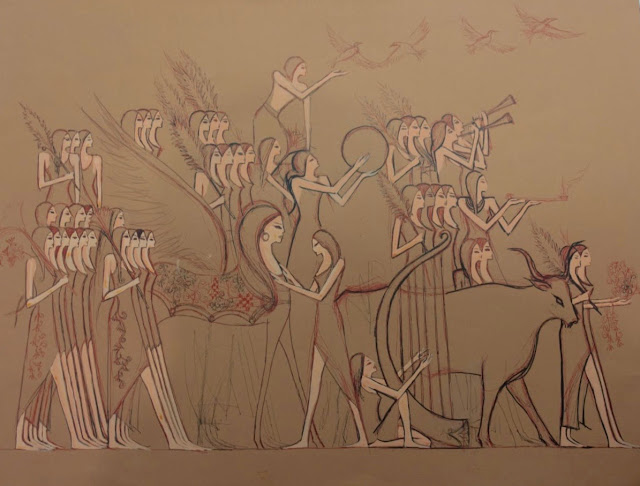
Thus, its processions of sacred boats of the Opet festival “rejoin” the celebration of the local saint, Abou el-Haggag. Its buffaloes from the Gournah cattle market seem to come straight from certain nobles’ tombs.
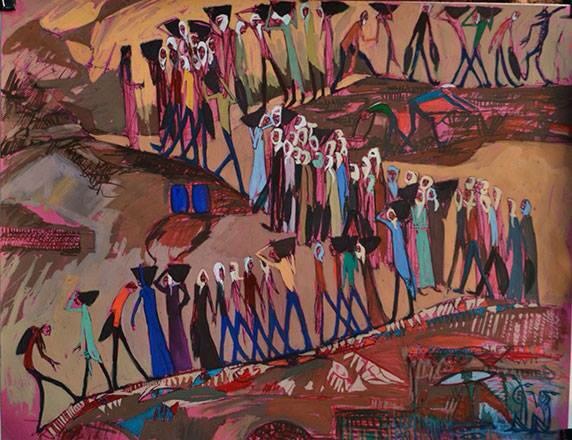
So, the “current” daily life is a source of inspiration. It could be the long procession of workers on the excavation sites who tirelessly work on the mountainside, handle their shovels, or carry black leather bags filled with rubble.
It can also be festivals and traditions. The “tahtib” – the stick dance – is again a reference to antiquity, as proven by the scenes from the tomb of Kheruef. Or the “Mermah”, a morning event during which the gournawis mount their horses and challenge each other with sticks in an immemorial ritual misted with sand dust…
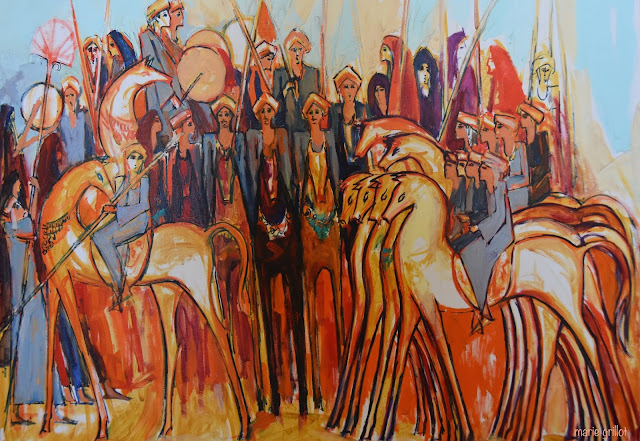
Alaa likes to paint the men of the village in Galabeya and turban and the women with big dark eyes and long black hair covered with a black Malaya.
If horses are very often represented in his paintings, we also sometimes find extraordinary creatures, like those from Nagada’s palettes … or even the Burak, which is “according to Islamic tradition, a fantastic steed, mount of the prophets”: a winged horse with a woman’s head.
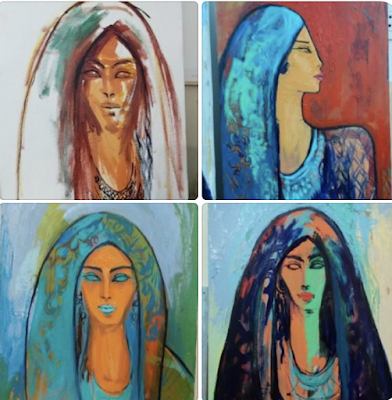
And his favourite subject is perhaps the “Zarqa al Yamama,” a “blue-eyed woman with an ability to predict events before they happen”—in a word, an Egyptian Cassandra. He gives her a face and a look of beauty that is as mysterious as it is attractive and covers her hair with scarves that one would wish a couturier could create…
Alaa est un artiste totalement – et fièrement -“égyptien” : “Du street-art à ses toiles néo-pharaoniques, de sa technique de l’acrylique et du pinceau, son œuvre, d’une indéniable élégance, s’adresse d’abord au peuple égyptien avec qui il partage ce si fabuleux héritage culturel que bien des coutumes et des traditions perpétuent encore jusqu’à présent”nous dit Christian Leblanc. Quant à Véronique Sedro, elle nous confie : “A travers lui j’ai identifié l’âme égyptienne”.
At the same time, La Villette welcomed Tutankhamun, Alaa Awad arrived in Paris and was invited to participate in the Cultural Year France—Egypt 2019.
His exhibition – which could not have any other title than “The West Bank Luxor” – will be held at the Egyptian Cultural Center – 111 Boulevard Saint-Michel – 75005 Paris, from Saturday, March 23 to Saturday, March 30, from 2 p.m. to 8 p.m. (except Sunday and Monday).
Marie Grillot
 lampmagician
Beautiful pictures 🌹🌹
LikeLiked by 1 person
Heartfelt thanks! 😊🙏🌹
LikeLiked by 1 person
Welcome dear friend 🌹🌹
LikeLiked by 1 person
🤗🙏💖
LikeLike
What an exceptional artist! I love how Alaa Awad blends the rich heritage of ancient Egypt with contemporary themes. The old and the new! In Jungian language; how he holds the tension of the opposites.
His work, particularly those murals on Mohamed Mahmoud Street in Cairo, capture the dignity and charisma of the Egyptian people, reflecting both historical depth and modern-day narratives. A joy to behold!
Thanks so much for sharing Aladin. Enjoy your weekend. Love and light, Deborah
LikeLiked by 2 people
Thank you, my lovely angel, for your profound and insightful words. The Jungian interpretation conveys a powerful message. Through his art, he presents a meaningful depiction of Egyptian life and culture. Love to you, my friend.🙏💖
LikeLiked by 1 person
Thanks for sharing this great post, on a really fascinating topic and a great artist – I found it very interesting
LikeLiked by 1 person
Thank you so much, dear Luisa. I am pleased you like it.🤗🙏
LikeLiked by 1 person
It is truly my pleasure, dear Aladin
Thank you for always being so sweet and kind 💞
LikeLiked by 1 person
That is surely you…🤗💕🥰😘
LikeLiked by 1 person
🙏💐🙏
LikeLiked by 1 person
nk you for sharing this. It is amazing, from the colours to the details.
LikeLiked by 1 person
Indeed it is, my dear lady. I was stunned!! xxxxxx
LikeLiked by 1 person
Me too. It is amazing.
LikeLiked by 1 person
Wow! Van Gogh meets King Tut and Basquiat. I’m blown away by the stunning work of this unique and gifted artist and grateful for your introduction to him.
LikeLiked by 1 person
You have described my feelings already, my lovely Jeane. Thank you!🥰🙏💖
LikeLike
Great way to start the weekend! Nice change of pace but still a great blog post from you!
LikeLiked by 1 person
Thank you, dear friend. I always appreciate your kindness.
LikeLike
These are really wonderful! Wow and wow again!🎨
LikeLiked by 1 person
Indeed, dear Chris. A true artisan artist!😊🙏💖
LikeLiked by 1 person
Glorious images. Egyptian color and influencese with a modern twist. I love it. Thank you, Aladin. You’ve found and shared a treasure.
LikeLiked by 1 person
I agree with you totally! It is a worthy find. Thank you for coming by.
LikeLike
Magnificent work! 🌻
LikeLiked by 1 person
Agreed! He is brilliant. Thank you, dear sunshine, for dropping by.🤗🙏🌹
LikeLiked by 1 person
What amazing art – I love the colour palette and the way he uses ancient images to inspire his modern day work. I particularly love his interpretation of the mourners at Rameses tomb. What an amazing artist Aladin, thank you for bringing him to my attention. I hope your week is going well!
LikeLiked by 1 person
You already explained my feelings as I saw his works. He is brilliant! Thank you, my dear Lin.🤗🙏💖
LikeLiked by 1 person
What a beautiful work! I appreciate street art in murals, but this one is definitely spectacular. Thank you for sharing it with us! 🙂🙌🏻✨
LikeLiked by 1 person
It is unique street art, indeed! Thank You for stopping by and for your appreciated comment. 🙏💖
É muito bonito de si. Tenha um dia lindo. 🤗🌹💕
LikeLiked by 1 person
It’s fascinating! A great artist.😉🙏🖌️🖼️
LikeLiked by 1 person
Thank you for sharing this, Aladin!
I love this art. Alaa has taken an ancient art, that most rarely get to see in real life, and brought it into the 21st century.
Here many will get to see it, and marvel.
His style is impressive and inspiring.
I hope Canada commissions him to paint a mural for us.
Make Art, not war!
🌹❦💓🎨🌟
LikeLiked by 1 person
Make art, not war! You say that, Resa, the specialist.😉👏 I hope he will come to the area someday. 💖🥰🙏🎨🌺
LikeLiked by 1 person