
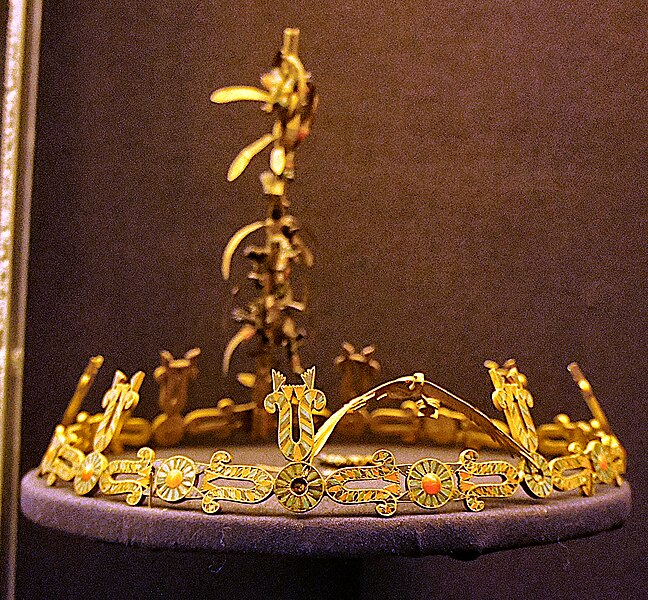
SONY DSC
To be honest, I was never impressed by jewellery. I can’t distinguish the worth of one stone from the other, and I never understood why some people are so fascinated by them. After all, a stone is just a stone, right? But these pieces of jewellery are something extraordinary.😉
Khenmet, or Khnumit, was an ancient Egyptian king’s daughter of the Twelfth Dynasty, around 1800 BC. She is mainly known for her unrobbed tomb, which contains a set of outstanding personal adornments.
Princess Khenmet is only known from her burial next to the pyramid of Amenemhat II at Dahshur. On the West side of the pyramid were three underground galleries with each of two tombs. Four of these tombs, including those of Khenmet, Ita, and Itaweret, were found unlooted. The father of Khenmet is uncertain, but since she was buried in the pyramid complex of King Amenemhat II, it seems likely that she was his daughter.

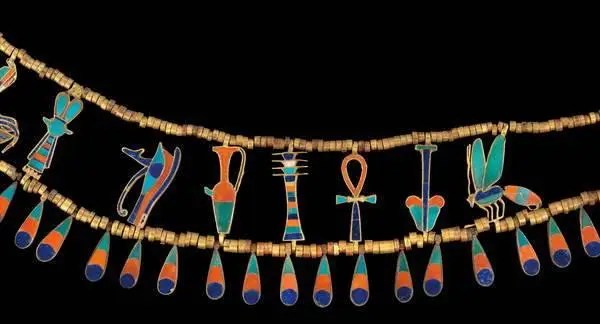
As we delve deeper into these jewels, we realize they are crafted not just from gold for their lustre but also as symbols of destiny, well-being, and everlastingness.


Now, let’s enjoy reading another fascinating discovery of these treasures by Marie Grillot.🙏💖🙏
Two bracelet clasps of Princess Khnumit
Via égyptophile

from her tomb, discovered on February 16, 1895, by Jacques de Morgan, in the funerary complex of Amenemhat II in Dahshur
Egyptian Museum of Cairo – JE 31091 – CG 52044 and CG 52045
Princess Khnumit was one of the many daughters of Amenemhat II, ruler of the 12th Dynasty (1932 – 1898 BC). According to some sources, she was also his son’s wife and successor, King Senusret II. She was buried in Dahshur, northwest of the White Pyramid (that of Amenemhat II).
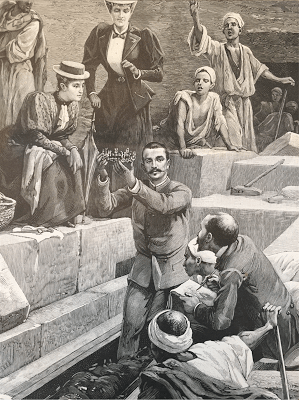
Jacques de Morgan during the discovery of Khnumit’s jewels in February 1905 in Dahchour
drawing published in “L’Illustration” on May 11, 1895
It was the French Egyptologist Jacques que Morgan who discovered her tomb in February 1895.
“The sarcophagus had been put in place at the same time as the tomb had been built. Perhaps even the wooden coffin it contained had also been placed before the death of the personage so that on the day of burial, all that remained was to place the body and the offerings in the tomb.”
Plan of the tomb of Princess Khnoumit published by Jacques de Morgan

The discoverer also specifies that the princely mummy was once painted and covered with a bitumen coating. Its gilded mask was decorated with red, blue, and gold designs, and two eyes mounted in silver.”
Sumptuous jewels accompanied her for eternity: necklaces, bracelets, in gold, inlaid with carnelian, emerald and lapis lazuli… The chamber of offerings concealed a veritable treasure. “Terracotta vases filled with the debris of the offerings covered the paving in the middle of a bed of white dust accumulated by the centuries. To the right, along the wall located between the two doors, was a pile of bones of oxen and geese, the remains of the provisions that had been deposited near the dead. Along the eastern wall and almost in the middle was the closed perfume box; further away, a small square board, the bronze perfume burner and finally, the canopic box, which occupied almost the entire back of the room. All these objects were dust-covered, so I found it difficult to distinguish their details in the darkness. However, after removing the vases, I was astonished to find some gold jewels near the perfume box.”
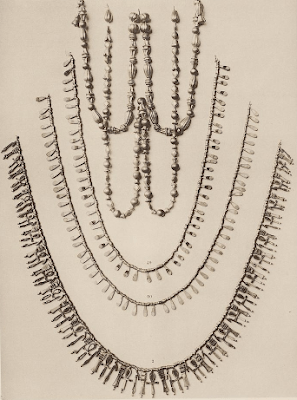
Among Princess Khnoumit’s jewels were numerous necklaces
The jewels that accompany the princess for her eternity are extraordinary, of such accomplished beauty and art that Jacques de Morgan would say: “I do not believe that, even today, a jeweller can achieve such great perfection, such truth of rendering and such beautiful designs as the obscure worker who, many centuries ago, chiselled in some street of Memphis these singular jewels with which Princess Khnoumit was to adorn herself.”
Khnoumit’s Jewels:
From work by Jacques de Morgan, this plate reproduces the two clasps decorated with the sign “SA.”
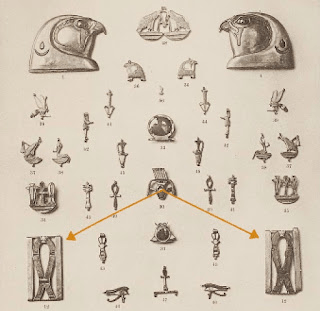
Among these jewels are these two bracelet clasps found in the sarcophagus. Although they are not among the most sumptuous or best known, they nevertheless deserve our interest.
They come in the form of a rectangular plate, nearly 4 cm high and just over 2 cm wide, bordered with gold. This “frame” is pierced with holes in which the threads of the rows of pearls are attached. Inside the sign, ‘SA’ stands out in lapis lazuli, decorated in its highest part with a small lion’s head, or panther, in gold.

from her tomb, discovered on February 16, 1895, by Jacques de Morgan
in the funerary complex of Amenemhat II in Dahshur – Egyptian Museum of Cairo – JE 31091 – CG 52044 and CG 52045
In “Bijoux et orfèvreries”—Fascicule 2 -, the Egyptologist Émile Vernier provides the following details on the manufacture of the “SA” sign: “It is divided into six pieces by the lioness’s head and by cloisonné links; these links are made of three small strips, the middle one in carnelian and the other two in turquoise.”
The hieroglyph ‘SA’ symbolises protection, “perhaps representing the folded mat used by shepherds to protect themselves from the elements.”
Émile Vernier also tells us about what we cannot see, the reverse side of the clasp: “The reverse side is chiselled, the body of the sign is made like a bundle of seven stems joined together and linked in six places corresponding to the lioness’s head and the five links on the front. These links are divided into three parts, a central one wider than the other two.”
These clasps are now “orphaned” from the rows of gold, carnelian, lapis lazuli, and turquoise beads that made up the bracelet they closed. Therefore, we must rely on our imagination to reconstruct them and imagine them adorning Princess Khnoumit’s arms.
These jewels were deposited at the Cairo Museum, recorded in the Journal of Entries JE 31091, and then in the General Catalogue under the references CG 52044 and CG 52045.
Sources:
Jacques de Morgan, Excavations at Dahchour, Adolphe Holzhausen, Vienna, 1894 http://dlib.nyu.edu/awdl/sites/dl-pa.home.nyu.edu.awdl/files/fouillesdahcho01morg/fouillesdahcho01morg.pdf Jacques de Morgan, Letter on the latest discoveries in Egypt, Reports of the meetings of the Academy of Inscriptions and Belles-Lettres, 1894, 38-3 pp. 169-177 http://www.persee.fr/doc/crai_0065-0536_1894_num_38_3_70401?_Prescripts_Search_tabs1=standard& Jacques de Morgan, Letter on his second excavation campaign in Egypt, Reports of the sessions of the Academy of Inscriptions and Belles-Lettres, 1895, 39-2 pp. 169-179 http://www.persee.fr/web/revues/home/prescript/article/crai_0065-0536_1895_num_39_2_70560?_Prescripts_Search_tabs1=standard& Jacques de Morgan, Excavations at Dahshur: 1894-1895, Adolphe Holzhausen, Vienna, 1903 http://digi.ub.uni-heidelberg.de/diglit/morgan1903/0049 Émile Vernier, General Catalogue of Egyptian Antiquities in the Cairo Museum, Jewelry and Goldwork, Issue 3, Number 52640-53171, IFAO, Cairo, 1925 http://gallica.bnf.fr/ark:/12148/bpt6k57740426/f96.item.r=52859.texteImage Cyril Aldred, Jewels of the Pharaohs ed Thames & Hudson Ltd. London, 1978
Mohamed Saleh, Hourig Sourouzian, Official Catalogue of the Egyptian Museum in Cairo, Verlag Philippe von Zabern, 1997
Francesco Tiradritti, Treasures of Egypt – The Wonders of the Egyptian Museum in Cairo, Gründ, 1999
 lampmagician
I am in love with this….it’s exquisite thanks for sharing 👍 💕
LikeLiked by 1 person
I knew it, sister; women are the true jewels!😉🤗🙏
LikeLiked by 1 person
So true hehe I hope you are having a nice weekend Aladin 😊 🌄 ✨️ sending a hug to you
LikeLiked by 1 person
Thank you, and have a great week ahead.🙏🤗
LikeLiked by 1 person
You too dear friend 😘 hugs
LikeLiked by 1 person
Simply wonderful!
Thanks a lot gor sharing this fascinating post
Have a lovely weekend, dear Aladin
LikeLiked by 1 person
As always, my lovely Luisa, I appreciate your kind support. Have a fabulous weekend.🙏💖
LikeLiked by 1 person
Thank you again 🙏🙏🙏
Wishing you the same
LikeLiked by 1 person
I love this! Great blog post and very informative!
LikeLiked by 1 person
You made my day, mate. Thank you!🙏🤙
LikeLike
There are gorgeous, gorgeous!! Although, I don’t think anything would look good on me😉
LikeLiked by 1 person
You are beautiful enough; you don’t need any of them!😉🤗💖
LikeLiked by 1 person
Oh, how the title alone, ‘jewel of eternity’ draws me in! What beautiful, exquisite pieces these pieces are! It’s hard to believe these were made thousands and thousands of years ago. Thank you so much for sharing another of Marie’s wonderful posts about ancient Egypt. Love and light, Deborah.
LikeLiked by 1 person
You speak the right words, my dear angel. These are not only jewels; they also contain some divine spirits inside. Sending my immense gratitude. 🙏🌹💕
LikeLiked by 1 person
Another fascinating article – the artistry of the jewellery is beyond belief. I have never been a great lover of priceless gems but Lapis Lazuli is one of my favourite stones. Thank you for sharing this Aladin.
LikeLiked by 1 person
You are wise, dear Lin! No one can seduce you with superficial shiny stones. Thank you, and have a great week ahead.🥰🤗🌟
LikeLike
❤
LikeLiked by 1 person
✌🌹💖
LikeLike
Absolutely exquisite. Thank you for sharing this beauty. I’m not a “jewelry person” either, but there were pieces from Egyptian tombs in museums in the Metropolitan Museum of Art in New York City, the Brooklyn Museum, and a small museum in Philadelphia that shared heart-opening jewelry made for queens and princesses long ago. In Philadelphia, the whole exhibit was in just one room and it was the most powerful because I could take it in. Thank you for bringing me back to my love of Egyptian mythology,
LikeLiked by 1 person
It is always nice to read your memories of those fascinating encounters. I believe If I could see them so close, I would fall in love with them! Thank you, dear Elaine and blessing.
LikeLike
These jewels do sound fabulous.
A brother and sister marrying is kind of common in royalty, and not just in ancient Egypt.
I have to wonder, if she was buried with all these items for her after life and they are taken away to a museum – does her spirit now reside in the museum? Should not the animal bones be there as well?
Same goes for all the dead and their artifacts.
I know mankind has learned a lot from digging up these Egyptian graves, and other graves.
Still, I always feel a disrespect, Aladin.
Thank you for another wonderful post on ancient Egypt!
❦🌟💓🫶🌹
LikeLiked by 1 person
These are wise words, my dear Resa. Humans did learn a lot about not wild-digging in such treasures, but they never understood their purpose!! Thank you, lovely friend.🙏🤙👋💖
LikeLiked by 1 person