

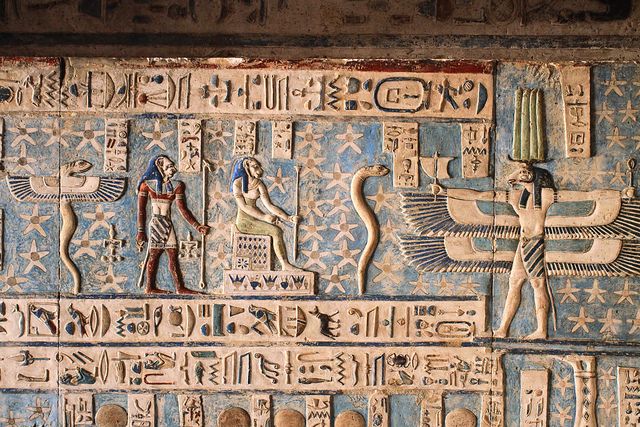

1-The Great Sphinx in Egypt is believed to have the face of Pharaoh Khafre — 2-Dendera: Egypt’s Best-Preserved Temple Complex — 3-View of the west wall, depicting Nakht and his wife, Tawy, seated before offerings (top left), Nakht hunting in the marshes (top right), Nakht and Tawy receiving the produce of the grape harvest (bottom left), and grape harvesting, winemaking, bird capturing, and plucking (bottom right) (Source: OsirisNet).
I decided to share this journal post about three short reports by great Egyptologists today in memory of Marc Chartier, an excellent journalist, human and friend whom I enjoyed and learned a lot from his works for a long time, particularly from his fascinating journey reports.
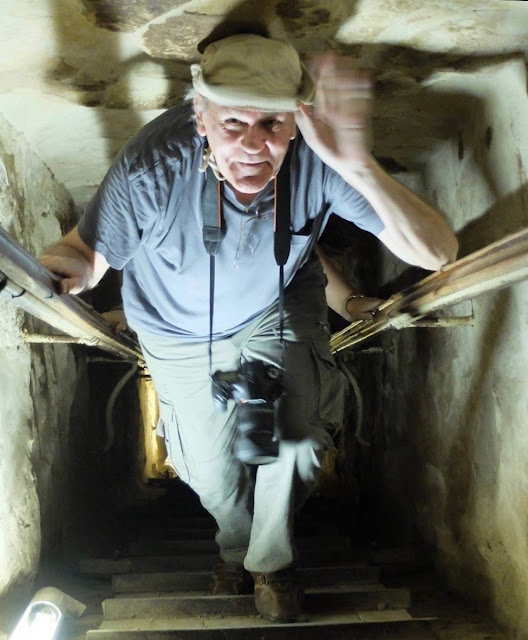
Journalist, passionate about Egypt in general and the pyramids in particular,
creator of the blogs: “Pyramidale”, “L”Egypte entre Guillemets”, “Egyptophile” and founder of the press review “Egypte-actualités.”
With forever thanks and immense gratitude to Marie Grillot, as she wrote in her post: During these periods of questioning that assail us all, Marc refocused on this sentence, full of wisdom, which is, in fact, an African proverb taken up by Aimé Césaire: “When you don’t know where you’re going, look where you come from”… These words brought him back to Guinevert, in Sarthe, to his father, to this little brother who both disappeared too soon and especially to “Mamani” who held her sons so tightly against her during the bombings…

Marc Chartier (Guinevert-Durtal, 23-2-1940 – Argenteuil, 27-7-2024)
Journalist, passionate about Egypt in general and the pyramids in particular,
creator of the blogs: “Pyramidale”, “L”Egypte entre Guillemets”, “Egyptophile”, and founder of the press review “Egypte-actualités”
Let’s join these amazing trips! RIP Marc.💖🙏💖
A day in Egypt with… Mohammed Ali Kamy, Jean Capart, Léon Labat
via égyptophile
A day in Egypt with… Mohammed Ali Kamy
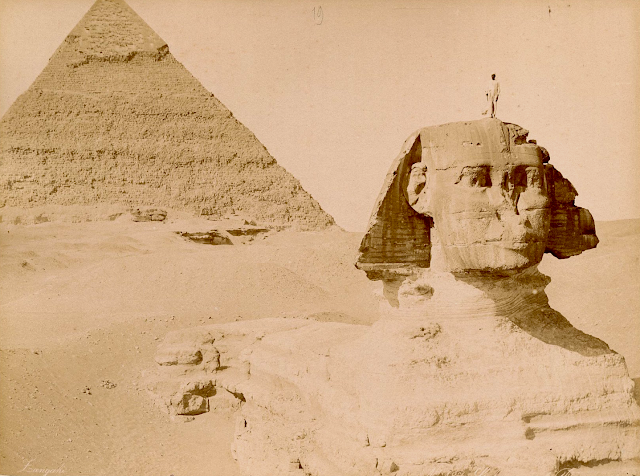
“At the foot of the pyramids stands the Sphinx, guardian of the sacred enclosure. It is rightly considered the most famous monument, after the pyramids, of this vast field of the dead, the Giza plateau. The Sphinx is a colossal statue carved in the rock that borders the desert plateau. It must originally have been a rough rock, to which nature had given the vague contours of a crouching animal. The artists of the Old Kingdom gave it the form of a lying lion, a symbol of physical strength, and sculpted a human head, an emblem of mental strength, that of the king, as indicated by the headdress decorated with the uraeus. This fourth wonder of Giza is located north of the Valley of King Chephren temple. (…)
An imposing expression of strength and grandeur remains in the whole, even after the deterioration that the monument has undergone over time: the beard and nose have been broken (part of it is preserved in the British Museum), the neck has shrunk; the mouth smiles, the eyes look into the distance, piercing infinity and the whole face bears the imprint of Egyptian beauty. The red tint that enlivened his features has been erased almost everywhere. No work coming from the hand of men offers more strength or sovereign grandeur. (…)
What is he doing there, this impassive being under the sky, lost in solitude? What is he doing there, this being who defies time and seems to say to passers-by: “You are all mortal, I am eternal”?
The ancient historians who visited Egypt gave no information or description about it. All their attention was devoted to the pyramids. Was the Sphinx already buried in the sand since it did not attract the attention of historians? To our knowledge, the first time it was dug out of the sand was under the New Kingdom. At that time, the ancient Egyptians who lived in the vicinity of the necropolis of Giza worshipped it as an image of the God Ra under the name of Hor-em-aches, that is to say, “Horus in the horizon”, or the rising sun. The stelae discovered near the great pyramids prove that the kings sought this region of the suburbs of Memphis for hunting wild beasts and gazelles. For this reason, the ancient Egyptians called it The Valley of the Gazelles. (…) Despite the mutilations of time and men, the Sphinx retains a mighty and terrible serenity that strikes and seizes to the depths of the heart. This calm and impassive figure, whose smile sometimes seems filled with disdain and pity, bears the imprint of great wisdom. His eyes fix the infinite on the side where the sun, creator of all things, rises as if he wanted to be the first to discover, in the morning, over the valley the apparition of Re. The whole evokes a sort of mystery, and the Sphinx retains a sovereign expression of strength and grandeur even in his distress. Faithful guardian of the sacred enclosure, he always watches over the foot of the Pyramids of Giza.
The artist who conceived this prodigious statue was already a complete artist and master of its effects in the beauty of the type, the grace of the expression and the perfection of the work. One never forgets, when one has seen them, the intensity and the depth of thought of these eyes that look so far beyond the reality of things. It imposes an indefinable fear, so much that its face remains impenetrable, and its empty eyes seem to keep the vision of a crowd of distant, unknown and terrible things. How many people have not passed before it, then vanished into time? How many, among humans, are in the presence of this symbol of mystery, and are they not tempted to say to it: “Ah, if you could speak and tell what these eyes have seen that look so far beyond the reality of things!” The Sphinx, Hor-em-aches, God of the Rising Sun, seems to be the ever-living soul of old Egypt.”
(extract from “La Revue du Caire”, n° 102, September 1947)
**********
A day in Egypt with… Léon Labat (1803-1847), a great traveller and former surgeon to the Viceroy of Egypt

“One of the most beautiful privileges of architecture is to reveal to posterity the particular character of each person. That of the Egyptians was austere like their customs: the style was simple but imposing and sublime. Their constructions were neither frivolous nor ephemeral like most of ours. Eternity was, for them, a cult whose dogmas they inscribed on the living pages of their gigantic monuments. Everything about them bore the imprint of a noble and thoughtful character. These people, who constantly meditated on the eternal works of God, tried to imitate them as if to come closer to their ancient origin. These monuments, which they would have liked to make imperishable, were to be the object of religious contemplation for present generations and posterity. Greece, Rome, and later our modern Athens erected temples to the gods, palaces to the kings, and circuses for the people’s amusement. To this triple purpose of utility, the Egyptians knew how to add another which constitutes the specific character of their architecture: their monuments, with broad bases and large surfaces, whatever their destination, were arranged in such a way as to receive their hieroglyphic inscriptions.
A religious and conservative principle thus attaching itself to the buildings which were erected from generation to generation, the long valley of the Nile was soon dotted with an infinite number of temples, mausoleums, obelisks, palaces and aqueducts which led water into all the cities. A noble sentiment of religious piety and respect for the dead made them undertake the most prodigious constructions which human power has ever attempted: their masses, which rose up to the heavens, gave birth in the spirit of these populations a feeling of meditation and recollection which we ourselves have deeply felt at the sight of the colossal pyramids of Memphis. Not content with honouring the gods and the memory of great men by erecting monuments to them, they also wanted to give the mortal remains of their parents an asylum of rest and eternal preservation: immense hypogea were dug into the sides of the mountains and into the bosom of the earth to house innumerable mummies which were for them a sort of protest against nothingness. All the actions of these virtuous people constantly recalled the worship of the divinity and the respect for the dead. This respect was such that the Egyptians buried in the tombs of their ancestors the different objects they had loved and the instruments that had contributed to their illustriousness. Finally, they pushed their gratitude for the works of God to the point of embalming and housing in the hypogea of various species of animals. One would be tempted to believe that they wanted to extend the dogma of immortality to all the beings that heaven had brought forth on the fortunate soil of Egypt.”
(extract from Ancient and Modern Egypt, 1840)
**********
A day in Egypt with… Jean Capart (1877-1947), Belgian Egyptologist
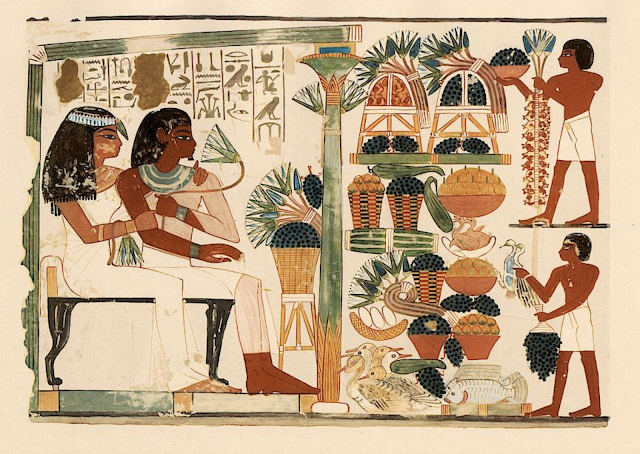
“Without wishing to settle the most severe problems of aesthetics, let us now ask ourselves if it is impossible to point out in a few simple facts what one could call the awakening of the feeling of beauty among the Egyptians. The first noticeable characteristic to underline is their extraordinarily developed taste for floral decoration. The Egyptians passionately loved flowers, yet the Egyptian flora was not wealthy. They used the lotus for the most diverse uses on feast days, hung garlands at the top of walls, hung the cornice of kiosks and canopies, surrounded vases, and made necklaces and crowns with it. Decorative art, here, only had to copy the usual forms to produce fixed decorations of great richness. Jewellery will remain faithful for a long time to nature’s forms, as rich as they are uncomplicated. Isn’t this love of flowers that can also be linked to the taste for brilliant and coloured materials that will be manifested in the pieces of jewellery with inlays, in the furniture combining materials of various colours, in the carpets and mats, whose repertoire is hugely varied? A thousand clues reveal to us the taste of the Egyptians for grace, elegance, and slenderness in feminine forms. Industrial art, in particular, has drawn from its remarkable types that transform an object of vulgar utility into an object that is truly beautiful or simply pleasant to look at. When the ancient workman gave a container for make-up the form of a young girl carrying a vase on her shoulder or of a swimmer who has seized a duck, he obviously wanted to do more than provide his customer with a container for make-up. The original aim has almost disappeared, and the manufacturer’s intention has focused primarily on creating a pretty object of nature to tempt the elegant woman whose artistic delicacy is thus awakened. In this case, we find ourselves in the presence of an artist who creates beauty and, of equal importance, of a clientele demanding artistic productions. When the Egyptians reproduced grotesque figures, such as that of the god Bes or foreign captives, they intended to provoke laughter or to bring out by contrast the superiority of beautiful and graceful forms.”
(extract from Egyptian Beauty, Advertising Office, 1942)
Posted on January 8th 2018, by Unknown
Labels: Ali Kamy (Mohammed) Capart Labat (Léon)
 lampmagician

Very nice
LikeLiked by 1 person
Thank you! 😊🙏
LikeLike
Reading this article about the ancient Egypt and the reflections about the meaning and the use of some images… I found it magnificent. Thank you!
LikeLiked by 1 person
It is very encouraging and very kind of you. You are highly appreciated.🙏🤙
LikeLiked by 1 person
Thank you so much for sharing this valuable post that I read with great interest and from which I learned a lot
LikeLiked by 1 person
Thank you, my dear Luisa, though it has a sad message about losing a good friend.💖🙏
LikeLike
A wonderful post and tribute to Marc. Thank you so much for sharing all this with us Aladin. Ancient Egypt obviously lived deeply inside Marc’s heart. Love and light, Deborah.
LikeLiked by 2 people
You say that, my dear Deborah. Sending gratitude and hugs.
LikeLiked by 1 person
Terrific! Thanks for posting this!
LikeLiked by 1 person
Thank You, my friend, for being there. 🙏🤙
LikeLike
How wonderful. I would love to actually see the Sphinx in Egypt – maybe one day..?
LikeLiked by 1 person
Maybe one day; please take me with you, dearest Chris. 🤗💖
LikeLiked by 1 person
Yes, we will walk together sometime!🥰😊
LikeLiked by 1 person
A rich, fascinating read! Thank you for sharing it. Jeanie
LikeLiked by 1 person
I think these fascinations are endless. Thank you, my dearest Jeane.🥰🌹🙏
LikeLike
A great post, Aladin, Thank you!
I learned a lot today, as I do whenever you publish articles about ancient Egypt.
I know I sound shallow, but I searched for articles on Cleopatra. I found only one, about whether a snake killed her. I remember that post.
So many kings and queens, why Cleopatra? I don’t know?
I celebrate with you the life of your friend, Marc Chartier!
May he rest in peace!
❦🌟💓🌹🕊🌸
LikeLiked by 2 people
Such a beautiful condolences, my dear Resa. Thank you so much. Honestly, I have the same feeling about Cleopatra and the snakes; maybe it is because of the influence of the tremendous monumental movie of the ’60s with Elizabeth Taylor, Rex Harrison, and Richard Burton…? Who knows!? Anyway, your kind words always make me happy and encourage me to keep going. Thank you!🌟🙏💖😘
LikeLiked by 1 person
Lol! I love that movie, “Cleopatra”.
I guess I think of Cleopatra as looking like Liz Taylor, as opposed to perhaps Liz looking like Cleopatra.
Anyway, losing a love, a kindred spirit, a good friend, and yes, sometimes even an adversary leaves emptiness, and intellectual disturbance.
My pleasure to stop by!
🌟🙏💖😘
LikeLiked by 1 person
You and your mind are always heartily welcome.🤗🙏💖😘😘🌹
LikeLiked by 1 person
💖😘😘🌹💖😘😘🌹
LikeLiked by 1 person
Thank you for sharing more Egyptian beauty and artistry. I don’t think I’ll get to Egypt in this life, but I wanted to go there after reading ‘Search in Secret Egypt’ by Paul Brunton.
LikeLiked by 2 people
It could also be my wish, though this post is more of a tribute to a dear lost friend, Marc Chartier. Thank you!
LikeLike