

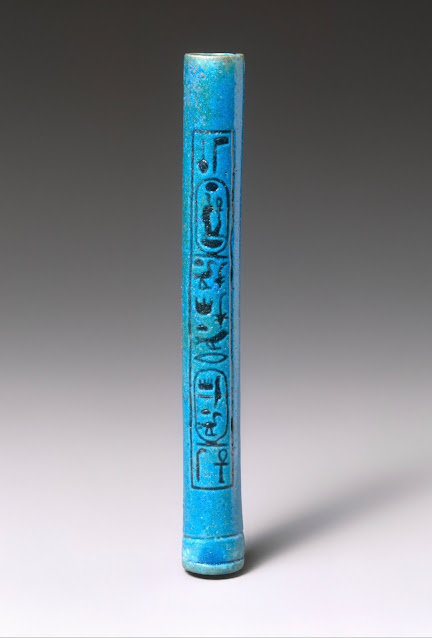
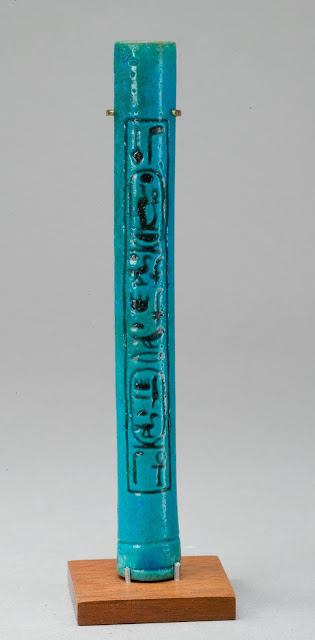
This is a deep blue glazed faience kohl tube. A column is inlaid with light blue on one side of the cylinder. This inscription is placed within a light blue frame. It reads, “The Good God, Lord of the Two Lands, Neb ma’at-re (Amenhotep III). The Kingdom, Wife Tiy, granted life.” A shallow indentation forms a border at the bottom of the tube. Condition: Small cracks at the bottom; blue glaze missing on half of the “neb” sign.
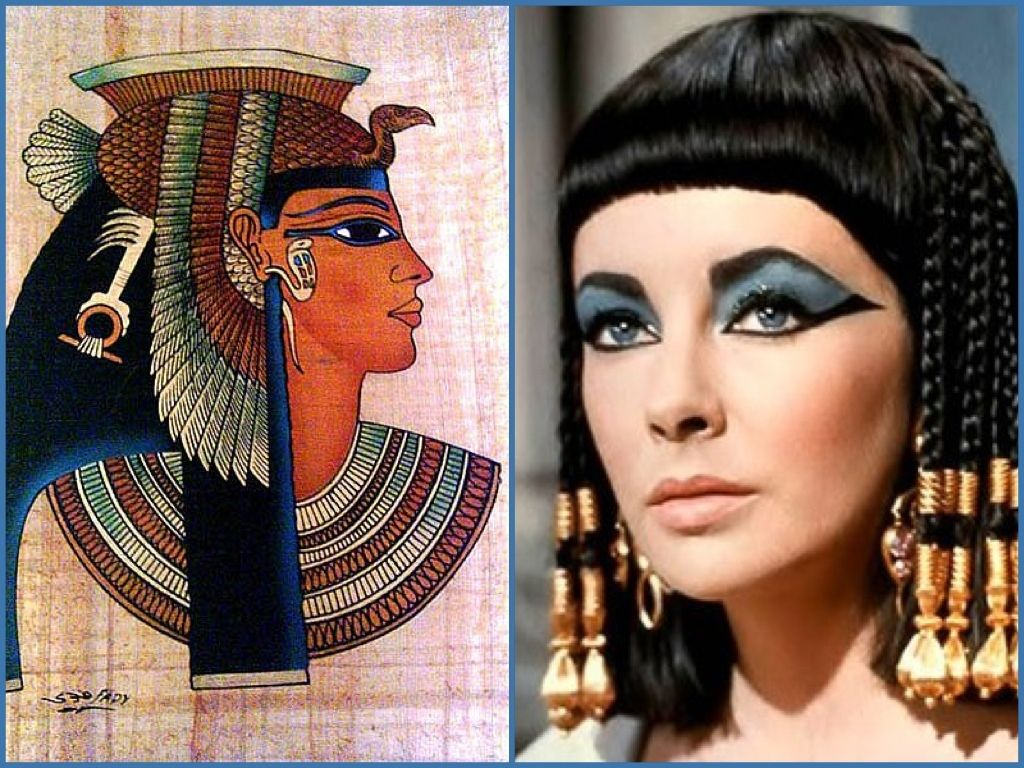
Here is another fascinating story by the brilliant lady Marie Grillot of a deity tube to help compare to divine beauty.
A kohol tube in the names of Amenhotep III and his daughter and wife Satamon…
via égyptophile
formerly in the collection of Reverend William MacGregor – acquired by Lord Carnarvon at Sotheby’s London in 1922
arrived at the Metropolitan Museum of Art in New York in 1926 by acquisition from the Carnarvon Collection – entry number 26.7.910
This delicate and elegant Egyptian earthenware kohol tube is 14.4 cm high and has a diameter of 1.8 cm. For Jeanne Vandier d’Abbadie (“Egyptian toilet objects at the Louvre Museum”), it was during the New Kingdom that kohol vases or pots which had varied shapes “were very often replaced by kohol tubes. This new form would have been introduced into Egypt under the reign of Tuthmosis III by the Asians. Indeed, it sometimes happens, from this time on, that the servants who assist the lady in her toilet have the Syrian type… These young foreigners hand their mistress the kohol tube into which the stylus is immersed…”
Originally, this tube was a simple Nile reed – hence sometimes its name “flute” -in the hollow of which the makeup was placed. For the wealthier classes of society, artisans were inspired by this natural element. They reproduced it more “luxurious” with more precious materials, ivory, for example, or, in this case, earthenware.
Kohl tube of Satamon, daughter and the great royal wife of Amenhotep III – earthenware – 18th dynasty
formerly in the collection of Reverend William MacGregor – acquired by Lord Carnarvon at Sotheby’s London in 1922
arrived at the Metropolitan Museum of Art in New York in 1926 by acquisition from the Carnarvon Collection – entry number 26.7.910
In ancient times, kohol was the makeup product par excellence; it was inseparable from the concept of beauty, intimately linked to the enhancement of the gaze. Its use has thus transcended these stretched eyes surrounded by black, which, even today, disturbs and fascinates. Made from powdered galena, it not only highlighted the intensity of the “Egyptian” gaze but also had, in this country where the light is so bright, the reverberation so intense, and the sun so burning, a protective function of the eye.
It was applied using a fine stylus – or stick. With a rounded head and a blunt tip, it could be made of hematite, wood (like ebony), ivory, and sometimes bronze or copper. No stylus is presented with this tube; one can imagine it has disappeared. Likewise, nothing indicates the presence or absence of a small “accommodation” fitted inside to store it. The sealing is also absent: in the more “rustic” models, it was done by a plug of fabric or wood.
Kohl tube of Satamon, daughter and the great royal wife of Amenhotep III – earthenware – 18th dynasty
formerly in the collection of Reverend William MacGregor – acquired by Lord Carnarvon at Sotheby’s London in 1922
arrived at the Metropolitan Museum of Art in New York in 1926 by acquisition from the Carnarvon Collection – entry number 26.7.910

In “Amenhotep III, the Sun Pharaoh”, Arielle P. Kozloff provides technical information on its creation: “The colour of the tube is medium blue, which suggests a copper base. This colour was used more frequently towards the end of the reign of Amenhotep III and during the Amarna period, unlike the cobalt-based blues that the king preferred. The dark-coloured inscription is undoubtedly cobalt-based.”
If the object is well made, the vertical inscription presented in a rectangle delimited by a black line in a column of delicate hieroglyphs is precious. Christiane Ziegler (“Queens of Egypt”) translates it thus: “The good god Nebmaâtre [Amenhotep III]; the king’s daughter, the Great Royal Wife Satamon, may she live.” She adds, “We noticed that the king’s name always accompanies that of the woman in his family mentioned on the kohol tubes.”
When we mention the wife of Amenhotep III, we immediately think of Queen Tiyi… Satamon (“The Daughter of Amon”) was the eldest daughter of Tiyi and Amenhotep III. However, explains Christian Leblanc in “Queens of the Nile”: “She distinguished herself especially towards the end of the reign of Amenhotep III by herself becoming the wife of her own father”.
Due to our current morality and contemporary conception of the family, understanding and admitting such a union is often tricky. However, well attested since at least the Middle Kingdom, this incest could only exist in the royal and divine world for reasons of an eminently sacred nature. Ordinary mortals did not practise it.

Petrie Museum, London – UC 14373 – museum photo
“The role of princesses was so important that two of them, Satamon and Isis, became ‘Great Royal Wives’ during the last decade of the reign, which in no way diminishes the status of Queen Tiya. Indeed, the “Theological model of divine families on which that of the king’s family was modelled favoured the adoption of different generations of women. Was Hathor not simultaneously mother, wife and daughter of the god Ra?” (Arielle P. Kozloff). Thus, different museums hold kohol tubes, identical or close to that of Satamon, with the names of Tiyi, of course, and Isis.
Its current history is found in the 20th century in the collection of Reverend William MacGregor (1848-1937). This vicar is a “prominent member of the Egypt Exploration Society and the Institute of Archeology of the University of Liverpool. He patronised numerous excavations, notably those undertaken by Naville, Garstang, and Petrie, for which he frequently and actively participated in the field. His remarkable collection of antiquities is unprecedented compared to any other private collection in England, Europe or America” was then specified in the introduction to the sales catalogue when he decided to separate it. One thousand eight hundred objects will be auctioned at Sotheby’s London from June 26 to July 6, 1922.

Reverend William MacGregor, vicar, prominent member of the Egypt Exploration Society, Institute of Archeology, University of Liverpool and patron of many excavations
(Liverpool, 16-5-1848 – Tamworth, 26-2-1937)
Satamon’s kohol tube, presented under lot 255, will be acquired by another great collector, Lord Carnarvon. The same year, it was among the artefacts lent by the British aristocrat for the “Exhibition of Ancient Egyptian Art” at the Burlington Fine Arts Club in London. Percy Newberry, responsible for writing the catalogue, describes it as follows under number 17: “Kohol tube – blue glazed earthenware -, with a vertical line of hieroglyphs in black, giving the names of Amenhotep III and the great royal wife, Sat-amon'”.
Lord Carnarvon died in Cairo on April 5, 1923, shortly after the discovery of Tutankhamun’s tomb. According to a codicil to his will, intended for his wife, Lady Almina, he had expressed his suggestions on the future of his collection in case she had to part with it, which she did, putting Howard Carter in charge of the negotiations.
Lord Carnarvon – George Edward Stanhope Molyneux Herbert, 5th Earl of Carnarvon
(Highclere – RU – 26-6-1866 – Continental-Savoy Hotel, Cairo, Egypt – 5-4-1923)
and his wife, Lady Almina

Thanks to the generosity of Edward S. Harkness, the Metropolitan Museum of Art in New York acquired it in 1926 for $145,000.
This is how this kohol tube bearing the names of Amenhotep III and Satamon arrived in the great New York Museum collections: it was registered under entry number 26.7.910.
Sources:
Kohl Tube Inscribed for Amenhotep III and Princess Sitamun https://www.metmuseum.org/art/collection/search/544512 Catalogue of the MacGregor collection of Egyptian antiquities, Sotheby, Wilkinson & Hodge, auction catalogue, sale dates: 26-30 June and 3-6 July 1922, London, 1922 https://www.abebooks.fr/edition-originale/Catalogue-MacGregor-collection-Egyptian-antiquities-Sotheby/31411328486/bd Percy Edward Newberry, Harry Reginald Hall, Catalogue of an Exhibition of Ancient Egyptian Art, London: Burlington Fine Arts Club, p. 34 no. 17, 1922 https://archive.org/details/catalogueofexhib00burlrich Rev William MacGregor https://www.tamworthheritagetrust.co.uk/articles/rev-william-macgregor Jeanne Vandier d’Abbadie, Egyptian toilet objects at the Louvre Museum, editions of the national museums, Paris, 1972
William C. Hayes, Scepter of Egypt II: A Background for the Study of the Egyptian Antiquities in the Metropolitan Museum of Art: The Hyksos Period and the New Kingdom (1675-1080 B.C.), Cambridge, Mass., The Metropolitan Museum of Art, p. 257, fig. 155, 1959
Christian Leblanc, Nefertari, “L’aimee-de-Mout”, Editions du Rocher, 1999 (pp. 185-186 on incest practised in the royal sphere)
Amenhotep III, the sun pharaoh, Meeting of National Museums, 1993
Christiane Ziegler, Queens of Egypt, Somogy éditions d’art, Grimaldi Forum, 2008
Christian Leblanc, Queens of the Nile, The Library of the Introuvables, 2009
Morris L. Bierbrier, Who Was Who in Egyptology, London, Egypt Exploration Society, 2012
Pierre Tallet, 12 queens of Egypt who changed history, Pygmalion, 2013
Published January 6 ago by Marie Grillot
 lampmagician
Your post reminded me that in Jordan, some years ago, I bought a wonderful jar of kohl, very artistic.
When I arrived in Italy my sons told me it might contain lead and forbade me to use it. It’s still there, looking at me from the locker and reminding me of my beautiful past trips
LikeLiked by 1 person
You have got a jewel, my lovely Luisa. However, your sons might be right. It is better to keep it on the ledge as a memory than to risk poisoning! 😉😅💖🙏
LikeLiked by 1 person
Thanks a lot for your kind and wise reply 💞
LikeLiked by 1 person
Thanks for sharing another of Marie’s fascinating posts on ancient Egypt, Aladin. I have to say I love the colour of this tube (I would call it turquoise but that may be my laptop!). What an amazing artifact, I’ve never seen one before. As men and women equally wore make up and jewellery in these ancient times, it’s fun to think that men possessed these kohl tubes too. Love and Egyptian delight, Deborah.
LikeLiked by 2 people
They are definitely turquoise and a deeply saturated unforgettable color.
LikeLiked by 2 people
I agree with you completely, my dear Deborah. The colour is turquoise, without a doubt. In any case, ancient Egypt was much more civilized than modern man, I must admit! Thank you, my beloved angel.🤗💖🦋🙏
LikeLiked by 1 person
I love these. I’ve seen a collection at the Metropolitan Museum of Art in New York City and another at the Penn State Museum in Philadelphia. The color is astounding. As I recall, they held kohl and perfumes.
LikeLiked by 2 people
That is right, dear Elaine. You have seen the original, and it makes me jealous!!😉😅 Thank you for your visit, dear friend.🙏💖
LikeLike
By the way, I still haven’t received your last article, First Spring Butterfly. I know this because I always receive double posts from your site, one from https://follow.it/, where I can’t do anything and see only the text, and another one in a typical form from WP. Now I have the one from Follow It/, but not the latter one. I hope it will come one day!!😅
LikeLike
The pigment and the colour is gorgeous! Wow. 🩵🖤
LikeLiked by 1 person
Ancient Egyptians knew the magic of colours very well, didn’t they? Thank you, my lovely Chisel, for pointing out this splendor.😊🙏🥰
LikeLiked by 1 person
Wow this is such a beautiful colour – it never fails to amaze me how such small objects made of such fragile materials survive over so many years intact. Thank you for sharing this Aladin.
LikeLiked by 2 people
That is the luck we have to see these exceptional phenomena. I hope people appreciate them and keep them safe. Thank you, dear Lin, for being there.🙏💖🌹
LikeLiked by 1 person
💙
LikeLiked by 1 person
💚💛
LikeLike