
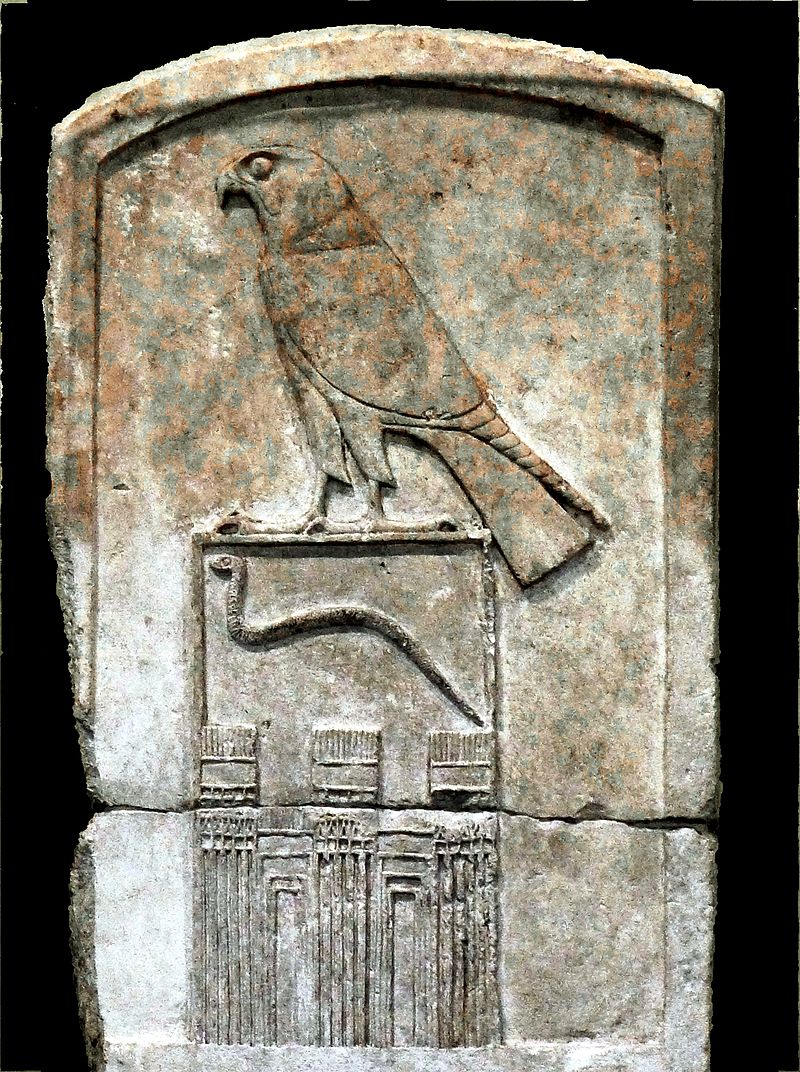
It is unimaginable that this Stele is over five thousand years old. Thanks to human curiosity and the joy of discovery, fascinating artefacts continued to appear.
Djet, also known as Wadj and Zet, was the fourth pharaoh of the First Dynasty and Djer’s successor. Djet’s Horus name means “Horus Cobra” or “Serpent of Horus. “.
Here, we read the story of this huge ancient stele by brilliant Marie Grillot, which shows humans merging with the divines.
The title image: Wikipedia
At the Louvre, the stele of Djet, the “Serpent King”
via: égyptophile

Necropolis of El-Araba el-Madfouna – Oumm el-Qaab – by Émile Amélineau during the excavations of 1895 – 1896
Department of Egyptian Antiquities of the Louvre Museum E 11007
(by acquisition in November 1904 in Drouot of lot 303 of the Amélineau sale)
photo © 2023 Louvre Museum / Maurice Chuzeville
This large limestone stele, with a current height of 1.43 m and a width of 0.65 m, is one of the oldest monuments in the Egyptian department of the Louvre Museum.
It is dated 3100 – 2900 BC. It comes from the tomb of one of the founding sovereigns of the 1st dynasty and thus bears witness, with elegance and sobriety, to a page of history 5000 years old.
It was discovered in 1895 – 1896 by Émile Amélineau. This Egyptologist, a graduate of the École Pratique des Hautes Études where his teachers included Gaston Maspero and Eugène Grébaut, and also a member of the French Archaeological Mission in Cairo, returned to Egypt in November 1895 to carry out research excavations on a site that he does not yet know… “It was not without great apprehension that I agreed to go and excavate the necropolis of Abydos: the shadow of the great Mariette seemed to guard it against any rash attempt, and I knew, having read his works, that he had searched it for eighteen years. From then on, I wondered what I could discover in such circumstances because I had never been to Abydos… Therefore, I set to work with ardour, and he relates this ardour I preserved during the five months that “the campaign lasted, despite many setbacks and disappointments ” in “The New Excavations of Abydos”.

“New excavations of Abydos … full account of the excavations
description of the monuments and objects discovered” in 1899
In the necropolis of El-Araba el-Madfouna, “Oumm el-Qaab” (the “Mother of jugs” or “Mother of pots”), of which Jacques de Morgan had granted him the concession, he brought numerous tombs to light – with the help of more than 450 workers! – and several royal burials from the “Thinite” period (- 3100 – 2700 BC). “To the west of the large hill, almost perpendicular to the tomb of Osiris and in the first line”, he relates, he discovers that of the one he will identify as “the Serpent King, whom others have called Dja, or even Djet”. Son and successor of Djer, he was the fourth sovereign of the 1st dynasty and the father of Den, to whom he left power.
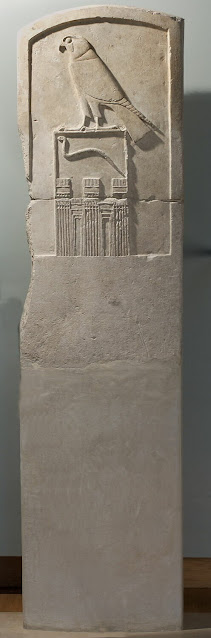
This royal tomb – later referenced as “Z” – notably contained this stele, broken into three pieces. “The lower fragment, undecorated, must have been left on site. The stele, which measured 2.50 meters or 2.60 meters in its original state, was significantly more slender. Sculpted in relief on a recessed background, the name of the sovereign is written, one of his names rather, since the kings of the time generally had two,” specifies Jean-Louis de Cenival in “A century of French excavations in Egypt, 1880 -1980”.

Stele of the Serpent King – limestone – circa 3100 – 2900 BC – discovered at Abydos, in the royal tomb (“Z”) of Djet
Necropolis of El-Araba el-Madfouna – Oumm el-Qaab – by Émile Amélineau during the excavations of 1895 – 1896
Department of Egyptian Antiquities of the Louvre Museum E 11007
(by acquisition in November 1904 in Drouot of lot 303 of the Amélineau sale)
published by Émile Amélineau in “The new excavations of Abydos, Report of the excavations of Abydos, 1896-1898”)
In “Ancient Egypt at the Louvre”, Christiane Ziegler makes this enlightening reading: “The sovereign image of a large falcon dominates that of a snake framed by the enclosure of a fortress; the whole reads like a royal name, the name of the Serpent King. The falcon is the personification of the god Horus, protector of royalty. The serpent is the hieroglyph reading DJ or the sign used to write the name of the cobra. The enclosure is the image of the palace, with its raw brick walls reminiscent of a fortress with defence towers; the walls, pierced with high doors, present a succession of projections and recesses crowned with a cornice “.
For Georges Bénédite (“The so-called stele of the Serpent King” ): “It is logical to consider the building illustrated by the serekh as the residence of the Double, that is to say, the Tomb”… In “The Serekh as an Aspect of the Iconography of Early Kingship”, Alexandra A. O’Brien gives us these precious explanations: “The serekh is a way of writing the king’s name. It is generally made up of three elements: at the bottom, a part of the facade in a niche; above, a panel on which the king’s name is written; and, seated on it, a falcon. This is the ‘classic’ model. Sometimes, the falcon is joined by a Sethian animal, replaced by another, completely absent, or joined by a second falcon. This may seem like a simple motive, as the implication of each element is quite easy to explain. The facade of the niches probably represents a large building associated with the king – his palace perhaps or his tomb, and either would serve to represent the wealth, power and authority of the monarch”…
Stele of the Serpent King – limestone – circa 3100 – 2900 BC – discovered at Abydos, in the royal tomb (“Z”) of Djet
Necropolis of El-Araba el-Madfouna – Oumm el-Qaab – by Émile Amélineau during the excavations of 1895 – 1896
Department of Egyptian Antiquities of the Louvre Museum E 11007
(by acquisition in November 1904 in Drouot of lot 303 of the Amélineau sale)
photo © 2002 Louvre Museum / Christian Décamps
During these three excavation missions from 1895 to 1898, Émile Amélineau discovered hundreds, even thousands of artefacts. According to the legislation in force (law on antiquities of 1891), they were distributed between Egypt and the “digger” during a “division carried out in Abydos under the supervision of Jquier, who replaced Morgan, who was bedridden at this period”, specifies Marc Étienne in “Émile Amélineau (1850-1915). The misunderstood scholar”.

Émile Amélineau, Egyptologist
(La Chaize-Giraud – Vendée, 28-8-1850 – Châteaudun – Eure-et-Loir – 12-1-1915)
The missions have been financed by a company of shareholders (bankers, collectors, etc.), and they expect a fair return on their investments… On his return to France, Émile Amélineau is responsible for selling the artefacts to be able to compensate them. But, faced with the difficulties encountered and the sales deadlines, which promise to be long, he will be forced to reimburse the investors, thus becoming the owner of all the objects brought back. The transactions he then pursued, notably with the Louvre to which he hoped to sell the entire collection, for obscure reasons, did not succeed… Finally, the Egyptologist decided to put his collection up for public sale at the Hôtel Drouot in Paris on November 3 and 4, 1904… “Due to the clauses of the shareholders’ company, three groups were formed by the remains unearthed during the excavations; this is what Amélineau designated in 1904 in the preface to the sales catalogue by the terms ‘first, second and third collection’, designating respectively the product of the excavations of the campaigns of winter 1895 – spring 1896, winter 1896 – spring 1897 and finally winter 1897 – spring 1898 (Amélineau sale, 1904)” specifies Marc Étienne.
Stele of the Serpent King – limestone – circa 3100 – 2900 BC – discovered at Abydos, in the royal tomb (“Z”) of Djet
Necropolis of El-Araba el-Madfouna – Oumm el-Qaab – by Émile Amélineau during the excavations of 1895 – 1896
Department of Egyptian Antiquities of the Louvre Museum E 11007
(by acquisition in November 1904 in Drouot of lot 303 of the Amélineau sale)
photo © 2002 Louvre Museum / Christian Décamps
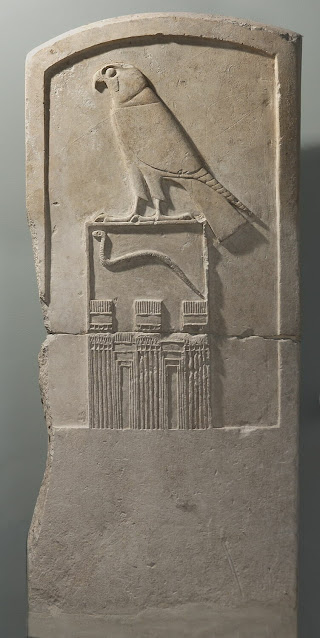
At this sale, the Louvre Museum will acquire this stele of King Serpent, presented under number 303. Thus, it will enter its collections under inventory number E 11007.
sources:
Stele of the Serpent King https://collections.louvre.fr/ark:/53355/cl010012035
Émile Amélineau, The new excavations of Abydos, Report of the excavations of Abydos, 1896-1898, Imprimerie A. Burdin, Angers, 1896 https://archive.org/details/lesnouvellesfoui00am/page/n5/mode/2up
Émile Amélineau, Mission Amélineau. The new excavations of Abydos, 1895-1896, full report of the excavations, description of the monuments and objects discovered (September 1, 1898) https://gallica.bnf.fr/ark:/12148/bpt6k58048302/f438.item.r=jeu
Émile Amélineau, New excavations of Abydos … full report of the excavations, description of the monuments and objects discovered, Ernest Leroux Editeur, Paris, 1899 https://archive.org/details/nouvellesfouille00amel/page/n11/mode/2up
Amélineau sale – Egyptian antiquities found in Abydos. Ivories, carved wood, enamelled earthenware, amulets, scarabs, funerary statuettes, gold and bronze objects, flint, terracotta, and pottery, various sculptures, hard stone vases and cups, steles, tables, and fragments with hieroglyphic inscriptions, etc. Hôtel Drouot Paris, February 8-9, 1904 https://gallica.bnf.fr/ark:/12148/bpt6k1247688b/f6.item
Émile Amélineau, The new excavations of Abydos 1897-1898, Ernest Leroux Editor, Paris, 1905 https://gallica.bnf.fr/ark:/12148/bpt6k58048302/f438.item.r=jeu
Georges Bénédite, The so-called stele of the Serpent King (Louvre Museum), Monuments and memories of the Eugène Piot Foundation, volume 12, fascicle 1, 1905. pp. 5-18 https://doi.org/10.3406/piot.1905.1260 https://www.persee.fr/doc/piot_1148-6023_1905_num_12_1_1260
Christiane Desroches Noblecourt, Jean Vercoutter, A century of French excavations in Egypt, 1880 – 1980, cat. exp. (Paris, Musée d’Art et d’Essai, Palais de Tokyo, May 21 – October 15, 1981), Cairo, French Institute of Oriental Archeology (IFAO), 1981, p. 6, illus. p. 6, no. 2 Alexandra A. O’Brien, The Serekh as an Aspect of the Iconography of Early Kingship, Journal of the American Research Center in Egypt Flight. 33, 1996, pp. 123-138 (16 pages) https://www.jstor.org/stable/40000610
Guillemette Andreu, Marie-Hélène Rutschowscaya, Christiane Ziegler, Ancient Egypt at the Louvre, Paris, Hachette, 1997, p. 43; 250-251 Marc Etienne, Émile Amélineau (1850-1915). The misunderstood scholar, Archéonil, 17, 2007, p. 27-38, p. 30, fig. 4 https://www.persee.fr/doc/arnil_1161-0492_2007_num_17_1_929
Publié il y a 29th December 2023 par Marie Grillot
Libellés: 1895-1896 1904 3100 – 2900 av. J.-C. Abydos Den Djer Djet Drouot dynastie I E 11007 El-Araba el-Madfouna lot 303 Louvre Oumm el-Qaab stèle roi Serpent thinite tombe “Z” Émile Amélineau
 lampmagician
What a truly impressive artifact! To be honest I didn’t notice the serpent but rather the Falcon. Naturally Horus comes to mind. Thank you for sharing another excellent article, Aladin.
LikeLiked by 2 people
Thank you, my angel. Ancient Egypt is famous for using many animal heads, mostly from birds. Anyhow, it is fascinating.💖🙏
LikeLiked by 1 person
Another fascinating article Aladin…thousands of artefacts all discovered all at once is quite a find! I am amazed he had problems selling them but thank goodness museums purchased them so that they can be shared with the world.
LikeLiked by 2 people
Although Egyptology has become a dirty business for some decades, it is just as accurate. I learned this because I tried to coordinate in different groups. It is sad, but we will strive to maintain the truth.🥰🙏💖😘
LikeLiked by 1 person
This is terrific!
LikeLiked by 1 person
Indeed! Thank you, mate.
LikeLike
How wonderful they look – the Falcon and the Serpent.
LikeLiked by 1 person
Oh yes! They knew what kind of wise animals to choose!😉Thank you!🤗🙏💖
LikeLiked by 1 person