
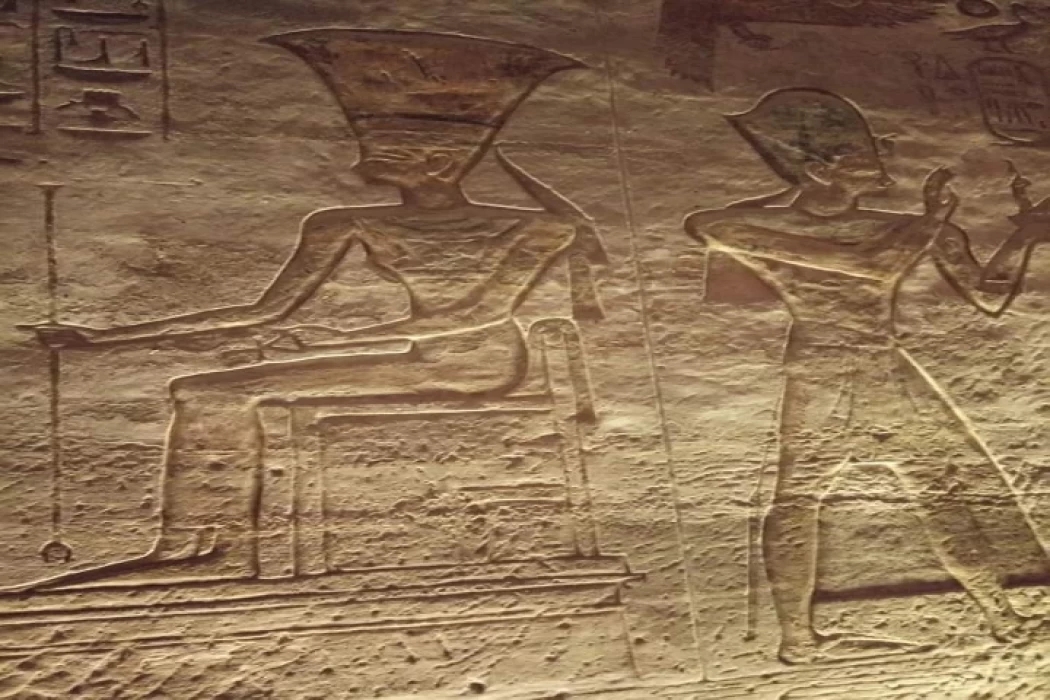
As we continue researching the precious heritages of ancient Egypt, we find more and more feminine Myths of the Goddesses!
Here is another one: Anuket, Anouket, Anukis, the Goddess of Nil.
Anuket (or Anukis, her Greek name) is a Nubian goddess, represented as a lady with a crown of feathers or reeds, with a sceptre, and the well-known ankh of Ancient Egyptian culture. Her name means “she who embraces”, and she was venerated in Sehel and Elephantine. Cairo


Anuket, in Egyptian religion, is the patron deity of the Nile River. Anuket is usually depicted as a beautiful woman wearing a crown of reeds and ostrich feathers and accompanied by a gazelle. She was initially a Nubian deity.
Here, we read an article about a beautiful emblem of this fascinating Goddess by the brilliant Marie Grillot.
I wish everybody a leisurely and peaceful Merry Christmas.💖🌹🥰
This emblem of Anouket in the Louvre attests to her cult in Deir-Medineh
via égyptophile
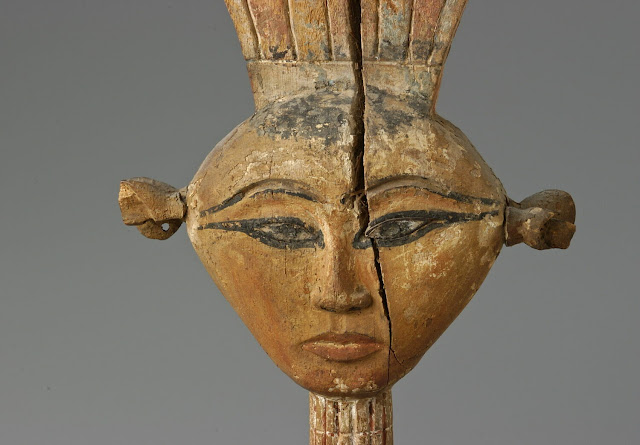
from Deir el-Medineh – Department of Egyptian Antiquities of the Louvre Museum – N 3534
by acquisition of the Salt Collection in 1826 (Salt n°559) – © 2006 Musée du Louvre / Christian Décamps
Associated with the god Khnum and the goddess Satis, Anouket (Anoukis) is the third divinity of the triad of the First Cataract, or Elephantine triad. She is generally presented as “the daughter of the divine couple” or even “the wife of the god”.
In “Ancient Egypt and its Gods”, Jean-Pierre Corteggiani specifies that one of her titles is: “Mistress of To-Seti, that is to say of Nubia; she is sometimes called the Nubian, although there is no evidence that it actually originated in this region, one of its functions is to guard the southern border of Egypt… And he adds, “As a text from the temple of Edfu clearly explains, if it is up to Satis, assimilated to Sothis, to raise the beneficial flow, it falls to Anoukis (Anouqis) the equally essential task of reduce and thus allow, after the flood has receded, seeds to germinate and vegetation to grow on the land released by the waters.” Therefore, it depends on the food and subsistence of an entire people, a whole country… This can explain the reason for the spread of its cult towards the north, notably to Deir el-Medineh, where it was probably introduced “by the workers who worked in the granite quarries of Aswan.

“Two-faced” emblem of Anouket (Anoukis) – painted wood (tamarisk and shea) – 19th dynasty (around 1295 – 1186 BC)
from Deir el-Medineh – Department of Egyptian Antiquities of the Louvre Museum – N 3534
by acquisition of the Salt Collection in 1826 (Salt n°559) – © 2006 Musée du Louvre / Christian Décamps
Between the high walls of “Set Maât her imenty Ouaset” (“the Place of Truth to the west of Thebes”, today’s Deir el-Medineh), they lived between 60 and 120 families dedicated to digging and decorating tombs of royal necropolises. They had stone houses covered with palm leaf roofs, their own necropolis, and places of worship. Amon, Ptah, Meretseger, and Hathor were celebrated there, but other divinities also had their place. Indeed, as Guillemette Andreu points out in “The Artists of Pharaon”, “Khnoum and his two consorts, Satis and Anoukis, enjoyed great favour in the community, without us knowing if a particular sanctuary was built for them. Likely, one of the numerous devotional chapels located north of the site was occasionally used as a place of worship, but these cults appear essentially private and domestic.
“Two-faced” emblem of Anouket (Anoukis) – painted wood (tamarisk and shea) – 19th dynasty (around 1295 – 1186 BC)
from Deir el-Medineh – Department of Egyptian Antiquities of the Louvre Museum – N 3534
by the acquisition of the Salt Collection in 1826 (Salt n°559)
published here by Dominique Valbelle in BIFAO 75, 1975

This “two-faced” emblem of Anouket made “For the ka of the servant in the Place of truth, Pached, acquitted”, testifies to this cult. On the other hand, in their “Guide to Deir el-Medina”, Guillemette Andreu and Dominique Valbelle recall that “the procession of the emblem of Anouqet is represented in the chapel of the tomb of the team leader Neferhotep”.
Two things are striking in the representations of Anouket: her very particular headdress, we will come back to it, and, more strikingly, her resemblance to Hathor. “As D. Valbelle has shown, this object, whose appearance evokes that of a hathoric sistrum, illustrates a syncretism between Ânouket of Elephantine and Hathor of Diospolis Parva in the context of a local cult in Deir el- Medineh” recalls Christophe Barbotin in “Egyptian statues of the New Kingdom”.

from Deir el-Medineh – Department of Egyptian Antiquities of the Louvre Museum – N 3534
by acquisition of the Salt Collection in 1826 (Salt n°559) – © 2006 Musée du Louvre / Christian Décamps
It is made from tamarisk wood, is 27.5 cm high and 13.5 cm wide, and rests on a shea tree base. The support, comparable to a fluted column, is surrounded by horizontal lines. The head surmounts it – in fact, two heads, reproduced identically, “back to back” – of the Goddess. Her face takes the shape of a diamond with rounded contours. The widest part is at the level of the cow’s ears and the thinnest at the chin level. Her large eyes, stretched with a line of makeup, are painted black with a large dark iris, which leaves little space for the white of the eye. They are topped over their entire length by very arched eyebrows, hollow and encrusted with a black material. The nose is flat, and the mouth with drooping corners displays a slight difference on the two sides, one of the upper lip being thinner. The left side of one of the two faces is marked with a long and painful scar.

“Two-faced” emblem of Anouket (Anoukis) – painted wood (tamarisk and shea) – 19th dynasty (around 1295 – 1186 BC)
from Deir el-Medineh – Department of Egyptian Antiquities of the Louvre Museum – N 3534
by acquisition of the Salt Collection in 1826 (Salt n°559) – © 2006 Musée du Louvre / Christian Décamps
Anouket’s main attribute, which makes her immediately identifiable, is her high and generous headdress made of ostrich feathers. Christophe Barbotin precisely describes this: “The mortar, painted red with vertical white lines, is topped with feathers with traces of blue and red paint (seven feathers on each side, three on each edge). It is placed on a black-painted cap visible at the top of each face but not on the sides. The top of the feathers constitutes a perfectly flat surface.
“Two-faced” emblem of Anouket (Anoukis) – painted wood (tamarisk and shea) – 19th dynasty (around 1295 – 1186 BC)
from Deir el-Medineh – Department of Egyptian Antiquities of the Louvre Museum – N 3534
by acquisition of the Salt Collection in 1826 (Salt n°559) – © 2006 Musée du Louvre / Christian Décamps

This Anouket emblem dates from the 19th dynasty (c. 1295 – 1186 BC). It arrived at the Louvre Museum in 1826 through the acquisition by Charles X – for the sum of 250,000 francs – of the collection of the British consul Henry Salt. Jean-François Champollion will also go to Livorno to draw up a descriptive inventory of the 4014 objects, this one bearing the number 559. In his “Descriptive note of the Egyptian monuments of the Charles X Museum” (1827), he will present it under A.136, “Painted wood. Symbolic head of the goddess Anouké”. Today, it is exhibited in the Sully wing, in room 336, dedicated to the Nile, under inventory number N 3534.
Sources:
Anouket Emblem https://collections.louvre.fr/ark:/53355/cl010024883 Jean-Pierre Corteggiani, Ancient Egypt and its gods – Illustrated dictionary, Fayard 2007
Sylvie Guichard, Jean-François Champollion, Descriptive notice of the Egyptian monuments of the Charles 87-88, illus. p. 88, A. 136
Guillemette Andreu, The artists of Pharaon. Deir el-Medina and the Valley of the Kings, RMN; Brepols, 2002, p. 273, ill. p. 272, no. 221a -Andreu, Guillemette; Valbelle, Dominica, Guide to Deir el-Medina. A village of artists, Cairo, French Institute of Oriental Archeology (IFAO), 2022, p. 150, fig. 131 – Barbotin, Christophe, Egyptian statues of the New Kingdom, 1, Royal and divine statues, [Louvre Museum, Paris], Paris, Louvre éditions / éditions Khéops, 2007, p. 146-147, figs. 1-15 p. 238-241, no. 85
Dominique Valbelle, Testimonies of the New Kingdom on the cults of Satis and Anoukis at Elephantine and at Deir el-Médineh, Bulletin of the French Institute of Oriental Archeology (BIFAO), 75, 1975, p. 123-145, https://www.ifao.egnet.net/bifao/75/7/, p. 141-145, figs. 7, pl. XXI-XXIIII, Doc. 10 Jean-François Champollion, Descriptive notice of the Egyptian monuments of the Charles X Museum, Paris, Imprimerie de Crapelet, 1827, p. 7, A.136 https://gallica.bnf.fr/ark:/12148/bpt6k1040365n
Publié il y a 15th October par Marie Grillot
Libellés: 1826 Anoukis bois Collection Salt Deir el-Medineh Emblème; Anouket karité Louvre N 3534 Salt n°559 tamaris
 lampmagician
💛
LikeLiked by 1 person
🙏💖
LikeLike
Thanks a lot for such a fantastic article.
I loved it so much 🙏
Best wishes for a joyous Christmas filled with love, happiness, and prosperity!✨
LikeLiked by 1 person
All the same back to you, dear Luisa, from the bottom of my heart.💖🙏🎅🌹🌟💥
LikeLiked by 1 person
You’re more than welcome
/\
//\\
///\\\
][
LikeLiked by 1 person
Fantastic post and a great read!
LikeLiked by 1 person
Indeed, it is an excellent reportage. Thank you, dear friend; I really appreciate your support. Have a great Christmas.
LikeLiked by 1 person
You’re more than welcome! Merry Christmas to you, too!
LikeLiked by 1 person
🙏💥👍
LikeLiked by 1 person
😀
LikeLiked by 1 person
I am smitten with the Nile river!
LikeLiked by 1 person
Agreed! This can be called the vein of the earth. Have a lovely feast, my dear Chris.💖🥰
LikeLiked by 1 person
As always this is a wonderful Ancient Egyptian post. I love the attention to detail that Marie presents us and all those amazing photos. She seems so dedicated to sharing information about these artefacts, and you’ve obviously held a deep interest in this field for many years too, Aladin.
This Egyptian mask leaves me thinking of the Roman God Janus (and January) as he was the god of beginnings, gates, transitions, time, duality, doorways, passages, frames, and endings. Thus, this “Two-faced” emblem of Anouket, fits perfectly with the forthcoming New Year. Love and light, Deborah.
LikeLiked by 1 person
My dear, lovely Deborah, you have opened another door for me again! I remember this Janus mask, which I saw once, and how it fits to bring hope and equality (understanding duality and finding the gates and transitions) for the following year. Love to you, my dear angel.💖
LikeLiked by 1 person
So the ancient Egyptians adopted her from Nubia! Fascinating!!
LikeLiked by 1 person
That’s definitely my opinion, too! Thank you, Brother.🤙🖖🙏
LikeLike
Such a fascinating collection, my dear friend, and you honoured me again. I am sending you my immense gratitude.🙏🙏💖
LikeLike