

“The monotony and loneliness of a quiet life stimulate the creative mind” A. Einstein.
Loneliness, happiness, happiness in loneliness? It is an exciting issue which caught my eye as I saw this article by Marina Moscha. I never want to say I am an intellectual or to talk about my IQ (I think it is not more than 160!), but I found something very in common with such intelligent people; I find my happiness in my solitude 100% for sure!
Here, I would like to share this article with my intellectual friends, along with my best wishes.💖🙏🦋
Mark Zuckerberg (the 32-year-old creator of Facebook) said in an interview with the New York Times that he considers himself shy and introverted and prefers to hang out only with people like him.
A new study has found that people with high IQs tend to spend less time with close friends and have difficulty socializing.
Evolutionary psychologists from Singapore and London have found that intelligent people struggle to interact socially, even with close friends.
“What makes people happy today?” – How is happiness measured?
Satoshi Kanazawa of the London School of Economics & Political Science and Norman Li of the University of Singapore Administration wanted to answer the question, “What makes people happy today?”
Scholars assume that the way of life of our ancestors, who were hunter-gatherers, is the cornerstone of the perception of today’s happiness.
So, they studied 15,000 people aged 18 to 28 years. The couple found that people living in densely populated areas were more likely to report less satisfaction with their lives than those living in more sparsely populated areas. In other words, the higher the population density, the less happy they said being participants.
The researchers also found that respondents’ more significant interaction with close friends gave them more joy.
So, they applied the concept of “The Savanna Theory of Happiness” to explain their findings. The results, however, surprised them as the correlations for intelligent people were reversed.
“The Swiss psychiatrist and writer Elisabeth Kübler-Ross has stated quite rightly: The most beautiful people are those who have known defeat, pain, struggle, and loss and found their way. These individuals have an appreciation, sensitivity, and an understanding of life that fills them with compassion, kindness, and a deep love interest. In other words, good people were not born good – they chose to be.“
I prefer to be alone!

The team measured people’s intelligence and ingenuity even though they did not reveal the exact levels of their IQ (respondents’ IQ). The two researchers found that the effect of population density on life satisfaction was more than twice as high for people with a lower IQ than for people with a high IQ.
In fact, the most intelligent people were less satisfied with their lives when they were forced to socialize, even with their closest friends.
In other words, intelligent people tend to need more time and isolation. If they spend too much time with friends, they feel less satisfied with their lives.
Carol Graham of the Brookings Institution, an expert on the economics of happiness, explains:
“The findings here show – and not surprisingly – that people with greater intelligence and the ability to use it. They are less likely to spend so much time socializing because they focus on other long-term goals. “
In other words, the most intelligent person might prefer to spend their time evolving their science or knowledge or even taking part in organizations with goals rather than feeling that she/he is wasting their time with socialization. , which not only does not offer them anything since it does not evolve this way but on the contrary, it hinders them as they abuse their “useful” time, which could be much more creative.

The relationship with our prehistoric ancestors
However, Kanazawa and Li’s explanation of the “happiness theory” is as follows:
They begin with the assumption that the human brain evolved to meet the demands of the then-primitive environment in the African savannah, where population density was similar to that of rural Alaska, with less than one person per square kilometre.
Our prehistoric ancestors, who were hunter-gatherers, lived in small groups of 150 people, where to survive and reproduce, they had to have as friendly relations with each other as possible.
Researchers have concluded that intelligent people may be better equipped to cope with the evolutionary changes of modern living in a densely populated area, with less and less impact on overall mood and well-being.
The study, meanwhile, states that it determines happiness in terms of self-reported satisfaction rather than the more objective sense of well-being or happiness through sentences such as: “When was the last time a person laughed?” Or “How many times did he get angry last week, since this definition does not matter to their theory. The Savanna Theory of Happiness is not bound by a specific purpose as it is compatible with any rational conception of happiness, with subjective well-being and life satisfaction.
The study was published in the British Journal of Psychology.
Marina Moscha (Μαρίνα Μόσχα)
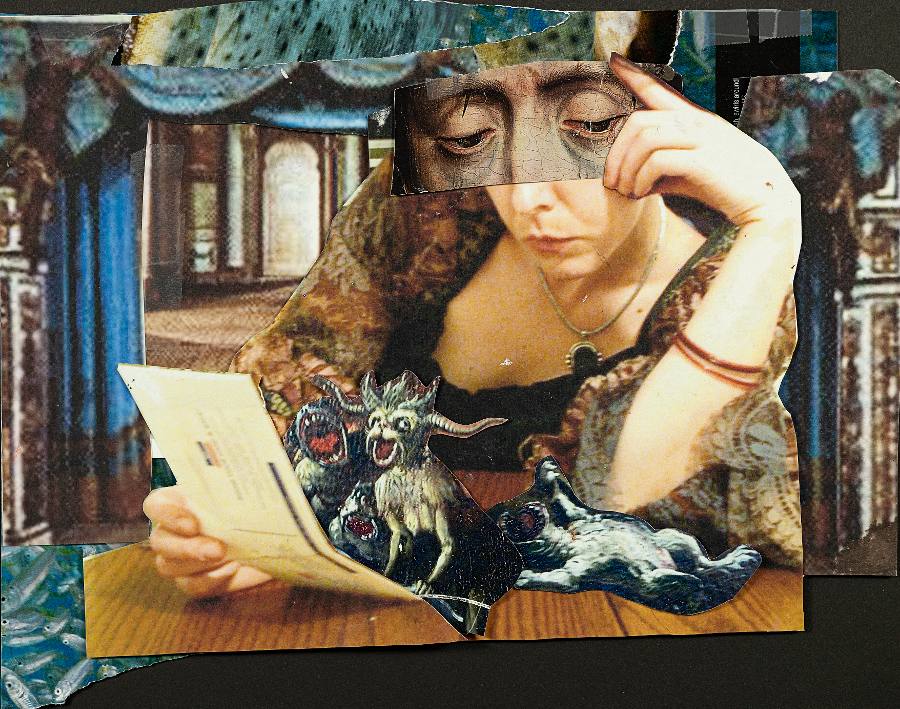
The art images are all by Carrie Ann Baade.
source: https://marinamoscha.life /
With thanks to SearchingtheMeaningofLife
 lampmagician

People 18 to 28? That’s who they studied? At that age I was halfway through grad school in nuclear engineering (plasma physics) and there wasn’t time for much socializing but we did it with the other grad students and never thought we were particularly unhappy, just that the work we had chosen was hard. And I chose it – one of the few women to do so – because I could, and it seemed a waste not to.
I read a lot, had a large family to go back to in Mexico periodically, and proceeded with life. I still do.
If Illness didn’t leave me so bereft of energy, I would do a lot more. I stay in contact with friends all over the world by computer.
LikeLiked by 1 person
Apologies! It was my fault – the window I was reading in was off the bottom of my screen. All is NOT fouled up. All is well.
LikeLiked by 1 person
Still, it was a pleasant memory from you. However, I am sorry for your discomfort. Thank you! 🙏💖
LikeLike
Kind of you. It just seemed an odd group to study – most people are quite unformed at that age.
LikeLiked by 1 person
You said that!🤙💖
LikeLike
An interesting article, thank you Aladin. Me, I would describe myself as a happy introvert, one who enjoys her own company and others company (not large groups I hasten to add). I balance my time between ‘being alone’ and ‘being together’ very well. That way my life is sweet and I am happy. Love and light, Deborah.
LikeLiked by 1 person
Very wise! That’s also my point of view. 🤗🙏
LikeLiked by 1 person
I found the article very interesting. I like being alone: just think that after two weeks at the spa surrounded by somewhat superficial people I couldn’t wait to come home, where being in the company of my Sissi is delightful🐾🐾
LikeLiked by 2 people
You got the point! We must know that we are some individuals in the mass and have to know our places where we are staying. 🤗❤️👍🙏
LikeLiked by 1 person
Thanks a lot for your kind reply, dear Aladin
Have a lovely Sunday💐
LikeLiked by 1 person
Thank you for this. What a great article! As a person who prefers to be alone, it sure makes me feel better! Jeanie
>
LikeLiked by 1 person
That was clear to me, and I have no doubt that you know your path in this solidarity. 🤗❤️ Thank you, my lovely teacher. 🙏
LikeLike
Thanks Aladin. Concerning re the age group studied though –
LikeLiked by 1 person
Oh yeah, you are right! Thank you, dear Susan. 🙏💖
LikeLike
♥️
LikeLiked by 1 person
🤗👏
LikeLike
Interesting, Aladin!
LikeLiked by 1 person
It is indeed! Thank you, Chris, dear.💖🙏
LikeLiked by 1 person
It’s an interesting study Aladin and I have to agree – I much prefer to be alone and if I am socialising then I’m happiest with just 2or 3 people maximum – large groups and making small talk isn’t my bag! For me being out photographing alone or working on images suits me down to the ground 🙂
LikeLiked by 1 person
We are on the same path then, my dear Lin. I can feel your solitude when I watch your fabulous photographs.🥰💕
LikeLiked by 1 person
An informative and engaging post, including the artwork and quote! Several points of interest and connection. Thank you. ✨🙏🏻
LikeLiked by 1 person
You made me happy with your kind comment, my beautiful lady. It is always good to look deeper inside, which we might ignore sometimes. Thank you, ma Bella. 🤗🌹💕🙏💖
LikeLiked by 1 person
Happy note, thank you. 🙏🏻😊💗
LikeLiked by 1 person
This is very thought-provoking!
LikeLiked by 1 person
True, mate! We must keep our brains working. 😉🤙
LikeLiked by 1 person
Yes, indeed!
LikeLiked by 1 person
I fully relate to this article although I cannot say for certain my IQ. I too find socialising and making social chitchat extremely taxing. It seems to me though that when intelligent friends or partners are together but can also quietly enjoy their own tasks this can also be very enjoyable too.
LikeLiked by 1 person
Indeed! However, I, personally, am very introverted. I can enjoy very well in my solitude. Thank you so much for your kind visit.🙏😊
LikeLiked by 1 person
The beauty and preservation of ancient Egyptian art you share amazes me. Each image is a precious jewel. I understand about the challenges of age in healing from illness, but we also live in a stressful violent world. Please take good care of yourself and your family. And heal well.
LikeLiked by 1 person
That’s not so wrong as you say, my wise friend. I appreciate your concern, dear Elaine, and please take care and keep safe.🤗🙏💖
LikeLike
Above is a comment for the previous blog, but maybe the answer isn’t so different. I loved being with my husband who was introverted most of the time. We led a quiet life together. It’s a little more challenging after his death and with hearing loss to handle the solitude and the difficult feelings that arise in stressful times. I now think of myself as an extrovert who was forced by her body to become an introvert. Thankfully, I’m good at being alone. Best to you.
LikeLiked by 1 person
You might not believe how similar it is between me and Regina, my wife. She is an extrovert, and she, too, makes an effort to endure the solitude because of me! However, I can imagine how heavy it can be when one is alone like you, my dear Elaine. Thank you so much for your wise comment.
LikeLike
Thank you for this, Alaedin!
The more people I know who call me a recluse, and goad or pressure me to come hither for this event… go yon for that happening, the more I dig in and don’t go.
Even in the densely populated area I live in, I am alone.
I walk in the alleys, and only go out to the main street to enter t a store for supplies.
I like blogging on WP because there are many creatives out here.
They are in my computer, which I can shut off when I want to be creative.
So it is now. Time to draw! Time to close the window.
Be well!
💖🤗🤔🦋💓
LikeLiked by 1 person
There seems to be a special connection between us! I feel fortunate when I don’t have to venture out. In real life, I have a few countable friends; in my digital or visionary life, I have many friends on FB and Twitter, and as you said, just a click, and you are in your beautiful world of solitude. Stay tuned, my dear lady. 💕🙏🤗🌹🌹💖🦋🌺
LikeLiked by 1 person
I will stay tuned! 💕🙏🤗🌹🌹💖🦋🌺
LikeLiked by 1 person
Why? Because most people are intensely annoying!
LikeLiked by 1 person
Haha! Yeah, you said that, Master. 😂🤙
LikeLiked by 1 person
Great article! I get tired of hearing that old chestnut ‘human beings are social animals and not meant to be alone’. Maybe that was true in primitive times but we’ve evolved since then.
LikeLiked by 1 person
Absolutely agreed! We are all born individuals and stay individual, even in the masses. Thank you so much for your wise mentions. 🤗🙏💖
LikeLiked by 1 person