Greetings between destruction and making up! the work is on progress.


Have a lovely weekend, everyone. 🤗🤟❤️

Greetings between destruction and making up! the work is on progress.
Have a lovely weekend, everyone. 🤗🤟❤️

I “do try to” wish you all, my friends, a leisurely, happy Summer Solstice. I say I try because from one side, I love you all and know you all have honest heart and soul, but on the other side, my heart and soul is injured and very much disappointed by all the so-called democracy and human right that the West claim to have! Oh yes, I am talking about the situation in Iran; the Islamic regime brutally kills young girls and boys, and no severe reaction comes from the West. It might be declared that it is not so easy to stop this genocide, but joining in and helping them is surpassed! Joe Biden, the angel who won against Trump, the devil, merchandising with the Islamic regime and in Albania, the police attack a group of the Iranian opposition (The Mujahedin), and in France, the country of love and the protector of freedom, they stop the activity of this group. The government apologised to the Mullah’s regime in Belgium and invited them to make a new connection! What the Hell is going on?
I am not a member of this opposition group and do not agree with their theses, but as the great quote (by Voltaire or Evelyn Beatrice Hall) says: “I disapprove of what you say, but I will defend to the death your right to say it,”

I know you do agree, more or less, with the corruption in most rulers in the world, but the trickster’s trick is that so far, one is ensured and confirmed in their own environment; any new activity is a considerable risk and better to avoid it! I can only say that we all are humans with the same rights, and if we don’t care about our fellow humans, we will be the next to be deceived!
In the end, I must be thankful, at least, for having this opportunity to open my heart to you, my lovely friends, and I wish you, with immense gratitude, a healthy and precious time. 🙏💖🙏

In that challenging year, just before the tsar summoned him, Pushkin wrote the poem “The Prophet”, in which he expands the romantic concept of the prophet to the literal, giving the poet the psyche and role of the Old Testament prophet as described by Isaiah:

The Prophet
Longing for spiritual springs,
I dragged myself through desert sands …
An angel with three pairs of wings
Arrived to me at the cross of lands;
With fingers so light and slim
He touched my eyes as in a dream:
And opened my prophetic eyes
Like the eyes of the eagle in surprise.
He touched my ears in movement, single,
And they were filled with noise and jingle:
I heard a shuddering of the heavens,
And angels’ flight on Azure heights
And creatures crawl in long sea nights,
And the rustle of vines in distant valleys.
And he bent down to my chin,
And he tore off my tongue of sin,
In cheat and idle talks aroused,
And with his hand in bloody specks
He put the sting of wizard snakes
Into my deadly stoned mouth.
With his sharp sword, he cleaved my breast,
And plucked my quivering heart out,
And coals flamed with God’s behest,
Into my gaping breast were ground.
Like dead, I lay on desert sands,
And listening to God’s commands:
‘Arise, O prophet, hark and see,
Be filled with utter My demands,
And, going over Land and Sea,
Burn with The Word the humane hearts.’
Translated by Yevgeny Bonver (edited by me!)
Dostoyevsky liked this poem very much and often recited it, emphasizing the last verse in particular.
“Like dead, I lay on desert sands,
And listening to God’s commands:
‘Arise, O prophet, hark and see,
Be filled with utter My demands,
And, going over Land and Sea,
Burn with The Word the humane hearts.”
The image above Vasily Tropinin, and the next one: Prophet by Mikhail Vrubel via WikiArt
There are many translations of this beautiful poem; here is another one, translated by Maurice Baring (1874-1945)
Addendum! Just for anyone’s interest, I will be very (unwillingly) busy next, not because of any vacation but for changing our 25 years old kitchen cabinets and the floor by “do-it-yourself”! I will try to be active here if any energy remains.
Here I add the original which it’s always the best, if one could read!
Пророк
Александр Пушкин
Духовной жаждою томим,
В пустыне мрачной я влачился, —
И шестикрылый серафим
На перепутье мне явился.
Перстами легкими как сон
Моих зениц коснулся он.
Отверзлись вещие зеницы,
Как у испуганной орлицы.
Моих ушей коснулся он, —
И их наполнил шум и звон:
И внял я неба содроганье,
И горний ангелов полет,
И гад морских подводный ход,
И дольней лозы прозябанье.
И он к устам моим приник,
И вырвал грешный мой язык,
И празднословный и лукавый,
И жало мудрыя змеи
В уста замершие мои
Вложил десницею кровавой.
И он мне грудь рассек мечом,
И сердце трепетное вынул,
И угль, пылающий огнем,
Во грудь отверстую водвинул.
Как труп в пустыне я лежал,
И бога глас ко мне воззвал:
«Восстань, пророк, и виждь, и внемли,
Исполнись волею моей,
И, обходя моря и земли,
Глаголом жги сердца людей».

It is never wrong if we become sceptical repeatedly, and instead of simply believing everything, think a little and do some research. The famous Russian prob gives good advice; Trust is good, Control is better! Of course, I don’t mean everything is a lie, but everything is not true, indeed! Now continuing on my topic (after parts one & two), I dare to confuse the everyday all-day life of some of us and may naughtily stir up some teasing. It will never be boring, I promise!
The world of Nexus! (an extra-dimensional realm of wish fulfilment that exists outside of normal space-time). An imaginary world that can be desirable for everyone. I got to know this world in one of the Star Trek movies: Star Trek; Beyond The Nexus. As you might have seen in this movie, there is a world or a dimension in which everything is possible; you must only wish for what you’d like to have. Here is everything and nothing real! Isn’t it a dream world? (I always ask myself if what we see is real at all?!)

Imaginary worlds are highly successful. The most popular fictions produced in the last few decades contain such a fictional world. They can be found in all fictional media, from novels (e.g., Lord of The Rings and Harry Potter) to films (e.g., Star Wars and Avatar), video games (e.g., The Legend of Zelda and Final Fantasy), graphic novels (e.g., One Piece and Naruto), and TV series (e.g., Star Trek and Game of Thrones), and they date as far back as ancient literature (e.g., the Cyclops Islands in The Odyssey, 850 BCE).
These all can help us to extend our imagination and understand our environment.
In Sade’s work; discourse on Method; Rudiments for a Theory of Fantasy, the common characteristic of major libertine discourses is that the libertine expounds sexual theories or what might be better described as methodological recipes for jouissance (enjoyment).
Although, if we are aware of the world around us and think consciously, we have to be careful of what they want to feed us. By “they”, I mean those powerful behind the scenes who want to control everything.
The one who controls the food supply has the power to control the people, the one who controls the energy has the power to control the continents, and the one who controls the money has the power to control the entire world.
Henry Kissinger

I have mentioned before that the safe way can only be made by “us” through all kinds of arts, writing, painting, making movies or music, to show our awakeness and help each other stay vigilant! I don’t want to scare anybody, but sometimes fear can awaken the perception, and it’s always better than to keep dumb!
Let’s have some examples and comparisons:
1984 is great at illustrating the warning behind government totalitarianism. The characters live in a world where the government monitors everything they do.
Brave New World is a similar warning from the standpoint of a Technocratic Utopian control.
Fahrenheit 451 explores a world in which ignorance is rampant and causes the decline of education to the point where the government begins to regulate reading.
What would be the 4th book to add to these other 3?
Edit: Top 5 list (subject to change)
We can also have all these intelligent arts together:

I will continue this article later. May we take time to overthink all these! Let’s wish for an honest and truthful world. 💖🙏🤟
The image at the top: AI Painting Photos-1
Sources: toonpool.com / u/Panwall

“Man sieht nur das, was man weiß.” You only see what you know!
Goethe is undoubtedly one of the great thinkers, poets and somehow psychoanalysts. In one of his collection of Goethe’s writings, published posthumously in 1833.: “Maximen und Reflexionen” (Maxims and Reflections), he dug into a very corner of human life.
An old man loses one of the most important rights of man: he is no longer judged by his peers. “Der Alte verliert eines der größten Menschenrechte: er wird nicht mehr von seines Gleichen beurteilt.”
There’s nothing worse than ignorance in action. “Es ist nichts schrecklicher als eine tätige Unwissenheit.” via; ThoughtCo.

And here are his four passages to help clear our minds towards life:
In this world, there is no right way;
in vain if you are worthy and wise in vain,
he wants you to be docile and humble!
* * *
I’m part of the part that was everything in the beginning
I am part of the beings that give birth to the light.
* * *
What can your life give you now? Be deprived! Always get robbed!
That is the eternal purpose
ringing in everyone’s ears…
* * *
Are the poor a miracle
amid wonders, they stumble,
what dark, what invisible threshold
tread their lost steps?
Under the light and caress of heaven
I feel the hell near… Hades.
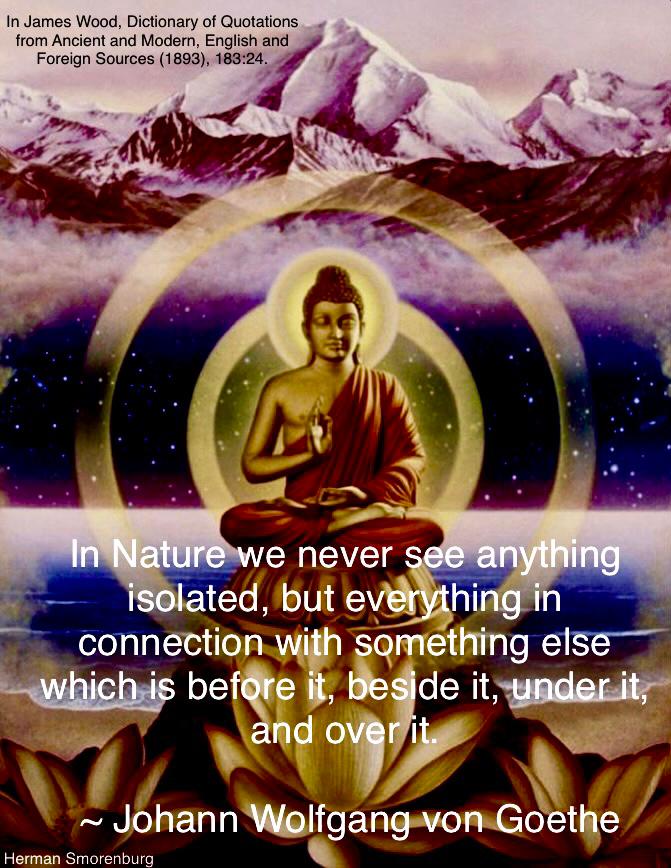
In dieser Welt gibt es keinen richtigen Weg;
vergebens, wenn du würdig und weise bist, vergebens,
es möchte, dass du fügsam und demütig bist!
* * *
Ich bin Teil des Teils, der am Anfang alles war
Ich gehöre zu den Wesen, die das Licht gebären.
* * *
Was kann dir dein Leben jetzt geben?
Benachteiligt sein! immer beraubt werden!
Das ist der ewige Zweck
der allen in den Ohren klingt…
* * *
Sind die Armen ein Wunder?
inmitten von Wundern straucheln sie,
Was für eine Dunkelheit, was für eine unsichtbare Schwelle
ihre verlorenen Schritte beschreiten?
Unter dem Licht und der Liebkosung des Himmels
Ich fühle mich verdammt nahe, Hades.
The image on top: File:JW Goethe by GM Kraus 1775 76.jpg – Wikimedia Commons
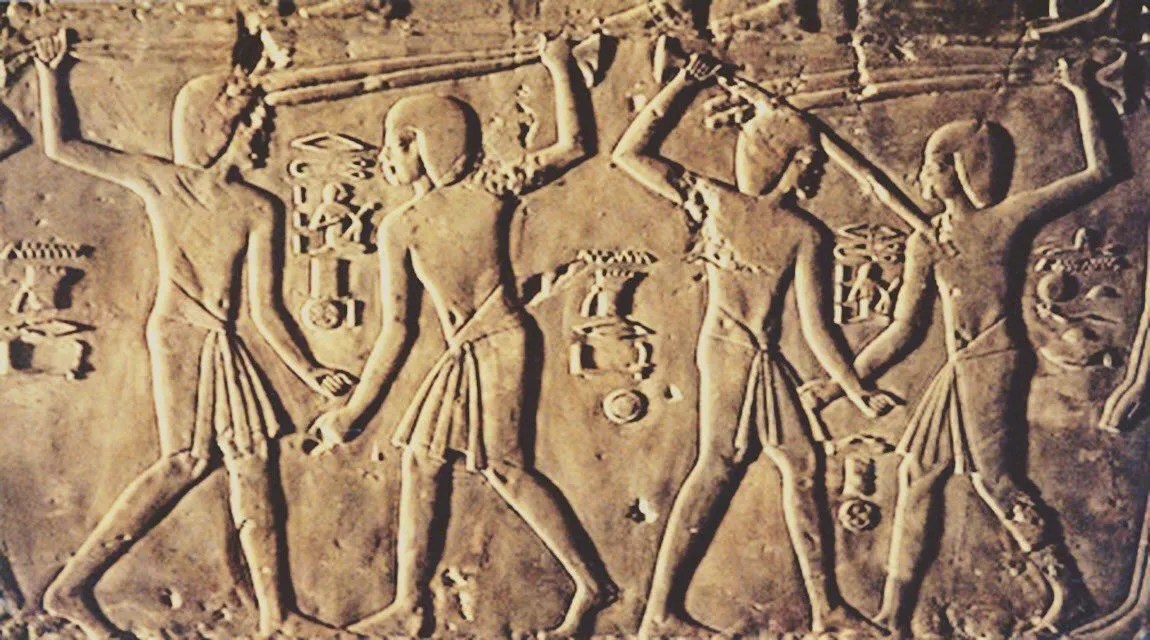
Tahtib is the term for a traditional stick-fighting martial art originally named fan a’nazaha wa-tahtib, “the art of being straight and honest through the use of a stick”. The original military version of tahtib later evolved into an Egyptian folk dance with a wooden stick. It is commonly described in English as a “stick dance”, “cane dance”, “stick-dancing game”, or as ritual mock combat accompanied by music. Nowadays, the word tahtib encompasses both martial practice and performance art. It is mainly practised today in Upper Egypt. Tahtib is regularly performed for tourists in Luxor and Aswan. Stick fighting
The Stick dance was originally a dance style that African–Americans developed on American plantations during the slavery era, where dancing was used to practice “military drills” among the enslaved people, where the stick used in the dance was, in fact, a disguised weapon.
And In Iran, it is also a traditional art: Choob bazi, also known as chob bazi, chub-bazi, çûb-bâzî or raghs-e choob, is a chain dance found all over Iran, performed by men with sticks; the name translates to English as ‘stick play’. There are two types of Choob bazi dance styles, the first one being more combative in style, only performed by men (normally only two men, assuming the roles as the attacker and the defender) and does not appear to have a rhythmic pattern; this style is more frequently found in Southwestern Iran. The second style, Choob bazi, is a circle or line dance with a pattern, performed by both sexes and is more of a social dance. Wikipedia
The stick used in tahtib is about four feet long and is called an asa, asaya, assaya, or nabboot. It is often flailed in large figure-eight patterns across the body with such speed that air displacement is loudly discernible. Wikipedia
Tahtib is a little-known stick-fighting discipline developed during Egypt’s pharaoh period. Its history has seen it used in combat, snubbed by its countrymen, and transformed into a type of folkloric dance before its re-emergence as a martial art in recent years.
Imagine there would never be any fighting between people in the world but the fight between dancing artists!
Anyway, this is a brilliant article by Mr Marc Chartier, an Egyptian journalist, researcher, and adorable friend of mine. It is an old article (June 2016), but still enjoyable.
via égyptophile
It is sometimes compared to Brazilian capoeira, another art of African origin, because of the role of the public and musical training. However, one noticeable difference is that the tahtib is exercised with a stick, considered an “extension of the body”.
The word “tahtib” is derived from “hatab”, which means “firewood”. From there, imagine that this playful and sporting practice is synonymous with the art and the way of making your opponent understand “what wood we are warming ourselves with”; there is only one step we will not take! It also bears a complete name that would bring us back on the right track if necessary: “fann al-nazaha wa-l-tahtib”, “the art of purity of heart and the staff”. In other words, bad intentions or the desire to hurt the other jouster would go against the very spirit of tahtib. It would be immediately sanctioned by the public, whose role is to punctuate the players’ evolution and arbitrate when they evolve in a bad spirit by cheating or displaying excessive aggressiveness.

Whereas, until the 19th century, the jousters challenged each other with wooden weapons “strong enough to break a bone”, the outcome of the bloody combat sometimes being death, today the stick of tahtib is made of fibre rattan, a hollow stem from Southeast Asia, to prevent injuries.
“The game is to pass the guard to make an attack, or in Egyptian terminology, to pass ‘the door’ (al-bâb). The winner is the first to touch (graze) his opponent’s head. The fight results in extreme excitement followed by disturbing immobility where the opponents spy on each other and gauge each other while waiting for weakness or the right moment. During the games, there is no question of injuring your opponent; the contacts are symbolic; here, it’s not about actually hitting, but about simulating a fight (it’s all in technique and concentration).” (arts-and-combat-games.fr)
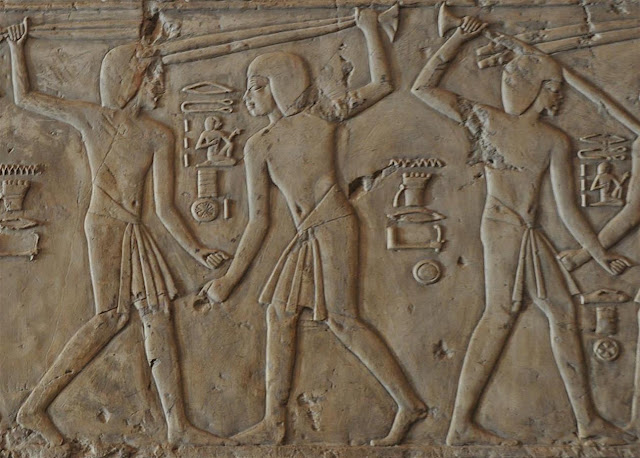
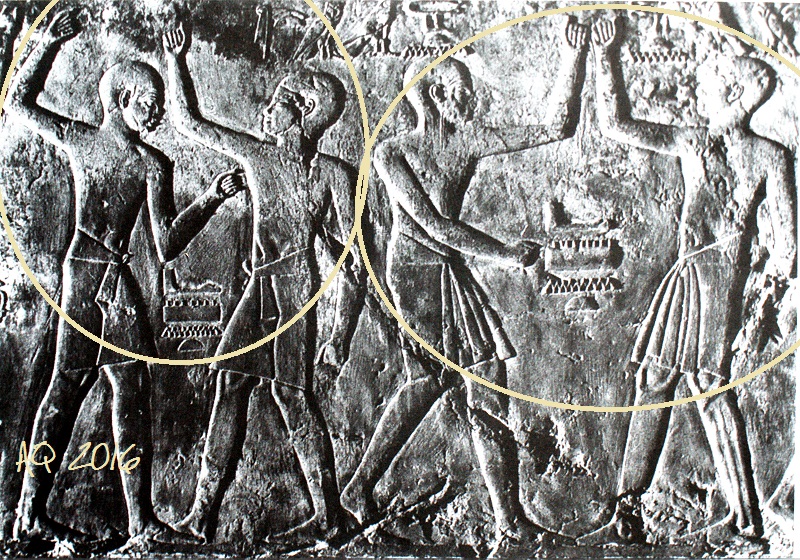
Having become choreography, sporting activity and festive entertainment, the tahtib originates from the Pharaonic era. There are, says the website tahtib.com: “countless traces (engravings and drawings) left on the walls of the tombs of ancient Egypt, from the Old Kingdom to the arrival of Alexander the Great in Egypt (…) The codes of the tahtib are established around 3200 BC, as shown by the excavations carried out by the famous Egyptologist Zahi Hawass in the region of Abu Sir (… ).” The engravings discovered there feature tahtib, among other sporting activities, featuring instructors and their young students.

The tahtib recalls the same source: “appears as much on the walls of the royal pyramids as those of many tombs. (It) was therefore not reserved for a specific social class but shared by all. (…) (It ) crosses the history of Egypt without interruption. Its representations dating from the Middle Kingdom concern soldiers in training. They are visible on the walls of the tombs of Middle Egypt in the necropolis of Beni Hassan in the region of Minya. At the same time, another form of stick combat appeared: the short stick with different codes from the tahtib. Representations of the tahtib continued in the New Kingdom, notably on the walls of tombs in Luxor and those of Saqqara. At that time, the tahtib also became demonstrative. With “danced” steps and gestures, it had a positive intention for the spectators, as is still the case today in Upper Egypt.”

A “martial” art, just like archery and wrestling, the tahtib is, in reality, in its first expression since it was invented and codified to exercise the royal soldiers of the ancient world in combat. Egypt teaches them how to protect themselves against a blow from a stick or reach the opponent’s head without wasting time hitting the stick or elsewhere. Then, over the centuries, peasants and shepherds appropriated this military practice to transform it into a “game of challenges” and a festive activity, accompanied by dances and traditional music, in the villages of the Nile Valley.
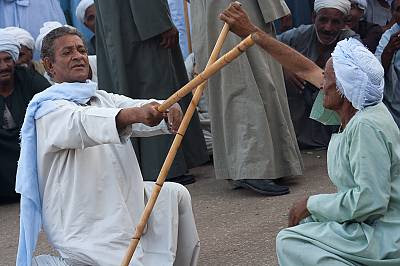
This distraction, long relegated to the rank of folklore for weddings, mawlids or other popular festivities, is today once again rehabilitated as a true martial art, thanks to a few enthusiasts, including the Franco-Egyptian Adel Paul Boulad, founder of the association Seiza. Thus: “After seven years of gestation and planning led by Adel Paul Boulad and his teams in Egypt and France, Modern Tahtib was born on March 6, 2014. Modern Tahtib is a martial discipline practised with a stick: fights, rhythms and sequences. “
The Seiza association develops this sporting discipline concerning the “Art du Baton et Tahtib – Medhat Fawzi” Center in Malawi in Upper Egypt.
The instructors of the Medhat Fawzi Center and the Seiza Association highlight the dual dimension – playful and formative – of Modern Tahtib. In 2010, they made a world premiere, a demonstration at the International Festival of Martial Arts in Paris, as well as a first international internship in Egypt. In 2011, they trained five schools in Cairo and organised the first inter-school tahtib tournament. Currently, they are working on creating the Tahtib Academy in Egypt, whose mission will be the artistic development of the activity, its promotion and the training of instructors. Egypt has applied to UNESCO to support initiatives recognising this discipline as an intangible cultural heritage.
“When you have a stick in your hand, specifies Adel Paul Boulad, you first learn to respect the other and yourself. With percussion, you also learn to enter into harmony with the others. (…) The codification of this art removes violence. We transform warlike principles into a principle of self-development through martial art. At the heart of the operation, there is respect.”
As “martial” as it is, the tahtib “conveys universal social and educational values”. An exemplary value that we owe to Egypt!
Sources:
All Sticks, by Thomas Saint-Cricq, “Le Monde” May 17, 2014
Adel Paul Boulad, Modern tahtib, The Egyptian fighting stick, Budo Editions
http://www.tahtib.com/ http://www.tahtib.com/media/articles/IMAtahtib.pdf http://www.egyptos.net/egyptos/actualite-egypte/le-tahtib-un-art-martial-egyptien-pluri-millenaire-vivant.php,406 https://www.facebook.com/Modern-Tahtib-139424397876/ http://club.seiza.free.fr/index.html

I haven’t written any posts about the Iranian revolution for a long time. But it doesn’t mean that any ending or something big happened. It is because the opposition abroad failed to take an effective post to make a strong front against the Islamic regime. Thanks to a few who felt like great leaders and were focused on being as majestical creatures to shine on and rescue a nation, including @Pahlavi, who had no idea of the aim of this revolution and just in belief that he had been the chosen one! And in the other side, some are good-hearted but inexperienced and can’t choose or take the right way seriously, as the brutal regime does kill these brave youths in front of the @EU, @UNO, and @USA without inhibitions!
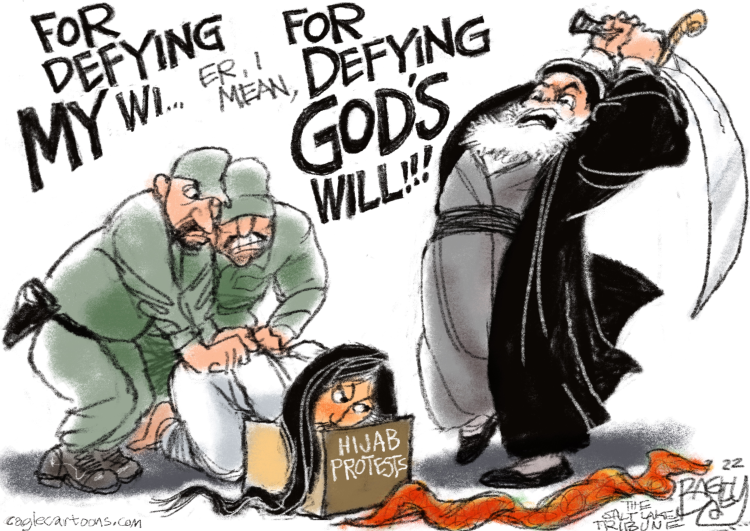
In fact, the revolution is caught in a limbo of a mess. The brave young women and men on the streets of Iran are disappointed. They thought as they were fighting with their foust against the regime’s weapons, it would come to help from aboard to reach their goal, namely their freedom and now they feel left alone!
I can imagine the Mullahs regime is not so bad for the lobbyists in the West, Though I must say no! Sorry, I have to dash the hopes of some Western governments which think it is good to keep the dictatorships in the third world to shut up nations and make profits.
Many Iranian people in Western countries are doing their best to help the revolution keep going, and they do it honestly, despite of few lumps who try to make noises to destroy this uprising. But we will conquer; we will never surrender! #IRGCTerrorists
The images credit: Cagle.com

As I talked about this topic in my last part, children have souls with a great capacity of absorbent power with their instinct to pull all the knowledge they can take. I noticed it when I witnessed my son grow up and today when I observed my grandchildren. And you might imagine how my heart breaks as I see the children in Iran can’t experience their adulthood (The execution machine is going on with no stop!). But their souls continue in their comrade’s bodies and are still there to catch the goal.
In part one, I mentioned the necessity of love and passion towards our children, but is it enough? Regina, my wife, is a teacher in a special needs school (förderschule), and there are many disabled children (18 to 20-year-old children!). Of course, I catch up a lot about how her job is going and how many difficulties arise. Apart from brutality from parents, some are too kind to their children. They show no limits and put up with everything, and it causes lots of problems for the teachers.
It might sound hard, but it is a pure fact!
Of course, I want to go with something other than Plato and his Utopia. However, it can also be a topic to discuss!
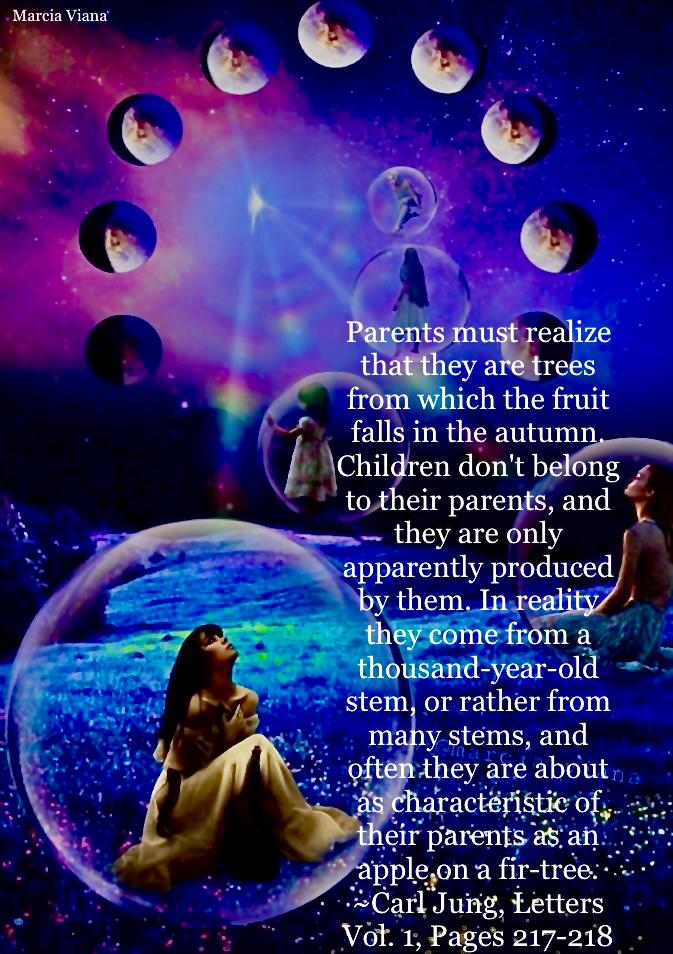
We see then that only giving love is not enough and sometimes even detrimental. I believe the first lesson which we must learn is that our children do not belong among our properties.
Anne Frank can also be considered an example of the child archetype from modern culture – an innocent child who, because her Life was taken away from her by the forces of evil in the world, never had the opportunity to grow up and so in the minds of the world remains ever young and pure.
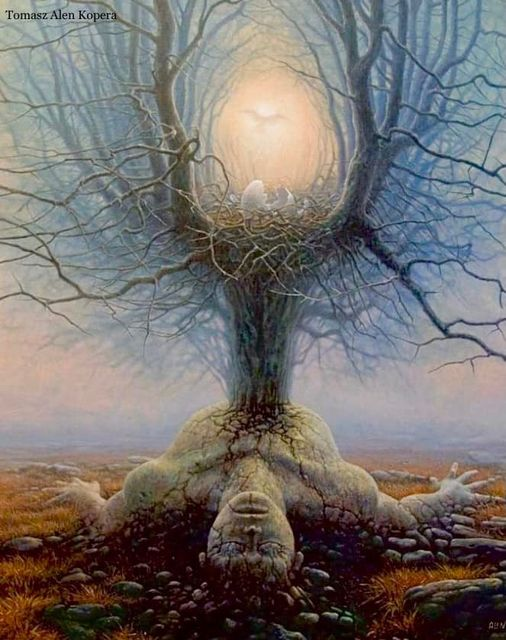
“Your children are not your children. They are the sons and daughters of Life’s longing for itself. They come through you but not from you, and though they are with you, they belong not to you yet. You may give them your love but not your thoughts. For they have their own thoughts. You may house their bodies but not their souls, for their souls dwell in the house of tomorrow, which you cannot visit, not even in your dreams. You may strive to be like them but seek not to make them like you. For Life goes not backwards, nor tarries with yesterday.” ~ Khalil Gibran.
So, let’s read some parts about the ideas and analysis of Dr Jung:
Within each of us, the Innocent is the spontaneous, trusting child that, while a bit dependent, has the optimism to take the journey. The Innocent, fearing abandonment, seeks safety. Their greatest strength is the trust and optimism that endears them to others, so they gain help and support on their quest.
Jung placed the “child” (including the child hero) in a list of archetypes representing milestones in individuation. Jungians exploring the hero myth have noted that “it represents our efforts to deal with the problem of growing up, aided by the illusion of an eternal fiction”. Thus for Jung, “the child is the potential future”, and the child archetype symbolizes the developing personality.

Others have warned, however, of the dangers posed to the parents drawn in by the “divine child” archetype – the belief in the extraordinary potential in a child. The child, idealized by parents, eventually nurtures a feeling of superiority.
Even where affected less acutely, the child archetype may inhibit psychological maturation and result in an adult who is, in essence, “Mama’s darling”. A man will end up with a solid attachment to a mother figure, either real or symbolic, and will lack the ability to form a commitment or be generative. The female version of this, specified as the “puella”, will have a corresponding attachment to her father figure.[ Wiki
The image at the top: via Mr Purrington.
Sources: Child Archetype / n. Wikipedia /
To be continued! 😊🙏

 lampmagician

You must be logged in to post a comment.