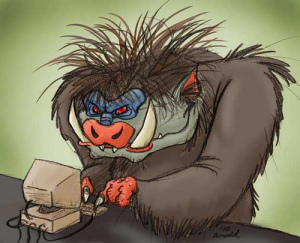
As far as I can make out, all internet trolls are failed writers with an enormous chip on their shoulders, who have never actually managed to produce a publishable book. Because of their anger at being rejected due to their own literary inadequacies, they see those of us who enjoy some modicum of success as the enemy. They cannot attack the agent, editor or publisher who rejected them for fear of retaliation in the form of a law suit, so they vent their spleen by attacking the easiest target – the Indie writer. Just take the time to look at the average one star review written by any one of them and it is obvious why they failed.
Here are a few verbatim examples of the typical kind of one star review. Every one of them is poorly written. I have deliberately left out the title of each book, to…
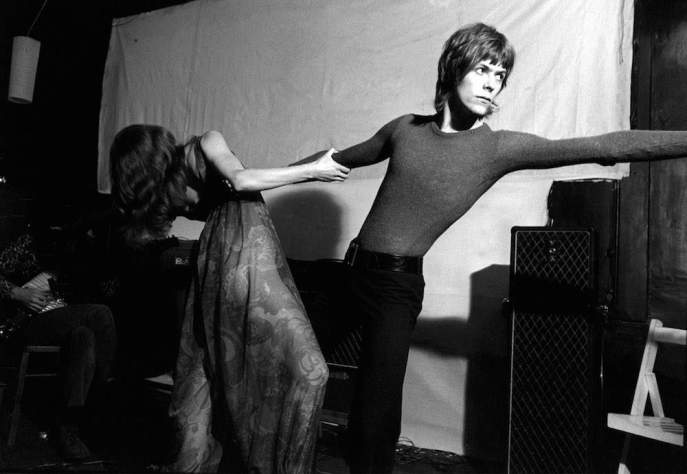
It’s late 1960’s and at No. 22 Clareville Grove, South Kensington, West London a frustrated David Bowie, in the company of his then young lover, budding actress Hermione Farthingale, is at his wits end struggling to complete the lyric for his new song, ‘Life on Mars’.
“What’s the problem Daveypoops? You’ve a face like Andy Warhol chewing a can of baked beans without his dentures in.”
“Oh, my little Hermit it’s all gone horribly wrong.”
“What has?”
“Well Hermlicalls, as you are well aware I’ve been engrossed attempting to knock out a swift one I’m dedicating to you yet I’m missing the crucial finishing touch.”
“Pardon?”
“A song, sweet Hermanology, a song. What did you think? Matters not. I have a song title, ‘Life on Mars’, I even have the music and all the other verses, it’s just this irksome conclusion to the first verse that’s holding me back.”
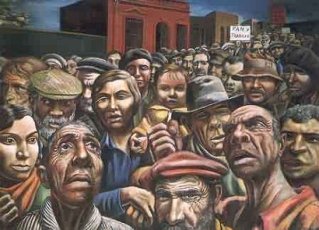
Antonio Berni began in 1934 to show the social problems of the 30s.
Of that year are his works: Unemployed and Manifestation.
In Manifestation, the workers and their family ask for bread and work, in their eyes, there is no hate, there is no revenge, but there is anxiety. Painting gives a feeling of unity, of strength. The painter shows the terrible reality, but also the hope aspires to find the solution.
In Unemployed, the image of the boy in the foreground is highlighted. There is a resignation in the figures in the background. Someone is thoughtful, like the one in the red pullover, which very much resembles his self-portrait.-
Antonio Berni comenzó en 1934 a mostrar la problemática social de la década del 30.
De ese año son sus obras: Desocupados y Manifestación.
En Manifestación, los obreros y su familia piden pan y trabajo, en sus ojos no hay odio, no hay revancha, pero sí hay ansiedad. La pintura da sensación de unidad, de fuerza. El pintor muestra la terrible realidad, pero también la esperanza, aspira a que se encuentre la solución.
En Desocupados, se destaca la imagen del muchacho en un primer plano. Hay resignación en las figuras del fondo. Alguno está pensativo, como el del pullóver rojo, que mucho se parece a su autorretrato.-
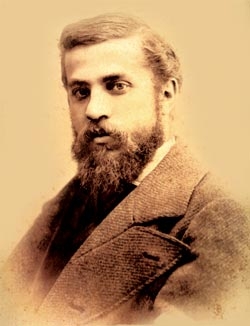
Gaudí was an architect with an innate sense of geometry and volume, as well as a great imaginative capacity that allowed him to project mentally most of his works before moving them to plans. In fact, he rarely made detailed plans of his works, preferring to recreate them on three-dimensional models, moulding all the details as he thought of them; at other times, he would improvise on the fly, giving instructions to his collaborators about what they had to do. After a few beginnings influenced by neo-Gothic art, as well as certain orientalizing tendencies, Gaudí led to modernism in its heyday, between the late nineteenth and early twentieth centuries. However, Gaudí went beyond orthodox modernism, creating a personal style based on the observation of nature, the fruit of which was his use of regulated geometric forms, such as the hyperbolic paraboloid, the hyperboloid, the helicoid and the conoid.
Parc Güell: “The Project”:
Güell and Gaudí had in mind a project in the style of English garden cities (which is evident in the initial Park Güell spelling). Count Güell had experience with the English labour organization, as was reflected in his project of the working-class city of Colonia Güell, in Santa Coloma de Cervelló. Likewise, Güell was inspired by the garden areas in the Jardin de la Fontaine in the city of Nîmes, where he lived in his youth. Gaudí insisted on achieving a perfect integration of his works in nature. Proof of this are the columns made of stones of very variable sizes and shapes, suggesting trunks of trees, stalactites and natural caves. Right angles do not appear anywhere: the columns are slanted like palm trees.
Designed by Antoni Gaudí I Cornet and built between 1900 and 1914. The commission for this project, which was to be aristocratic urbanization with single-family residences, was made to Gaudí by the Count of Güell. The project finally failed and consequently became the municipal property and since 1923 it has been transformed into a public park that is located in the upper part of Barcelona. The main entrance shows two administrative pavilions built in stone, Catalan vault roof and covered with “trencadis” (covering surfaces with irregular mosaic fragments, which was then widely used in Modernism).
Both roofs are crowned by original tiny domes that resemble the shape of a mushroom, the pavilion on the left also shows a stylized tower topped by a four-armed cross very typical of Gaudí. Entering the park we find a double staircase divided by a dragon before arriving at a hypostyle hall of considerable dimensions with 86 massive Doric columns that support the great plaza of the park. On the ceiling of this room, you can see coloured panels (drawing by Josep Maria Jujol). The aforementioned square is a beautiful balcony with views over Barcelona and the sea. The square is delimited by a wavy bench covered with trencadis. This wide square is used for cultural and popular holidays. The park is organized around this central square. The entire garden is connected with carriage roads or pedestrian paths, many of which are supported by inclined columns.
Gaudí fue un arquitecto con un sentido innato de la geometría y el volumen, así como una gran capacidad imaginativa que le permitía proyectar mentalmente la mayoría de sus obras antes de pasarlas a planos. De hecho, pocas veces realizaba planos detallados de sus obras, prefería recrearlos sobre maquetas tridimensionales, moldeando todos los detalles según los iba ideando mentalmente; en otras ocasiones, iba improvisando sobre la marcha, dando instrucciones a sus colaboradores sobre lo que tenían que hacer. Después de unos inicios influenciado por el arte neogótico, así como ciertas tendencias orientalizantes, Gaudí desembocó en el modernismo en su época de mayor efervescencia, entre finales del siglo XIX y principios del XX. Sin embargo, Gaudí fue más allá del modernismo ortodoxo, creando un estilo personal basado en la observación de la naturaleza, fruto…
ancient-greek-columns
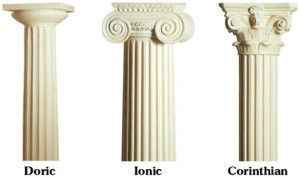
From left to right: Doric, Ionic and Corinthian columns.
Art: “Greek Columns”: Doric, Ionic and Corinthian Columns:
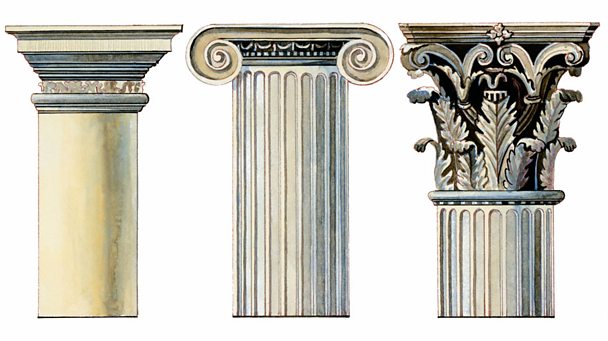
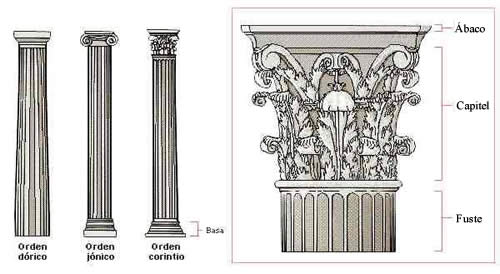
In the Greek architecture of the classical period, three types of columns were developed.
The oldest ones are the Doric, they lack a base and the capital is composed of the equine and the abacus. As a general rule, Doric columns do not have flutes. While the other two, more sophisticated, carry them.
On the contrary, the Ionic ones have bases and the capital unfolds in two volutes placed directly under the abacus.
The most complex is the Corinthians. Its main characteristic is the capital in the form of an inverted bell covered with acanthus leaves.
De izquierda a derecha: Columnas Dórica, Jónica y Corintia.
Arte: “Columnas Griegas”: Columnas Dórica, Jónica y Corintia:
En la arquitectura griega del período clásico se desarrollaron tres tipos de columnas.
Las más antiguas son las Dóricas, carecen de basa y el capitel está compuesto por el equino y el ábaco. Por regla general, las columnas Dóricas no llevan estrías. Mientras que las otras dos , más sofisticadas, las llevan.
Por el contrario, las Jónicas tienen basa y el capitel se desdobla en dos volutas colocadas directamente debajo del ábaco.
Las más complejas son las Corintias. Su principal característica es el capitel en forma de campana invertida cubierto de hojas de acanto.
De izquierda a derecha: Columnas 1. Dórica, 2. Jónica y 3. Corintia.
Or, why we should Watch “at least” the made Movie by François Truffaut from 1966.
I have seen this in the early seventies and of course by luck! Because the Shah’s regime of Iran, doesn’t allow such intellectual art in the country but this time, they just thought that it is showing more the way of communist regents which were famous to control every action in their territories. And they were not so wrong you bet!
I’ll tell you how is it; in those days, the current cinemas always showed the so-called; “home movie” (Heimatfilm) as the German say. It means just cheap and ordinary movies which don’t help the brain to work out! and because of the out looking better (for the world to show how free Iran is), it had been allowed to occur some festival of movies which we got into all of it every day, from eight o’clock in the morning till night. And this movie had been shown at these festivals.
Anyway, when I and my brother among friends got back home, one of the friends who I respected him as an intellectual, just said: Wow! The communist can be so horrible! But we’d definitely began to discuss and I meant, that’s also very easy to be used by the capitalists. They could try always to convince you in the life of freedom, but as you can see today, it is becoming so easy to control you and your privets, therefore, the movie is a Timeless one, not just because of the art, “I think the description of Arts is the Timelessness, but because of the permanent situation in which we keep living in!
That’s one of the most lovely scenes, which I never forget, I love Charles Dickens.
Ray Bradbury’s Fahrenheit 451 envisions a future where “firemen” are sent out not to put out fires, but to burn up any books they find with flamethrowers. To students assigned to read the novel today, the idea of an America that has outlawed books entirely might seem like an intriguing if far-fetched notion, perhaps more suited to the reality of the 1950s than the reality of today. Even if we’ve never read Fahrenheit 451, nearly all of us know the basic outline of its story by now, so why should we still read it? In less than five minutes, the animated TED-Ed video above by the University of Wisconsin-Madison’s Iseult Gillespie offers an answer to that question.
“Fahrenheit 451depicts a world governed by surveillance, robotics, and virtual reality, a vision that proved remarkably prescient, but also spoke to concerns of the time,” says Gillespie. “The novel was published in 1953, at the height of the Cold War. The era kindled widespread paranoia and fear throughout Bradbury’s home country of the United States, amplified by the suppression of information and brutal government investigations. In particular, this witch hunt mentality targeted artists and writers who were suspected of communist sympathies. Bradbury was alarmed at this cultural crackdown. He believed it set a dangerous precedent for further censorship and was reminded of the destruction of the Library of Alexandria and the book-burning of fascist regimes.”
These concerns, though relevant to the era in which Bradbury wrote Fahrenheit 451, are essentially timeless. As with all dystopian fiction, the novel “amplifies troubling features of the world around us and imagines the consequences of taking them to an extreme.” Some of the troubling features of the world 65 years ago have diminished, but some have greatly increased, and we would do well to bear in mind that in Fahrenheit 451 “it was the apathy of the masses that gave rise to the current regime. The government merely capitalized on short attention spans and the appetite for mindless entertainment, reducing the circulation of ideas to ash. As culture disappears, imagination and self-expression follow.” Culture may take many more forms now than it did in the 1950s, but without our constant vigilance, all of them could still be extinguished, just as easily as paper goes up in flame.
Based in Seoul, Colin Marshall writes and broadcasts on cities, language, and culture. His projects include the book The Stateless City: a Walk through 21st-Century Los Angeles and the video series The City in Cinema. Follow him on Twitter at @colinmarshall or on Facebook.
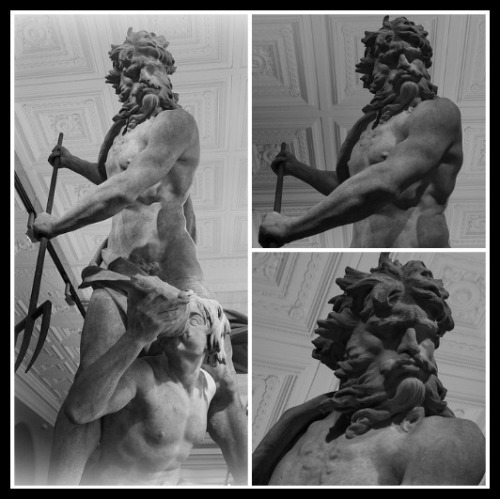
Poseidon (Roman equivalent: Neptune), was a son of Cronos and Rhea and brother of Zeus, Hades, Hera, Hestia and Demeter.
Poseidon was the god of the sea, rivers, flood and drought, earthquakes, and horses.
Being the ruler of the sea, he was described as gathering clouds and calling forth storms, but at the same he has it in his power to grant a successful voyage and save those who are in danger.
He was further regarded as the creator of the horse, and was accordingly believed to have taught men the art of managing horses by the bridle, and to have been the originator and protector of horse races.
The common tradition about Poseidon creating the horse states that when Poseidon and Athena disputed…
There are as many reasons to descend into the Underworld as there are Underworlds: some go to recover love, others to find guidance, while others still are called to learn forbidden knowledge. These are just a few of the reasons that have led brave or desperate souls past Hell’s Gates, down into the Chthonic Realms.
However, taking control of the Underworld, as in wanting to rule it, isn’t usually a character’s primary motive…
Unless you are the Goddess Inanna-Ishtar, in which case you want to rule everything.
*
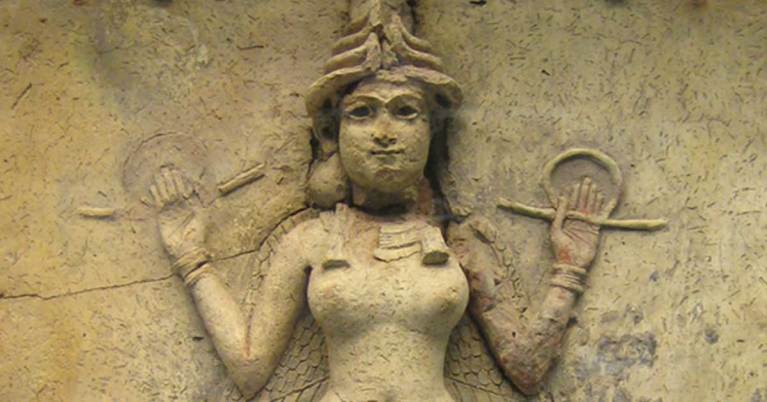
Inanna was a significant Sumerian deity, figuring in some of the oldest (if not the oldest) mythic literature in the world. Under the name of Ishtar, She was also worshiped by the Akkadians, Babylonians, and Assyrians, who all added their own mythic twists to Her tales. These new versions include a revised Descent tale, as well a role for Ishtar in the Epic of Gilgamesh.
Gatekeeper, Lo! open thy gate!
Open thy gate that I may enter!
If thou openest not the gate to let me enter,
I will break the door, I will wrench the lock,
I will smash the door-posts, I will force the doors.
I will bring up the dead to eat the living. And the dead will outnumber the living.
Now, as I promised at the end of part one of this post, it’s time to move on: human meat-hooks and demonic abduction are all about to present themselves as we continue to follow Inanna/Ishtar down, into the Underworld…
*
We can’t be entirely sure what Inanna wanted from the Underworld; what do know is that Her sister, Ereshkigal was its Queen, whose husband had recently died.
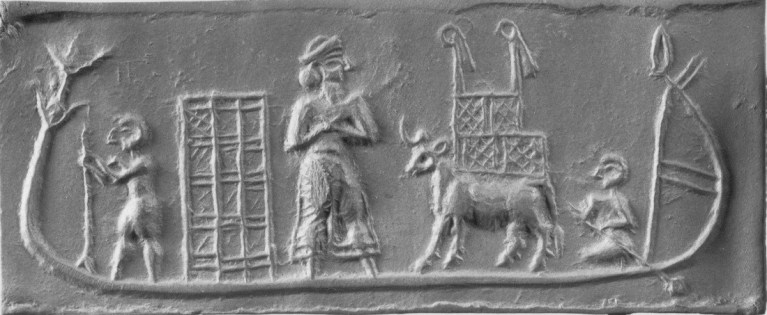
Imagine this: a divine voice warns you of an impending flood that will wipe out all living things on the face of the Earth. You are ordered to construct an ark, and load it with as many animals as you can. You comply, build the ark, and manage to preserve both humanity and all other forms of life.
Now, you will be forgiven for assuming that I’m asking you to imagine being Noah from the Book of Genesis, but he’s not one I’m talking about.
I’m talking about Utnapishtim from Tablet XI of the Epic of Gilgamesh, which the majority of scholars agree far predates the Biblical flood story.
So let’s start with our hero, Gilgamesh, and figure out why he’s looking for his ancestor, Utnapishtim.
*
King Gilgamesh could be cruel; this was the complaint of his subjects in the city of Uruk. The goddess Arura heard…





 De izquierda a derecha: Columnas Dórica, Jónica y Corintia.
  De izquierda a derecha: Columnas 1. Dórica, 2. Jónica y 3. Corintia.
  Modelos de Columnas Griegas: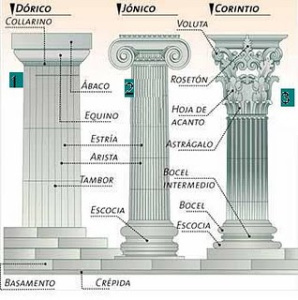



 lampmagician
You must be logged in to post a comment.