That is like the Gnostic myth of the soul, the soul being the spinther (the Greek word for spark) which falls from the pleroma or the empyrean into matter; that spark is the soul
of man and if it is touched, there will be a fire.
That’s really fascinating how Nietzsche was so interested in Zarathustra. I, myself, as a Persian, have been very interested in my ancient history and have had a good look of the ancient persian’s Gods though, in this case; I was much more interested in Mani or the painter, who came in the time of powerful Zarathustra, to continue his religion more in the spiritual form. Anyway, I think that Nietzsche was fascinated in Zarathustra because of the duality which the last showed in all his acting; the unit of Animus and the Anima;
((Now, this rencontre contains a secret. That the meeting with that old woman meant to him something like a little child is a speech metaphor naturally, but it contains more
than a mere metaphor; it points to a secret connected with his meeting the anima. It continues; ,,,,.. As Nietzsche himself is nearly always pregnant with thoughts, his anima is with child.
Prof Jung:
Exactly. But why does Zarathustra behave as if he had a child under his mantle? He is not a woman.
Dr. Whitney: He is identical there with the anima.
Prof Jung: Yes, that is the point. Nietzsche is identified with Zarathustra and naturally also with his anima, because he can only reach Zarathustra through the medium of his anima, that being by definition of the function which connects the conscious with the unconscious.
Anyhow, It’s always interesting to know Nietzsche and read about him by Dr Jung.
NIETSCHE, ZARATHUSTRA SEMINAR
Date: August 11, 2018Author: lewislafontaine
via https://carljungdepthpsychologysite.blog/
A heretic wilt thou be to thyself, and a wizard and a sooth-sayer,
and a fool, and a doubter, and a reprobate, and a villain.
Ready must thou be to burn thyself in thine own flame; how
Couldst thou become new if thou have not first become ashes! [Nietzsche in Zarathustra]
Here he describes what naturally will happen when you really meet your own devil, your own opposite; it will be a fight to death, a conflagration in which nothing remains but a heap of ashes.
Of course this statement is a bit too strong, too mythological.
It is like the Phoenix that burns itself, together with its nest, the soul and the body, and arises from the ashes anew. Such a total transformation is hardly possible.
That is not the myth of the ordinary man, but of the god in man, the primordial man, who was called the Anthropos ( Anthropos is Greek for human. It is part of an expression that is translated as Son of man in the New Testament.) in Neo-Platonist philosophy and in those syncretistic religions at the time of Christ.
It was on account of that idea of the Anthropos that Christ called himself the Monogenes, meaning the son of man-that primordial man, not of God.
(The Monogenes means “the only begotten,” and the autogenous means “the self-begotten.”)
This is the Anthropos in man, or you can call it the self, and the story of the self is like the Phoenix myth and like this passage here.
When man is on the way to himself, he will see his other side, and there will be a tremendous conflict; it will be a conflagration, a flame in which he is burned up.
Nietzsche always foresaw something of that; even in one of his first works the Unzeitgemassige Betrachtungen (Out of time considerations) , there is a peculiar passage: “A spark from the fire of justice fallen into the soul of a seeker will be sufficient to devour his whole life.”
That is like the Gnostic myth of the soul, the soul being the spinther (the Greek word for spark) which falls from the pleroma or the empyrean into matter; that spark is the soul
of man and if it is touched, there will be a fire.
This idea was in the grain of man, and in the philosophy of the time of Christ.
There is an apocryphal word of Christ, a “logion”, which says. “Whoever is near to me is near to the fire and whoever is far away from me is far from the kingdom.”
So the kingdom is the kingdom of fire. Christ himself is the flame.
That is also expressed in the Pentecostal miracle where the Holy Ghost descends in tongues of fire.”
And there is an authentic “logion” of Heraclitus which says: A dry glowing best and wisest soul.
You see, it is inevitable that anybody who seeks the self is forced into that fight with the shadow, with the other side of himself, his own negation; and that will be a catastrophe in which the ordinary man is as if destroyed: he becomes ashes.
There is again the connection with alchemy here, of course.
This conflagration is necessary; otherwise the self as the living unit cannot appear, otherwise it would be obliterated by the continuous fight of the Yea and the Nay.
They must exhaust each other in order that we may be still enough to hear the voice of the self and follow the intimation.
This is the ordinary way of the religious experience.
First it is a Yea and then it is a violent Nay, and then there is a catastrophe and man ceases to exist; then he becomes willing and submits to God.
Then it is the will of God that will decide for him.
Without that terrible conflict, there is no reality in such in such an existence.
To go into a revival meeting and get caught is no merit. ~Carl Jung, Zarathustra Seminar, Pages 721-723.
Prof Jung:
Exactly. The rule is that a man dreams of an old anima when he is too young in his own consciousness.
That may be for the time being or it may be generally so; certain men are too young for their age by lack of experience, or they are just childish, and then the anima is apt to be very old in order to compensate for the conscious individual.
As a woman’s animus may be just a very childish boy, full of naughty ideas, because the conscious is too old and wise.
Of course that is not always true-there are certain exceptions, the obvious one being the figure of the Puer Aetemus. (The bad side of Eros is the puer aetemus, the eternal boy, and Lucius Apuleius resembles this archetype: a bit of a homosexual, a bit of a Don Juan,…)
Now, this rencontre contains a secret. That the meeting with that old woman meant to him something like a little child is a speech metaphor naturally, but it contains more
than a mere metaphor; it points to a secret connected with his meeting the anima.
What could that child be? It is as if he were a mother himself carrying a child.
This is very interesting.
Mrs. Sigg:
As Nietzsche himself is nearly always pregnant with thoughts, his anima is with child.
Prof Jung:
Exactly. But why does Zarathustra behave as if he had a child under his mantle? He is not a woman.
Dr. Whitney: He is identical there with the anima.
Prof Jung: Yes, that is the point. Nietzsche is identified with Zarathustra and naturally also with his anima, because he can only reach Zarathustra through the medium of his anima, that being by definition of the function which connects the conscious with the unconscious.
So he is identical with his anima and with the old man and with every other archetype in sight. And since Zarathustra is hiding that child he carries, what kind of child would it be? ~Carl Jung, Zarathustra Seminar, Page 730.
Prof Jung:
Exactly. The rule is that a man dreams of an old anima when he is too young in his own consciousness.
That may be for the time being or it may be generally so; certain men are too young for their age by lack of experience, or they are just childish, and then the anima is apt to be very old in order to compensate for the conscious individual.
As a woman’s animus may be just a very childish boy, full of naughty ideas, because the conscious is too old and wise.
Of course that is not always true-there are certain exceptions, the obvious one being the figure of the Puer Aetemus.
Now, this rencontre contains a secret. That the meeting with that old woman meant to him something like a little child is a speech metaphor naturally, but it contains more
than a mere metaphor; it points to a secret connected with his meeting the anima.
What could that child be? It is as if he were a mother himself carrying a child.
This is very interesting.
Mrs. Sigg:
As Nietzsche himself is nearly always pregnant with thoughts, his anima is with child.
Prof Jung:
Exactly. But why does Zarathustra behave as if he had a child under his mantle? He is not a woman.
Dr. Whitney: He is identical there with the anima.
Prof Jung: Yes, that is the point. Nietzsche is identified with Zarathustra and naturally also with his anima, because he can only reach Zarathustra through the medium of his anima, that being by definition of the function which connects the conscious with the unconscious.
So he is identical with his anima and with the old man and with every other archetype in sight. And since Zarathustra is hiding that child he carries, what kind of child would it be? ~Carl Jung, Zarathustra Seminar, Page 730.



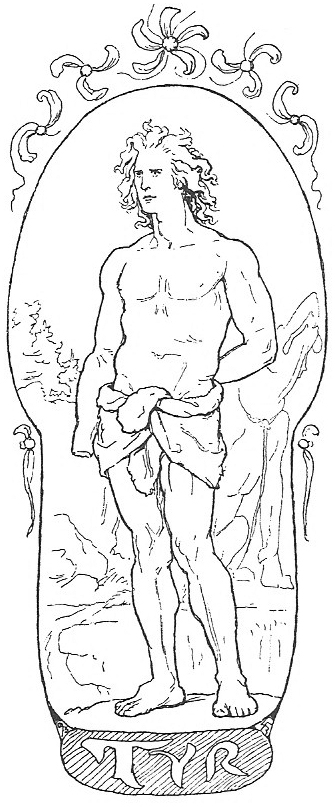 Etching by Lorenz Frølich (1895)







 lampmagician
You must be logged in to post a comment.