
via “Blessed is he who leaves” – “Flights” by Olga Tokarczuk
Month: July 2018
Halloween Special: C. G. Jung’s Spine-Chilling Nights in a ‘Haunted House’
Standardvia: http://www.forbiddenhistories.com/
Though it’s still some months till Halloween it’s nice to read something different by dear Dr Jung’s Spooky Bed story! 😉

Jung writes that in the summer of 1920 he was invited by a colleague (whose identity he protects by calling him ‘ Dr X.’) to give lectures in England. In expectation of Jung’s visit, ‘Dr. X.’ had found a suitable place for the weekends, “a charming cottage” in Buckinghamshire, at “a ridiculously low price”. After giving detailed information about the layout of the house and his room, Jung reports:

The first night, tired from the strenuous work of the week, I slept well. We spent the next day walking and talking. That evening, feeling rather tired, I went to bed at 11 o’clock but did not get beyond the point of drowsing. I only fell into a kind of torpor, which was unpleasant because I felt I was unable to move. Also, it seemed to me that the air had become stuffy and that there was an indefinable, nasty smell in the room. I thought I had forgotten to open the windows.
Finally, in spite of my torpor, I was driven to light a candle: both windows were open, and a night wind blew softly through the room, filling it with the flowery scents of high summer. There was no trace of the bad smell. I remained half awake in my peculiar condition until I glimpsed the first pale light of dawn through the east window. At this moment the torpor dropped away from me like magic, and I fell into a deep sleep from which I awoke only towards nine o’clock.
On Sunday evening I mentioned in passing to Dr X that I had slept remarkably badly the night before. He recommended me to drink a bottle of beer, which I did. But when I went to bed the same thing happened: I could not get beyond the point of drowsing.
Both windows were open. The air was fresh, to begin with, but after about half an hour it seemed to turn bad; it became stale and fuggy, and finally somehow repulsive. It was hard to identify the smell, despite my efforts to establish its nature. The only thing that came into my head was that there was something sickly about it. I pursued this clue through all the memories of smells that a man can collect in eight years of work at a psychiatric clinic. Suddenly I hit on the memory of an old woman who was suffering from an open carcinoma. This was quite unmistakably the same sickly smell I had so often noticed in her room.
As a psychologist, I wondered what might be the cause of this peculiar olfactory hallucination. But I was unable to discover any convincing connection between it and my present state of consciousness. I only felt very uncomfortable because my torpor seemed to paralyze me. In the end, I could not think any more and fell into a torpid doze.
Suddenly I heard the noise of water dripping. “Didn’t I turn off the tap properly?” I thought. “But of course, there’s no running water in the room—so it’s obviously raining—yet today was so fine.” Meanwhile, the dripping went on regularly, one drop every two seconds. I imagined a little pool of water to the left of my bed, near the chest of drawers. “Then the roof must leak,” I thought. Finally, with a heroic effort, so it seemed to me, I lit the candle and went over to the chest of drawers. There was no water on the floor and no damp spot on the plaster ceiling.
Only then did I look out of the window: it was a clear, starry night. The dripping still continued. I could make out a place on the floor, about eighteen inches from the chest of drawers, where the sound came from. I could have touched it with my hand. All at once the dripping stopped and did not come back. Towards three o’clock, at the first light of dawn, I fell into a deep sleep. No—I have heard death-watch beetles. The ticking noise they make is sharper. This was a duller sound, exactly what would be made by drops of water falling from the ceiling.
I was annoyed with myself, and not exactly refreshed by this weekend. But I said nothing to Dr. X. The next weekend, after a busy and eventful week, I did not think at all about my previous experience. Yet hardly had I been in bed for half an hour then everything was there as before: the torpor, the repulsive smell, the dripping.
“…something brushed along the walls, the furniture creaked now here and now there, there were rustlings in the corners”.
And this time there was something else: something brushed along the walls, the furniture creaked now here and now there, there were rustlings in the corners. A strange restlessness was in the air. I thought it was the wind, lit the candle and went to shut the windows. But the night was still, there was no breath of wind. So long as the light was on, the air was fresh and no noise could be heard. But the moment I blew out the candle, the torpor slowly returned, the air became fuggy, and the creakings and rustlings began again. I thought I must have noises in my ear, but at three o’clock in the morning, they stopped as promptly as before.
The next evening I tried my luck again with a bottle of beer. I had always slept well in London and could not imagine what could give me insomnia in this quiet and peaceful spot. During the night the same phenomena were repeated but in an intensified form. The thought now occurred to me that they must be parapsychological. I knew that problems of which people are unconscious can give rise to exteriorization phenomena because constellated unconscious contents often have a tendency to manifest themselves outwardly somehow or other. But I knew the problems of the present occupants of the house very well and could discover nothing that would account for the exteriorizations.
“There were loud knocking noises, and I had the impression that an animal, about the size of a dog, was rushing round the room in a panic.”
The next day I asked the others how they had slept. They all said they had slept wonderfully. The third night it was even worse. There were loud knocking noises, and I had the impression that an animal, about the size of a dog, was rushing around the room in a panic. As usual, the hubbub stopped abruptly with the first streak of light in the east.
“Sounds of knocking came also from outside in the form of dull blows, as though somebody were banging on the brick walls with a muffled hammer.”
The phenomena grew still more intense during the following weekend. The rustling became a fearful racket, like the roaring of a storm. Sounds of knocking came also from outside in the form of dull blows, as though somebody was banging on the brick walls with a muffled hammer. Several times I had to assure myself that there was no storm and that nobody was banging on the walls from outside.
The next weekend, the fourth, I cautiously suggested to my host that the house might be haunted and that this would explain the surprisingly low rent. Naturally, he laughed at me, although he was as much at a loss as I about my insomnia. It had also struck me how quickly the two girls [whom ‘Dr. X’ had engaged as housekeepers] cleared away after dinner every evening, and always left the house long before sundown. By eight o’clock there was no girl to be seen.
I jokingly remarked to the girl who did the cooking that she must be afraid of us if she had herself fetched every evening by her friend and was then in such a hurry to get home. She laughed and said that she wasn’t at all afraid of the gentlemen, but that nothing would induce her to stay a moment in this house alone, and certainly not after sunset. “What’s the matter with it?” I asked. “Why it’s haunted, didn’t you know? That’s the reason why it was going so cheap. Nobody’s ever stuck it here.” It had been like that as long as she could remember. But I could get nothing out of her about the origin of the rumour. Her friend emphatically confirmed everything she had said.
As I was a guest, I naturally couldn’t make further inquiries in the village. My host was sceptical, but he was willing to give the house a thorough looking over. We found nothing remarkable until we came to the attic. There, between the two wings of the house, we discovered a dividing wall, and in it a comparatively new door, about half an inch thick, with a heavy lock and two huge bolts, that shut off our wing from the unoccupied part. The girls did not know of the existence of this door. It presented something of a puzzle because the two wings communicated with one another both on the ground floor and on the first floor. There were no rooms in the attic to be shut off, and no signs of use. The purpose of the door seemed inexplicable.
“I had the feeling there was something near me, and opened my eyes. There, beside me on the pillow, I saw the head of an old woman, and the right eye, wide open, glared at me. The left half of the face was missing below the eye.”
The fifth weekend was so unbearable that I asked my host to give me another room. This is what had happened: it was a beautiful moonlight night, with no wind; in the room, there were rustlings, creakings, and hangings; from outside, blows rained on the walls. I had the feeling there was something near me, and opened my eyes. There, beside me on the pillow, I saw the head of an old woman, and the right eye, wide open, glared at me. The left half of the face was missing below the eye. The sight of it was so sudden and unexpected that I leapt out of bed with one bound, lit the candle, and spent the rest of the night in an armchair. The next day I moved into the adjoining room, where I slept splendidly and was no longer disturbed during this or the following weekend.
I told my host that I was convinced the house was haunted, but he dismissed this explanation with smiling scepticism. His attitude, understandable though it was, annoyed me somewhat, for I had to admit that my health had suffered under these experiences. I felt unnaturally fatigued, as I had never felt before. I, therefore, challenged Dr X to try sleeping in the haunted room himself. He agreed to this and gave me his word that he would send me an honest report of his observations. He would go to the house alone and spend the weekend there so as to give me a “fair chance.”
Next morning I left. Ten days later I had a letter from Dr X. He had spent the weekend alone in the cottage. In the evening it was very quiet, and he thought it was not absolutely necessary to go up to the first floor. The ghost, after all, could manifest itself anywhere in the house, if there was one. So he set up his camp bed in the conservatory, and as the cottage really was rather lonely, he took a loaded shotgun to bed with him.
Everything was deathly still. He did not feel altogether at ease, but nevertheless almost succeeded in falling asleep after a time. Suddenly it seemed to him that he heard footsteps in the corridor. He immediately struck a light and flung open the door, but there was nothing to be seen. He went back grumpily to bed, thinking I had been a fool.
“…he again heard footsteps, which stopped just in front of the door; the chair creaked, as though somebody was pushing against the door from the other side.”
But it was not long before he again heard footsteps, and to his discomfiture, he discovered that the door lacked a key. He rammed a chair against the door, with its back under the lock, and returned to bed. Soon afterwards he again heard footsteps, which stopped just in front of the door; the chair creaked, as though somebody was pushing against the door from the other side. He then set up his bed in the garden, and there he slept very well.
The next night he again put his bed in the garden, but at one o’clock it started to rain, so he shoved the head of the bed under the eaves of the conservatory and covered the foot with a waterproof blanket. In this way, he slept peacefully. But nothing in the world would induce him to sleep again in the conservatory. He had now given up the cottage.
A little later I heard from Dr X that the owner had had the cottage pulled down since it was unsaleable and scared away all tenants. Unfortunately, I no longer have the original report, but its contents are stamped indelibly on my mind. It gave me considerable satisfaction after my colleague had laughed so loudly at my fear of ghosts.
As Jung’s above remark regarding ‘exteriorization phenomena’ suggests, he did not believe in ‘ghosts’ as an explanation for the disturbances, but tried to account for most of them in terms of hypnagogic hallucinations, dramatised intuitions, exaggerated perceptions in a state of hypnoid catalepsy, and other psychological phenomena. However, Jung also conceded that his interpretation “naturally does not pretend to explain all ghost phenomena” – a caveat which the better-corroborated cases in Fanny Moser’s extraordinary book and similar studies maybe appear to justify?
Happy Halloween…
Significant Songs (192)
Standard
The Boys Are Back In Town
You don’t see many rock songs on this blog, I know. But this is a really good one. Back in 1976, Irish band Thin Lizzy were doing very well indeed. They had already achieved success in the UK, and all around Europe, and were touring in America. The distinctive vocals of front man Phil Lynnot and some excellent guitar work gave the group an identifiable sound, and much critical acclaim too.
The band went through various changes of line up, including the arrival, departure, and eventual return of the wonderful Gary Moore. But by 1983, differences (and drugs) had taken their toll, and the band split for good, following the Reading Festival performance. In 1986, just ten years after the high watermark of this single, Lynnot died of complications from drug addiction. He was just 36 years old.
“That is why we use the term” mass “in this type of man – not so much because of his crowd but because of his slowness.” ~ Ortega y Gasset
QuoteA worty anlisis of humanity.

Notably from Ortega y Gasquet’s book “The Uprising of the Masses”
– Society is always the dynamic unity of two factors: minorities and the masses. Minorities are individuals or groups of individuals with special qualities. So, when we say mass, we should not only mean the “working masses”. Mass is the average person.
– When one speaks of “fine minorities,” it is common for the malicious to distort the meaning of this expression, by doing how he does not know, that the chosen person is not the hunter who thinks himself superior to the others but the one who requires more he himself than the others, even if he did not manage to make those high claims on his face.
– The mass crushes beneath everything that is different, everything that excels, which is charismatic and exquisite. Anyone who is not like everyone, who does not think like everyone else, is in danger of disappearing.
– The History of the Roman Empire is at the same time the history of the rise of the mastery of the masses, which absorb and abolish the leading minorities and put themselves in their place.
– There are centuries that die of self-satisfaction because they do not know how to renew their desires, just as the happy drone dies after the wedding flight.
– In our days we no longer know what is going to happen tomorrow in our world, and this brings us a secret joy because of this weakness of anticipation, this horizon always open to all contingencies, constitutes authentic life, true completeness our existence.
– By destroying them, we give them life, we do them to serve our vital purposes. We can be in more places than we could before, and enjoy more arrivals and departures, to consume more secular time in less vital time.
– The other truth is quite the opposite: we live in a time when a man feels he has mythical abilities to create, but he does not know what to create. The Lord of all is not the master of himself. He feels lost in his abundance.
– That is, it lives from the need of the present, and not from the plan of the future. And so its activity turns out to be the avoidance of the difficulties of the time ‘ not to solve the difficulties, but to escape them at present…
– On the contrary, the eminent man, the extraordinary man, urges, from an inner necessity, to refer, beginning from himself to a pattern beyond himself, superior to himself, to whose service he is free.
– The kindness is defined by the demands imposed on us – by the obligations, not by the rights. Noblesse oblige. ” To live for the satisfaction of his senses Consolidation of his senses is accomplished ” the nobleman strives for the order and the law “(Goethe)
– This is why we use the term “mass” in this type of man – not so much because of his crowd but because of his slowness.
– These are the chosen people, the nobles, the ones who act by action and not by reaction [for outward stimulation], for whom life is an endless effort, an unstoppable course of education. Education = exercise. These are the ascetics.
– Baby is a lifetime baby ‘has no resources. That’s why Athletic Franks said how the baby is much worse than the bad because he’s been resting sometimes, the baby never.
– It does not make sense to talk about ideas unless there is an admission of a higher authority regulating them, a series of rules that you can invoke in a discussion. These rules are the principles underlying culture (culture). I do not care about the form they hire. What I am affirming is that there is no culture(culture) where there are no rules that our partner can appeal to . There is no culture (culture) where there are no principles of innateness, in order to overcome them. There is no culture (culture) where there is no admission of certain final spiritual positions, in which a disagreement may be raised .There is no education when the battle of aesthetic issues does not recognize the necessity of justifying the work of art. When all these things are lacking, there is no education (culture) ‘exists in the most precise meaning of the word, barbarism.
– Under the types of syndicalism and fascism, for the first time in Europe, there is a type of person who does not want to give the reasons for his actions or justify their correctness, but he simply seems determined to impose his opinions. This is the new element: the right to be absurd, or the ” logic of the absurd .”
– Almost all, a homogeneous mass is borne by the public, power and disintegration, annihilates every opposition group. The mass – who would say it, seeing its compact and myrrh-shaped presence? -do not want to share life with those who are not of it. It feeds deadly hatred for what it is not.
– In general , public life and, above all, politics must urgently return to inertia, Europeans will not be able to make the leap that the optimists demand from them, unless they first put their clothes in until they reach their naked essence , and return to their true self.
– This satisfaction with himself leads him to exclude himself from any external criterion, “not to listen, not to put his opinion under suspicion, not to take into account the existence of the other.
– The frontal assault must come in such a way that the massager can not take his precautions against it; he will see it in front of him and will not suspect just how this is the frontal assault.
– The cynic, a parasite of civilization, lives by denying it, because it is exactly convinced that culture will not fail.
– Certainly, on the assumption that our astral person would not search for extraordinary individuals, but would look for the genetic type of the “man of science”, the highest point of the eunuch mankind.
And now it turns out that the scientist is the prototype of the massager. Not by accident, not because of the mass failure of each scientist, but because science itself – the root of our civilization – automatically transforms it into a maze, makes it a primitive, modern barbarian.
– The expert “knows” very well his own, little corner of the world, but ignores the rest of the world radically;
– But our expert cannot fall into any of these categories. He is not educated because he typically ignores everything that does not concern his speciality, but he is neither an uneducated person because he is a “scientist” and “knows” very well his own little piece of the world.
– When the mass acts on its behalf, it does it only in one way, because it has no other: it is a lynching.
– Creative life requires a state of rigorous mental health, high education, fixed incentives that keep active the consciousness of human dignity.
– The city was not built, such as the farmhouse or the Domus, as housing against the weather and the rise of the species – these are personal and family interests – but to discuss public affairs.
– Life is the struggle, the effort to realize yourself.
– A people are capable of creating a state insofar as it is capable of imagining. So it is in all peoples that there is a limit in their evolution towards the State precisely the limit that nature sets in their imagination.
– If you do not wish to be subjected to any rule, you will be forced, nolens volens, to submit to the rule of denial of all morality, and that is not unethicality but immorality.
Curator’s Diary June 2018: Up Close with the Sphinx, Ancient and Modern
Standard
Last month I had the chance to spend a couple of days in close proximity with the Great Sphinx at Giza whilst filming a documentary for Discovery Channel (a crash course in pithy communication, ideal for museum curators). Unrestricted admittance to the Sphinx enclosure (usually off-limits to visitors) prompted me to consider the degree of access ancient people might have had to this iconic monument, and how those ancient monuments have in turn shaped our expectation of the tourist experience today.

In modern times, hundreds of tourists and local Cairenes pose for thousands of photos at the Great Sphinx each day. The recent cult of the selfie has assured the iconic status of this human-headed lion, whose colossal profile is particularly suited to ‘kissing’ photos. This sort of interaction has been enabled and encouraged by the convenient modern viewing platforms flanking the Great Sphinx to north and south.
This has…
View original post 678 more words
Ali’s Book Review of Sacha Black’s KEEPERS
QuoteA Heresy for the 21st Century: The Kabbalah
Standard
 The Tree of Life
Although Gnosticism is, on the whole, treated as a phenomenon intimately connected with Christianity, there is evidence that it predates the birth of Jesus in certain heretical Jewish circles. This is unsurprising as Judaism would have been in contact with Babylonian/Persian religious traditions, as well as Hellenic Platonic speculation. Gnosticism certainly gained its first adherents from within the Hellenized Jewish and Jewish-Christian communities, however these would eventually become part of the sphere of Christianity (whether orthodox or heterodox).
Indeed it seems paradoxical, if not downright perverse, to make mention of a Judaic Gnosticism. Gnosticism with its Dualism, distant God in the pleroma, not to mention the Demiurge who creates matter and the habit of turning scripture on its head, seems to be entirely inimical to Judaism with its monotheism and a God who is omnipotent, omnipresent and omnibenevolent. In many respects it is; yet within the…
View original post 534 more words
Musings From My Cave
StandardA Heresy for the 21st Century: The Cathars
Standard Dominic Guzmán and the Albigenses, 1480, Pedro Berruguete
Around the mid 12th Century the Catholic Church reported on the emergence of a new heresy: Catharism. Although Catharism shared many similarities in beliefs and organisational structure that it appears to be a descendant of other Gnostic heretical sects such as the Bogomils, Paulicians and others, all the way back to the Manichaeans in the 3rd Century, it would become for the Catholic Church the Great Heresy.
Although the first reports of Catharism was from Cologne, the heartlands of the heresy was the Languedoc, ruled at the time by independent Counts. By the early 13th Century adherents of Catharism were said to outnumber Catholics in the region, a development that Pope Innocent III tried to combat by sending missionaries to debate with the leaders of the Cathars, the perfecti. Faced with the embarrassment of educated churchmen out-debated by humble, illiterate weavers (who…
View original post 525 more words
Greek Mythology: “The Charites” (“The Three Graces”).-
Gallery
►Greek Mythology: “The Charites” (“The Three Graces”):

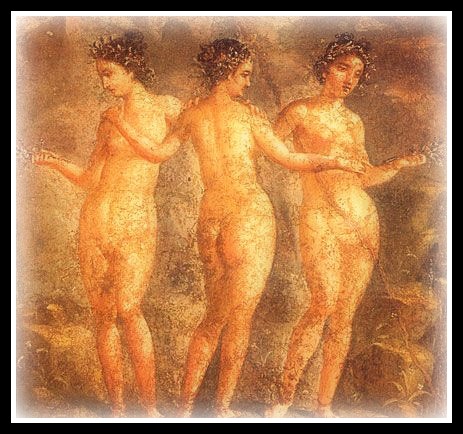 Fresco from Pompeii, House of Titus Dentatus Panthera, ca 65 -79 AD; Museo Archeologico Nazionale di Napoli – Three Graces

_________________________________________________________________________________________________
The Charites (Three Graces) were reputed to be the essence of beauty, charm, and grace and were associated with the Nine Muses, who presided and inspired arts and sciences.
The Charites were three goddesses, who were sisters between them: Aglaia (Αγλαια Brightness), Euphrosyne (Ευφροσυνη Joyfulness), and Thalia (Θαλια Bloom).
The character and nature of the Charites are sufficiently expressed by the names they bear: they were conceived as the goddesses who gave festive joy and enhanced the enjoyments of life
Pindar, Olympian Ode 14: “Kharites (Charites, Graces) three . . . Euphrosyne, lover of song, and Aglaia (Aglaea) revered, daughters of Zeus the all-highest . . . with Thalia, darling of harmony.”
They are said to be daughters…
View original post 647 more words
 lampmagician
You must be logged in to post a comment.