This strange and disturbing Surrealist text, with its frenzied sexual connotations and violent imagery was written by Georges Bataille in 1927 and published in 1931 with illustrations by longtime collaborator Andre Masson (alas I have been unable to find the drawings so instead I have chosen a colour lithograph by the same artist instead).
L’Anus solaire is a riot of analogy and allusion, and as it mentions both a sewing machine and an umbrella would seem to be clearly indebted to the Black Bible of Surrealism, Les Chants de Maldoror by the mysterious Uruguayan Comte de Lautréamont. Other touchstones are the Marquis De Sade, William Blake and Friedrich Nietzsche.
A quick word about the Jesuve mentioned in the text. Bataille elsewhere notes that “The Jésuve is not only Jesus, which in France is both a saviour and a sausage, but also sève, the sap of Dionysos; the Jesuve is both the…
You can’t go near the literary press lately without hearing mention of Nathan Hill’s sprawling new novel, The Nix, widely praised as a comic epic on par with David Foster Wallace’s Infinite Jest. Novelist John Irving, to whom Hill has drawn comparisons, goes so far as to compare the novelist to Charles Dickens. Such praise goes too far if you ask Current Affairs editor Brianna Rennix. In a caustic review essay, Rennix unfavourably measures not only The Nix, but also the postmodern novels of Wallace, Pynchon, McCarthy, Franzen, and DeLillo, against the baggy Victorian serialized works of writers like Dickens and George Eliot. “Books like Middlemarch,” she writes, “took seriously the idea that novels had the power to transform human life, not merely—as seems to be the goal of a lot of postmodern novels—to riff off its foibles for the purpose of making the author look clever.”
It’s possible to appreciate Rennix’s essay as a reader of more ecumenical tastes—as someone who happens to enjoy Dickens and Eliot and all the authors she dismisses. There’s much more to the postmodern novel than she allows, but there are also very good reasons particular to our age for us, turn, or return, to Dickens
In the TED-Ed video above, scripted by literary scholar Iseult Gillespie (who previously made a case for Virginia Woolf), we get some of them. For all the fun he had with human foibles, Dickens was also a social realist, the greatest influence on later literary naturalism, who “shed light on how his society’s most invisible people lived.” Unlike many novelists, in his own time and ours, Dickens had the personal experience of living in such conditions to draw on for his authentic portrayals.
Nonetheless, Dickens’ did not allow his enormous popular success to blunt his compassion and concern for the plight of working people and the poor and socially marginalized. The engrossing, highly entertaining plots and characters in his novels are always pressed into service. We might call his motives political, but the term is too often pejorative. The “Dickensian” mode is a humanist one. Dickens’ did not push specific ideological agendas; he tried, as Alain de Botton says in his introductory video above, “to get us interested in some pretty serious things: the evils of an industrializing society, the working conditions in factories, child labor, vicious social snobbery, the maddening inefficiencies of government bureaucracy.” He tried, in other words, to move his readers to care about the people around them. What they chose to do with that care was, of course, then, as now, up to them.
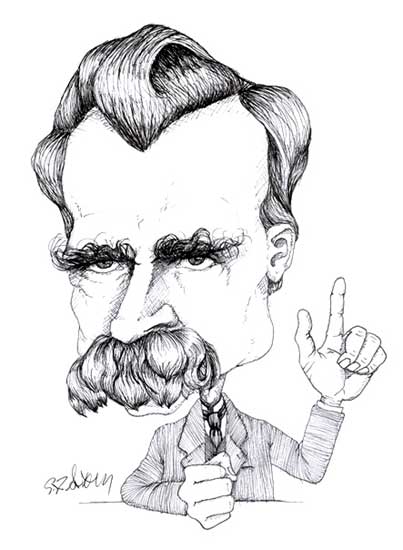
Friedrich Nietzsche:
“The Key to Overcoming Nihilism:” Slave Morale “.-
“Have you ever wondered sufficiently how expensive the establishment of every ideal has been made to pay on earth? How much reality had to be always slandered and misunderstood for it, how much lie, sanctified, how much conscience disturbed? … We modern men, we are the heirs of the vivisection of conscience, and of the torture “. (Nietzsche, The Genealogy of Morals).
The slave is both the shepherd and the flock. According to Nietzsche, it reveals the lack of confidence in the individual to singularize himself, to create his own vision of the world and to affirm the difference. Because of the fear of individuation, the will of the slave manipulates the conscience of the Other. It acts out of resentment in the face of the desire for differentiation, and the morality it employs rests precisely on its specific origin. The will of the slave coined a moral that responds to his own shortcomings in acting, differentiate and recreate the world originally. In the words of Nietzsche: “The morality of the slave is that which says no, already in advance, to an Out, to an Other, to a Non-Self” (IBD, Genealogy of Morality).
Of all the devices of power of the morality of the slave the bad conscience is the most effective (“the greatest, the most sinister ailment, a disease from which humanity has not been cured until today, the suffering of man by man, by itself, the result of a violent separation of its animal past, the result of a leap and a fall, the result of a declaration of war against the old instincts in which until that moment its strength, pleasure and fecundity rested ” IBD Nietzsche: The Genealogy of Morals).
The act that founds the triumph of slave morality is the formation of bad conscience in the Other. It is the foundational spring of all integration based on the morality of the slave, whose file seeks to institute a self-repressive subjectivity in the Other in order to keep it under the aegis of the pastor. By internalizing the debt as guilt becomes unpayable. In Christian Judeo morality the pastor introjects the pain in the Other and makes the debtor a perpetual creditor of himself (or the shepherd that he harbours in himself). The bad conscience, interpreted as the device of introjected debt that truncates any will of individuation, thus universalizes the morality of the slave. Once introjected the immeasurable guilt, it is stuck in the interior (“The entire inner world, originally thin, as enclosed between two skins, was separating and growing … the relief of man out was being inhibited: this is the origin of the bad conscience “(IBD Nietzsche: The Genealogy of Morals).
The overcoming of nihilism requires transfiguring the negative energy of the ascetic ideal of the slave into creative energy. The Will to Power, understood in its positive meaning as the power to create and transfigure a symbolic order must operate by reversing the projective mechanism of the will of the slave. Just as the will of the slave in his moment neutralizes the free will, reverting the active forces against themselves (bad conscience as introjection, clogging of the creative energies in the subject); in the same way, the will to power must interpellate to revert the inhibitory energies of the priest-priest-manipulator of consciences. It is not about dissolving the energy that inhabits the will of the slave, but actively turning it against the shepherd himself who feeds himself.
Source: Hopenhayn, Martin. After Nihilism (Cap II, ap IV). Barcelona. Andres Bello. 1997
“La Clave para la Superación del Nihilismo: “La Moral de Esclavo”.-
“¿Os habéis preguntado alguna vez suficientemente cuán caro se ha hecho pagar en la tierra el establecimiento de todo ideal? ¿Cuánta realidad tuvo que ser siempre calumniada e incomprendida para ello, cuánta mentira, santificada, cuánta conciencia conturbada?… Nosotros los hombres modernos, nosotros somos los herederos de la vivisección de la conciencia, y de la autortura”. (Nietzsche. La Genealogía de la Moral).
El esclavo es tanto el pastor como el rebaño. Según Nietzsche, revela la falta de confianza en el individuo para singularizarse, para crear su propia visión del mundo y afirmar la diferencia. Por el temor a la individuación, la voluntad del esclavo manipula la conciencia del Otro. Actúa por resentimiento frente a la voluntad de diferenciación, y la moral que emplea tiene, precisamente, en el resentimiento su específico origen. La voluntad del esclavo acuña una…
El buen autor, el que de veras se compromete con su causa, quiere que aparezca otro y lo eclipse sosteniendo la misma causa de modo más claro y resolviendo exhaustivamente los problemas contenidos en ella. La muchacha que ama desea descubrir, en la infidelidad del amado, la devota fidelidad de su propio amor. El soldado desea caer en el campo de batalla por su patria victoriosa: pues en la victoria de su patria triunfan al mismo tiempo sus más altos deseos. La madre da al hijo lo que se quita a sí misma, el sueño, la mejor comida, en algunos casos la salud y los bienes. ¿Pero son, todos éstos, estados altruistas? ¿Son, estas acciones de la moral milagros, en tanto que son, según expresión…
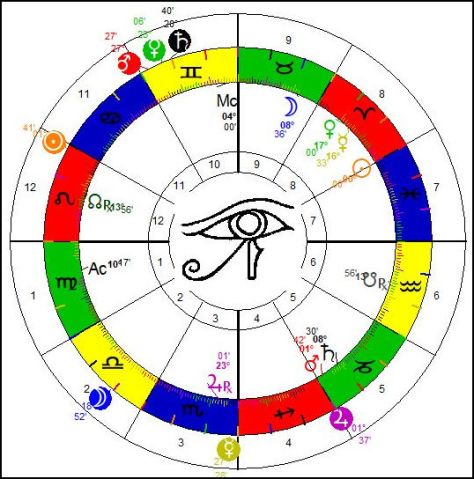
Aries Ingress 2018-03-20 G 16:15:25 UT Greenwich, United Kingdom 000° e 00′ 51° n 29′ Asc: 00°00′ Virgo, Moon: 08°36′ Taurus – showing Hermetic Lots
The Ingress of the Sun into zero degrees Aries marks the Spring Equinox and Nowruz. In some respects, this astrological event is the most important in the yearly cycle because it marks the astrological New Year and the chart provides us with insights into the entire year. Most importantly, we can derive the identity of the Lord or Lady of the Year – an influence which will be felt throughout.
This year the Moon exalted in Taurus in the Ninth House is the Lady of the Year. The Sun is Exalted in Aries and we find Mars in his Exaltation with Saturn in his Domicile in the Fifth House. The planetary Day is Mars and the Planetary Hour belongs to Mercury. The Almuten of the charts is also Mars. Venus is in her Fall…
Why would a goddess have antlers when only male deer have antlers? These ancient goddesses come from a time when people were closely connected with reindeer. They were hunter gatherers and followed the Deer trods of the reindeer in their migratory patterns. They depended on the reindeer for food, shelter, warm clothing. They survived because of the reindeer.
Both male and female reindeer grow antlers. The antlers begin to grow on males in March or April, for females it is May or June. The male loses his antlers at the end of rutting season (late fall) and the females keep theirs until they calf in the spring. They both grow new antlers every year and each year they grow in bigger.


 The Sun-Andre Masson 1938



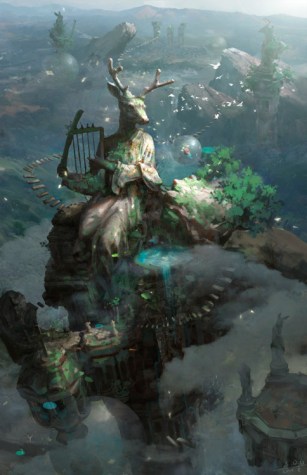 Kingdom of the Deer Concept by Wang Rui
  lampmagician
You must be logged in to post a comment.