Greek Mythology: “Aphrodite, Hephaestus, Ares and her Other Lovers”.-

Gallery

Aquileana's avatar⚡️La Audacia de Aquiles⚡️

►Greek Mythology: “Aphrodite, Hephaestus, Ares and her Other Lovers”:

guarda_griega1_3

"Mars and Venus Surprised by Vulcan" by Joachim Wtewael. (1601). “Mars and Venus Surprised by Vulcan” by Joachim Wtewael. (1601).

guarda_griega1_3

_____________________________________________________________________________________________

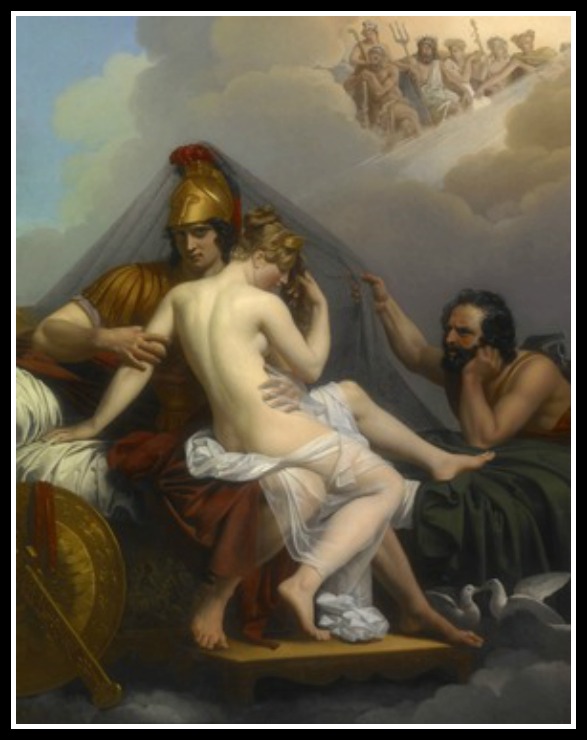
Hephaestus (Roman equivalent: Vulcan), the smith and craftsman of the gods, was married to Aphrodite (Roman equivalent: Venus), the goddess of love and beauty.

It was not a good  marriage because Aphrodite was as an unfaithful wife.

But Hephaestus also cheated her, for example with Athena, the Greek goddess of reason, intelligent activity, arts and literature.

Aphrodite most notable lovers were the gods Ares (God of War. Roman equivalent: Mars),Dionysius, Greek God of Wine and Fertility,  Hermes, (Greek God of herds and herald of the gods. Roman equivalent: Mercury), Zeus (King of Gods. Roman equivalent: Jupiter), Nerites (A young Sea-God who was the very first love of Aphrodite). Poseidon (Greek God of the Sea. Roman equivalent: Neptune), and the mortal, Adonis, who was Myhrra’son

View original post 593 more words

►Greek Mythology: “Hephaestus” / “Collaboration with Holly Rene Hunter” 🔥.-

Gallery

Aquileana's avatar⚡️La Audacia de Aquiles⚡️

►Greek Mythology: “Hephaestus”  /

“Collaboration with Holly Rene Hunter”:

“The Fall Of Hephaestus” by C. Van Poelenburg. 17th century.

_____________________________________________________________________________

Hephaestus(Roman equivalent: Vulcan)  was the Greek god of fire, metal work, blacksmiths and craftsmen.

According to Homer’s  “Iliad”, Hephaestus was born of the union of Zeusand Hera. In another tradition, attested by Hesiod, Hera bore Hephaestus alone.

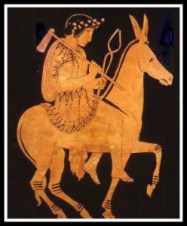
Hephaestus. Attic Red Figure. 430 – 420 BC.

Hesiod tells us in “Theogony”, that in order to get even with Zeus for solely bringing about the birth of Athena, Hera produced the child Hephaestus all on her own.

Though Hesiod’s version seems to be the one that is most commonly accepted among readers, its content greatly alters our understanding of the birth of Athena. The ancient texts unequivocally state that it was Hephaestus who released the goddess from the head of Zeus by cracking the god’s…

View original post 1,352 more words

Carl Jung: I found it exceedingly odd that you should amiably take me for an atheist

Standard

Source: Carl Jung: I found it exceedingly odd that you should amiably take me for an atheist

Carl Jung: I found it exceedingly odd that you should amiably take me for an atheist

Standard

Unknown's avatarCarl Jung Depth Psychology

To Paul Maag

Dear Colleague, 1 June 1933

Many thanks for kindly confirming my expectations.

You are, ofcourse, quite right: I have not yet given up struggling for a philosophy of life and I very definitely hope that this struggle will not come to an end too soon, for I cannot see that possessing the absolute truth is a state in any way to be envied.

I would therefore rather not make any specific prognoses about the future, since the modest share of the light of knowledge that has been vouchsafed me does not enable me
to see whither and to what goals the tortuous paths of fate are wending.

Theology and the Church do not embarrass me in the least.

On the contrary, I am indebted to both for extraordinarily valuable insights.

It was kind of you to recommend Martensen’s Jacob Bohme’s Leben und Autorenschaft. Bohme’s writings have long…

View original post 256 more words

Carl Jung on Depth Psychologie via Lewis Lafontaine

Standard

[Carl Jung on “UFO’s” – Anthology]

I think it [UFO’s] is chiefly an obstinate rumour, but the question whether there is something real behind it is not answered. ~Carl Jung, Letters Vol. II, Pages 5-6.

This, too,[UFO’s] is an expression of something that has always claimed my deepest interest and my greatest attention: the manifestation of archetypes, or archetypal forms, in all the phenomena of life: in biology, physics, history, folklore, and art, in theology and mythology, in parapsychology, as well as in the symptoms of insane patients and neurotics, and finally in the dreams and life of every individual man and woman. ~Carl Jung, Letters Vol. II, Pages 397-398.

I do not believe and do not disbelieve in the existence of UFOS. I simply do not know what to think about their alleged physical existence. ~Carl Jung, Letters Vol. II, Pages 403-404

As it is questionable in how far UFOS are physical facts, it is indubitable that they are psychological facts. ~Carl Jung, Letters Vol. II, Pages 403-404

Hoyle’s book has arrived and I’ve finished it already. It is extraordinarily interesting to see how an astronomer collides with the unconscious and especially with the Ufo problem. ~Carl Jung, Letters Vol. II, Page 408.

I myself recently dreamed that a UFO came speeding towards me which turned out to be the lens of a magic lantern whose projected image was myself; this suggested to me that I was the figure, himself deep in meditation, who is produced by a meditating yogi. ~Carl Jung, Letters Vol. II, Pages 476-477

These [UFO] symbolisms, which are cropping up everywhere nowadays, paint a picture of the end of time with its eschatological conceptions: destruction of the world, coming of the Kingdom of Heaven or of the world redeemer. ~Carl Jung, Letters Vol. II, Pages 476-477

Although I have been studying the UfO phenomenon for about 12 years now and have read practically all the relevant literature, I a m still unable to form a satisfactory picture of it or to assert that anything adequate is known about the nature of UfO’s. I cannot even say whether they exist or not. ~Carl Jung, Letters Vol. II, Pages 627-628

The science fiction about travelling to the moon or to Venus and Mars and the lore about Flying Saucers are effects of our dimly felt but none the less intense need to reach a new physical as well as spiritual basis beyond our actual conscious world. ~Carl Jung, Letters Vol. II, Pages 592-597