Saint Anna, Virgin and Child By Leonardo da Vinci Wikipedia
The double birth signifies that motif known from hero mythology, which allows the hero to descend from the divine and human parents. The motif plays a significant role in mysteries and religions as a motif for baptism or rebirth. This motif also led Freud to make a mistake in his study A Childhood Memoir of Leonardo da Vinci in 1910. Without realising that Leonardo is by no means the only one who painted the motif of St. Anne Selbdritt (Saint Anna, Virgin and Child), he attempts for Anna and Mary, namely grandmother and mother, to be reduced to Leonardo’s mother and stepmother, i. H., to assimilate the image to his theory. Did the other painters all have stepmothers too? What prompted Freud to commit this violence was evidently the fantasy of dual descent suggested by Leonardo’s biography. Fantasy painted over the incongruous reality that St. Anna is the grandmother and prevented Freud himself from researching the biography of other artists who also dealt with St. Anna Selbdritt. The author himself has confirmed the “religious inhibition” mentioned on p. 17. The theory of incest that has been so strongly emphasised is also based on an archetype, the well-known incest motif often encountered in heroic myths. It derives logically from the original hermaphrodite type, which seems to go back far into primitive times. Whenever a psychological theory proceeds somewhat violently, there is a reasonable suspicion that an archetypal fantasy image is trying to distort reality, which would correspond to the Freudian concept of “religious thought inhibition”. Explaining the origin of the archetypes with the incest theory would be just as fruitful as if you scooped water out of a kettle into another vessel standing next to it, but which was connected to the kettle by the pipes. One cannot explain one archetype by another, i.e. one cannot explain at all where the archetype comes from because there is no Archimedean point outside these a priori conditions.
Carl Jung: Archetypen
Über den Archetypus mit besonderer Berücksichtigung des Animabegriffes 1936 [Fußnote S. 89] (On the Archetype with Special Consideration of the Anima Concept 1936) [footnote p. 89]
This topic might still sound strange, unfamiliar, or even unacceptable (especially to men), but I think it is one of the most important issues in our existence. I come from a society where religion is dominant, meaning the man has the saying! Although, in big Iranian cities, men have learned (thanks Pahlavi regime) that women also have the right to live with their wishes. Nevertheless, man has always the end in his hands! These thoughts also influenced me though I was curious to understand the feminine side. I remember well, as Al and I were often in the bookstores in southern Tehran, once I got a thick book in my hand titled: All That Men Know About Women. And when I leafed through that, I saw all the pages blanc white! Maybe from that time, I have decided to try to understand this “opposite?”. Honestly, I had learned a lot from my mother and her female side. She taught me how to cook, sew or any other typical woman’s housework. And I tell you, men: I am thrilled and proud of having this opportunity (freedom😉 ). Through my research, I learned that understanding the woman could only be possible through looking into my own feminine. When my mother died, I kept her lessons in my mind and heart, and I could do all jobs by myself. And I admit my pride in my whole life, having so many ladies as friends (more than gents), both in so-called visual and real life. When I got to know Dr Jung, he confirmed me and my feelings. I expanded my knowledge and have learned much more about this.
Now I present (translated from German by my littleness) a part of Jung’s book: [Die Beziehungen Zwischen Dem Ich Und Dem Unbewussten]; Die Individuation, Anima und Animus. He explains here how effective is for men to consider their Anima sides.
“The parent spirits are the most practical of the possible spirits, hence the universal cult of ancestors, which initially served to appease the ‘revenants’ but later became an essentially moral and educational institution (China!). Parents are the child’s closest and most influential relatives. In adulthood, however, this influence is split off; therefore, the parent imagines are possibly even more repressed from consciousness and, because of their after-effects, perhaps even suppressing effect, are easily given a negative sign. In this way, the Parent-Imagines remain alien in a psychic ‘outside’. But what now replaces the parents as a direct environmental influence for the grown man is the woman. She accompanies the man; she belongs insofar as she lives with him and is more or less of the same age; she is not superior, either by age, authority, or physical strength. It is, however, an influential factor that, like the parents, produces an imago of a relatively autonomous nature, but not an imago which, like that of the parents, is to be split off but rather to be kept associated with consciousness. With her psychology so dissimilar to man’s, the woman is (and always has been) a source of information about things man has no eyes for. She can inspire him; Her power of foreboding, often superior to that of men, can give him a helpful warning. And her feeling, which is oriented toward the personal, can show him ways in which his feeling with little emotional connection would not be discoverable. What Tacitus says about the Germanic women is quite accurate in this respect.”
{According to Tacitus, Germanic women do not participate in feasts or plays, unlike Roman women. However, it is unlikely they were excluded from this since it was part of the women’s job to serve the men at the table. More here.}
“Here undoubtedly lies one of the primary sources of the feminine quality of the soul. But it doesn’t seem to be the only source, for no man is so entirely male that he has nothing female in him. Instead, the fact is that very masculine men in particular (albeit well protected and hidden) have a very soft emotional life (often wrongly referred to as “feminine”). It is considered a virtue for a man to repress feminine traits as much as possible, just as it has been deemed unpalatable to a woman, at least up to now, to be a man’s wife. The repression of female traits and tendencies naturally leads to an accumulation of these claims in the unconscious. The imago of the woman (the soul) also naturally becomes the receptaculum of these claims, which is why the man in his choice of love is often subject to the temptation to win that woman who best corresponds to the special nature of his own unconscious femininity, also, a woman who can absorb the projection of his soul as easily as possible. Although such a choice is often viewed and felt to be ideal, it may just as well be his own worst weakness that the man is visibly marrying in this way. (This might explain some very odd marriages!)
It now seems to me that besides the woman’s influence, there is also the man’s own femininity, which explains the fact of the femininity of the soul complex. It shouldn’t be a question of a mere linguistic “accident”, for example, in the way that the sun is feminine in German but masculine in other languages, but we have the evidence of art from all times – and moreover, the famous question: “habet mulier anime”? (does a woman have a soul?). Probably most men, who have any psychological insight at all, know what Rider Haggard means when he speaks of ‘She-who-must-be-obeyed’ or which chord strikes them when they read Benoit‘s description of Antinea. They also tend to easily know what kind of woman best embodies this secret, but often only a clearly suspected fact.”
I think here it is enough for now, but there is more about that later for sure. Be well and safe, everybody. 🙏💖🌹✌🥰🦋
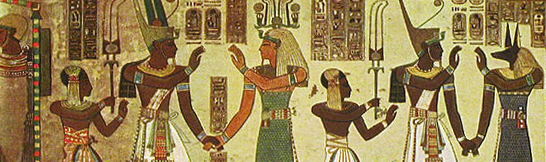
Egypt, Thebes (UNESCO World Heritage List, 1979) – Luxor – Valley of the Kings. Tomb of Seti II. Entrance. Relief (Dynasty 19, Seti II, 1214-1186 BC) (Photo by S. VANNINI/De Agostini/Getty Images)
Userkheperure Setepenre (means “Powerful are the manifestations of Re) Seti II (reigned 1203 B.C.E. – 1197 B.C.E.) was the fifth Pharaoh of the Nineteenth Dynasty during the New Kingdom. His rule commenced a period known for dynastic intrigue and short reigns. Seti II had to deal with many severe plots and complications, most significantly the rise of a rival king named Amenmesses, possibly a half-brother, who seized control over Upper Egypt and Nubia during Seti II’s second to fourth regnal years. Ancient Egypt Wiki
The name ‘Seti’ means “of Set”, which indicates that he was consecrated to the god Set (also termed “Sutekh” or “Seth”). As with most pharaohs, Seti had several names. Upon his ascension, he took the prenomen “mn-m3’t-r’ “, usually vocalised in Egyptian as Menmaatre (Established is the Justice of Re). His better-known nomen, or birth name, is transliterated as “sty mry-n-ptḥ” or Sety Merenptah, meaning “Man of Set, beloved of Ptah”. Wikipedia
Of course, Seti II has nothing to do with Sati I, who lived in the time of Moses!
No sooner had Giovanni Battista Belzoni succeeded, in Thebes in the summer of 1816, in the delicate operation of “removing” the bust of the young Memnon on behalf of the British consul in Egypt Henry Salt when the latter offered him a to enter his service… In fact, his interest in Pharaonic civilisation and his passion for antiquities is combined with his real diplomatic and political mission. If he is in charge of “the official mission of enriching the Egyptian department of the British Museum, ” his substantial fortune allows him to constitute his own collection concomitantly.
This is how he made Belzoni his leading “agent” in the field, providing him with money and means to buy artefacts and discover them on the sites… Belzoni quickly set up several excavation sites – including Karnak – then sailed to Aswan, where he would not return until October…
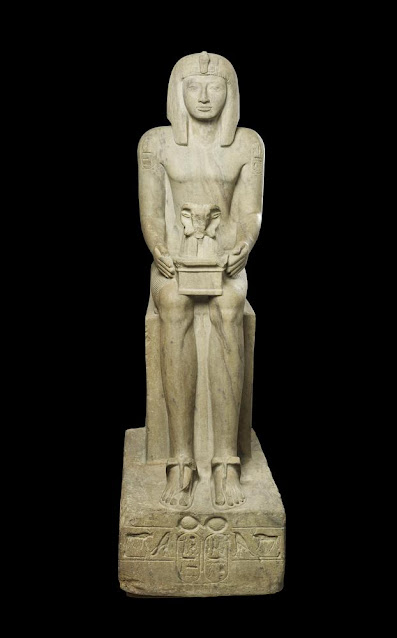
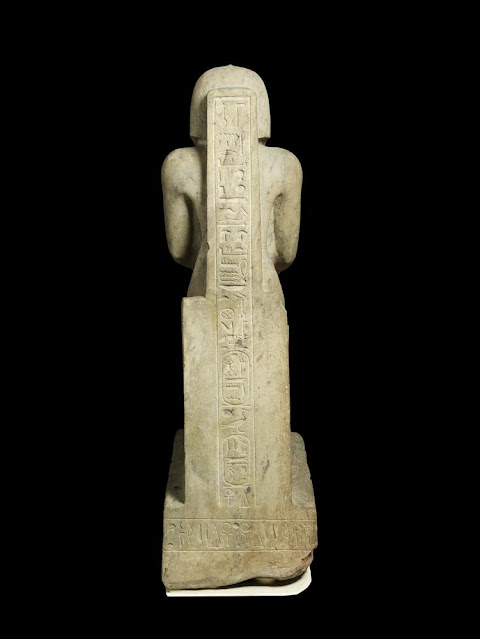
Statue of Sethi II seated holding a naos of Amun-Re – quartzite sandstone
New Kingdom – 19th Dynasty – Reign of Sethi II (circa 1203-1194 BC)
discovered in October 1817 by GB Belzoni on behalf of Henry Salt in the Temple of Mut at Karnak
British Museum EA 26 – acquired in 1823 at the Salt Collection sale
In “Travels in Egypt and Nubia”, he recounts his first beautiful discovery at the temple of Mut: “I found the excavations at Karnak advanced; but they had given no result, and there was no appearance that, however, it was there that I found in the space of a few days eighteen statues, six of the whole, of which number is a white statue of life-size, supposed to be that of Jupiter-Ammon. And which we now see with the others, in the British Museum”.
This statue which he specifies “was among the others in an irregular position”, will, after study, be attributed to Sethi II. Beautifully crafted, it represents the son of Merenptah and Queen Isis-Nofret II, the fifth pharaoh of the 19th dynasty. His reign – which appears to have been contested at the start and somewhat chaotic at the end – is generally dated from 1203 to 1194.
Of the twenty of his statues listed to date, this is the only one where he is represented seated. Sculpted in quartzite sandstone, it is 1.64m high, 0.49m wide, 0.85m deep and weighs almost 700kg!
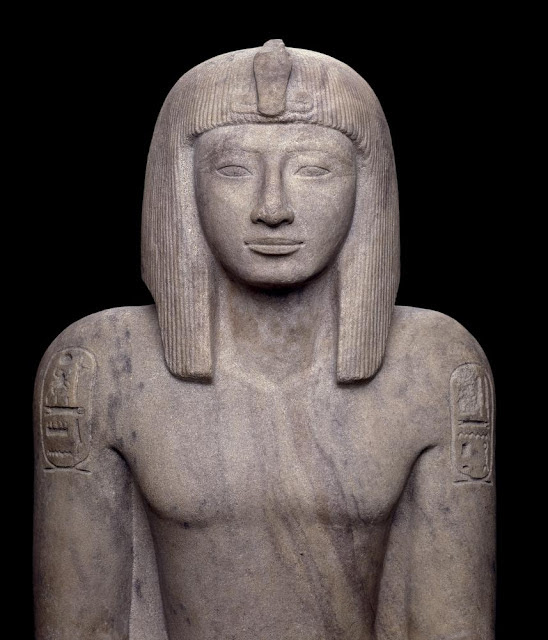
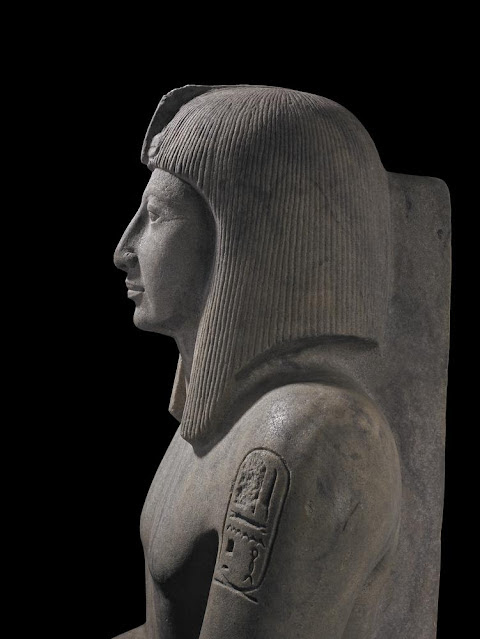
The sovereign does not wear a headdress or royal crown, but a wig covers the back of his neck with extended side panels dipping towards the base of the neck. It is adorned with a frontal uraeus whose head is missing.
The face with regular features has a closed expression. The eyes are small but advantageously stretched by a make-up line and surmounted by arched eyebrows. The nose is straight, and the mouth with hemmed lips is closed.
The neck is short and contrasts with the breadth of the shoulders. The arms are thick, while the torso and waist seem rather slim. He is dressed in the shendyt: “The pleated loincloth is held by a wide belt adorned with a rhomboid decoration, from the back of which a piece of pleated fabric emerges. An animal’s tail, suspended between the legs and the sandals, completes the royal dress,” specifies the British Museum. The legs are long and muscular, and his feet, sculpted with precision, are slipped into pretty sandals.
Statue of Sethi II seated holding a naos of Amun-Re – quartzite sandstone New Kingdom – 19th Dynasty – Reign of Sethi II (circa 1203-1194 BC) discovered in October 1817 by GB Belzoni on behalf of Henry Salt in the Temple of Mut at Karnak British Museum EA 26 – acquired in 1823 at the Salt Collection sale published in Gallery of Antiquities Selected from the British Museum, Francis Arundale, Samuel Birch, Joseph Bonomi
His arms are carried forward, resting on the space between his legs. “He holds a small naos or altar, with both hands before him. On which is the head of a ram, the living emblem of the god Noum, one of the types of Amoun-Ra”. (Gallery of Antiquities Selected from the British Museum, Francis Arundale, Samuel Birch, Joseph Bonomi). The face of the ram is, unfortunately, partly missing.
The king presents this altar, making it a “Naophore” statue. This solemn and profoundly religious act perhaps explains the rigidity of the royal attitude… “The narrow throne with a low backrest has a cushion on which the king sits. The sides of the throne are decorated with the heraldic plants of Upper and Lower Egypt, tied together to symbolise the union of the Two Lands. These plants are usually placed to match the direction of the statue and occupy the same position on either side. However, their positions are reversed: on the right side of the throne, we find the papyrus towards the back and the lotus towards the front, while on the left side, we observe the opposite,” indicates the London museum.
In “Eternal Egypt”, Hourig Sourouzian thus analyses the inscriptions of the statue and its dorsal pillar: “The royal names are engraved on the shoulders: Userkheperure-Meriamun on the right, Seti-Merenptah on the left. A text on the back of the statue begins with the epithets ‘The perfect god, bold in arms, and of great strength like Montu, lord of Thebes’ and ends with the two cartouches. The royal title is also inscribed around the base, flanking the central cartouches surmounted by the solar disk. Seti II is ‘beloved of Osiris-Khentamenti’ on one side, of ‘Ptah-Sokar-Osiris’ on the other. They were gods of the Necropolis, worshipped in Abydos, Memphis and Thebes”.
This Naophorus statue entered the British Museum – in 1823 – under reference C 26 (EA 26). Nigel Strudwick clarifies the role of “ambassador” granted to him by the consul: “The statue was clearly one of Salt’s favourite objects, and he sent it to England in the autumn of 1819, long before the rest of the collection, presumably to persuade the trustees of the British Museum to buy his other objects”…
We are already back from our holiday, and I thought that the muse might not be ripe for making a new post. But the intuition to write a new, doesn’t let me wait for the next week. Therefore, I share this quotation from Dr Jung, which I posted yesterday on FB and I love it so much. Have a wonderful weekend everyone 🤗❤️🦋🌹
But if dreams produce such essential compensations, why are they not understandable? I’ve been asked this question many times. One must answer that the dream is a natural event and that nature shows no inclination to make its fruits available free of charge and in accordance with human expectations. It is often objected that compensation is ineffective if the dream is not understood. But that is not so certain, since many things work without being understood. However, we can undoubtedly increase the effect considerably through understanding, which is often necessary because the unconscious can be overheard. “Quod natura relinquit imperfectum, ars perficit!” (What nature left unfinished, art finishes!) is an alchemical saying. Carl jung Vom Wesen Der Träume Traum und Traumdeutung. Art; Mother Nature, Pinterest (Josephine Wall)
I might call it “Another Extrablatt!” Because after a turbulent week and a funeral (bereavement) without any (four) weddings, my adorable wife has holidays, which means freak out otherwhere! Though this time (as the condition demands), our trip will be no further than in the neighbourhood: Holand; from tomorrow Saturday, till the following Saturday. Therefore, I must apologise for will not burdening you for a while!
However, I had an unforgettable memory of my Holand’s trips, as I did it more often in the 90s. Along with our younger friends, Al and I have travelled many times there. Not only because of “free smoking” but also the friendly and beautiful Dutch people. But this unique trip which I am talking about had some extraordinary events. That was about the middle of the 90s as we: Al, me and three friends borrowed my girlfriend’s car from those days and drove to Amsterdam. We wanted to stay there for about three days and had some sleeping bags to stay overnight in the parks. We had a lovely time and had got a lot of fun. On the last day, when we wanted to leave back home, one of our friends insisted that we had to have a final walk through the city and we could still drive home in the evening. We agreed, and I drove the car toward an abandoned place to park it and cared about the forbidden parking traffic signs; as I saw almost everywhere in Amsterdam, parking was strictly prohibited.
After our final cut, we returned to where I parked the car and shockingly saw the empty place. First, I thought loudly of some robbery, but Al meant it was daylight, and it couldn’t be. We were all confused until some young men passed by, and one of them said smilingly: the police must have towed it away! What!! I asked the young man if he could please tell us how we’d trace our car? He was so nice and gave us the direction; we walked about three or four kilometres till we reached the towing service. From there, we were sent to the police office a few kilometres away downtown. We were exhausted and out of breath when we reached that department. The officer was very kind to us and kindly asked for 250 Golden to give us the car back! How expensive! I said, and he answered: it’s so the price, and for the next time we should know there’s no free parking place in Amsterdam!
The truth is bitter! Once one had said, but this time it was truly bitter: we had not a penny in the packet. The only way out of this mess was to phone my girlfriend to ask for money if she’d like to see her car again! The officer was more kind to let me call home by his phone. Although my darling wasn’t so thrilled to hear the news, she unwillingly agreed to send me the money per post. It was the fastest way, and we had to accept it. We went to our car in the parking lot (all the towed vehicles). An officer warned us not to stay there, and better if we would take our sleeping bags and go to the opposite, there was a meadow to spend the night. We did that, more or less, and thank goodness that we were still young!
On the following day, early as possible, we walked to the post office (luckily wasn’t so far) and got back to pay the charge. On the way back home, we sang songs and laughed at that adventure. Everything always goes easily in the youth when the battery is still full! Have a lovely time till back then. 🤗🥰🙏💖✌🎻🎵
At the beginning of my entrance on Facebook, I became a hungry member of many Egyptian groups. It was, of course, not because of my knowledge about this magical myth, but because of my brother Al who knew a lot about and highly acknowledged this topic. Mainly through his love for two great Egyptologists: Graham Hancock and Robert Bauval.
Although the idea that I could work with this and learn more went wrong! Unfortunately, the story of discovery in Egypt is so old that there are certain firmnesses based on some arrogant opportunists who think they have known every mystory and have found everything that there was to be found. I was so disappointed that I had to leave many of these groups.
Anyhow, a long-time connection to a Jung connoisseur, Mr Lewis Lafontaine, made me decide to do an experiment with a new search and Jungian groups. And my disappointment changed into a great encouragement when I found a group of Dr Jung followers, “Carl Jung and the Creative Bridge”. It was a door not only to my studies in the future but also a great help to look back inside my soul.
There it became much better when I met two excellent Jungian masters: Laurent Tremblay and Craig Nelson. They pushed me forwards on this topic, especially when Craig Nelson told us about five hundred pages found written by Carl Jung in German and asked for any possible help to translate them. I dared give my hand, and he dared trust in me! Of course, he gave me only five pages, and I tried not to disappoint him, though, putting it bluntly, these five pages brought me out of breath. It is somehow like notes or first-hand-write lines of his memories and hard to decipher. But I did it and recently edited it again (It was very necessary because I have found out how much I have learned in these past years!)
After refinement!
(PS: I would like to know what happened with these five hundred pages? Was it the Black Book?!!)
Now here it is, a heart-touching, inmost, honest and matey narrative by such a great Master. Enjoy!
______________________________________________
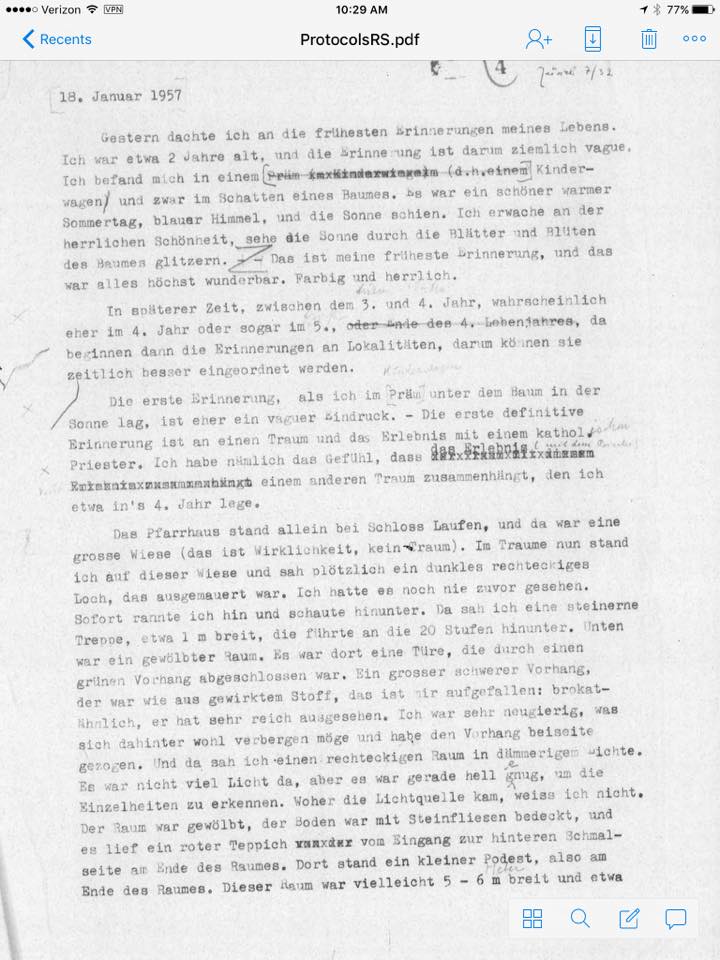
Yesterday, I thought about my very earlier memories of my life. I was about two years old, and therefore, my memories are somehow vague. In fact, I found myself in a children’s carriage in the shadow of a house. It was a nice warm summer day, blue sky, and the sun was shining. I woke up in that splendid beauty. I see the sun glittering through the leaves and flowers of the house. This is my earliest remembrance, which was all incredible, colourful and gorgeous.
In the later time, between three and four in age, probably four or even five; there the memories are more on localities so that they can be better classified temporally. Instead, it is a vague remembrance of my first memory as I was in Präm and as I lay under the tree in the sun. The first definitive reminder is about a dream and its experience with a catholic priest. I naturally feel that the experience with paradise has been related to the other dream I’d had in four years.
The Vicarage (Pfarrhaus) stood alone at castle Laufen, and there was a big meadow (that’s but real and not a dream!). In the dream, I stood in this meadow, and suddenly I saw a dark, rectangular hole that was walled. I’ve not seen it before. Immediately I ran there and looked down. There I saw a stone staircase about one meter wide which led down to the 20 steps. Down was a vaulted room, and a green curtain covered a door. A big heavy curtain was like a knitted fabric, which I noticed that it was brocade-like and looked very rich.
I was curious to know what might be hidden behind it and pulled the curtain out. Then I saw there a rectangular room in the dusk light; there was not very much light but enough to see the details. From where this light was coming, I’d never know. The room was vaulted, the ground was covered with stone tiles, and a red carpet ran from the entrance to the narrow rear side at the end of the room. There stood a small pedestal at the end of the room. This room was maybe about five or six-meter wide and about twice so long or maybe ten meters long, and now at the end of the room, the opposite of the entrance, on the narrow wall led two-three steps to a podium and on it stood a throne, an excellent rich golden throne. I’m not sure, but maybe there was a red pad on it. A fabulous armchair was like a fairy tale, a genuine royal armchair. I’d say there was now something that lay; a tree trunk, with a diameter of 50 to 60 cm, a huge fabric that almost went up to the ceiling. It was 4 to 5 meters tall and had an eye on the top. Of course, not a head; the whole was an erected phallus. When I saw it, I heard my mother’s voice, whom I knew that she was not nearby. She called; yes, look at him now, the human eater! There I got a horrible feeling and awakened with fear. This emotion came back again in my experience with the catholic priest because the fear I felt with this sight wasn’t new to me; instead, it was as if I had thought it could be the human eater.
The experience was so; I (in reality) was playing on the stairs in front of the house, on the opposite side I saw a figure coming in a Soutane, I thought there was a woman, but then I recognized that he was a man. I also thought he was a Jesuit, got a terrible horror and escaped from the house, running to the floor where I crawled. I’ve got a deadly fear, and there, from floor windows; I looked out and saw nobody was around. When I was sure that nobody was there, I ventured out again. I’d horribly terrified, and as I remember my father was talking with his colleagues about how dangerous were the Jesuits, I surely didn’t know what that really was. The word JESUS I knew from my prayers. I thought; they were devils! Therefore, they are disguised. I would be embarrassed like in the dream about Phallus. Jesuit Catholics are “entirely different”. Later I took a trip with my parents to Arlesheim; I was about 6 – 7 years old then. There was a Catholic church, the first one I met.
I wanted insistently to go inside, but when I got through the door, I stumbled, fell, and injured my knee. It has bled, and I have screamed terribly. Of those days remained a great memory; that was when my father took me to Thurgau to meet friends. They had a castle at Bodensee. There, I was not to get away from water; the waves of steamers came to the shore, the sun glittered on the water, the width, an unimaginable pleasure, a glory without equal. At that time, an idea was established for me that I must live at a lake. Man cannot live without water at all! I’ve told nobody about the dream of Phallus in my youth. The Jesuit also belongs to this secret. From then rose some doubt on me, in that time that the religious teaching was impressed in my head and they kept saying; it’s nice, it’s beautiful, and I kept thinking that there’s but another secret which the people didn’t know. And this “another” had to do with Catholic Church. That was (counter throw); it was that another Extreme. I’d associated my childhood experiences with the Catholic Church for a long time. I couldn’t enter a Church without a secret fear of the Jesuits and the falling, blood of falling, and Jesuits! It was the clay in which it was surrounded. But it had always fascinated me. When it was called the people there were Catholics, I could not help feeling a secret fear, and it remained.
Then I remember, as I still was very young, have got disgusting eczema on my body for a long time. I couldn’t sleep so well and be often crying. As I remember, when I was about three years old, my father took me in his arm and carried me in the room up and down and sang his old student songs. I remember one of them in particular because I liked it very much and it calmed me. It was the so-called father’s countryside song: “All be silent! Everyone now inclines his head to this tone.” It began somehow with these words; I can clearly remember his voice as he sang over me.
Around eczema, it occurs to me that I’ve got many injuries; once I almost fell through the terrain of the railway bridge in the Rhein River; my nanny could just hold me (at the last moment) on my rock climbs! I’ve always got a big scar on my head all through to my puberty. This hung together with the relationship between my parents. It didn’t work well; my mother left us for an extended period, maybe some months. I can remember that a nanny had taken care of me, and also remember how she took me in her arm and how I laid my head on her shoulder. She had black hair and olive-coloured skin. I mentioned that she’s different to my mother. This impression got to be later a component of my Anima, this Type. Strangely, my later mother-in-law came occasionally to take me for a walk.
When I was three or four years old, we came to Basel. There, on the other side of the Rhein, was a small village named Wörth. I remember a young, very beautiful, friendly girl with blue eyes and blond hair who took me for a walk around. It was autumn, and the sun shone through the golden leaves, and the yellow leaves were lying on the ground. This was my first impression of my later mother-in-law. She was living in this village which belonged to my father’s Parish. My mother was away for months; therefore, I felt distrust when I heard the word “Love”. I always felt distrustful when I heard this. To me, the sense of female was unreliability; man can never rely on it. “Father” meant for me reliability and faint! This is the handicap which I have started with. Later, this impression was revised; I believed that I’d got friends and was disappointed by them. I was mistrustful in front of women, and I’ve not been disappointed!
In the New Year 1875=76, we’d moved to Laufen and Basel in the winter 1978=79. But I have no remembrance of moving out.
There is but another memory; on a lovely summer evening, my mother took me outdoor and showed me the Alpines mountain range; you could see them clearly every nice evening; “lueg jetz dert, die Bärg sind alli rot” (Look now there; the hills are all red!) There I saw them aware for the first time, then I heard about an excursion would take part up there, and I wanted to be among them, and I was unfortunate when they said I’d be too young to go with.
In another memory, as I can remember, a girl ran into the house and said that the fishermen had landed (got) a corpse and asked if she could keep it in the “Buchihuus” (washhouse). This house is still there. I was very interested and wanted eagerly to see this corpse, though my aunt had strictly prohibited me from doing this. But I’d broken out and did go there to this house. The doors were locked; I looked around the house and saw an outlet of the washhouse, water and blood was coming out of it, and I found it very interesting!
And the other memory; I sat on a high children’s chair in the eating room in vicarage before a cup of hot milk with bread crumbs in it. This had a very characteristic odour, and those days it was for the first time that I became aware of it. That was momentary in which I became conscious of smell.
That was one of my earliest memories…..
Somehow, if I am still learning to find my way, I have known at least one thing well!! 😉🤗🙏 💖💖
This post must be called “The word of Silence” 2! But never mind; it’s all that doesn’t matter anyway!
As I made a shortcut in that post, we travelled to Berlin by train (it is much more comfortable than with the car, I think the highways in Germany are famous enough because of the traffic jam)! Although with the train we also had fifty minutes delay because the train had no desire to do its job! “The train does not want to continue!” The young voice was saying this announcement on the air, but we had enough time to get on time the next day at nine o’clock to keep our appointment on time!
We arrived late in the evening and could just eat some “Würstchen mit Kartoffelsalat.” I shaved, showered to be nice enough for the Americans the following day, and dived into the beds in the hotel.
On the next day, we got up early enough (though I was awake most of the night thinking in English to bring up and refresh the language.) then we got our breakfast. After I wore my Sunday clothes, we decided to walk toward the embassy because we couldn’t trust the punctuality of the buses and didn’t want to take any risk.
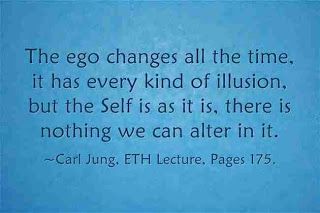
We were on time, but once we were there I couldn’t believe what I saw in front of me; it was not only me who was invited but many from worldwide, and all about the same time; there was a line of people waiting outside the door! It looked like I was in the wrong way to take this as a personal meeting; my ego deceived me, yet, I belonged to the mass!😜 I remembered a quote from Master Jung as salvation to calm my pride:
Oh yes! My ego had deceived me, as I might be the one who was in the middle of the happening. That was only a very common invitation for all the citizens and fellow citizens from all over the world to try their chance to enter the new(?) world. Anyway, we went toward the entrance, and there, a policeman told me very kindly and politely what I needed to take with me. Regina, my wife, was not allowed to come in; only the aspirants!
Of course, we’d accepted, and I kept my documents and left the rest with Regina. I went into a row and took some deep breaths to relax as I observed these different folks and the police officers, who were very friendly and easygoing. Suddenly I heard someone shout, “Hey! Take your backpack!!” I turned back and saw Regina shamingly coming up the stairs and taking the bag she had just left in the corner of the terrasse. Apparently, she was just about to take some pictures of me and had no idea how it simulates the evil intentions of terrorists! The pure heart can sometimes be problematic! After all, she took that damn bag and vanished, but now I had another heart beating: I’ve heard the police officers had a short discussion: “You must react faster when you see a bag left around. And the other one: Yes, I know! I had called out at once! My thought began to worry: What if they are talking about us right now? They might ask themselves: Wasn’t that woman with this man in the row? Therefore would they put my name on a suspicion list?!
Just needless excitements! We went in one after another and visited some counters showing papers and taking photos (separated, of course, and no family photos!) Finally, the “interview”, which took only a few minutes, was about when I left Iran and if I still had my Iranian passport? The answer to the latter was no, and I felt it was somehow important!? Last but not least, they kept my passport, and I got the instructions to be notified in about two weeks of what will ever come to me.
When I came out of the building, I felt lighter. It was like an enormous burden had been taken away from my shoulders. It has been done now; whatever will happen doesn’t mean to me anymore. Then I saw my faithful wife, sitting obediently further from the house and waiting for me. I am still alive! I told her to calm her kind heart and added that we could use the chance to enjoy this big city. Of course, we both do have not the feeling like tourists this time; however, there were two days left to look around Berlin and visit one or another exciting thing. We’ve decided first to walk back to the hotel to take some rest.

Spree
I will write about our “touristic” visits later in another post. I only will finish this one with the “unbelievable” news that I am yet not the villain that one suspected, and I am allowed to travel to the USA! It didn’t last two weeks, even not a week; it seems that they immediately threw themselves at work and already prepared the visa for the next day because when we came back on Saturday, on Tuesday, I had the Email telling me my passport was on the way. The next day I got it, with ten years of valid visa stamped on a page! Honestly, I have no money to undertake such travels now, but ten years is a long time; let’s see what happens. In that far, I might begin to learn American English!! 😉👇👇
American Slang phrase English meaning I’m game: I can join you/I will do it. I’m down: I can join you/I will do it. I’m in: I can join you/I will do it. Have a blast: Having a great time.
We might be sleeping, and when we die, we will awaken; unknown!
I must count the years since you left this Earth (or as you called it in your book: changing the level!) to find out how long it passed because these don’t mean to me as I have the feeling it was yesterday. (Tonight, we enter the sixteenth year of separation, although our reunion is getting closer.)
You’ve written many things about death and have many versions. I have found some of your notes on this, though some were hard to discern. ( Mostly, you were drunk when you wrote them and called them “Schnapsideen”, according to Germans!) But they all show your efforts to definite this great puzzle: the death.
The last days in Tehran. At the left is a very close friend of ours, a great late actor; they are now together– blessing!
“Death is psychologically as important as birth, and like it, is an integral part of life. … As a doctor, I make every effort to strengthen the belief in immortality, especially with older patients when such questions come threateningly close. For, seen from a correct psychological perspective, death is not an end, but a goal and life’s inclination toward death begins as soon as the meridian is passed. C. G. Jung (1957) CW 13
But the other day, you were full of life and permanently in love! However, this “falling in love” was not so expected or ordinary, as you never were! You were rather alone, and when I among our friends have tried vainly to set you up with a girl, you’ve been looking for a forbidden love. You have loved the impossible love, like Pip in one of your favourite novels, The Great Expectations by Charles Dickens. Pip had loved Estella from the button of his heart but painfully and in vain as you worshipped it: painfully and in vain. Yes! You were unconventional; what love desires.
However, you never forgot your beloved point of “changing the level”, and I kept believing. Once, you told me about Jung’s point of view on this matter, that “death is inevitable and to think otherwise is to live in denial. More than just denial, it means living against one’s instincts.”
Live on and look forwards!
Jung writes from his most profound personal encounter with his soul in The Red Book, “The knowledge of death came to me that night… I went into the inner death and saw that outer dying is better than inner death. And, I decided to die outside and live within… I turned away and sought the place of the inner life.”
Yet, I try to follow the master and live the inner life, as you’ve done, even though what remains for me is the memories; You do remember how Paul Simon had mused about it; Time it was And what a time it was; it was A time of innocence A time of confidences Long ago, it must be I have a photograph Preserve your memories They’re all that’s left you (“Bookends” Simon & Garfunkel)
Although the word Pietà (from Italy means compassion) essentially comes from Jesus & Mary Statue, we can find many of these kinds in our ancient history. Is it a coincidence (which I would never believe in that!) or a repeating idea?
Anyhow, we all have such nursing by our own mother and, with more luck, by Mother Nature, which is a precious goal. Here is another worth reading article by Marie Grillot about this Goddess mother and her influential and legendary will to bring (tinker) her brother/husband scattered body into life again. And also a reportage on the find of this golden Pietà. 🙏💖
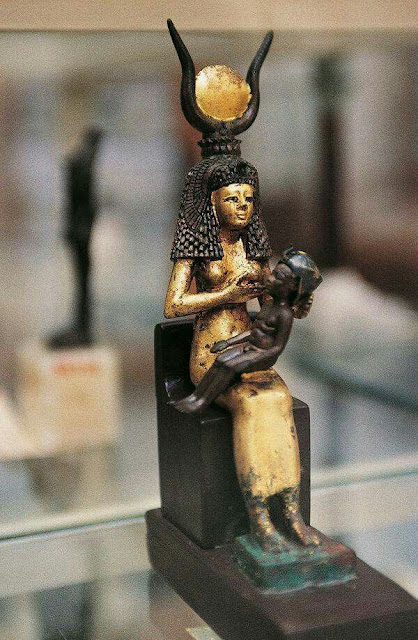
Statuette of Isis breastfeeding Horus – bronze and gold leaf – Late Period (664-332 BC) Provenance: Saqqarah or Abusir – Egyptian Museum of Cairo – JE 91327 – photo of the museum
If its more distant origins remain obscure, the first mention relating to the goddess Isis – Aset – is found, in the 5th Dynasty, in the “Texts of the Pyramids”. Daughter of Geb and Nut, sister of Nephthys, and wife of her brother Osiris, the “role” in which she is perhaps the most represented are that of mother of Horus…
We will not recount the violent quarrels and intrigues that lead to her husband’s terrible assassination by her brother Seth… Dismembered and butchered, the grieving widow will never stop, with the precious help of her sister, recovering the 14 (16 or 42?) body parts…
Drying up her tears, courage, and will, will help her in this quest, which is long and arduous but ultimately fruitful. She will thus be able to reconstitute, by the practice of funeral rites and by the creation of mummification, the body of Osiris… To compensate for the absence of the sex of the deceased that a fish would have swallowed, she knew how to show an imagination “fertile”… “The goddess’ talents as a great magician and the many artifices of which she has the secret put to use again: she models a penis in the ground and replaces the missing phallus. She thus restores her virility to Osiris, hoping to conceive a child by him and give an heir to the throne of Egypt coveted by Seth” (Florence Quentin).
This posthumous union will be – one might say – “blessed by the gods”… Fertilized but still threatened, Isis will hide in the thickets of papyrus to experience her pregnancy there… In the “swamps of Chemnis”, it is there that she will be born this little Horus, eternal child of the Osirian myth…
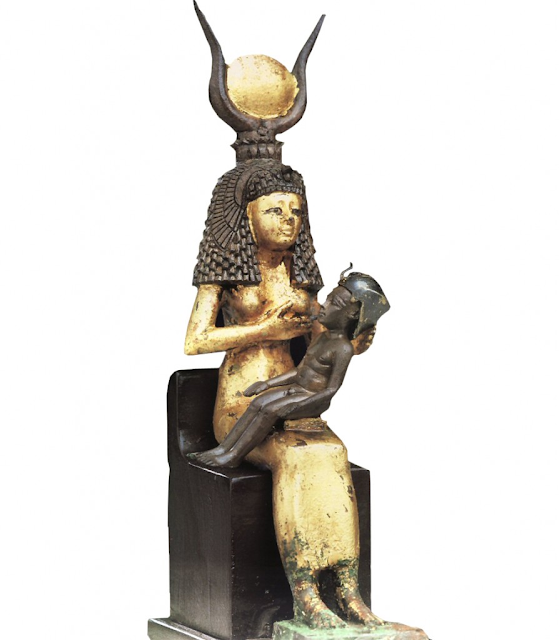
Statuette of Isis breastfeeding Horus – bronze and gold leaf – Late Period (664-332 BC) Provenance: Saqqarah or Abusir – Egyptian Museum in Cairo – JE 91327
Nourished from her breast – “by breastfeeding him Isis transmitted power to him” – he was loved and protected by this mother. The latter, aware of the threats hanging over him, applied herself not only to thwart the plots but also to make them stronger and to “legitimize” them…
“After that, she helped her son with her intelligence and magical power during his struggle to recover his inheritance and the lawsuit he had to bring against his uncle to succeed his father” (Isabelle Franco)…
Revered and adored as a nurturing, loving and protective mother, she enjoyed great popular piety. “It was during the Third Intermediate Period that Isis assumed this role of archetypal mother in this iconographic type and, during the 1st millennium, it was declined in countless statuettes”, specifies Laurent Coulomb. He further adds that this type of statuette “could be consecrated in a religious context but is also similar to the amulets with prophylactic virtues which accompanied the different stages of the life of the Egyptians, from birth to death and travel in the world. ‘beyond”…
This is how the Egyptian departments of museums hold – often in several copies – these figures of breastfeeding Isis – snuggling or nursing Isis – or Isis Lactans…
Statuette of Isis breastfeeding Horus – bronze and gold leaf – Late Period (664-332 BC) Provenance: Saqqara or Abusir – Egyptian Museum in Cairo – JE 91327
This representation is particularly touching and luminous in the Cairo Museum (JE 91327). It is 22 cm high, and the bronze in which it is fashioned is, for the image of the goddess (apart from her headdress) enhanced with gold leaf.
Isis is seated on a throne whose hieroglyphic sign is used to write her name… She wears a lovely three-part “raven black” wig with tubular locks covering her shoulders with the remains of a vulture; it is surmounted by a mortar ringed with uraei. In its centre are stuck cow horns in the shape of a lyre enclosing a golden solar disk. Compared to the precise work of the hairstyle, her face seems more summarily treated. The large, inlaid eyes are expressive; the nose is fine, the mouth discreet… Dressed in a long dress, which goes down to the ankles, her silhouette is graceful.
Her pose is classic. With her right hand, she holds her round breast, which she holds out to the child seated on her lap, whose head she supports with her left hand.
Statuette of Isis breastfeeding Horus – bronze and gold leaf – Late Period (664-332 BC) Provenance: Saqqarah or Abusir – Egyptian Museum in Cairo – JE 91327
Little Horus, naked and sated, appear slender. His anatomy – which is no longer really that of an infant – is well rendered, particularly the well-marked chest and navel and a few folds on the abdomen… Confident, his eyes half-closed, he does not wear the wisp of childhood that usually makes him so easily identifiable. He is wearing a curious helmet adorned with a frontal uraeus that seems too big for him…
This “mother to child”, reproducing this gesture which comes from the depths of time and nourishes us all, is imbued with tenderness and love…
Dating from the late period, its provenance is summarily indicated: Saqqara or Abusir… The opportunity to recall that, far from the known sanctuaries dedicated to her such as Philae or far from the Greco-Roman Mammisi, Isis was also venerated in the sector of the pyramids… Thus Francesco Tiradritti recalls that: “In the district of the Pyramids, a tradition dating back to the first millennium before our era, identified the southernmost pyramid of the queens of Cheops as the burial place of the goddess Isis. Along its side eastern shrine, which remained active from the 21st Dynasty to the Ptolemaic Period, was built and dedicated to “Isis of the Pyramids. Minimal remains today of the small temple, except the chapel that the priests of the cult of Isis had built in honour of their goddess”.
The twilight of the pharaohs – masterpieces of the last Egyptian dynasties, catalogue of the exhibition at the Jacquemart-André-Paris Museum, from March 23 to July 23, 2012
Isis, the Egyptian Goddess who Conquered Rome: Egyptian Museum of Cairo, November 29-December 31, 1998
According to the Germans, it is an Extrablatt (by a special newspaper edition)! Because tomorrow we are going to Berlin for a few days, mainly to realize my three-year-old appointments with US Embassy for my visa. Actually, as a German, it’s no problem getting the visa for us via ESTA (my wife already got it), but I was born in Iran, which makes a problem! Therefore, I must do a personal interview to prove if I am qualified for it.
Anyway, it is a long story (if someone might remember that) about my attempt to fly to the USA in early 2020 to visit my brother-in-law and his daughters after almost forty years. But as you can guess, it’s all cancelled plus many further appointments. Now it looks like it will take place.
So! But as it’s not the weekend (my brain is still raw!🥴) and human is a creature of habit, I’ll make it easier for myself and bring some lovely tweets from my Twitter stall. May the force be with you and your finger crossed (for me?😁 ) until we overwhelm all the problems. Take care. 🙏🥰💖🙏🤗

















 lampmagician
You must be logged in to post a comment.