You have the one God, and you become your one God in the innumerable number of Gods!
With immense gratitude and always grateful to Petra Glimmdall
The title of this post was inspired by the Iranian youth’s motto during their revolution, where they referred to their new God as “The God of Rainbow”. I am sure this is the perfect name for a God who would embody every colour and form of existence if we believed in the creation of humans.
This is a worthy choice. So, I have faith in this new generation. But let’s delve deeper into the topic of God! I allow myself to get help from my mentor, Dr. Jung, especially his Masterwork, The Red Book.
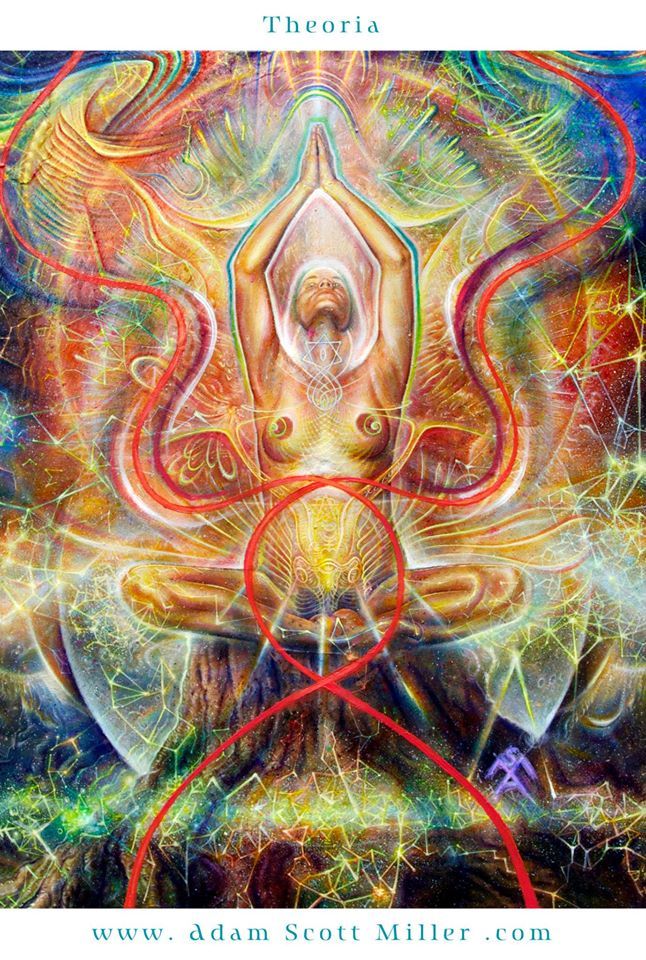
An imaginative image of the God of the rainbow!? via mgki master
I have been baptised with impure water for rebirth. A flame from the fire of Hell awaited me above the baptismal basin. I have bathed myself with impurity, and I have cleansed myself with dirt. I received him, I accepted him, the divine brother, the son of the earth, the two-sexed and impure, and overnight he has become a man. His two incisors have broken through, and light down covers his chin. I captured him, I overcame him, I embraced him. He demanded much from me and yet brought everything with him. For he is rich; the earth belongs to him. But his black horse has parted from him.
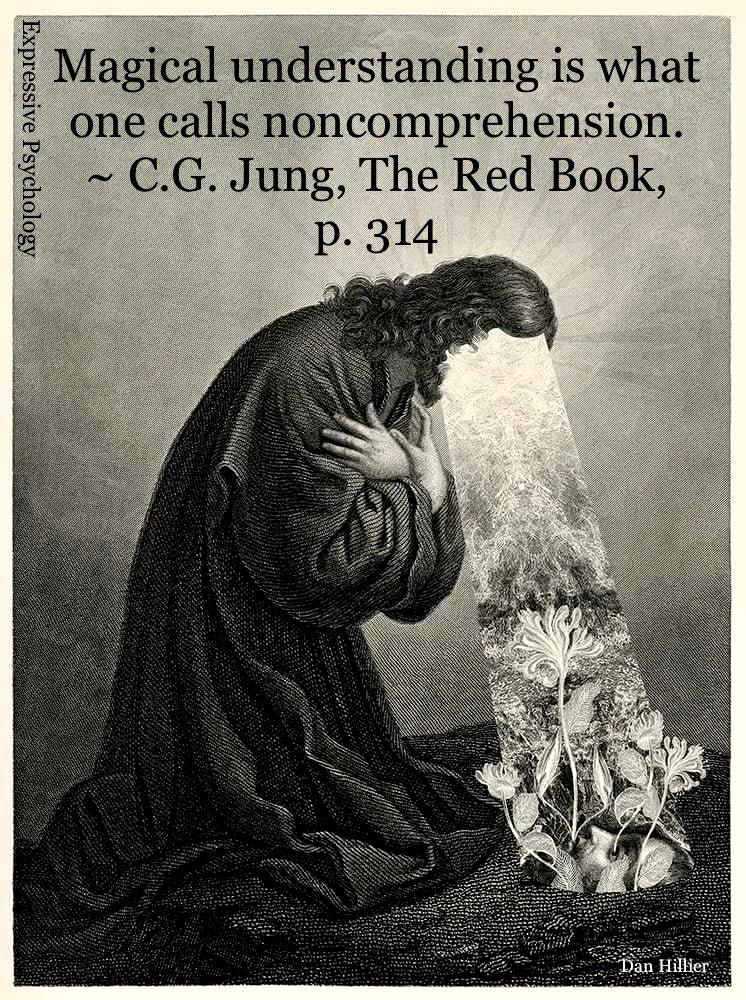
“You are afraid to open the door? I, too, was afraid since we had forgotten that God is terrible. Christ taught: that God is love. But you should know that love is also terrible .”
Carl Jung Red Book
Of course, the term God is not limited to the Third World (especially the Muslim world). It is a general whole world problem! As you might know, I am a non-religious person and having such a God as a great man sitting on his throne scratching his beard and sometimes having a horrible caprice, for me, is absolutely nonsense! However, I know these thoughts are also turning in your brains, my intellectual friends. Thus, I love the God of the rainbow, and I believe Dr. Jung himself has had a great challenge finding or even having encountered this very God.
“The practical knowledge of human nature I have accumulated in the course of sixty [60] years has taught me to regard each case as a new experience, for which, first of all, I have to seek the individual approach.” ~C.G. Jung, “Symbols and the Interpretation of Dreams,” The Symbolic Life, CW 18, par. 518
Another gift from my adorable friend, Petra Glimmdall
“If a man is contradicted by himself and does not know it, he is an illusionist, but if he knows that he contradicts himself, he is individuated.” ~C.G. Jung, Letters, Vol. 2, p. 324
I must confess to stealing this last quote of Dr. Jung from one of the articles of a great Jungian analyst and an adorable friend of mine, Jean Raffa, and I am sure she has no problem with it. (You can find the whole article here!)
“[T]he term self is often mixed up with the idea of God. I would not do that. I would say that the term self should be reserved for that sphere, which is within the reach of human experience, and we should be very careful not to use the word God too often. As we use it, it borders on impertinence; it is unlawful to use such a concept too often. The experience of the self is so marvellous and so complete that one is, of course, tempted to use the conception of God to express it. I think it is better not to because the self has the peculiar quality of being specific yet universal. It is a restricted universality or a universal restrictedness, a paradox; so it is a relatively universal being and therefore doesn’t deserve to be called “God.” You could think of it as an intermediary [a portal? my word], or a hierarchy of ever-widening-out figures of the self till one arrives at the conception of a deity. So we should reserve the term God for a remote deity that is supposed to be the absolute unity of all singularities. The self would be the “preceding stage” [quotes mine], a being that is more than man and that definitely manifests; that is the thinker of our thoughts, the doer of our deeds, maker of our lives, yet it is still within the reach of human experience.” CG Jung, Nietzsche’s Zarathustra: Note of the Seminar Given in 1924-1939, Vol. II (3 June 1936) par. 977-78.
We actually don’t need to think twice, as once must be enough, that if any God exists, it has to be a God for all the possibilities and coloured, don’t you think so?
I wish you all a wonderful weekend! I’ll try my best to publish some posts next time. However, here in Germany, it’s also school holidays in early October, and my lovely wife tends to take me away (to kidnap me!). Honestly, I give dearly up and let myself be taken away because I believe I need a break urgently!🤗💖🙏😘🦋
The Temple of Amun is an archaeological site at Jebel Barkal in Northern State, Sudan. It is about 400 kilometres (250 mi) north of Khartoum near Karima. The temple stands near a large bend of the Nile River in the region called Nubia in ancient times. The Temple of Amun, one of the largest temples at Jebel Barkal, is considered sacred to the local population. Not only was the Amun temple a leading centre of what was once considered an almost universal religion but, along with the other archaeological sites at Jebel Barkal, it was representative of the revival of Egyptian religious values. Up to the middle of the 19th century, the temple was subjected to vandalism, destruction, and indiscriminate plundering before it came under state protection.
The Great Temple of Amun entrance, Karnak Temple complex, Luxor, Egypt. by AlexAntonGreat Temple of Amun, Karnak statuary
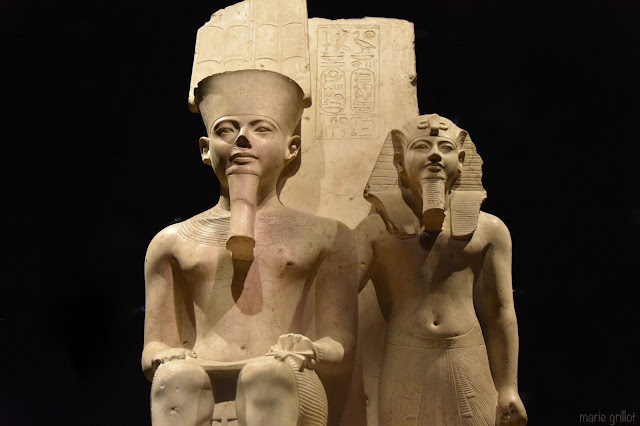
The image above is a limestone sculpture depicting the Gods Amun and Tutankhamun. XVIII Dynasty, 1333-1323 BCE, from the Temple of Amun, Thebes. (Egyptian Museum, Turin)
Here is an excellent, elegantly written report by Marie Grillot about this discovery.
The Statuary Group of Amun and Tutankhamun from the Turin Museum
Statuary group of Amun and Tutankhamun (or Horemheb?) – Limestone – 18th dynasty Discovered in 1818 at the Temple of Mut in Karnak by Jean-Jacques Rifaud on behalf of Bernardino Drovetti Arrived at the Egyptian Museum in Turin through the acquisition of the Drovetti Collection in 1824 – C. 768
This statuary group, 2.11m high, sculpted in magnificent white limestone, sits at the entrance to the Galleria del Rei (gallery of the kings) of the Egyptian Museum in Turin.
Dated from the New Kingdom, from the 18th dynasty, it represents the Theban god Amun-Re, seated on a throne, with to his left, on a much smaller scale, a pharaoh, who is standing.
Amon, recognizable by his characteristic flat hairstyle topped with two tall stylized ostrich feathers, is “ideally” handsome, with a face and body of perfect proportions.
In 1824, in his “Letters to Mr. the Duke of Blacas d’Aulps relating to the Royal Egyptian Museum in Turin”, Jean-François Champollion described it as follows“ “The main figure, which represents the most powerful of the divinities of Egypt, Amon-ra, (Ammon), was no less, although seated, than eight feet in height; he is now only six feet three inches, the upper parts of the hairstyle being today destroyed. The king of gods is represented with a human head whose features, full of grandeur, are executed with admirable finesse of work.
Amon – Detail of the statuary group of Amon and Tutankhamun (or Horemheb?) – Limestone – 18th dynasty Discovered in 1818 at the Temple of Mut in Karnak by Jean-Jacques Rifaud on behalf of Bernardino Drovetti Arrived at the Egyptian Museum in Turin through the acquisition of the Drovetti Collection in 1824 – C. 768
He wears a false beard and is adorned with a large necklace “with eight rows ending in beads in the shape of pears”. His torso is absolutely perfect, punctuated by the swell of the chest and the slight hollow of the navel. He is dressed in a single-pleated linen loincloth that reaches above the knee. His forearms, decorated with bracelets, rest on his thighs and, in his right hand, he firmly holds the sign of life“ “ankh”.
The powerful legs help to accentuate the impression of strength and stability; the feet are bare.
The pharaoh who stands next to him is slightly behind. Its size, much smaller, reflects the “recognition of God’s omnipotence and the fact that he places himself under his protection. With his right arm, he surrounds the shoulders of the divinity.
Tutankhamun (or Horemheb?) – Statuary group of Amon and Tutankhamun (or Horemheb?) – Limestone – 18th dynasty Discovered in 1818 at the Temple of Mut in Karnak by Jean-Jacques Rifaud on behalf of Bernardino Drovetti Arrived at the Egyptian Museum in Turin through the acquisition of the Drovetti Collection in 1824 – C. 768
He wears the uraeus nemes and the false beard. His face is sculpted very precisely. “The face modelled in an elongated and triangular way, the upper lip arched with drooping ends, the lower lip a little swollen and protruding, finally the furrow of the lips which cannot be said to be rectilinear, but rather slightly sinuous, all these particular traits of Tut-Ankh-Amon, we find them on the face of the statue. These are the same conventions which mark the effigy of the pharaoh as immortalized in his best status,” analyzes Ernest Scamuzzi in “Egyptian Art at the Turin Museum”.
His gaze looks far away. “The eyes are represented in hollow orbits with half-closed eyelids, unlike pre-Amarna faces, whose features were graphically applied to a flat frontal plane and underlined with strongly artificial lines which joined the lines of the makeup”, specifies Eleni Vassilika in “Art Treasures of the Museo Egizio”. And she adds: “The king has a high waist, a prominent abdomen, and, to accentuate it, the belt of his loincloth is lowered in the front.” Thus, we can also read reminiscences of the Amarna era in how the sculptor treated the body.
The garment, which we imagine to be made of finely pleated linen, is nicely worked, particularly on the belt and on the central panel, which falls longer. He has, just like ”his” God, bare feet.
Does this statue really represent Tutankhamun? Or his successor, Horemheb, because it is impossible to hide the fact that the statue bears his name…
Statuary group of Amun and Tutankhamun (or Horemheb?) – Limestone – 18th dynasty Discovered in 1818 at the Temple of Mut in Karnak by Jean-Jacques Rifaud on behalf of Bernardino Drovetti Arrived at the Egyptian Museum in Turin through the acquisition of the Drovetti Collection in 1824 – C. 768 (museum phot“)
“In reality, the king’s Amarna features are so convincing that they suggest this sculpture could be a product of Akhenaten’s immediate successor, King Tutankhamun,” says Eleni Vassilika.
It may also be a usurpation “common phenomenon in royal circles. “… And it is interesting to read this interpretation by Ernest Scamuzzi: “If the name of the successor of Tout-Ankh-Amon, Horemheb, whose reign put an end to the 18th dynasty, is engraved to the right and left of the front face of the throne of Amun, and in the two lines of text which are engraved at the top and the right of the pharaoh, it does not follow that we must, on the sole testimony of more recent use, attribute to Horemheb the first initiative of this group begun but not completed, perhaps because of the brevity of his reign, by Tut-Ankh-Amon.
Thus, this statue is undoubtedly linked to the “restoration” of the cult of the Theban god Amon by the successors of Amenhotep IV – Akhenaten (who had, we remember, imposed the cult of a single god, Aton).
This statuary group comes from the large Karnak complex. Dedicated to the Theban triad, it is made up of three distinct groups: the Montou enclosure, the large buildings dedicated to Amon Ré and the Mout domain. It is precisely in this last area – which extends around ten hectares south of the large temple to which a dromos connects it – that it was found.
Statuary group of Amun and Tutankhamun (or Horemheb?) – Limestone – 18th dynasty Discovered in 1818 at the Temple of Mut in Karnak by Jean-Jacques Rifaud on behalf of Bernardino Drovetti Arrived at the Egyptian Museum in Turin through the acquisition of the Drovetti Collection in 1824 – C. 768 Inscription engraved by the discoverer
As evidenced by the inscription engraved on the right side of the throne, “N1 Drt by Jq Rifaud sculptor. 1818 Thebes IN THE SERVicE of D. M. D”, the discovery was made by Jean-Jacques Rifaud from Marseille who, in 1818, began excavations at Karnak on behalf of Bernardino Drovetti (the “M.D.” of engraving).
Drovetti, of Italian origin, formerly of the Egyptian campaign, was then serving as French consul in Egypt, a post to which he had been appointed in 1803. At age 26, he had thus found, with immense happiness, the land of the pharaohs.
Upon his arrival, this antique enthusiast “ruined himself in antique objects and constituted a collection of first value which commanded the admiration of Chateaubriand”. At the same time, he gave Méhémet Ali the support of the Masonic lodge that he directed, the “Egyptian Secret Society”, and became its advisor. This proximity allowed him to easily obtain the “firman” (permits) to undertake excavations.
In this original drawing by Jean-Pierre Granger (1818), Bernardino Drovetti holds the plumb line; behind him, we recognize the energetic face of Rifaud. (interpretation by Jean-Jacques Fiechter in “The Harvest of the Gods”)
So, to carry out his projects successfully, he recruits several agents. The main ones are the sculptor Jean-Jacques Rifaud and the designer Frédéric Cailliaud – who excavated and researched the most beautiful pieces for him. On the ground, particularly in ancient Thebes, the team came up against the “competitor” of the British consul Henry Salt, who notably employed the great Giovanni Battista Belzoni.
The rivalry is such that the protagonists often show themselves unscrupulous, resorting to disrespectful practices in their frantic race for discovery. What will be called the “war of the consuls” is full of quite extraordinary episodes!
Moreover, the fact that the discoverer engraved his name on the statues was undoubtedly not only a way of “referencing” them but also a good way of not having the authorship of the discovery stolen!
If the consuls constitute their personal collection, they also constitute, at the same time, very important collections which they offer to the sovereigns of certain European countries (mainly Italy, France and England) who wish to create or enrich their museums…
It was precisely in 1824, when His Majesty the King of Sardinia purchased the first “Drovetti” collection, that the statue arrived in Turin. It was referenced C.768.
Jean-François Champollion, Letters to M. le Duc de Blacas d’Aulps relating to the Royal Egyptian Museum of Turin, first letter – historical monuments, Turin, July 1824, Firmin Didot, 1824 (pp. 1-92). http://gallica.bnf.fr/ark:/12148/bpt6k65247619
Egyptian Museum, Turin Museum of Egyptian Antiquities Foundation, Franco Cosimo Panini Editore, 2016 Art Treasures of the Egyptian Museum, Eleni Vassilika, Allemandi & Co Museo Egizio guide, editions Franco Cosimo Panini The Egyptian Museum Turin, Federico Garolla Editore Egyptian Art at the Turin Museum, Ernest Scamuzzi, Hachette, 1966 The harvest of the gods – The great adventure of Egyptology, Jean-Jacques Fiechter Table of Egypt, Nubia and surrounding places, or Itinerary for the use of travellers who visit these regions, Jean-Jacques Rifaud, Treuttel et Würtz (Paris), 1830 Topographical bibliography of ancient Egyptian hieroglyphic texts, reliefs, and paintings – II – Theban Temples by the late Bertha Porter and Rosalind L.B. Moss, Hon. D. Litt. (Oxon.),F.S.A.. assisted by Ethel W. Burney, second edition revised and augmented, Oxford at the Clarendon Press, 1972
Okay, we can delve deeper into this analysis if you’re ready. According to Jung, modern intelligent people would not find these theories amusing. They may be too tired or lazy to understand or consider them outdated. I fully understand Dr. Jung’s sentiments and how he often felt isolated. In my opinion, these magical concepts may provide solutions to certain mysteries surrounding our existence.
Here we go! (to freshen the memories, here and here are the old posts.)
The Mandala Symbolism (Dream 16) P.3
There are a lot of people there. Everyone walks counterclockwise around the square. The dreamer is not in the middle but on one side. It is said that one wants to reconstruct the gibbon.
Such things are, of course, complete nonsense to the modern intellect. However, this value judgment in no way eliminates the fact that such combinations of ideas occur and have even played an important role over many centuries. It is up to psychology to understand these things and leave it to the layperson to complain about nonsense and obscurantism. (Many of my critics who claim to be ‘scientific’ do exactly the same thing, as did the bishop who excommunicated cockchafers for improper reproduction.).
Just as the stupas contain relics of the Buddha in their innermost being, the Lamaistic square, like the Chinese square of the earth, contains the holiest or magically effective thing: namely the cosmic energy source, the god Shiva, the Buddha, a bodhisattva or a great teacher; in Chinese it is Kiän, the sky with its four radiating cosmic forces (Fig. 46).
Figure 46 The pearl, as a symbol of Kiän, is surrounded by four emanating forces (Dragons). (Chinese Bronze Mirror from the T’ang period, 7th-9th centuries)
In the Western, medieval Christian mandala, too, the deity is enthroned in the middle, often in the form of the triumphant Savior with the four symbolic figures of the evangelists (Fig. 47). The dream symbol contrasts most violently with this highest met physical idea; Because in the centre the ‘gibbon’, which is undoubtedly a monkey, is to be reconstructed. Here, we meet the monkey again, who first appears in Dream 22.
Figure 47 Rectangular mandala with a cross, in the middle of which stands the Lamb of God (Agnus Dei), surrounded by the four evangelists and the four streams of paradise. The four cardinal virtues are depicted in the four medallions. (Zwiefalten Monastery, Breviary, 12th century)
It gives rise to panic and the intellect’s helpful intervention. Now, it is to be ‘constructed’, which probably means nothing other than that the anthropoid, the archaic fact ‘human’, is to be restored. The left-hand path obviously does not lead up into the realm of gods and eternal ideas but down into natural history, the animal instinctual basis of human beings. So it is a – to put it in ancient terms – a Dionysian mystery.
Figure 7 The symbolic city as the earth’s centre represents a temenos with its protective walls arranged in a square. Majer: Viatorium, (Voyager)1651
The square corresponds to the Temenos (see Fig. 7), where theatre is played, in this case, a monkey play instead of a satyr play. The ‘golden flower’ interior is a ‘germinal point’ where the ‘diamond body’ is produced. The synonym’ ancestral land’ perhaps even indicates that this creation emerges from integrating the ancestral stages. (Wilhelm/Jung: The Secret of the Golden Blossom, 1939, p. 112.)
By my very adorable friend Petra Glimmdall.🙏💖
Ancestral spirits play a significant role in primitive renewal rites. Central Australian natives even identify with their mystical ancestors of the Alcheringa period, a kind of Homeric age. Likewise, in preparing for the ritual dances, the Taos Pueblos identify with the sun, whose sons they are. Psychologically, re-identification with the human and animal ancestors means an integration of the unconscious, actually a renewal bath in the source of life, where one is fish again, that is, unconsciously as in sleep, drunkenness and death; hence the incubation sleep, the Dionysian consecration and the ritual death in initiation. Of course, these processes always take place in holy places. One can easily translate these ideas into the concreteness of Freudian theory: the Temenos is then the womb, and the rite is a regression to incest. But these are the neurotic misunderstandings of people, some of whom still remain infantile and do not know that these are the subjects which have always been the exercises of adults, whose activities cannot possibly be explained as mere regressions to infantilism. Otherwise, humanity’s most significant and highest achievements would ultimately be nothing but perverted children’s wishes, and the word ‘childish’ would have lost its raison d’être.
Let’s take another break. Thank you for reading, and have a lovely WE.🤗🦋
It is one year since 22-year-old Jina (Mahsa) Amini was hit to death by the morality police custody, who had been accused of not wearing her hijab [veil] properly. Of course, it didn’t end up there as many other young girls and boys followed her and were brutally killed almost in the same way, and it is still continual. She was not only the start; she had also enflamed fire behind the ashes.
You may remember that I wrote those days about these happening and my feelings toward the Western governments ignoring all this bloodshed.
Yes, it’s been one year, and many more young people were arrested, raped, executed or died under torture in prisons. But still, the West keep silent, or even worse, they try to continue merchandising with the Mullahs under the slogan: We can not condemn a regime because we don’t like their faces!! Says @Josef Borrel, High Representative of the European Union for Foreign Affairs and Security Policy since 2019. Even if it sounds sad, politicians are never interested in humanity, people or Human Rights. Profits are, for them, the only subject that man must negotiate about! In this case, Western politicians are monitoring the ongoing conflict between Russians and Ukraine before seeking to initiate a regime change in Iran.
Dr. Parchizade, a political theorist, historian of ideas, senior analyst, and a valuable friend of mine, wrote in his article; Iran’s Mahsa Revolution One Year On
Who are the protesters?
The Woman, Life, Freedom Revolution was not the expression of a unified political movement. Not everyone opposes the Islamist regime for the same reasons, and people from every imaginable political stripe took part. The opposition is divided, however, into two main camps, which we can identify as the “progressive” and the “reactionary” opposition.
In the progressive camp fall the various pro-democracy movements of Iran. This includes a wide sweep of ordinary people as well as politically active individuals and organizations ranging from liberal to socialist and secular to Islamist. These currents have popular bases in Iranian society, especially among middle and lower classes as well as the marginalized sections of society such as ethnic, religious and sexual minorities.
On the other side, there’s the son of the former king (Shah) of Iran. He has been living a comfortable life for the past forty-five years since leaving Iran with his family and a substantial amount of money that rightfully belonged to the Iranian people. Despite not actively opposing the Mullahs regime, he has now become the focus of Western interest. Is this another attempt at the same 1953 coup against Dr. Mossadegh? Dr. Mossadegh’s efforts to establish democracy were thwarted when American and English intelligence services installed his father, Mohammad-Reza, in power. In fact, the former head of SAVAK and the agents of the former Shah’s regime are all working to control this revolution.
Pro-Mosaddegh protests in Tehran, 16 August 1953Tanks in the streets of Tehran, 1953Shaban Jafari, commonly known as Shaban the Brainless (Shaban Bimokh), was a notable pro-Shah strongman and thug. He led his men and other bribed street thugs and was a prominent figure during the coup.
In any case, the Iranian youth will always avoid falling into the tricksters. They have created the motto #Woman_Life_Freedom and God of the rainbow, a goal that is not only specific to Iranians but covers all humanity. Throughout history, revolutions have typically been led by a single individual with an ideology. However, the current movement is unique because it is a post-modern revolution without a clear leader. Instead, the prominent figures are the individuals taking to the streets.
Anyway, throughout their history, the Iranian people have experienced multiple revolutions, each time gaining new insights. Unfortunately, these revolutions have come at a significant cost of time and bloodshed. Though, as I remember, after World War II, Willy Brandt became the Chancellor of Germany and famously declared his desire for more democracy. He said: “Er wolle mehr Demokratie wagen!” (He wanted to dare more democracy.) We might have to do it as well!
Ultimately, I understand that everyone in this world is preoccupied with their own concerns and surroundings. However, I humbly request that any of my friends who come across this article take a moment to offer their prayers and well wishes to the youth who are only seeking their fundamental human rights to live.
You are not lost; your way is ongoing to reach the goal. Never forgive, never forget!
For more interest, here are a few articles which I once wrote. Here, here, and here. 💖🙏💖🦋
“I am fond of music, I think, because it is so amoral. Everything else is moral, and I am after something that isn’t. I have always found moralizing intolerable.” ― Hermann Hesse.
Over the weekend, I shared about my spouse’s cold. Unfortunately, it ended up spreading to others, including myself. I initially believed I could withstand it, but I was mistaken. As a result, I currently feel drained and exhausted, listless with null lust! Even though the symptoms aren’t severe. This is why I express myself with this post briefly yet with profound significance.
Memories flooded back from my youth when I came across this quote by Hermann Hesse. I remembered the days spent with my brother Al when we would enter the wonderland of music. As children, we listened to the radio with our mother, who loved this new invention and enjoyed audio shows and old Persian music. After that, our older brother brought us to the world of Western music, where we captured some unforgettable and amoral times. Therefore, I understand what Hermann Hesse means when he says these words. We must thank for the music which has been given to us.
So I say Thank you for the music, the songs I’m singing Thanks for all the joy they’re bringing Who can live without it, I ask in all honesty What would life be? Without a song or a dance, what are we? So I say thank you for the music For giving it to me. (ABBA; “Thank You For The Music”)
I will end my post with another quote from Hermann Hesse and wish you all a safe and healthy weekend.🦋🙏🥰
“I have had to experience so much stupidity, so many vices, so much error, so much nausea, disillusionment and sorrow just to become a child again and begin anew. I had to experience despair; I had to sink to the greatest mental depths, .. in order to experience grace.”
Psusennes I Tomb, evisceration gold plaque. Thoth, Oudjat Eye. Anubis and Horus, 1040 BC Egypt Stock Photo.
Psusennes I (Ancient Egyptian: pꜣ-sbꜣ-ḫꜥ-n-njwt; Greek Ψουσέννης) was the third pharaoh of the 21st Dynasty who ruled from Tanis between 1047 and 1001 BC. Among the most extraordinary findings about Psusennes washis relocation from the metropolis of Pi-Ramesse to Tanis. Pi-Ramesse was the fabled riverside capital built by Rameses II. Its location had puzzled archaeologists for years until Montet discovered its ruins in Tanis. His tomb is the only pharaonic tomb ever found completely unscathed by any tomb-robbing!
Montet with Psusennes I at various stages of the excavation. Photos from
This Golden Amulet with its mysterious “Two Mistresses (Ladies) is another riddle from the Wonder of Egypt. However, the story of its discovery is also fascinating, which we can read in this brilliant reportage by Marie Grillot with heartfelt thanks.
This golden amulet of the “Two Mistresses” was sewn to the shroud of Psusennes I
The death of Ramses XI, marking the end of the “ramesside” era, plunges the Kingdom of the Two Lands into an unstable political succession. At the beginning of the “Third Intermediate Period”, two “entities” govern it: in the South, in Thebes, the High Priests of Amun, while in the Delta, in Tanis, the “Tanite” kings settle. This line is founded by Smendès, who will reign for a quarter of a century and will briefly be succeeded by Amenemnisout. Then, the “Maât” seems to be back… “The arrival of Psusennes I at the head of Egypt, around 1039, marked the triumph of the strategy of Pinedjem I who, relying on the temple of Amun of Thebes, had succeeded in giving his son the crown of the North. His family now held the whole country…” (Damien Agut, Juan Carlos Moreno-Garcia, “The Egypt of the Pharaohs – from Narmer to Diocletian”).
During this 47-year reign, Psusennes I innovated by having a tomb “prepared for himself and his relatives within the very enclosure of the temple of Amun” (“Pharaonic Egypt”)…
When he died, around 989 BC, his mummy was placed there in a silver sarcophagus in his image, which itself was placed in an anthropomorphic black granite sarcophagus, all resting in an imposing pink granite tank … It will remain there for more than 2900 years…
Mask of Psusennes I – gold, lapis lazuli, black glass, white glass Third Intermediate Period – 21st Dynasty – circa 1000 BC. J.-C. from his tomb at Tanis (NRT III), discovered in 1940 by Pierre Montet Egyptian Museum – JE 85913 – Museum photo
In March 1939, Pierre Montet and his team detected the existence of a room, unexplored, in the tomb of Sheshonq… The constraints inherent in the Second World War will involve a long wait before prospecting… It will not be opened until February 16 1940. “Ah, here he is, at last, this pharaoh whose presence so many clues announced to Tanis! His name is there with his titulature and protocol, all intact. Psusennes means ‘The star which rises from the city’, and his banner name recalls that he is ‘Valiant bull by the gift of Amon, the opulent who appears in Thebes'” recounts Georges Goyon in “The Discovery of the Treasures of Tanis”.
Elevation view of tomb NRT III (Royal Necropolis of Tanis) containing the tombs of Psusennes I, of his wife Moutnedjemet, then of their son Aménémopé, of another son of king Ânkhefenmout, of the chief general of King Oundebaounded and in the antechamber, the sarcophagus of Sheshonq II between the remains of the mummies of Siamon and Psusennes II
He rested in “a deep room of pink Aswan granite”, surrounded by an exceptionally rich funerary treasure.
This tiny gold amulet, part of a series of ten, was sewn to the royal shroud. 3.6 cm high and 4 cm wide, it is certainly not one of the most sumptuous pieces… but its “symbolism” is strong.
Some gold amulets belonging to the series of ten from the tomb of Psusennes I (21st Dynasty) discovered in Tanis (NRT III) in 1940 by Pierre Montet published in “Tanis Trésors des Pharaons” by Henri Stierlin & Christiane Ziegler On the right, the amulet of the “Two Mistresses” (Egyptian Museum – JE 85815) “Executed in thin gold leaf, these 3 cm high amulets ensured the protection of the mummy of Psoussenès: one can recognise from left to right, the falcon, the soul-bird, the vulture and the symbol of the double royalty on the Haute Some gold amulets belonging to the series of ten from the tomb of Psousennes I (XXI dynasty) discovered in Tanis (NRT III) in 1939-1940 by Pierre Montet – published in “Tanis Trésors des Pharaons” d’ Henri Stierlin & Christiane Ziegler – on the right, the amulet of the “Two Mistresses” (Egyptian Museum – JE 85815) Cairo, Egyptian Museum, inv. JE 85814 and Lower Egypt”. Henri Stierlin, Christiane Ziegler, Tanis Treasures of the Pharaohs, Seuil, 1987 Psousennes I Cairo, Egyptian Museum, inv. I 85814
It is a wide necklace of the “usekh” type, equipped with a counterweight. The central motif represents the two tutelary goddesses of the Double Country: “The vulture-cobra group treated as a single being,” analyses Pierre Montet.
The vulture represents the goddess Nekhbet, originating from the city of Upper Egypt, which, in antiquity, bore her name and, today, is called El Kab. “Mistress of the sky, protective goddess of Upper Egypt and of the Pharaoh”; this divinity is very present in the iconography.
As for the cobra, it is associated with Wadjet, the tutelary goddess of Lower Egypt, originating from a district of Buto. “Originally, she is essentially a deity of the fertility of the soil and the waters and her name puts her in close relation with greenery and regeneration. However, her particular form and role as protector of the Delta, of the monarchy of the North, quickly caused its assimilation to the uraeus,” specifies Isabelle Franco in her “Dictionary of Egyptian Mythology”.
Thus, the cobra and the vulture symbolise the sovereign’s power over the Two Lands. Images of the unification of the kingdom: “Their heads were often placed side by side on the front of headdresses worn by kings on state occasions and on the headdresses of their statues and other depictions”.
Through this small amulet, called the “Two Mistresses”, by sharing the wings of one and the same bird, “the two deities extend their protection over the sovereign and the royalty,” specifies Christiane Ziegler in “Pharaohs”.
In “The Gold of the Pharaohs – 2500 years of goldsmithing in ancient Egypt” focuses more particularly on the technique of “chiselling” used by the goldsmith who made it: “Cut in a thin sheet of n gold, this amulet features a cobra and a vulture with wings spread in an arc. The raptor’s plumage and the details of the reptile’s body are chiselled with infinite delicacy on this jewel, which does not exceed 4 centimetres wide. Chasing consists of tracing a hollow decoration, no doubt indicated beforehand, using a chisel struck by any mass. The presence of the marks of blows can recognise this technique”.
This “Two Mistresses” amulet was recorded in the Cairo Museum Entry Journal JE 85815.
Pierre Montet, Tanis – Twelve years of excavations in a forgotten capital of the Egyptian Delta, 1942
Montet Pierre, The royal necropolis of Tanis according to recent discoveries. In: Minutes of the sessions of the Academy of Inscriptions and Belles-Lettres, 89th year, N. 4, 1945. pp. 504-517
Georges Goyon, The discovery of the treasures of Tanis, Pygmalion, 1987
Tanis the gold of the pharaohs, catalogue of the exhibition Paris, National Galleries of the Grand Palais, March 26 – July 20, 1987
Henri Stierlin, Christiane Ziegler, Tanis Treasures of the Pharaohs, Seuil, 1987
Jean-Pierre Corteggiani, Ancient Egypt and its gods, 2007
Isabelle Franco, Dictionary of Egyptian Mythology, 2013
Pharaons – Catalog of the exhibition presented at the Institut du monde arabe in Paris, from October 15, 2004 to April 10, 2005
The Gold of the Pharaohs – 2500 years of goldsmithing in ancient Egypt, Catalog of the 2018 summer exhibition at the Grimaldi Forum in Monaco, Christiane Ziegler
Damien Agut, Juan Carlos Moreno-Garcia, The Egypt of the Pharaohs – from Narmer, 3150 BC. AD to Diocletian, 284 AD. AD, Belin, 2016
Posted May 17 by Marie Grillot Labels: amulet Lower Egypt Bouto cobra two mistresses Two Lands Double Country El Kab expo Ramses II 2023 Goyon Upper Egypt la Villette Montet Nekhbet NRT III Wadjet Psousennes I Tanis vulture
Honestly, I wasn’t sure if I’d have enough time for my second post today because my wife and I were planning to drive to Hagen to meet her sister, which is about 150 km south of us. I had even prepared one of my heaviest and most effective masks for that occasion. However, my wife caught a bad cold, and we had to cancel the trip. While I’m not happy that she’s sick, I have to admit that I’m relieved that I don’t have to wear that very mask!



So! I thought the best way would be the easiest way to share the visit to an Art Gallery in our small town, Bielefeld, which we did last Sunday. Putting it bluntly, I do not have a good relationship with where I live. When I first moved here, it was a friendly “big” village filled with all peace and beauty. But it began to try to expand to become a big town, damaging its charm and losing every corner of what it once was. When Regina offered me to visit a museum last Sunday, I immediately thought of the City Museum, the biggest one in our town and the most boring one ever! But she had a different one in mind: “Kunstforum Hermann Stenner”. Also, I agreed, and when we arrived, I was pleasantly surprised to see such fascinating art from somehow unknown artists and more amused to find out that most of them were women.
For example, Marlies Jung 😉
Anyway, here are you and this intriguing new art by the new generation.
I love this girl!
The picture at the top: Kunstforum Hermann Stenner by Thomas Ruthmann. The rest by me!
We are taught various subjects such as chemistry, physics, geography, and geometry during our school years. While I cannot say that geometry was my favourite subject, I must admit that my lack of proficiency in it was not entirely my fault. I struggled to understand it because I did not have a good teacher. However, I had excellent teachers for one or even two semesters and suddenly found myself good enough in geometry. Indeed, I have never thought about where it all comes from! I surely miss those days in which I could learn the fascination of geometry, although it might never be too late!
In part two (Part one here), Dr. Jung explores fascinating ideas on the magic of geometry and its relation to Mandalas. Mandalas are not just circles but also consist of various other geometric shapes.
The Mandala Symbolism (Dream 16) P.2
There are a lot of people there. Everyone walks counterclockwise around the square. The dreamer is not in the middle but on one side. It is said that one wants to reconstruct the gibbon.
The eastern mandala, especially the Lamaist mandala, usually contains a square stupa plan (Fig. 32). If this really means a building can be seen from the bodily executed mandalas. There, with the figure of the square, the idea of the house or temple or an inner, walled room is also given. (Compare ‘city’ and ‘castle’ in the commentary on Dream 10 (see also figs. 7, 36).
Stupas must always be ritually circumambulated to the right because to turn to the left is evil. Left (sinister) means the unconscious side. Left-hand movement, therefore, implies a movement towards the unconscious, while right-hand movement is ‘correct’ and aims at consciousness. Since, through long practice in the East, these unconscious contents have gradually become definite forms expressing the unconscious, they must, as such, be taken over and retained by consciousness. Yoga proceeds similarly insofar as it is known to us as a fixed practice. It imprints fixed forms on the consciousness. Therefore, its most important Western parallels are the “Exercitia Spiritualia” of Ignatius of Loyola, which also impresses the psyche with the fixed ideas of salvation.
Figure 7 The symbolic city as the earth’s centre represents a temenos with its protective walls arranged in a square. Majer: Viatorium, (Voyager)1651
This practice is “correct” insofar as the symbol still validly expresses the unconscious fact. The psychological correctness of yoga in the East as well as in the West only stops when the unconscious process, which anticipates future changes in consciousness, has developed so far that it shows nuances that are no longer sufficiently expressed with the traditional symbol or no longer entirely with the same are tolerable. To that extent, and only to that extent, can one say that the symbol has lost its ‘correctness’.
Figure 37 The castle protects spirits against diseases. Fludd: Summum Bonom (The highest good), 1629
This process is probably a slow secular shift of the unconscious worldview and has nothing to do with intellectual criticism of the same. Religious symbols are phenomena of life, facts par excellence, and not opinions. Suppose the church has held for so long that the sun rotates around the earth but abandons this point of view in the 19th century. In that case, it can appeal to the psychological truth that for many millions of people, the sun rotates around the earth and first in the 19th century, a more significant number of people attained the security of intellectual functioning to see the evidence of the planetary nature of the earth. Unfortunately, there is only truth with people who recognise it.
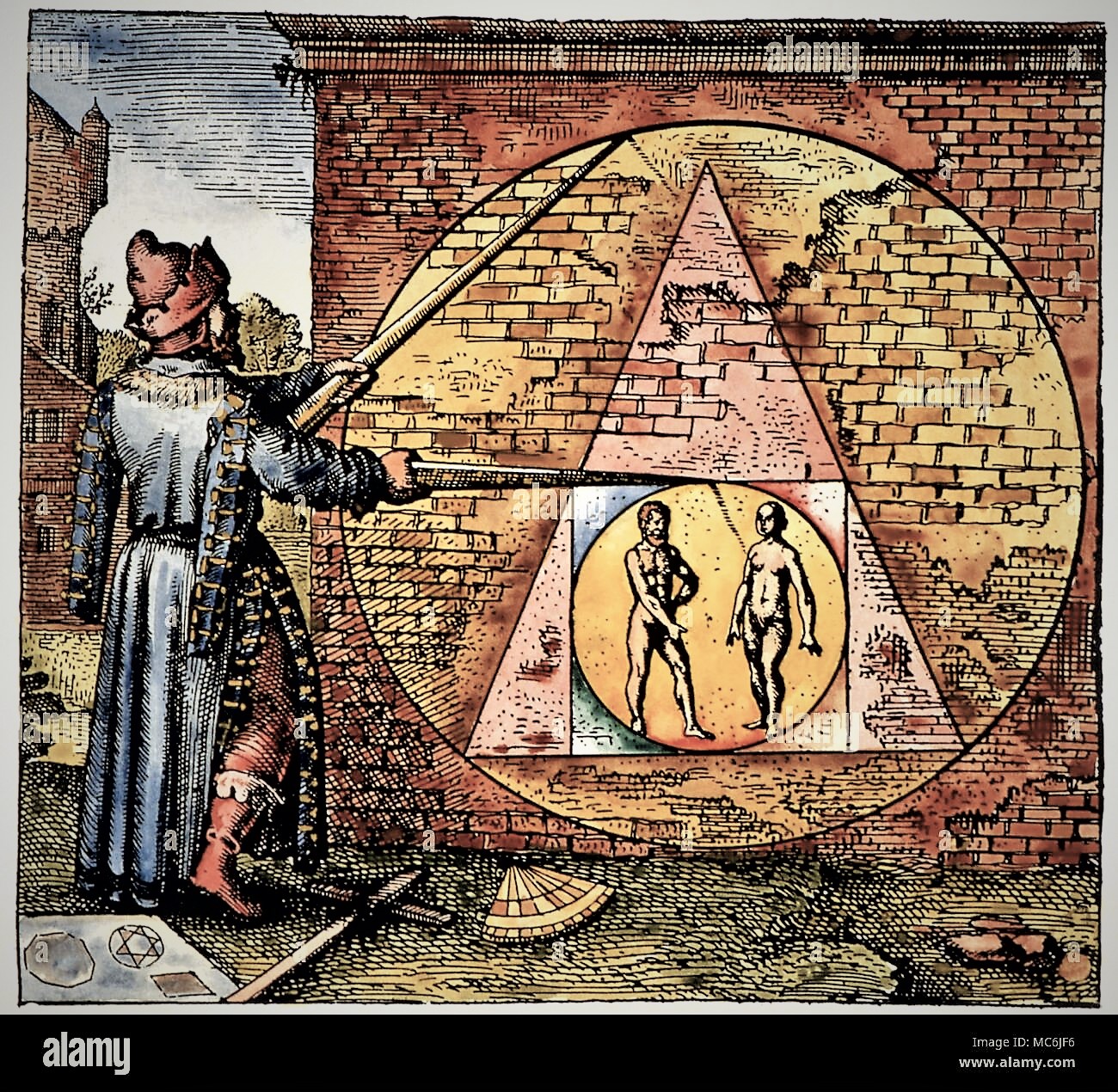
The left-handed or runner >circumambulatio< around the square should indicate that the squaring of the circle is passed through on the way to the unconscious; therefore, it is an instrumental passage point that conveys the achievement of an underlying, not yet formulated goal. It is one of those paths to the centre of the non-ego, which was also taken by medieval research, namely in the production of lapis. The ‘Rosarium Philosophorum’ says: ‘Make a circle around man and woman and draw the square out of it and the triangle out of the square. Make a circle, and you will have the philosopher’s stone.’ (Fig. 45; also Fig. 44)
Figure 45 Squaring the circle, combining two genders into a whole. Majer: Scrutinium chymicum, 1687Figure 44 Squaring the circle: All things stand only in the three / In four, they delight themselves. (Jamsthaler: Viatorium spagyricum, 1625)
(This quote is attributed to Pseudo-Aristotle, but it cannot be found in the ‘Tractatus Aristotelis alchemistae ad Alexandrum Magnum’ [Theatrum chemicum, 1622, vol. 5, p. 880 ff.])
Before taking another break, I’d like to add a footnote extending the abovementioned paragraph. It was a mix of Latin and German, which I take the best of: 🥰🙏💖
“In the Scholia zum (Hermes Trismegistus’ truly golden Treatise on the Secret Stones of the Philosophers with the Scholia of Dominikus Gnosius), it says (p. 43): the secret quadrilateral of the philosophers; In the centre of the square is a circle with radiation. By this, the Scholium explains: Divide your pages into the four elements… and join them into one, and you will have all mastery. = Quote from Pseudo-Aristotle. The circle in the middle is called the “mediator”. The mediator who makes peace between the enemies or (the four) elements; indeed, he is the one who brings about the squaring of the circle. [ p. 44]
Circumambulation has its parallel in the circling of the spirits or the circling distillation, that is, the outer to inner, the inner to outer: and so you would, if the lower and the upper came together in one and the same circle, no longer recognise what was from outer to inner, below, or above; but all would be one in a single circle or vessel. This is, for sure, the true philosophical pelican, and there is no other in the whole world. The adjacent drawing explains this process. The quartering is the “Exterius”: four rivers flowing in and out of the inner “ocean”. (p. 262 f.)
Today (I wrote this yesterday!), August 25, is the day that in the year 1900, Friedrich Nietzsche’s suffering body gave freedom to his magnificent soul. Since there are a few different assumptions about his death, I believe this by Rudolf Steiner would be a detailed portrayal of the deranged Nietzsche. After several strokes, also consistent with a diagnosis of nervous syphilis, Nietzsche was partially paralysed and unable to stand or speak. On August 25, 1900, at the age of 55, he died of pneumonia and another stroke in Weimar. He was buried at the Röcken village church in the family grave. (He only lived 55 of age! Like the other geniuses, his genius didn’t stand as long in his body.)
Nietzsche says, “It is not a lack of love but friendship that makes unhappy marriages”, and it is a remarkable thought. I clearly understand Nietzsche’s challenge to romanticise versions of love and friendship. According to him, erotic love is often driven by selfish desires of possession. At the same time, friendship is the enduring bond that truly withstands the test of time, claiming that love “may be the most ingenuous expression of egoism.” He proposes that love is close to greed and the lust for possession, and if we look more closely at love in history, most of the time, this is the case. Because love often burns too fast to the ashes, but a true friendship remains strong forever. Although, as I wrote once about my opinion on true love, I contended that genuine love and companionship are interconnected. However, I resonate with his perspective on love and find his disillusionment quite comprehensible.
As I perhaps mentioned once, he wasn’t evil, egotistical, or selfish. Instead, he was whole-hearted, gentle, and loving. He had a distaste for German arrogance and damp weather and gravitated towards the warmth of soul found in Italian and Greek cultures and landscapes. False judgments are often made about him, likely due to his books, which exude a sense of self-importance. For instance, in his work ECCE HOMO, he discusses why he writes good books or why he is destined for fate, etc. He writes in ECCE HOMO:
The good ones – They can’t do it, they are always the beginning of the end… They crucify the one who writes new values on new slates, they sacrifice the future, and they crucify all human futures! The good ones – They were always the beginning of the end… And whatever harm the world-slanderers might do, the harm of the good ones is the most damaging harm.
This explanation of his final days was published in the local newspaper:
“His way of life follows the doctor’s prescription, which regulates his diet and service. For the rest, he sits quietly, lost in himself; he only utters incomprehensible sounds when the noise of the street or children reaches his ears, but he calms down again when someone reads to him, although without understanding what it’s being read. His appearance is by no means unhealthy; only it is somewhat difficult to dress and undress him because of a certain clumsiness of the limbs which has been noticeable lately.”Jenaer Volksblatt vom 28. Juli 1897, S. 1.
Carl Jung said: The meaning of my existence is that life has addressed a question to me. That is a supra-personal task, which I accompany only by effort and with difficulty. Perhaps it is a question which preoccupied my ancestors and which they could not answer? Could that be why I am so impressed by the problem on which Nietzsche foundered: the Dionysian side of life, to which the Christian seems to have lost the way? (Jung, 1965 [1961], p. 350)
He was and remains an unconventional genius!
Here, I am sharing two short videos. The first is a silent footage of his last moments, during which his sister cared for him. The second one explains his illness in his final years and his passing. Thank you for being here. 🙏💖
The image at the top: Friedrich Nietzsche Poster by SH Visuals
The fragments might only be important once they belong to a higher family of undeniable fascination in an old, unique historical land: Egypt. The excavation is part of our ongoing search for historical artefacts that satisfy our curiosity about the past or quench our thirst.
And here is Marie Grillot‘s fascinating reportage on the exciting discovery made by the famous explorer Howard Carter, thanks to Marc Chartier.
Archeology Photograph – Akhenaten, New Kingdom Egyptian Pharaoh by Science Source /
Bas-relief portraying Amenhotep IV (Pharaoh Akhenaten, circa 1360-1342) and Nefertiti.
DEA Picture Library / Getty Images
A Fragment of Akhenaten’s Face; Discovered at Amarna by Howard Carter.
Fragment representing the nose and lips of Akhenaten – Limestone – New Kingdom – 18th Dynasty from the sanctuary of the Great Temple of Aten at Tell el-Amarna – discovered in 1891 during the excavations of W.M.F. Flinders Petrie on the sector attributed to Lord Amherst and entrusted to Howard Carter – attributed to Lord Amherst when sharing the finds acquired by Lord Carnarvon at the June 1921 Amherst sale in London – arrived at the Metropolitan Museum of Art in New York in 1926 by the acquisition of the Collection of late Lord Carnarvon – accession n° 26.7.1395 – photo of the MET
At the end of 1891, William Matthew Flinders Petrie finally obtained from the Antiquities Service, directed by Eugène Grébaut, the concession to excavate the remains of the ancient Akhetaton. “Tell el Amarna is one of the most valuable sites in the history of Egyptian civilization. Perhaps it had a shorter existence than any other city in the country. According to what remains, it seems to have been occupied for only one generation,” specifies the British Egyptologist in the introduction of his volume “Tell el Amarna 1894”.
William Matthew Flinders Petrie – British Egyptologist (Charlton, Kent, UK, 3-6-1853 – Jerusalem, 18-7-1942)
He began the mission on November 17, 1891, with some workers he had employed at Illahoun. Then, he relates: “At the beginning of January, I had the pleasure of being joined by Mr Howard Carter, who undertook to search certain parts of the city on behalf of Lord Amherst of Hackney”. Howard Carter was then only 17 years old. On Lady Amherst’s recommendation, Percy Newberry hired him as a draftsman copyist for the Egypt Exploration Foundation. Arrived in Egypt in October 1891, he first worked in the tombs of Beni Hassan, then in the temple of Montouhotep in Deir el-Bahari, and this is his third “construction site”.
Portrait of Howard Carter Young, at Swaffam (author and date unknown) – Swaffham Museum arrived in Egypt in the fall of 1891 at the age of 17, he became famous, discovering in November 1922, Tutankhamun’s tomb (London 9-5-1874 – 2-3-1939)
He will be assigned the sector of the great temple and will make some great discoveries there… Among them, this limestone fragment represents a small part of a face: the nose and the lips. According to the Metropolitan, it was unearthed either “in the dumps south of the sanctuary of the Great Temple of Aten or in the sanctuary itself”.
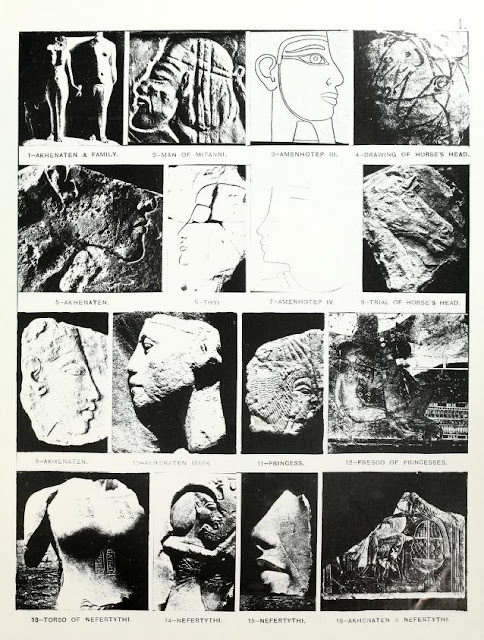
The analysis of W.M.F. Petrie and the wording under illustration No. 15 of the work quoted above was initially attributed to the great royal wife: “Queen Nefertythi also had a very marked personality. Her portraits are as recognizable as those of ‘Akhenaton. Of the many fine stone statues in the temple, a fragment of a nose and lips preserves a brilliant portrait for us (I, 15). The liveliness and force of the work are unequalled at any other period in Egypt; it lacks the naive naturalness of early productions, but its conventions are all put to best use; the slight exaggeration of the edges of the lips gives a clarity and sharpness of shadow, which is most pleasing”.
Fragment representing the nose and lips of Akhenaten – Limestone – New Kingdom – 18th Dynasty from the sanctuary of the Great Temple of Aten at Tell el-Amarna – discovered in 1891 during the excavations of William Matthew Flinders Petrie on the sector attributed to Lord Amherst and entrusted to Howard Carter – attributed to Lord Amherst when sharing the finds acquired by Lord Carnarvon at the June 1921 Amherst sale in London – arrived at the Metropolitan Museum of Art in New York in 1926 by acquisition from the Collection of the late Lord Carnarvon – accession no. 26.7.1395 presented here, below under n° 15, by W.M.F. Petrie in “Tell el Amarna 1894.”
However, many years later, a better knowledge of the Amarna sculpture combined with the study of statues of Akhenaten discovered later allowed us to attribute this portrait to him without any doubt. Even though this fragment is only 8.1 cm high and 6.3 cm wide, even in the absence of this disproportionate and prognathic chin, even if eyes had to be stretched and surmounted by a drooping eyelid it only remains the birth of the right eye, its characteristics, its morphology does not deceive. This long and straight nose, which is joined by two wrinkles starting from the nostrils to the lips at the same time, fleshy, thick, protruding and drooping, the particular design of this mouth signs the identity of the son of Amenhotep III and Tiyi. The Metropolitan Museum of Art in New York affirms it thus: “This fragment is attributed to Akhenaten. The inner corner of the eye is visible next to the nose. Although there is little to distinguish many representations of the king and queen, especially relatively early in the Amarna years, the particularly long line along the nose and lips and the curvy upper lip support this identification”.
Fragment representing the nose and lips of Akhenaten – Limestone – New Kingdom – 18th Dynasty from the sanctuary of the Great Temple of Aten at Tell el-Amarna – discovered in 1891 during the excavations of William Matthew Flinders Petrie on the sector attributed to Lord Amherst and entrusted to Howard Carter – attributed to Lord Amherst when sharing the finds acquired by Lord Carnarvon at the June 1921 Amherst sale in London – arrived at the Metropolitan Museum of Art in New York in 1926 by developing the Collection of late Lord Carnarvon – accession n° 26.7.1395 – photo of the M.E.T.
The mission of W.M.F. Petrie will end at the end of March, and two months will be necessary to “pack” all the discoveries. These are 162 boxes that he will take to the Giza museum.
During the division of the finds, this fragment was attributed to the person who had financed the area of excavations where it had been found. The same will be valid for many other artefacts; thus, one will be able to read later that: “Lord Amherst of Hackney had the third private collection of Egyptian antiquities, constituted largely in payment for the excavations that this rich English patron subsidized, in particular at Tell el-Amarna”.
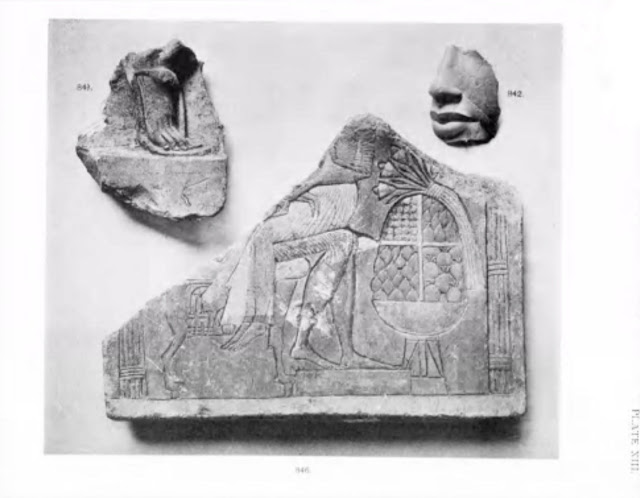
Fragment representing the nose and lips of Akhenaten – Limestone – New Kingdom – 18th Dynasty from the sanctuary of the Great Temple of Aten at Tell el-Amarna – discovered in 1891 during the excavations of William Matthew Flinders Petrie on the sector attributed to Lord Amherst and entrusted to Howard Carter – attributed to Lord Amherst when sharing the finds acquired by Lord Carnarvon at the June 1921 Amherst sale in London – arrived at the Metropolitan Museum of Art in New York in 1926 by acquisition from the Collection of the late Lord Carnarvon – accession no. 26.7.1395 presented here under n° 842 of the “Catalogue of the Amherst collection of Egyptian and Oriental antiquities” – June 1921
Thirty years later, during the “Amherst Sale”, which will take place from June 13 to 17, 1921, at Sotheby’s London, it will be offered at auction under the number 842. Acquired by Lord Carnarvon, he will lend it for the first art exhibition Egyptian organized in London the following year. In the “Catalogue of an Exhibition of Ancient Egyptian Art. London: Burlington Fine Arts Club”, Percy Newberry will describe it under n° 40a “NOSE AND MOUTH, white calcareous limestone. From the Plate VI. head of a statue of Queen Nofretete “.
Fragment representing the nose and lips of Akhenaten – Limestone – New Kingdom – 18th Dynasty from the sanctuary of the Great Temple of Aten at Tell el-Amarna – discovered in 1891 during the excavations of William Matthew Flinders Petrie on the sector attributed to Lord Amherst and entrusted to Howard Carter – attributed to Lord Amherst when sharing the finds acquired by Lord Carnarvon at the June 1921 Amherst sale in London – arrived at the Metropolitan Museum of Art in New York in 1926 by acquisition from the Collection of the late Lord Carnarvon – accession no. 26.7.1395 presented here under n° 40a of the “Catalogue of an Exhibition of Ancient Egyptian Art. London: Burlington Fine Arts Club”, 1922
Six years after Lord Carnarvon died in Cairo on April 5, 1923, his widow, Lady Almina, put her extensive collection of antiquities up for sale. Thanks to the generosity of Edward S. Harkness, the Metropolitan Museum of Art in New York acquired it in 1926 for the sum of $145,000…
This is how this magnificent fragment, admirably representative of Amarna art, arrived at the New York Museum, registered under 26.7.1395.
Catalogue of the Amherst collection of Egyptian and Oriental antiquities, which will be sold by auction by Messrs. Sotheby, Wilkinson & Hodge (Sir Montague Barlow, K.B.E., L.L.D., M.P. G. D. Hobson, M.A., and Major F. W. Warre, O.B.E., M.C.), auctioneers of literary property & works illustrative of the fine arts, at their extensive galleries, 34 & 35 New Bond Street, W. (1), on Monday, the 13th, of June 1921, and four following days at one o’clock precisely Sotheby’s https://bibliotheque-numerique.inha.fr/viewer/50379/?offset=#page=2&viewer=picture&o=bookmarks&n=0&q=
Lythgoe, Albert M. 1927. “The Carnarvon Egyptian Collection.” In The Metropolitan Museum of Art Bulletin, vol. 22, no. 2 (February)
“The Reign of the Sun Akhnaton and Nefertiti”, Catalog of the exhibition organized by the Ministers of Culture at the Royal Museums of Art and History, Brussels, January 17 – March 16, 1975, Dik van Bommel
Who Was Who in Egyptology, Bierbrier M., London, Egypt Exploration Society


















 lampmagician
You must be logged in to post a comment.