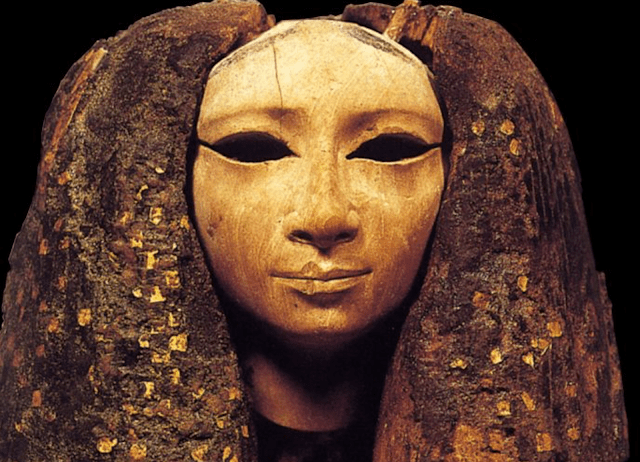
Head of the female statue – painted wood with gilding Middle Kingdom – XIIth Dynasty Provenance: Zone of the pyramid of Amenemhat to Licht – Excavations of the Metropolitan Museum of Art in New York – 1907 Egyptian Museum Cairo – JE 39380
The Head of a mysterious beautiful Lady. by Marie Grillot 🙏💖 with Marc Chartier as always much appreciated 🙂
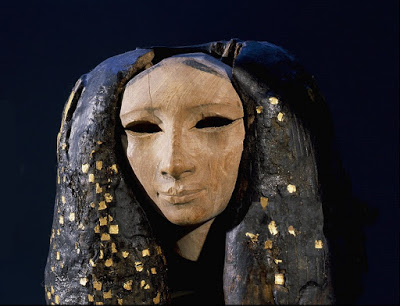
The face is noble, perfectly symmetrical, veins of light wood give it a sense of life. The general expression is soft, calm, soothed. Large almond eyes, of which only the orbit remains, are absent. And despite everything, they question us … What presence did she give to the face? What did they show? Did the glass paste and the rock crystal subtly and luminously enliven their pupils? These questions remain forever unanswered. The eyebrows are treated in relief, while the line of makeup is treated in hollow. The nose is well proportioned, the lips are fine, the slight injury they suffered reminds us of the pangs of time.
Head of the female statue – painted wood with gilding Middle Kingdom – XIIth Dynasty Provenance: Zone of the pyramid of Amenemhat to Licht – Excavations of the Metropolitan Museum of Art in New York – 1907 Egyptian Museum Cairo – JE 39380
What obviously impresses in this head of just over 10 cm, is the wide wig that framed it generously and should arrive at the shoulders, now missing. “The enveloping mass of the reported hair is worked in a darker wood and blackened with paint, it is attached to the head in lighter wood, using tenons.” The hair is black and fragments of gold, like so many small square touches bringing light and femininity, dot them. “The fact that the wig is particularly thin at the top, relative to the width of the lateral parts, suggests the presence of a crown or diadem.”
Head of female statue – painted wood with gilding Middle Kingdom – XIIth Dynasty Provenance: Zone of the pyramid of Amenemhat to Licht – Excavations of the Metropolitan Museum of Art in New York – 1907 Egyptian Museum Cairo – JE 39380
Who was this beautiful lady? A queen, a princess, a prominent person at the court of the sovereign? The quality of the work, the mastery of the artist, leave indeed to think that it can come from the workshops of Pharaoh. From the statue that represented it, in the foot, there remains only that face that does not identify it. Only her arms were found two years later in Situ.
The female statue head painted wood with gilding is often reproduced Middle Kingdom – XIIth Dynasty Provenance: Zone of the pyramid of Amenemhat to Licht – Excavations of the Metropolitan Museum of Art in New York – 1907
This head – which is also often used as a model to illustrate the beauty of the Egyptian women of antiquity – was discovered in 1907 in Lower Egypt, precisely in Licht, between Daschour and Meidoum. The city of Licht was created by Pharaoh Amenemhat I. “Not only to detach from Thebes and the followers of the last Montuhotep but also to keep an eye on the north and the Asian border, the city became the main royal residence during the twelfth and thirteenth dynasties … today give it another reality and another archaeological dimension than those that associate it with the two funerary monuments today reduced to two mounds: the pyramids of Amenemhat I and Sesostris I. ” (Egypt restored, T3, Sydney Aufrère, Jean-Claude Golvin).
The Metropolitan Museum of Art excavation site in New York on Licht site in 1907 with the discovery of the female statue head in painted wood with gilding (JE 39380) of the XIIth Dynasty
As early as 1882, Gaston Maspero undertook excavations on the site, which had then enabled the identification of the pyramids. For practical reasons (there were sometimes up to 11 m of water, he said), however, he could not go to the funeral chamber. The study of the site was then resumed in 1894-1895 by the French Institute of Oriental Archaeology.
Then, in 1906, while Maspero was at the head of the Antiquities Department, the Metropolitan Museum of Art applied for and obtained the concession, and then settled for several seasons of excavations. Indeed, the Egyptian Department of MMA was created October 15, 1906, and its directors, and its new director, Alfred Morton Lythgoe, see there the interest of enriching their knowledge, their experience and their collections.
Thus, under the joint direction of the director, Herbert Eustis Winlock (Harvard) and Arthur C. Mace (Oxford), their first campaign, financed by private funds.150 workers are recruited: some, already ‘trained’ in excavations, come from Upper Egypt, others from neighbouring villages; their number will continue to grow over the years.
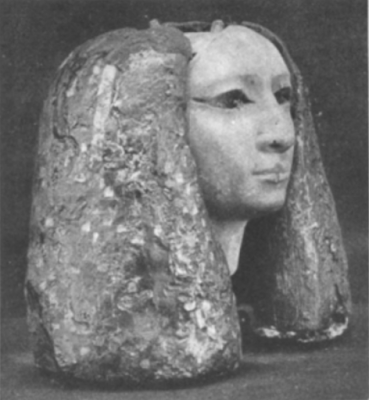
Head of the female statue – painted wood with gilding Middle Kingdom – XIIth Dynasty Provenance: Zone of the pyramid of Amenemhat to Licht Excavations of the Metropolitan Museum of Art in New York – 1907 Egyptian Museum Cairo – JE 39380 Reproduced for the first time in “The Metropolitan Museum of Art Bulletin” (No. 10 – Oct.1907)
The exact circumstances of the discovery of the head are not explained by Albert Lythgoe. In the October 1907 bulletin of the MMA, while it appears in the photo with the caption “Figure 2. Head of the wooden statuette from Lisht, 12th dynasty”, no details are given on the place where it was found. The author relates that the excavations concerned two sectors: that of the cemetery located to the west of the pyramid of Amenemhat, which delivered tombs of important figures of the XIIth dynasty, as well as an area located on a promontory. In all, more than 100 tombs were discovered for most of the twelfth dynasty. As the head is illustrative, opposite this paragraph, one can legitimately think that its discovery is related to those areas where dignitaries, relatives and members of the ruling family had the honour to rest, not far from Pharaoh.
This head is on display at the Egyptian Museum of Tahrir Square in Cairo under number JE 39380.
One idiot is an idiot. two idiots are two idiots ten thousand idiots are a political party!
Hi dear people, at first I’m lucky that I can write my third part of my journey to Prague because my computer or better to say the interaction to the web was horribly slow! But anyhow with some tricks, I’ve got through (don’t yammer again! 😉
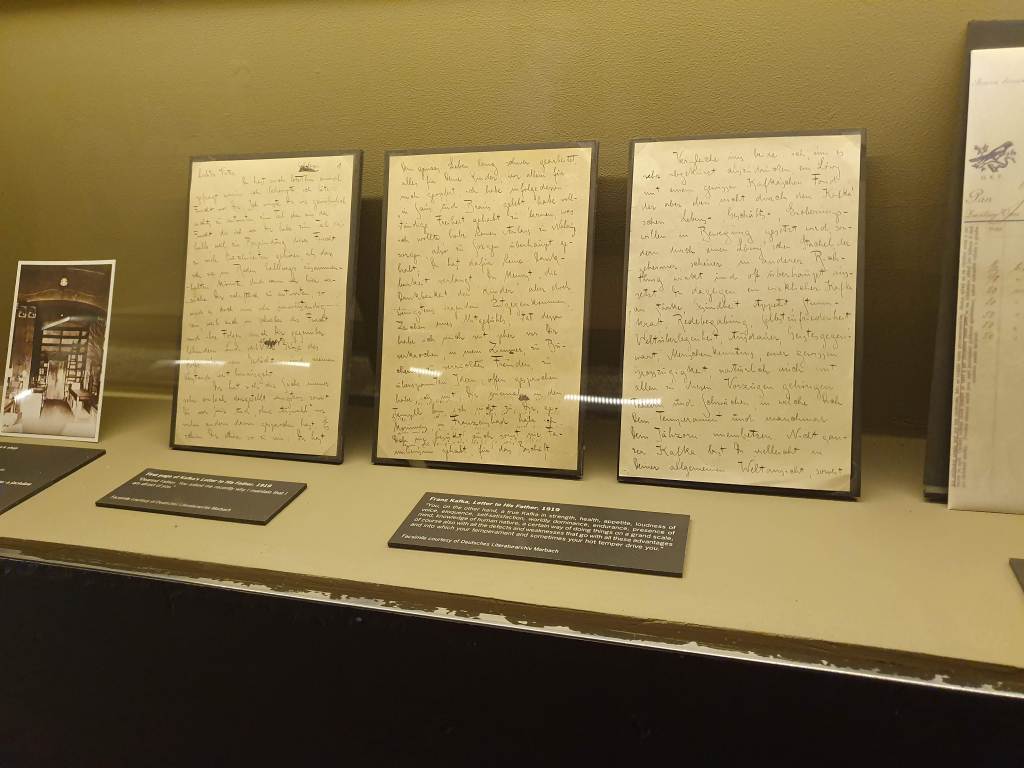
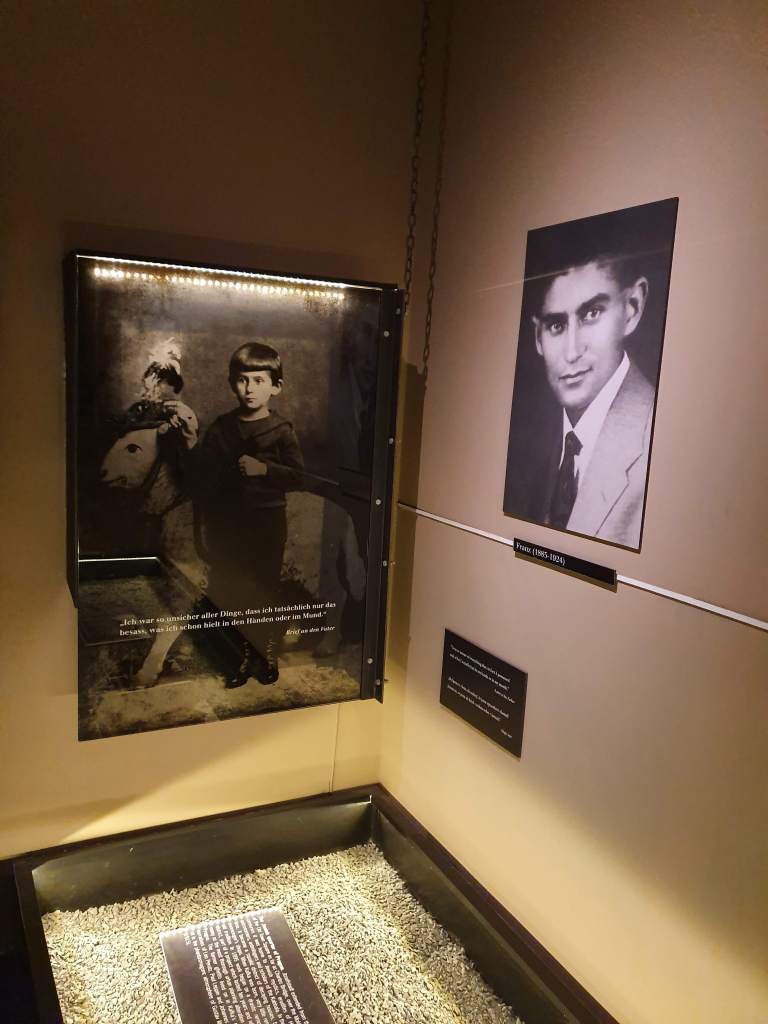
I began with Franz Kafka because it’s about our visit in Kafka’s museum and I have chosen one of his quote in German language (the translation has been subtitled 🙂 because, he wrote his scriptures all in German and it seems that some of them had been translated in Czech by Dora Dymant but they haven’t succeeded in the Czech Republic those days.
Of course, you’re laughing! But believe me, it was the entry behind these two funny statues standing there and … 😂
Anyway, I know Franz Kafka since I was about twenty-five, at first I have read “Process”, of course, translated in Persian and in such a situation the translator is almost as important as the writer him/herself. therefore, the first impression or effect was not so strong as I read the next one “The Metamorphosis” or The Transformation.
I would say I love him, he was and is the best Persian writer as I believe in, and he was so similar to Kafka as he writing such a protesting novel against the dictatorship of the Persian’s Shah regimes (the Father and the son) and in early 1951 in Paris commit suicide.
Sadegh Hedayat 1903-1951
Anyway, this book was the great thunder which hit my brain awakening to work! He has written his books mostly also in French.
This book was the one which shown me who Franz Kafka is and how he wrote about very simple people like me and you, who are confronting every day with the environment in our society and try to fix it.
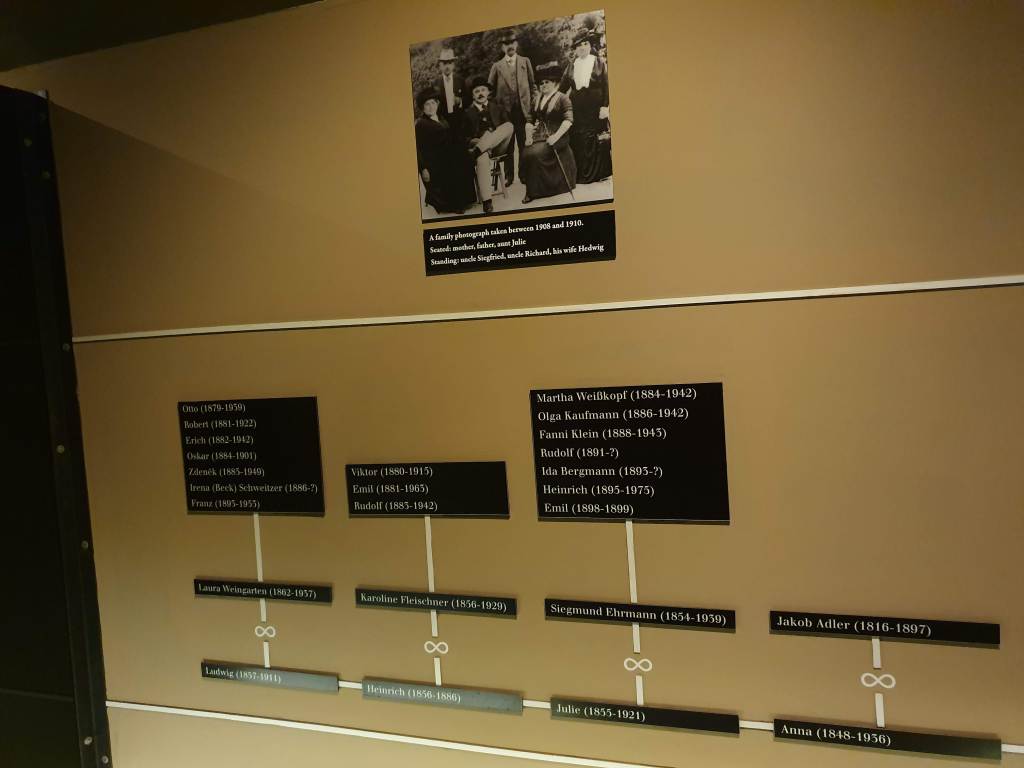
His sibling
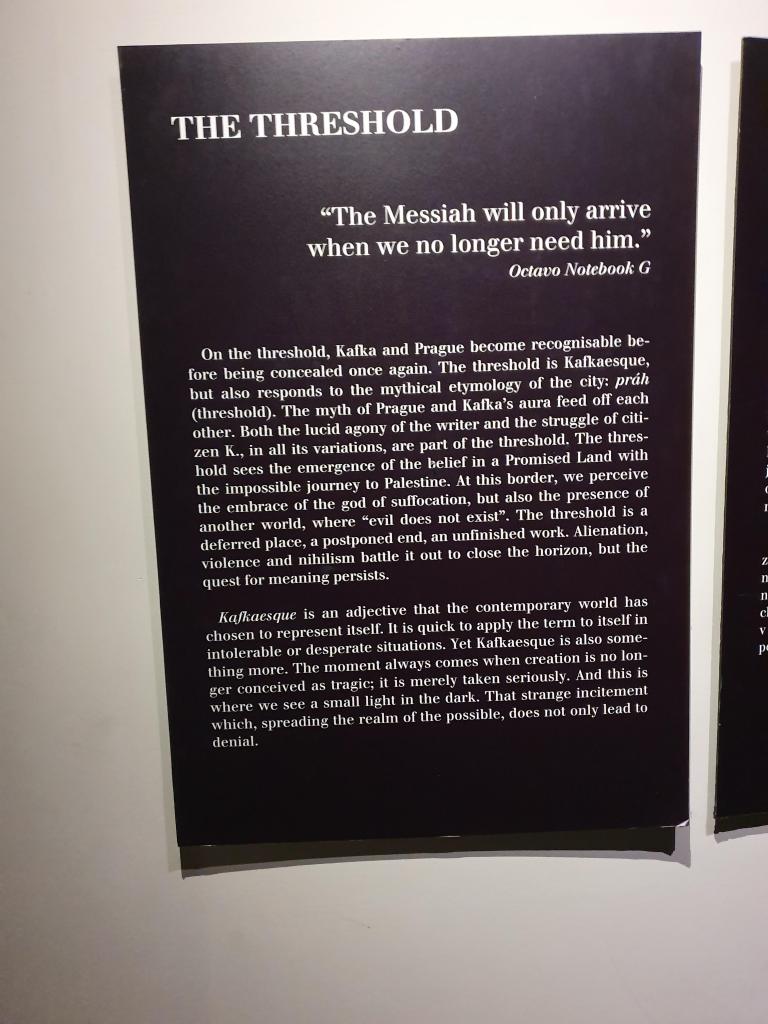
The Threshold The Messiah will arrive when we no longer need him; it reminded me of a novel by Dostoevsky; The Brothers Karamazov.
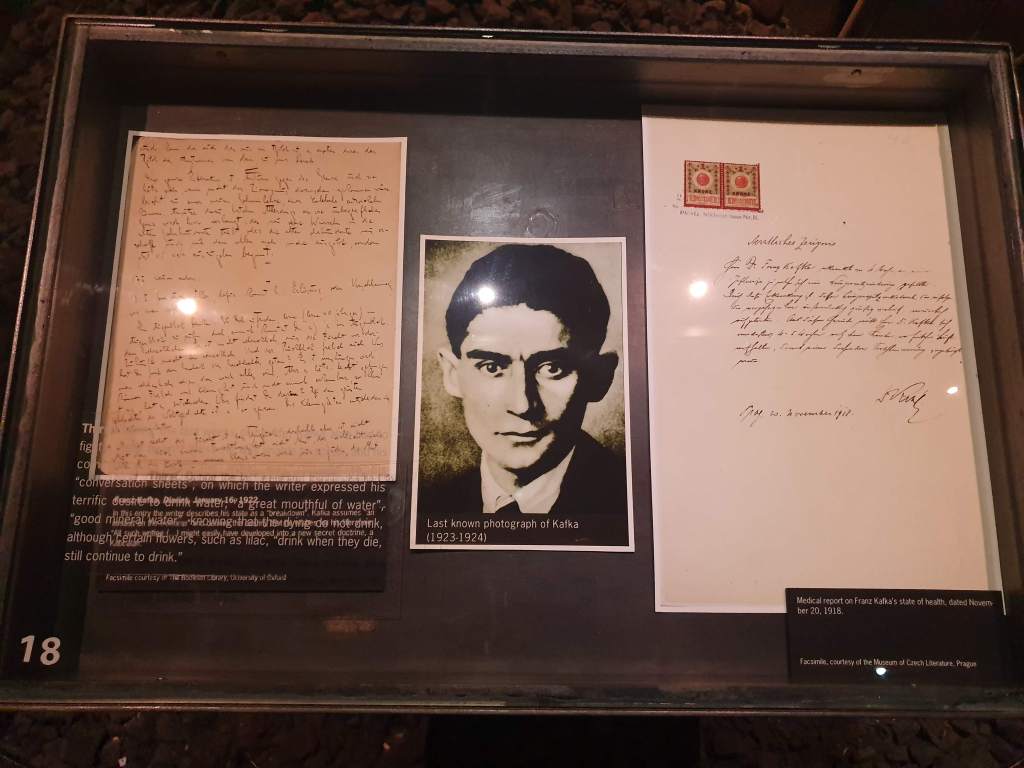
At the end I share an artwork of the head of Franz Kafka in Prague 🙂 have a beautiful Weekend ❤
Hi Friends. it’s a holiday today in some of the states in Germany (the catholic ones) not because of the Halloween but because of an old catholic ceremony to honoured the beloved ones who past away. The All Saint’s Day (here we call it Allerheiligen) it is a day to go to the cemeteries and remember of the loss.
I am at home to take the benefit of this but not going to the cemetery, not only because of my nonreligious opinion but surely for me it isn’t necessary to go to the cemetery to remember my beloved one, I have them in my heart and when I go there it’s just to look after if everything is okay!
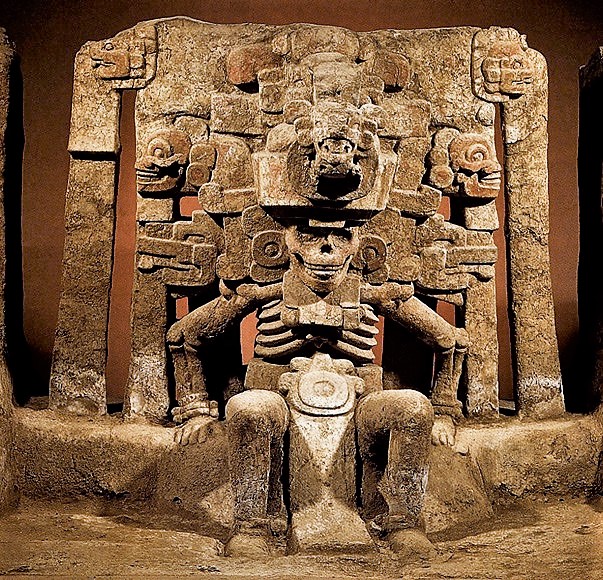
So now the reason of my writing is that I read an article in The Conversation a very interesting Website about the very ceremony of today by catholic, is not their invention but originally the Aztecs had it in those days. https://theconversationus.cmail19.com/t/r-l-jddthkjt-uihidylylr-n/
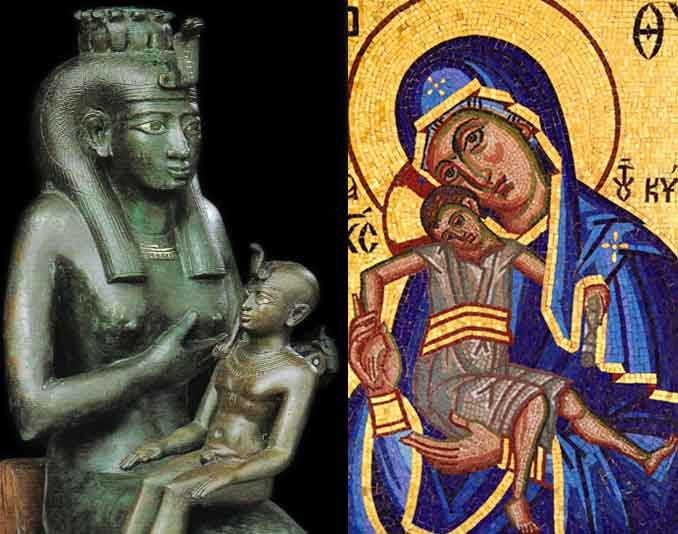
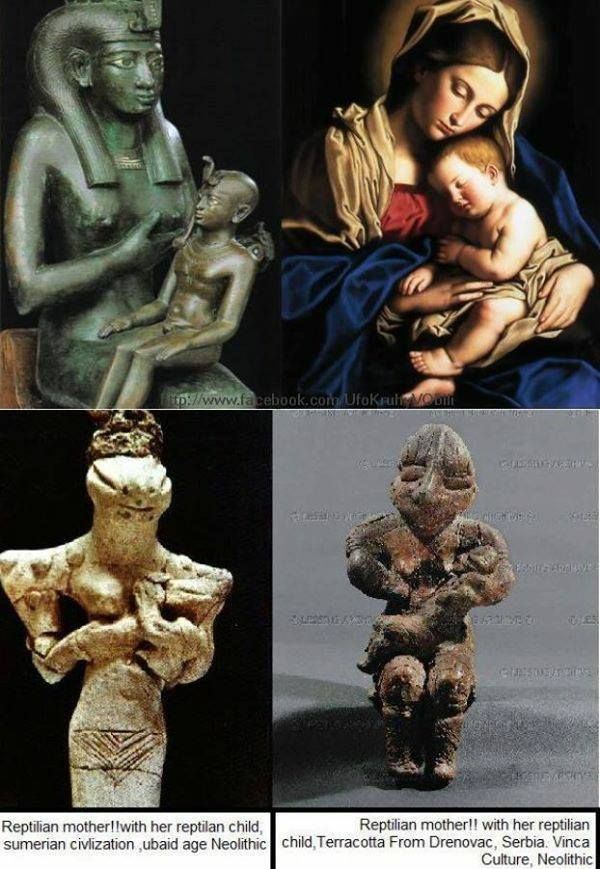
In the older history; about Mary & Jesus and Isis & Horus
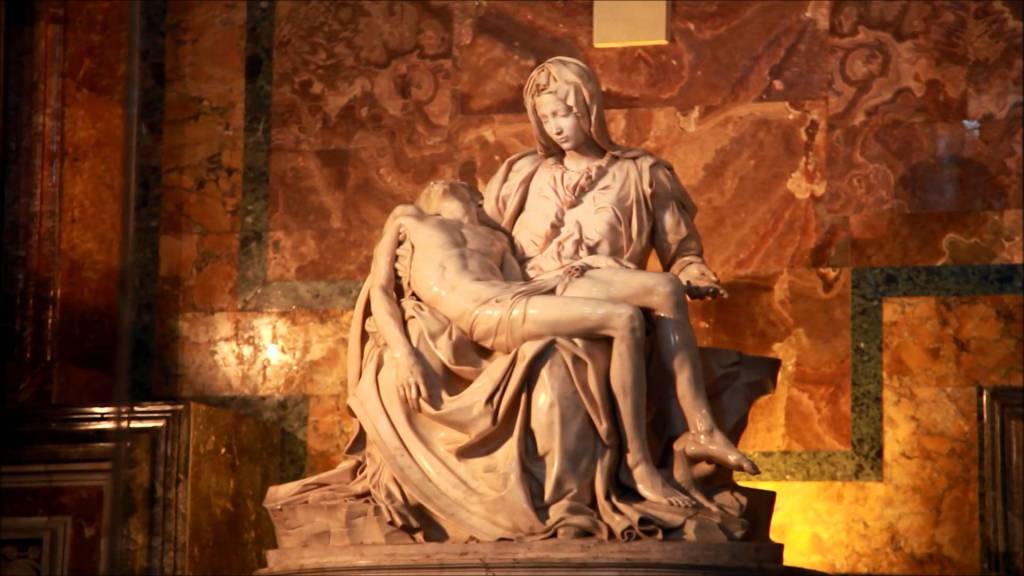
It’s really obvious as we look into the ancient history of mankind, we can find many similarities in between; for example, the famous Pieta(s) which isn’t found by the Christ on Mary’s lap:
I have found it always exciting to look after our history and from where have been all come from? There must be something important in our ancient time which had influenced all through history until now.
After the death of his old friend, Albert Einstein said “Now Besso has departed from this strange world a little ahead of me. That means nothing. People like us … know that the distinction between past, present and future is only a stubbornly persistent illusion.”
New evidence continues to suggest that Einstein was right – death is an illusion.
Our classical way of thinking is based on the belief that the world has an objective observer-independent existence. But a long list of experiments shows just the opposite. We think life is just the activity of carbon and an admixture of molecules – we live awhile and then rot into the ground.
We believe in death because we’ve been taught we die. Also, of course, because we associate ourselves with our body and we know bodies die. End of story. But biocentrism – a new theory of everything – tells us death may not be the terminal event we think. Amazingly, if you add life and consciousness to the equation, you can explain some of the biggest puzzles of science. For instance, it becomes clear why space and time – and even the properties of matter itself – depend on the observer. It also becomes clear why the laws, forces, and constants of the universe appear to be exquisitely fine-tuned for the existence of life.
Until we recognize the universe in our heads, attempts to understand reality will remain a road to nowhere.
Consider the weather ‘outside’: You see a blue sky, but the cells in your brain could be changed so the sky looks green or red. In fact, with a little genetic engineering we could probably make everything that is red vibrate or make a noise, or even make you want to have sex like with some birds. You think its bright out, but your brain circuits could be changed so it looks dark out. You think it feels hot and humid, but to a tropical frog it would feel cold and dry. This logic applies to virtually everything. Bottom line: What you see could not be present without your consciousness.
In truth, you can’t see anything through the bone that surrounds your brain. Your eyes are not portals to the world. Everything you see and experience right now – even your body – is a whirl of information occurring in your mind. According to biocentrism, space and time aren’t the hard, cold objects we think. Wave your hand through the air – if you take everything away, what’s left? Nothing. The same thing applies for time. Space and time are simply the tools for putting everything together.
Consider the famous two-slit experiment. When scientists watch a particle pass through two slits in a barrier, the particle behaves like a bullet and goes through one slit or the other. But if you don’t watch, it acts like a wave and can go through both slits at the same time. So how can a particle change its behavior depending on whether you watch it or not? The answer is simple – reality is a process that involves your consciousness.
Or consider Heisenberg’s famous uncertainty principle. If there is really a world out there with particles just bouncing around, then we should be able to measure all their properties. But you can’t. For instance, a particle’s exact location and momentum can’t be known at the same time. So why should it matter to a particle what you decide to measure? And how can pairs of entangled particles be instantaneously connected on opposite sides of the galaxy as if space and time don’t exist? Again, the answer is simple: because they’re not just ‘out there’ – space and time are simply tools of our mind.
Death doesn’t exist in a timeless, spaceless world. Immortality doesn’t mean a perpetual existence in time, but resides outside of time altogether.
Our linear way of thinking about time is also inconsistent with another series of recent experiments. In 2002, scientists showed that particles of light “photons” knew – in advance – what their distant twins would do in the future. They tested the communication between pairs of photons. They let one photon finish its journey – it had to decide whether to be either a wave or a particle. Researchers stretched the distance the other photon took to reach its own detector. However, they could add a scrambler to prevent it from collapsing into a particle. Somehow, the first particle knew what the researcher was going to do before it happened – and across distances instantaneously as if there were no space or time between them. They decide not to become particles before their twin even encounters the scrambler. It doesn’t matter how we set up the experiment. Our mind and its knowledge is the only thing that determines how they behave. Experiments consistently confirm these observer-dependent effects.
Bizarre? Consider another experiment that was recently published in the prestigious scientific journal Science (Jacques et al, 315, 966, 2007). Scientists in France shot photons into an apparatus, and showed that what they did could retroactively change something that had already happened in the past. As the photons passed a fork in the apparatus, they had to decide whether to behave like particles or waves when they hit a beam splitter. Later on – well after the photons passed the fork – the experimenter could randomly switch a second beam splitter on and off. It turns out that what the observer decided at that point, determined what the particle actually did at the fork in the past. At that moment, the experimenter chose his past.
Of course, we live in the same world. But critics claim this behavior is limited to the microscopic world. But this ‘two-world’ view (that is, one set of physical laws for small objects, and another for the rest of the universe including us) has no basis in reason and is being challenged in laboratories around the world. A couple years ago, researchers published a paper in Nature (Jost et al, 459, 683, 2009) showing that quantum behavior extends into the everyday realm. Pairs of vibrating ions were coaxed to entangle so their physical properties remained bound together when separated by large distances (“spooky action at a distance,” as Einstein put it). Other experiments with huge molecules called ‘Buckyballs’ also show that quantum reality extends beyond the microscopic world. And in 2005, KHC03 crystals exhibited entanglement ridges one-half inch high, quantum behavior nudging into the ordinary world of human-scale objects.
We generally reject the multiple universes of Star Trek as fiction, but it turns out there is more than a morsel of scientific truth to this popular genre. One well-known aspect of quantum physics is that observations can’t be predicted absolutely. Instead, there is a range of possible observations each with a different probability. One mainstream explanation, the “many-worlds” interpretation, states that each of these possible observations corresponds to a different universe (the ‘multiverse’). There are an infinite number of universes and everything that could possibly happen occurs in some universe. Death does not exist in any real sense in these scenarios. All possible universes exist simultaneously, regardless of what happens in any of them.
Life is an adventure that transcends our ordinary linear way of thinking. When we die, we do so not in the random billiard-ball-matrix but in the inescapable-life-matrix. Life has a non-linear dimensionality – it’s like a perennial flower that returns to bloom in the multiverse.
“The influences of the senses,” said Ralph Waldo Emerson “has in most men overpowered the mind to the degree that the walls of space and time have come to look solid, real and insurmountable; and to speak with levity of these limits in the world is the sign of insanity.”
The Freiberger Mulde (Czech: Freiberská Mulda, also called the Östliche Mulde or Eastern Mulde) is the right-hand, 124-kilometre-long (77 mi) headstream of the river Mulde, whose catchment covers an area of 2,981 km2 (1,151 sq mi) in the Czech Republic and Germany in central Saxony. It has a volumetric flow of 35.3 m3/s (1,250 cu ft/s) which is greater than that of the other headstream, the Zwickauer Mulde (or Westliche Mulde or Western Mulde) who flow is about 26.4 m3/s (930 cu ft/s),[2] which is nevertheless the longer stream.
I just have to think of a lovely river-song which I loved and used to play on the streets in the youngest times 😉
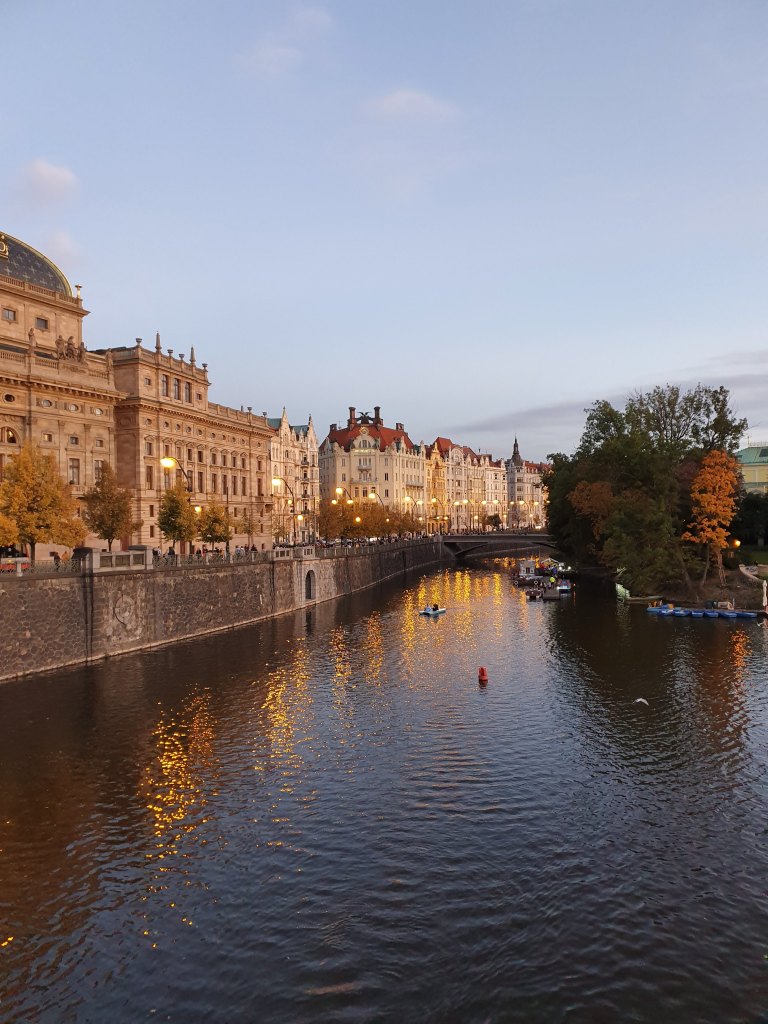
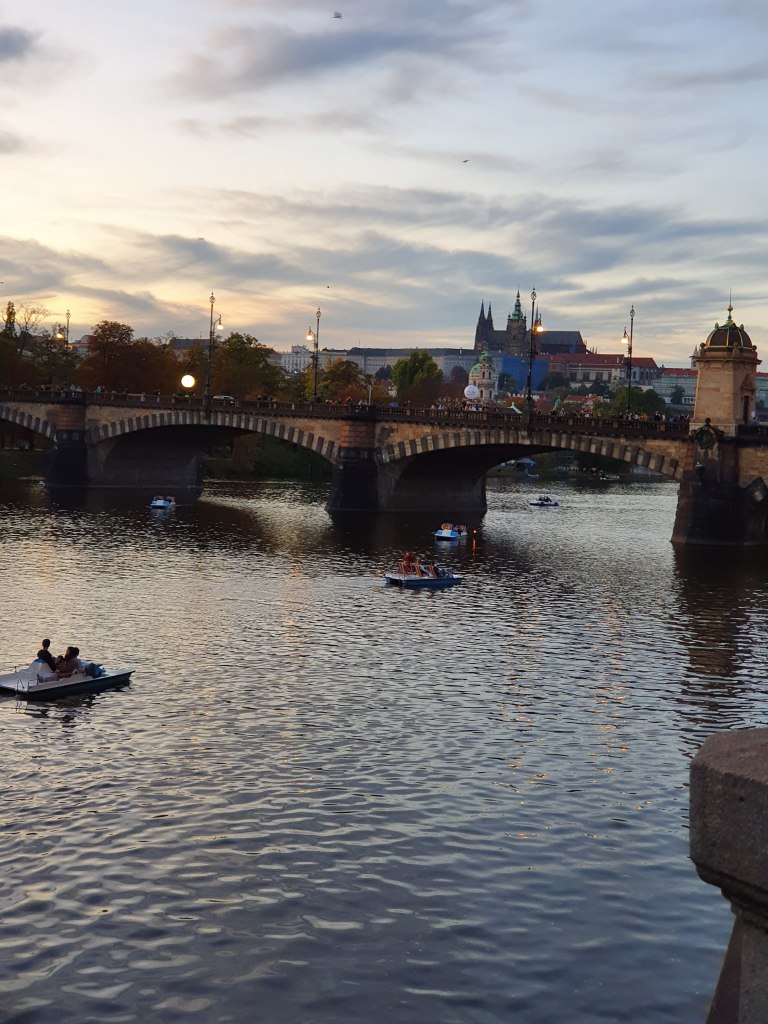
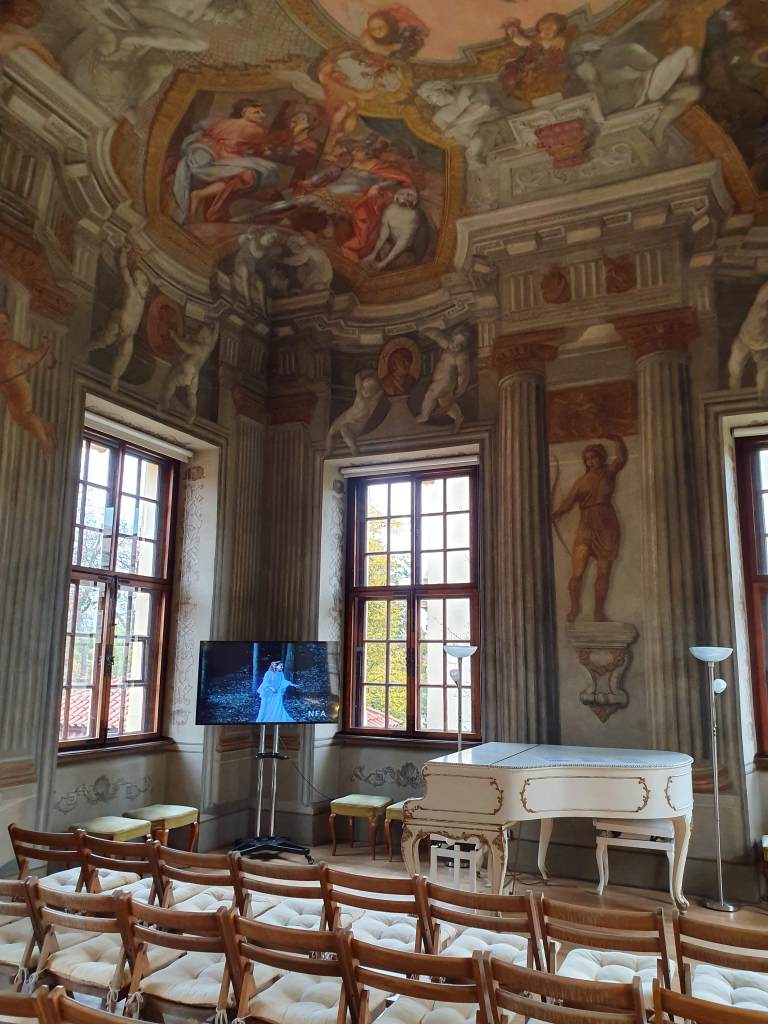
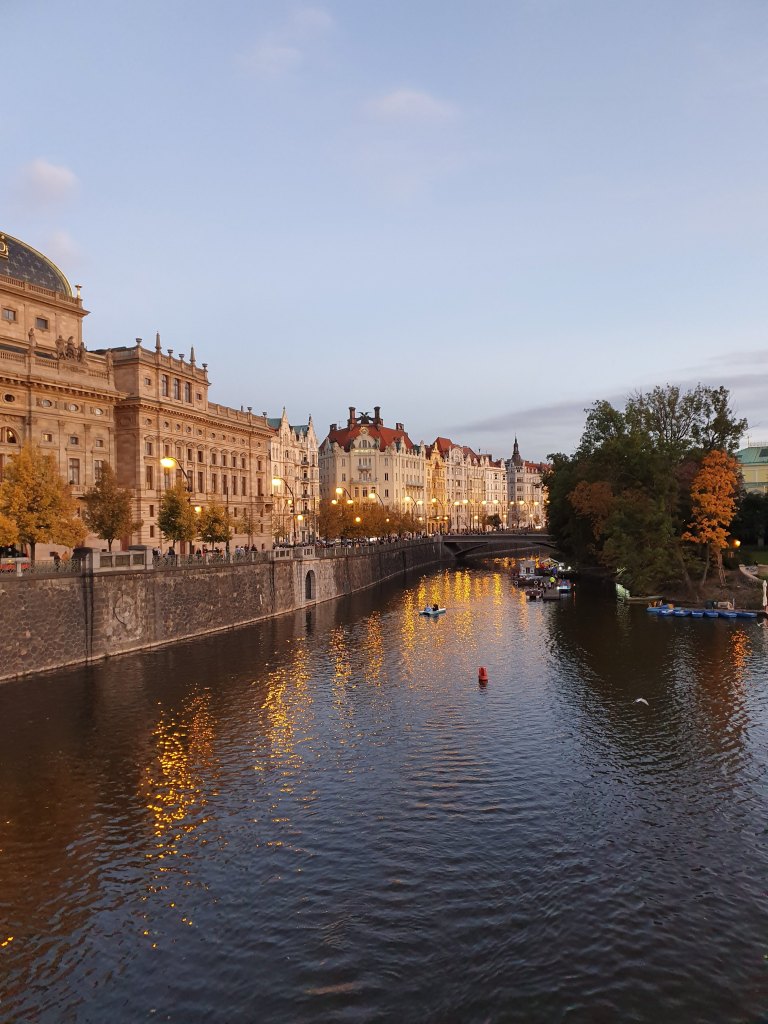
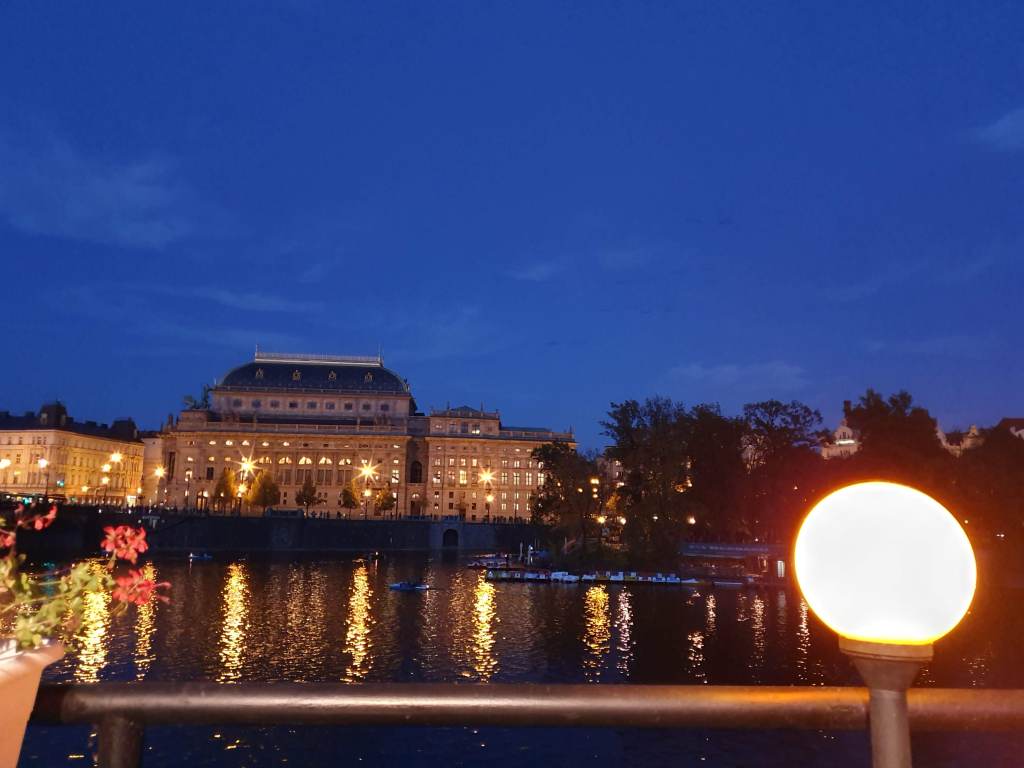
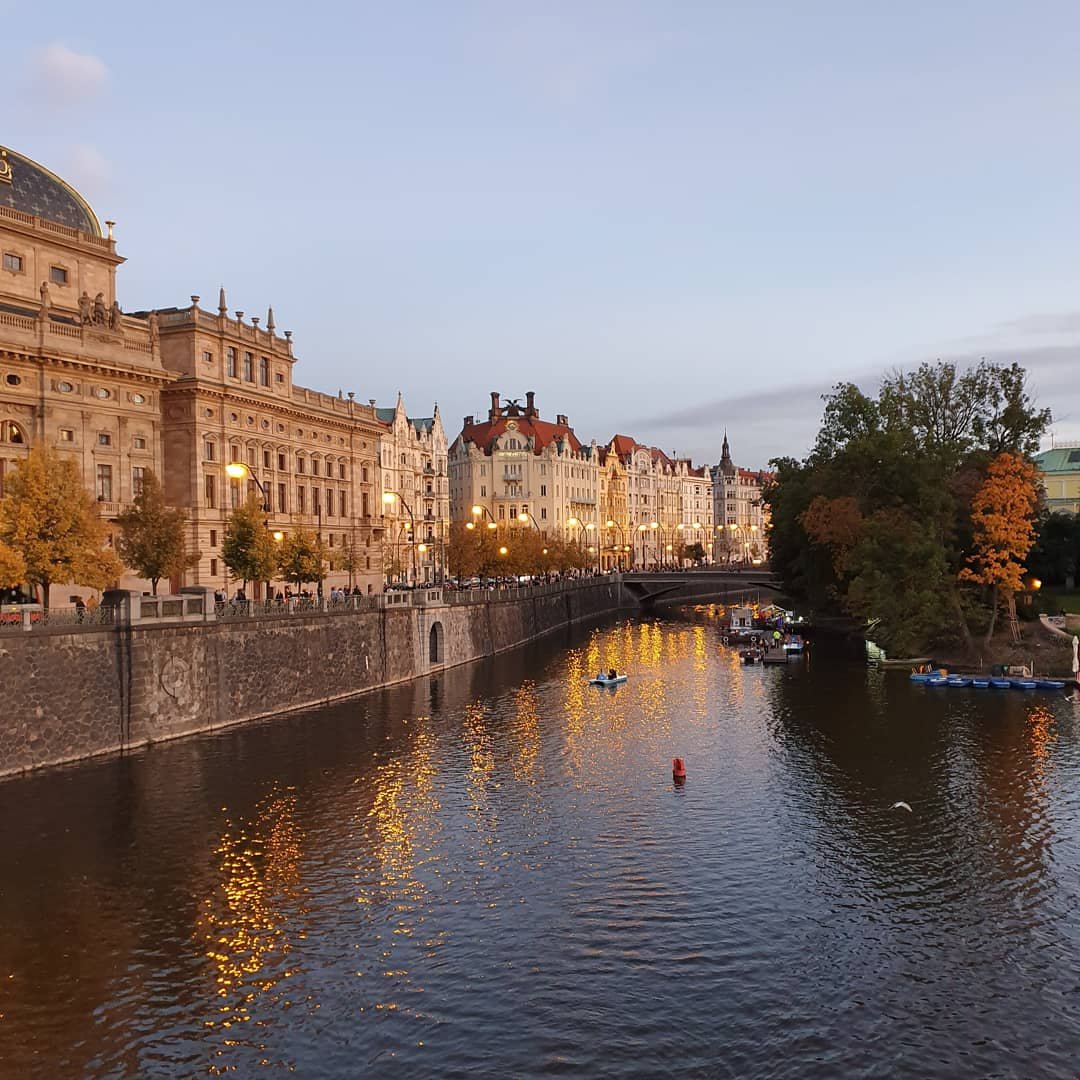
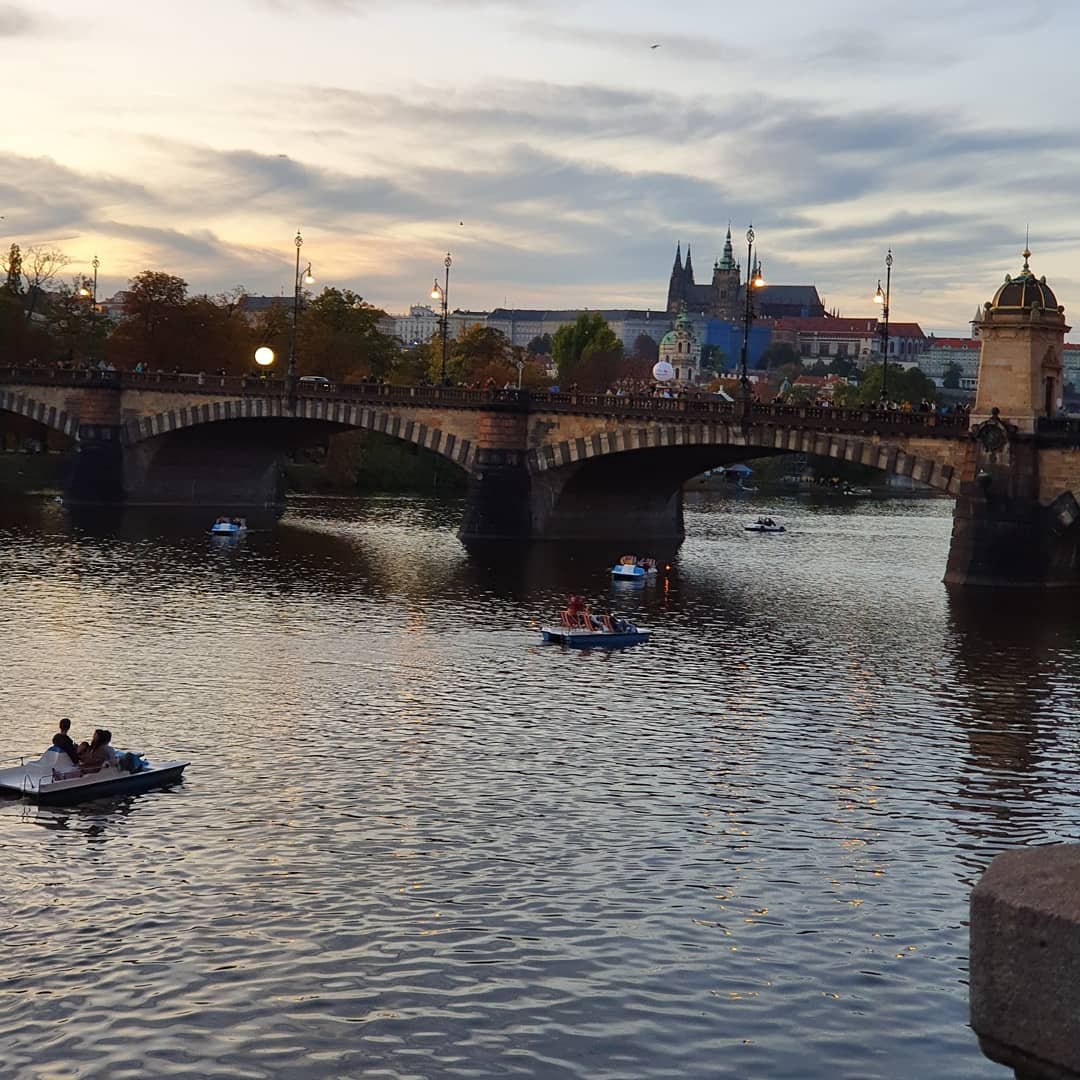
That is really one of the most beautiful and calm rivers as I’ve ever seen. As I walked along with this marvellous streaming, my mind was floating with Smetana’s Vltava (The Moldau), great Czech composer. http://Bedřich Smetana – Wikipedia
this piece fulfilled my soul as I’s watching the sparkles on the water surface.
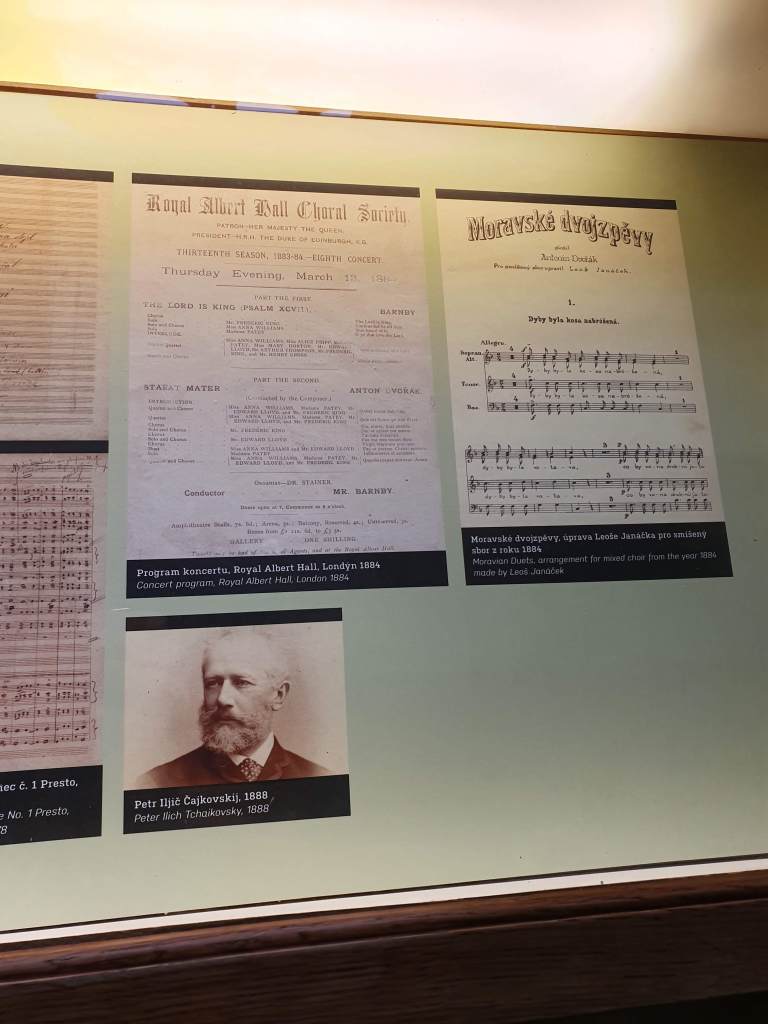
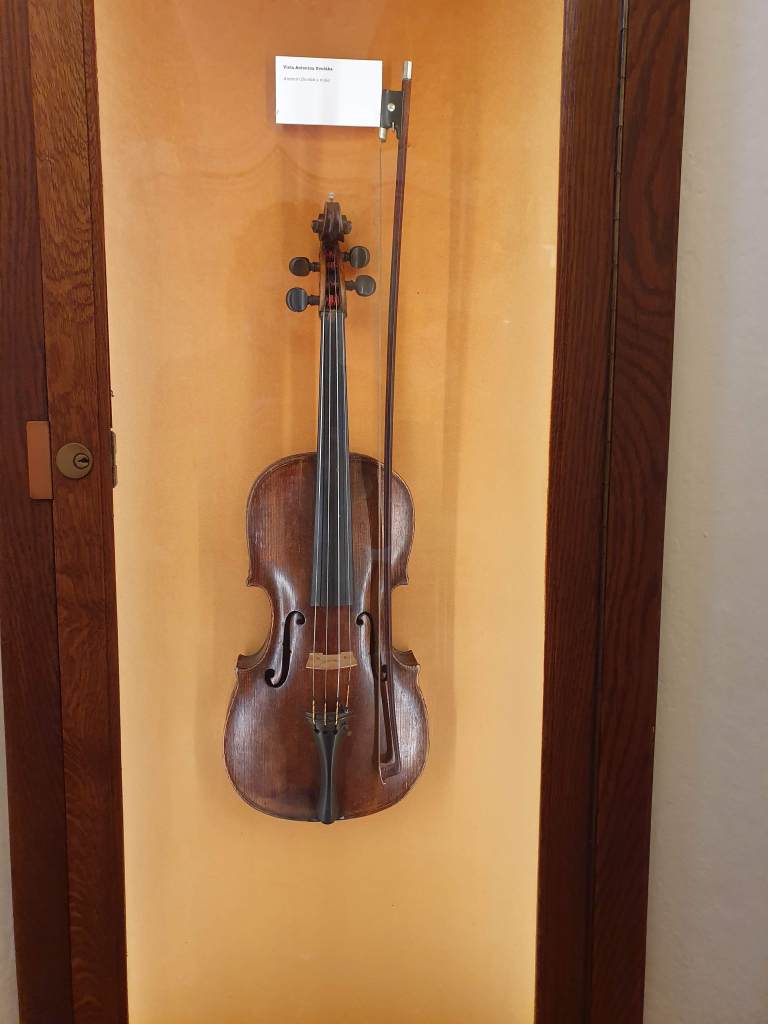
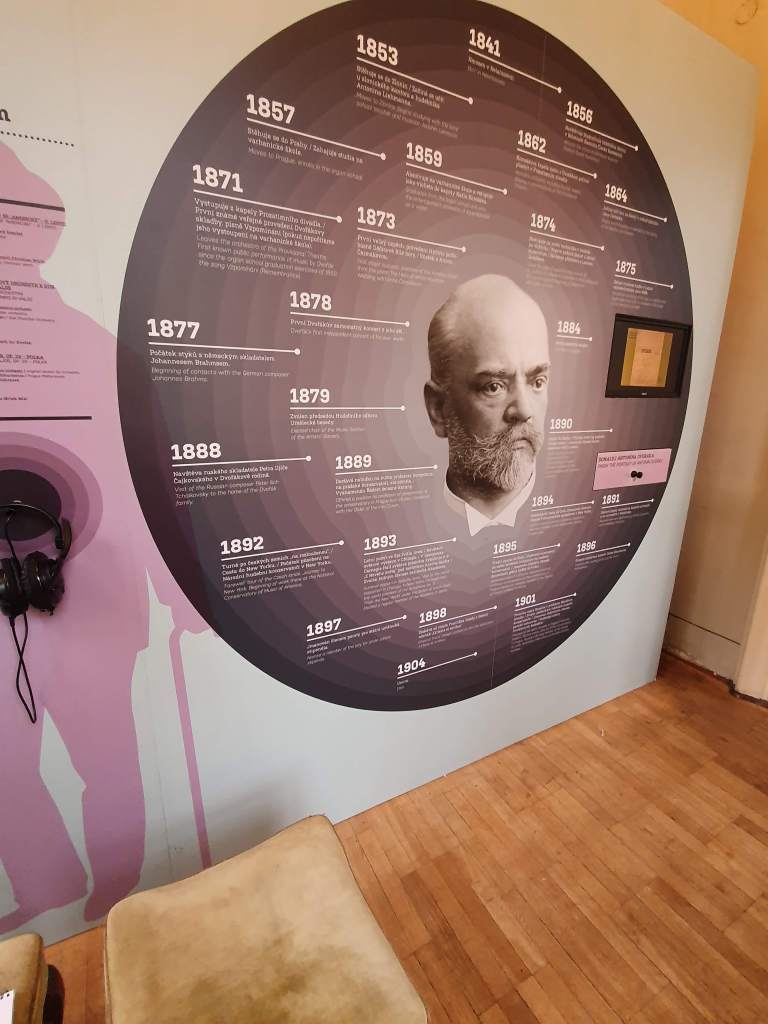
I have lost much time to search for one piece by Dvorak which I love but couldn’t find it.. damn!! Anyway, I have not share yet my favourite piece; Franz Kafka, and I will try next weekend to do it s, then; to be continued 😉 . Thank you all lovely friends and wish you a wonderful weekend ❤ ❤
I don’t really lament or as in German we say; jammern (yammer) but I’m really to be deplored! I have had planed since Wednesday when I came back from Prague trip to write a journal and the Saturday is for me the only chance but the God of luck wasn’t agreed to give me the chance and I had to fight all my morning and forenoon to get the pictures into my PC!! I have used a lot of tricks and ways which I knew but finally just could get them in an afternoon!
Anyway, let me try at least to begin it if I should make it as some partitions. As I still believe that I’m not a writer (as a professional at least) I need a longer time to write a story; (with a confess that I type with one finger each hand 😀 )
So; I wanted to see Prague because of my long but not lost interest since my youth. I know the city from its intelligence!; As I have heard of so many artists history and scene in the legendary pops; especially Franz Kafka’s tells. And also the 68’s Prague Spring with Alexander Dubček which it failed by the inversions USSR. https://en.wikipedia.org/wiki/Alexander_Dub%C4%8Dek
Alexander Dubček
Thanks my adorable wife, as she is caring for me and my wishes, arranged this short but amazing trip to see my idol(s). She knows me well as she might think that I have not so much time and must not take my all wishes with me into the grave. Please don’t think I’m exaggerating something; if you’d live in a country of the “so-called”; third world but have a brain on the beat, you’d surely have many wishes!
Before I share the pictures I want to show my appreciations to this; Czechoslovakia or these countries; Czech Republic & Slovakia for their separation in a peaceful condition which is unique in the human’s history. The Dissolution of Czechoslovakia https://en.wikipedia.org/wiki/Dissolution_of_Czechoslovakia
we can really recognize the whole city as a museum ❤
It is a really interesting question; I’d answer: Yes!
As we might know and history would show us, it is so and it has been all the time. We are all involved with the social fact as we are living in the mass of public!
…The cause of human-being coming to exist, however, is not clear. The only clearness is that this form of existence seems not to be what was required to be. This would be a case to discuss about, if we made a general consideration of human behavior and the path of indulgence and trespass that he has gone through his chronicle, in a serious way. To make it possible, the undeniable hostility between mankind and nature in general (in the order that one’s life means the other’s death), seems to be a proper clue for getting into a process which began when the first ape, if ever, in quest for meat climbed down his home-tree, and while missing his body hair and the other animal means, his mutation began. But this, either because of his mental disability or gradual lack of all necessary outfits (strong instinct and proper quality of senses, claws, teeth and body-cover) should have gone as a chaotic beginning, where our poor descending predecessor had no way but to somehow regain his missing necessary strength for survival. And since there was no natural way remained for this recovery process, he began to manipulate as well as to imitate nature, or in other words, he commenced to run for an unnatural life. It is simple to conceive that an abrupt fear took the new creature totally up, so that he felt himself defenseless and naked in confrontation with his apparently brutal and cruel environment. This is most likely that another result could or even had to be obtained if this misfortune in Man’s initial touch with nature had not obstructed the process. And this is also possible that a project had once been planned to create a special and extraordinary species to be able to engender an intellectual kind of harmony among the natural parts and elements on this planet.
This is a part of a roman “The Season of Limbo” which, my brother Al wrote in the 90’s.
Of course, it isn’t the whole of the article but, as you should mention it; it is something social therefore political. I mean; as we all once decided to live safety together as a social community on this almost unfamiliar terrain, we have chosen the communion way of life and as the art in us, is the communion way of our expression only as an idea to make it better!
As I lived in Iran, the great Political Idols for me were the artists in countries like: In the south Americas, or and so on!
finally; long talk short sense, I think the artists are growing up in the very society as they live, therefore, their arts come from their soul and I think that is the main point; Creation by one’s soul.
truly, I found this article and the memories of those days in which we were fighting against the dictatorship of the Shah’s regime (it wasn’t so fur worst as it is now!) and these activities like; Neruda, Garcia Marques, Milan Kundera, Ernest Hemingway, even Shakespeare were all the political activist. We all are Artists, who are trying to make a reason for our beings.
Does politics belong in art? The question arouses heated debate about creative freedom and moral responsibility. Assumptions include the idea that politics cheapens film, music, or literature, or that political art should abandon traditional ideas about beauty and technique. As engaging as such discussions might be in the abstract, they mean little to nothing if they don’t account for artists who show us that choosing between politics and art can be as much a false dilemma as choosing between art and love.
In the work of writers as varied as William Blake, Muriel Rukeyser, James Baldwin, and James Joyce, for example, themes of protest, power, privilege, and poverty are inseparable from the sublimely erotic—all of them essential aspects of human experience, and hence, of literature. Foremost among such political artists stands Chilean poet Pablo Neruda, who—as the TED-Ed video above from Ilan Stavans informs us—was a romantic stylist, and also a fearless political activist and revolutionary.
Neruda won the Nobel Prize for Literature in 1971, and, among his many other literary accomplishments, he “rescued 2,000 refugees, spent three years in political exile, and ran for president of Chile.” Neruda used “straightforward language and everyday experience to create lasting impact.” He began his career writing odes and love poems filled with candid sexuality and sensuous description that resonated with readers around the world.
Neruda’s international fame led to a series of diplomatic posts, and he eventually landed in Spain, where he served as consul in the mid-1930s during the Spanish Civil War. He became a committed communist, and helped relocate hundreds of fleeing Spaniards to Chile. Neruda came to believe that “the work of art” is “inseparable from historical and political context,” writes author Salvatore Bizzarro, and he “felt that the belief that one could write solely for eternity was romantic posturing.”
Yet his lifelong devotion to “revolutionary ideals,” as Stavans says, did not undermine his devotion to poetry, nor did it blinker his writing with what we might call political correctness. Instead, Neruda became more expansive, taking on such subjects as the “entire history of Latin America” in his 1950 epic Canto General.
Neruda died of cancer just weeks after fascist dictator Augusto Pinochet seized power from elected president Salvador Allende in 1973. Today, he remains a beloved figure for activists, his lines “recited at protests and marches worldwide.” And he remains a literary giant, respected, admired, and adored worldwide for work in which he engaged the struggles of the people with the same passionate intensity and imaginative breadth he brought to personal poems of love, loss, and desire.
























 lampmagician
You must be logged in to post a comment.