Make Love, No War. how it can be helpful to learn from our past and failure to make our life better. Let’s never forget them and try to live in peace together in this beautiful world ❤ ❤
In December of 1914, a series of grassroots, unofficial ceasefires took hold of the Western Front in the heat of WWI. On Christmas, soldiers from an estimated 100,000 British and German troops began to exchange seasonal greetings and sing songs across the trenches, some even walked over to their opponents bearing gifts. The incident became one of the most heart-warming displays of humanity in the history of human conflict and was dubbed the Christmas Truce.
Depiction of the Christmas Truce of 1914 by artist A. C. Michael, originally published in the Illustrated London News on January 9, 1915, with the caption “British and German Soldiers Arm-in-Arm Exchanging Headgear: A Christmas Truce between Opposing Trenches.”
From the trenches, a 19-year-old British private by the name of Henry William Williams — a man of confounding contradictions himself, who would go on to become one of the most lyrical nature writers in the English language, an early admirer of Hitler, and an opponent of the Second World War — wrote to his mother on Boxing Day:
Dear Mother, I am writing from the trenches. It is 11 o’clock in the morning. Beside me is a coke fire, opposite me a ‘dug-out’ (wet) with straw in it. The ground is sloppy in the actual trench but frozen elsewhere. In my mouth is a pipe presented by Princess Mary. In the pipe is tobacco. Of course, you say. But wait. In the pipe is German tobacco. Haha, you say, from a prisoner or found in a captured trench. Oh dear, no! From a German soldier. Yes, a live German soldier from his own trench. Yesterday the British & Germans met & shook hands in the Ground between the trenches, & exchanged souvenirs, & shook hands. Yes, all day Xmas day, & as I write. Marvellous, isn’t it?
This lovely short film captures the story and spirit of this symbolic moment of peace, grace, and humility amid one of history’s most violent and disgraceful failures of humanity.
I’ve gathered some images, sacred and sublime, to scroll through as you listen to “O Holy Night“, one of my favorite Christmas carols.
I love this song, not only for the haunting melody and beautiful lyrics, but also because night has always seemed holy to me.
When I walk out beneath the stars on a cold or balmy night, I’m awestruck by such beauty and mystery and magnificence. I feel humbled and incredibly grateful, as if witnessing the hand of the divine writ large across the sky.
The images below are my gift to you. They reflect what this season is all about for me, a sense of the sacred and sublime–scenes of the birth of Christ and families celebrating Christmas.
Photos of spectacular sunsets and winter wonderlands–nature in all her glory.
And finally, images of an infinite universe stretching out and wrapping about the earth as if we were a…
In abandoned captivity, within a wrought iron cage, within a cold Caen limestone walled cell, within a forgotten fortress set in the shadow of the dark side of civilization, sits an innocent occupant, determined by his sniggering contemporaries to be the guilty party, his crime, the stealing of the hearts of a divided nation. He tells lies. To himself. There was, after all, not another living soul to speak with or at insofar as he was aware.
Often, he would latch onto the merest glimpse of the enchanted boulevard where belles dames de la nuit would promenade when off duty, from the single arrowslit that sadly, for him at least, did not exist. For his sins, he lived in permanent darkness, his eyes as functionless as his appendix. On other occasions he would pray that he had a beard, in denial that his beard, one he regularly tripped over, now…
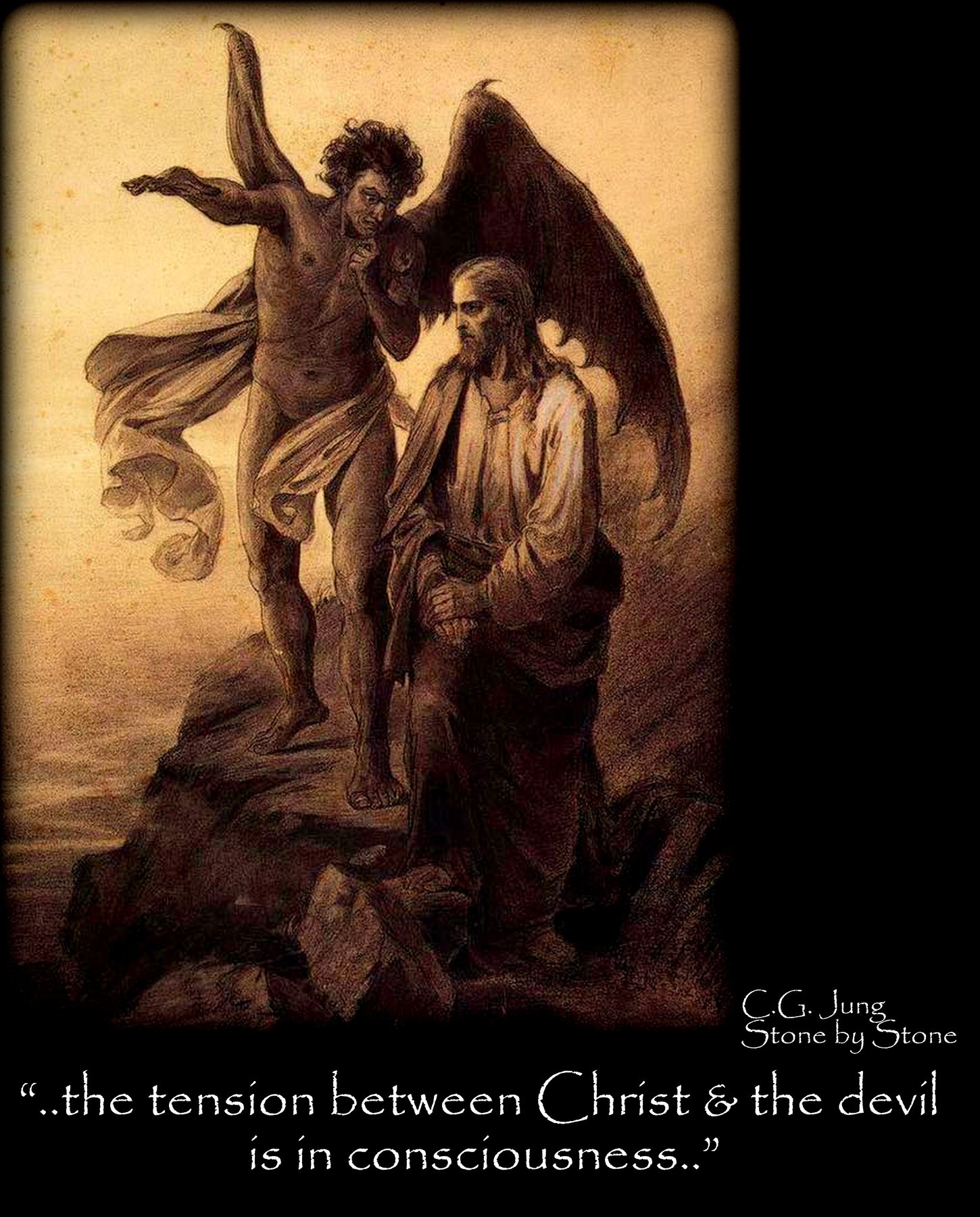
“..the tension between Christ and the devil is in consciousness..” C.G. Jung, Stone by Stone…”
The words say everything, though, Dr Jung here used the Christ (but not Jesus) just to show what he meant, isn’t religious but the recognition of the purity, as in the Christion’s religion has been known. I myself, have found Jesus as a phenomenal personality, even as I lived in Iran, as a Muslim. (I might notice here that the Muslims recognize Jesus and his mother Maria, as the holy persons in their religion.) but it wasn’t the reason why I did so; it was just because of his message: Love. Anyhow, what it’s saying here is, in my opinion, means that we’re always in the fight between two sides of ours: the light and the dark side. and further, I say the winning point is our unconsciousness, and to know it. we must get deeper and deeper in our soul to know ourselves better.
There is only one way and that is your way; there is only one salvation and that is your salvation.
Here I take the opportunity to use these two posts by two greats C.G.Jung experts Craig Nelson & lewislafontaine who also, fortunately, are my friends. to explain my feelings on this issue.
The tension of the future is unbearable in us. It must break through narrow cracks, it must force new ways.
You want to cast off the burden, you want to escape the inescapable. Running away is deception and detour.
Shut your eyes so that you do not see the manifold, the outwardly plural, the tearing away and the tempting.
There is only one way and that is your way; there is only one salvation and that is your salvation.
Why are you looking around for help?
Do you believe that help will come from outside?
What is to come is created in you and from you.
Hence look into yourself Do not compare, do not measure. No other way is really yours.
All other ways deceive and tempt you.
You must fulfill the way that is in you ~Carl Jung, Red Book, Page 308.
I love his way of discussion! I was a naive boy as my wise brother pushed four thick valiums set of books of Plato towards me and said: read! of course, I followed; they were the collection of Plato’s notes from the Socrates discussions complete. I can only remember when I began with reading them, once I was wandering on the Tehran’s street and just taking rest on a park bench, a girl came to me and asked: are you OK? I’d confusingly answered; of course, what’s the matter? you’re just looking so depressed I thought she said. I was so, not depressed but under a lot of heavy thought!
And what would you say about the prowess shown in the sea, sickness, poverty or political life? In addition, some people are brave when faced with pain and weak when taken by pleasure. That’s why I ask you again: what would we call the generosity of Lash?
Two Athenian generals Lachis and Niki discuss with Socrates the prowess that the combatants should demonstrate in the battlefield. Both generals lost their lives to Lachis in the Battle of Mantineia in 418 BC and Nicky in 412 in the Sicilian campaign. Socrates brings the conversation to a higher level than bravery and asks the General who are experts to express their opinion. Following is the dialogue: Lahis – A soldier recently showed us something new: He was one of my men and devised a spear-shaped spear. He was very proud of the potential of this weapon during the battle. In order to make no mistake, in a naval battle, his spear was caught in the rigging of another ship as we passed by beside him. The soldier pulled it, but the spear was not recited, so he was forced to run along the deck, vice versa, holding the grip firmly to keep him out of his hands. Eventually, he had to leave the spear and leave running while the crews of both ships laughed until tears. We could not keep it, you had to see how the spear was hanging from the rigging!
Nikia – I agree. I believe that this equipment seems remarkable.
Lahis – What is your view, Socrates? So far we are a pro, one against. The decisive vote falls on you!Socrates – Lahis, instead of voting, I would say we should focus our attention on a more substantive issue that you have just rightly put before. Do not you think that for an issue as important as the practice of the arms of your friends’ sons, should we look for a specialist and follow his advice?
Lahis – Of course, Socrates. This is right.
Socrates – What, then, should our expert be expert?Nikias – Now we were not talking about arms training? Whether our young people should be practised or not?
Socrates – Yes, Nikia. But should not we first answer this basic question? For example, when a person asks what medicine he has to put in his eyes, what does he really care about his medicine or eyes?
Nikis – Of course his eyes!
Socrates – And when he thinks of putting a bridle on a horse, the horse cares about it and not the bridle, is it?
Nice – Right. Socrates – Do not you see, then, Nikia, how to practice the weapons is like drugs and skirts – just a means of achieving a goal? What we really think about when it comes to different kinds of education is young people. It is the self, the soul of these young people undergoing education.
The doctor knows if it’s good for the eyes. Hippodomus what is good for horses. But who knows what’s good for the soul, that’s the basic question! Nikias – (laughing): I had to wait for it, Socrates, we have done similar discussions, and it is a painful process. However, in the end, I always leave with clearer ideas than at first. Are you ready to face him, Lah? I warn you of the experience this man has for us!
Lahis – Generally, I am not in favour of the discussions, unless I’m sure my interlocutor is a man of both acts and words. I was together with Socrates in the retreat after our defeat in the Battle of Delhi, if all were recognized as Socrates, we would have won. I would accept the questions of such a man at any time.
Socrates – Thank you, Lahis. Allow me to submit to you the part of this more general question that concerns you most because of your profession of driving soldiers into battle. What is Larus?
Lahis – This is easy, Socrates. It is a man who does not abandon his position and does not put his feet in danger. Socrates – Good definition of bravery, in terms of a pedestrian. Does it apply, however, to the cavalry that is constantly on the move? If I’m not mistaken, a favourite manoeuvre of the Scythians is to escape by galloping, turning both the trunk on the horse and hitting the enemy as they retreat.
Lahis – Correct observation Socrates. These horsemen are among the most prolific soldiers.
Socrates – And what would you say about the prowess shown in the sea, sickness, poverty or political life? In addition, some people are brave when faced with pain and weak when taken by pleasure. That’s why I ask you again: what would we call the generosity of Lash?
Lahis – You put me in Socrates thoughts. Now that I think about it better, I would say that bravery is a kind of soul’s heartbeat.
Socrates – My dear! Now you have given us a comprehensive definition, but perhaps too comprehensive, because if the real bravery is always a virtue, then the simple absurd misery can also be described as a virtue?
Lahis – I should have been wise. Socrates – Yes, but what does it mean wise? What is your view of the man who is able to fight and is willing to fight bravely because he has reasonably calculated that he will have the support of others, that he is fighting against the fewer and weaker than those who fight at his side? Would you say that this man who performs such a wit in such wisdom is a manly man? More prolific and by the one who has the will to stay and fight on the weak side?Lahis – I have no doubt that the man who is not sitting to figure out the risk is brighter than the other. Socrates – So, the man who dives in a well without knowing how to dive is brighter, even more, foolish than the trained diver? Lahis – I have to be consistent with what I said before Socrates, but there is obviously a gap in our reasoning. Source: Nasos Argiropoulos writes at : http: //nasosargiropoulos.blogspot.gr(We read it in Ronald Gross’s book, The Socrates Method)




 lampmagician
You must be logged in to post a comment.