
Uncategorized
An Interview with the Center for Jungian Studies of South Florida
Standard#Whole30 #Writing Log: Day 5


How the heck am I supposed to cheat with the good creamer when Bo’s home from work?
It’s taken a lot of stealthy sneakery, let me tell you. I put him on tooth-brushing detail before the school bus came. I’ve waited until he’s checking something on Facebook. I’ve listened for him to shut the bathroom door.
Aha! Creamer! It’s mine, I tell you, MIIIIINE!
Ahem.
And then he had to go into the kitchen to make his lunch. Can’t he cook somewhere else? Use the grill, most of the snow’s melted by now.
Dammit, now I gotta use the cashew milk.
BLECH YUCK BLECHITY BLECH
Ahem.
So why is Bo off of work? Biff and Bash have a concert this afternoon during their school day. It’s themed “All Things February,” only without anything Valentiney for some reason. Who wants to sing about Valentine’s Day when you’ve got American presidents, groundhogs…
View original post 281 more words
Oscar Wilde in Sicily
Standard
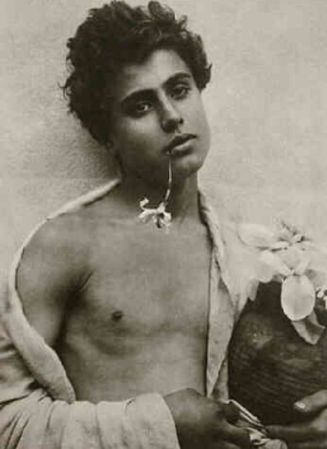
Things had to cool down after the further scandal which had involved Oscar Wilde and Lord Alfred Douglas while they were in Naples and Capri. So, Wilde quickly left the island and with the little money he had left, headed alone to Taormina in 1898. Wilde was not only attracted by those magnificent rocky and enchanted bays of the dark blue Mediterranean or that mythological fascination that Sicily offered to its visitors. At that time Sicily, with its ancient Greek associations, had become a sort of dream land for homosexual literati of the time. It was the place where to project their sexual fantasies and invoke the legitimization of the ancient ‘Greek love’ tradition. This is the Sicily Wilde had in mind when he wrote the following lines taken from ” Charmides” in 1881.
“He was a Grecian lad, who coming home
with pulpy figs and wine from Sicily
Stood…
View original post 540 more words
The Power of Letter Writing
Standard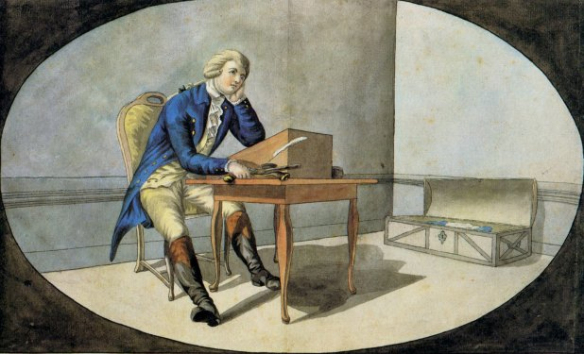
Among the many narrative techniques which were experimented by the authors of the eighteenth century, the epistolary novel was by no means the form which had the most effective and powerful impact on the mind of readers. Just guess, it was as if you could intercept some correspondence which was not addressed to you and you were free to peep into somebody else’s live, having knowledge of their emotions, secrets and confessions without even feeling guilty. You have also to consider that it was a time when people had no many other chances of diversions like today and while reading you were not distracted by notification beeps, telephone calls and modern noise in general. Therefore, letters, with their dates, names of the places, recipient names and even the time of the day, gave that sense of realism which made the reading seem more true and therefore, intense.
The greatest proof…
View original post 576 more words
Review “Climbing Over Grit”
Standard
Thanks so much dear:







Dear friends:
You can purchase my book; “Climbing Over Grit” Winner of “Canada Book Award” at;
Barnes & Noble, Gardners, Bertrams, Ingram, Baker & Taylor, Amazon.com and all bookselling channels via hubs in US, UK, Brazil, Germany, Russia and Australia. The links are listed below:
http://www.wisehouse-publishing.com
https://www.bertrams.com/BertWeb/index.jsp
Our Book Page is:
http://l-aleph.com/project/climbing-over-grit/
http://l-aleph.com/our-authors-2/
Join me at:
Facebook-LinkedIn-Laleh Chini
twitter @chini_laleh
Instagram avoicefromiran

Internet Trolls – what is their problem?
Standard

As far as I can make out, all internet trolls are failed writers with an enormous chip on their shoulders, who have never actually managed to produce a publishable book. Because of their anger at being rejected due to their own literary inadequacies, they see those of us who enjoy some modicum of success as the enemy. They cannot attack the agent, editor or publisher who rejected them for fear of retaliation in the form of a law suit, so they vent their spleen by attacking the easiest target – the Indie writer. Just take the time to look at the average one star review written by any one of them and it is obvious why they failed.
Here are a few verbatim examples of the typical kind of one star review. Every one of them is poorly written. I have deliberately left out the title of each book, to…
View original post 438 more words
DAVID BOWIE SUFFERS FROM LYRIST’S BLOCK
Standard
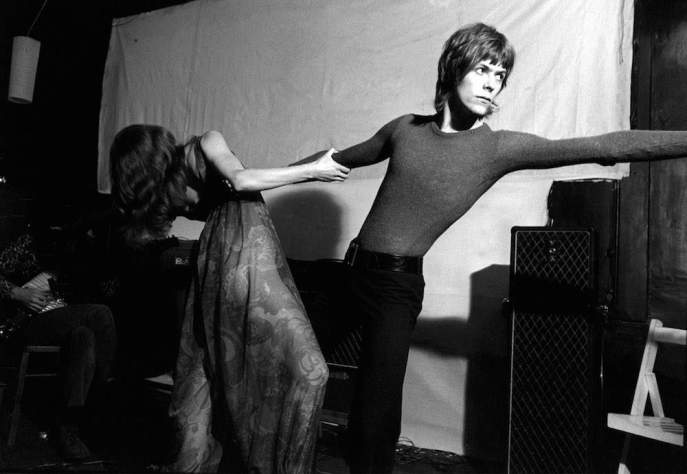
It’s late 1960’s and at No. 22 Clareville Grove, South Kensington, West London a frustrated David Bowie, in the company of his then young lover, budding actress Hermione Farthingale, is at his wits end struggling to complete the lyric for his new song, ‘Life on Mars’.
“What’s the problem Daveypoops? You’ve a face like Andy Warhol chewing a can of baked beans without his dentures in.”
“Oh, my little Hermit it’s all gone horribly wrong.”
“What has?”
“Well Hermlicalls, as you are well aware I’ve been engrossed attempting to knock out a swift one I’m dedicating to you yet I’m missing the crucial finishing touch.”
“Pardon?”
“A song, sweet Hermanology, a song. What did you think? Matters not. I have a song title, ‘Life on Mars’, I even have the music and all the other verses, it’s just this irksome conclusion to the first verse that’s holding me back.”
“Gosh…
View original post 450 more words
Antonio Berni: “Realismo social”.-
StandardAntonio Berni began in 1934 to show the social problems of the 30s.
Of that year are his works: Unemployed and Manifestation.
In Manifestation, the workers and their family ask for bread and work, in their eyes, there is no hate, there is no revenge, but there is anxiety. Painting gives a feeling of unity, of strength. The painter shows the terrible reality, but also the hope aspires to find the solution.
In Unemployed, the image of the boy in the foreground is highlighted. There is a resignation in the figures in the background. Someone is thoughtful, like the one in the red pullover, which very much resembles his self-portrait.-

Antonio Berni: “Realismo social”:
Antonio Berni comenzó en 1934 a mostrar la problemática social de la década del 30.
De ese año son sus obras: Desocupados y Manifestación.
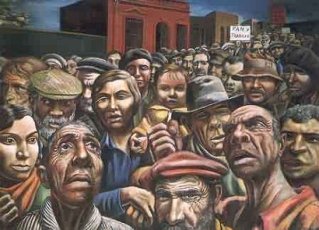
En Manifestación, los obreros y su familia piden pan y trabajo, en sus ojos no hay odio, no hay revancha, pero sí hay ansiedad. La pintura da sensación de unidad, de fuerza. El pintor muestra la terrible realidad, pero también la esperanza, aspira a que se encuentre la solución.

En Desocupados, se destaca la imagen del muchacho en un primer plano. Hay resignación en las figuras del fondo. Alguno está pensativo, como el del pullóver rojo, que mucho se parece a su autorretrato.-
__________________________________________________________________________________________________
Link: http://www.oni.escuelas.edu.ar/olimpi98/JuanitoyRamona/el3.htm
________________________________________________________________________________________________________________________
Antoni Gaudí: “Parc Güell”.-
StandardGaudí was an architect with an innate sense of geometry and volume, as well as a great imaginative capacity that allowed him to project mentally most of his works before moving them to plans. In fact, he rarely made detailed plans of his works, preferring to recreate them on three-dimensional models, moulding all the details as he thought of them; at other times, he would improvise on the fly, giving instructions to his collaborators about what they had to do. After a few beginnings influenced by neo-Gothic art, as well as certain orientalizing tendencies, Gaudí led to modernism in its heyday, between the late nineteenth and early twentieth centuries. However, Gaudí went beyond orthodox modernism, creating a personal style based on the observation of nature, the fruit of which was his use of regulated geometric forms, such as the hyperbolic paraboloid, the hyperboloid, the helicoid and the conoid.
_______________________________________________________________________________________________
Parc Güell: “The Project”:
Güell and Gaudí had in mind a project in the style of English garden cities (which is evident in the initial Park Güell spelling). Count Güell had experience with the English labour organization, as was reflected in his project of the working-class city of Colonia Güell, in Santa Coloma de Cervelló. Likewise, Güell was inspired by the garden areas in the Jardin de la Fontaine in the city of Nîmes, where he lived in his youth. Gaudí insisted on achieving a perfect integration of his works in nature. Proof of this are the columns made of stones of very variable sizes and shapes, suggesting trunks of trees, stalactites and natural caves. Right angles do not appear anywhere: the columns are slanted like palm trees.___________________________________________________________________________________________
______________________________________________________________________________________________________________
Parc Güell: “The Work”:
Designed by Antoni Gaudí I Cornet and built between 1900 and 1914. The commission for this project, which was to be aristocratic urbanization with single-family residences, was made to Gaudí by the Count of Güell. The project finally failed and consequently became the municipal property and since 1923 it has been transformed into a public park that is located in the upper part of Barcelona. The main entrance shows two administrative pavilions built in stone, Catalan vault roof and covered with “trencadis” (covering surfaces with irregular mosaic fragments, which was then widely used in Modernism).
Both roofs are crowned by original tiny domes that resemble the shape of a mushroom, the pavilion on the left also shows a stylized tower topped by a four-armed cross very typical of Gaudí. Entering the park we find a double staircase divided by a dragon before arriving at a hypostyle hall of considerable dimensions with 86 massive Doric columns that support the great plaza of the park. On the ceiling of this room, you can see coloured panels (drawing by Josep Maria Jujol). The aforementioned square is a beautiful balcony with views over Barcelona and the sea. The square is delimited by a wavy bench covered with trencadis. This wide square is used for cultural and popular holidays. The park is organized around this central square. The entire garden is connected with carriage roads or pedestrian paths, many of which are supported by inclined columns.
Antoni Gaudí: “Parc Güell”:
_________________________________________________________________________________________
A Propósito de Antoni Gaudí:
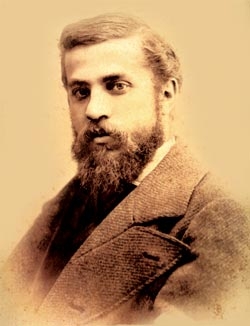
Antoni Gaudí i Cornet ( 1852 / 1926).-
Gaudí fue un arquitecto con un sentido innato de la geometría y el volumen, así como una gran capacidad imaginativa que le permitía proyectar mentalmente la mayoría de sus obras antes de pasarlas a planos. De hecho, pocas veces realizaba planos detallados de sus obras, prefería recrearlos sobre maquetas tridimensionales, moldeando todos los detalles según los iba ideando mentalmente; en otras ocasiones, iba improvisando sobre la marcha, dando instrucciones a sus colaboradores sobre lo que tenían que hacer. Después de unos inicios influenciado por el arte neogótico, así como ciertas tendencias orientalizantes, Gaudí desembocó en el modernismo en su época de mayor efervescencia, entre finales del siglo XIX y principios del XX. Sin embargo, Gaudí fue más allá del modernismo ortodoxo, creando un estilo personal basado en la observación de la naturaleza, fruto…
View original post 439 more words
 lampmagician
You must be logged in to post a comment.