Can an Artist do with politics?

Standard

It is a really interesting question; I’d answer: Yes!

As we might know and history would show us, it is so and it has been all the time. We are all involved with the social fact as we are living in the mass of public!

…The cause of human-being coming to exist, however, is not clear. The only clearness is that this form of existence seems not to be what was required to be. This would be a case to discuss about, if we made a general consideration of human behavior and the path of indulgence and trespass that he has gone through his chronicle, in a serious way. To make it possible, the undeniable hostility between mankind and nature in general (in the order that one’s life means the other’s death), seems to be a proper clue for getting into a process which began when the first ape, if ever, in quest for meat climbed down his home-tree, and while missing his body hair and the other animal means, his mutation began. But this, either because of his mental disability or gradual lack of all necessary outfits (strong instinct and proper quality of senses, claws, teeth and body-cover) should have gone as a chaotic beginning, where our poor descending predecessor had no way but to somehow regain his missing necessary strength for survival. And since there was no natural way remained for this recovery process, he began to manipulate as well as to imitate nature, or in other words, he commenced to run for an unnatural life. It is simple to conceive that an abrupt fear took the new creature totally up, so that he felt himself defenseless and naked in confrontation with his apparently brutal and cruel environment. This is most likely that another result could or even had to be obtained if this misfortune in Man’s initial touch with nature had not obstructed the process. And this is also possible that a project had once been planned to create a special and extraordinary species to be able to engender an intellectual kind of harmony among the natural parts and elements on this planet.

This is a part of a roman “The Season of Limbo” which, my brother Al wrote in the 90’s.

Of course, it isn’t the whole of the article but, as you should mention it; it is something social therefore political. I mean; as we all once decided to live safety together as a social community on this almost unfamiliar terrain, we have chosen the communion way of life and as the art in us, is the communion way of our expression only as an idea to make it better!

As I lived in Iran, the great Political Idols for me were the artists in countries like: In the south Americas, or and so on!

finally; long talk short sense, I think the artists are growing up in the very society as they live, therefore, their arts come from their soul and I think that is the main point; Creation by one’s soul.

truly, I found this article and the memories of those days in which we were fighting against the dictatorship of the Shah’s regime (it wasn’t so fur worst as it is now!) and these activities like; Neruda, Garcia Marques, Milan Kundera, Ernest Hemingway, even Shakespeare were all the political activist. We all are Artists, who are trying to make a reason for our beings.

http://www.openculture.com/2019/07/an-introduction-to-chilean-poet-pablo-neruda.html

An Introduction to Chilean Poet Pablo Neruda: Romantic, Radical & Revolutionary

Does politics belong in art? The question arouses heated debate about creative freedom and moral responsibility. Assumptions include the idea that politics cheapens film, music, or literature, or that political art should abandon traditional ideas about beauty and technique. As engaging as such discussions might be in the abstract, they mean little to nothing if they don’t account for artists who show us that choosing between politics and art can be as much a false dilemma as choosing between art and love.

In the work of writers as varied as William Blake, Muriel Rukeyser, James Baldwin, and James Joyce, for example, themes of protest, power, privilege, and poverty are inseparable from the sublimely erotic—all of them essential aspects of human experience, and hence, of literature. Foremost among such political artists stands Chilean poet Pablo Neruda, who—as the TED-Ed video above from Ilan Stavans informs us—was a romantic stylist, and also a fearless political activist and revolutionary.

Neruda won the Nobel Prize for Literature in 1971, and, among his many other literary accomplishments, he “rescued 2,000 refugees, spent three years in political exile, and ran for president of Chile.” Neruda used “straightforward language and everyday experience to create lasting impact.” He began his career writing odes and love poems filled with candid sexuality and sensuous description that resonated with readers around the world.

Neruda’s international fame led to a series of diplomatic posts, and he eventually landed in Spain, where he served as consul in the mid-1930s during the Spanish Civil War. He became a committed communist, and helped relocate hundreds of fleeing Spaniards to Chile. Neruda came to believe that “the work of art” is “inseparable from historical and political context,” writes author Salvatore Bizzarro, and he “felt that the belief that one could write solely for eternity was romantic posturing.”

Yet his lifelong devotion to “revolutionary ideals,” as Stavans says, did not undermine his devotion to poetry, nor did it blinker his writing with what we might call political correctness. Instead, Neruda became more expansive, taking on such subjects as the “entire history of Latin America” in his 1950 epic Canto General.

Neruda died of cancer just weeks after fascist dictator Augusto Pinochet seized power from elected president Salvador Allende in 1973. Today, he remains a beloved figure for activists, his lines “recited at protests and marches worldwide.” And he remains a literary giant, respected, admired, and adored worldwide for work in which he engaged the struggles of the people with the same passionate intensity and imaginative breadth he brought to personal poems of love, loss, and desire.

Related Content:

Pablo Neruda’s Historic First Reading in the US (1966)

Pablo Neruda’s Poem, “The Me Bird,” Becomes a Short, Beautifully Animated Film

The Lost Poems of Pablo Neruda: Help Bring Them to the English Speaking World for the First Time

Hear Pablo Neruda Read His Poetry In English For the First Time, Days Before His Nobel Prize Acceptance (1971)

Josh Jones is a writer and musician based in Durham, NC. Follow him at @jdmagness.
How worthy is Life?

Standard

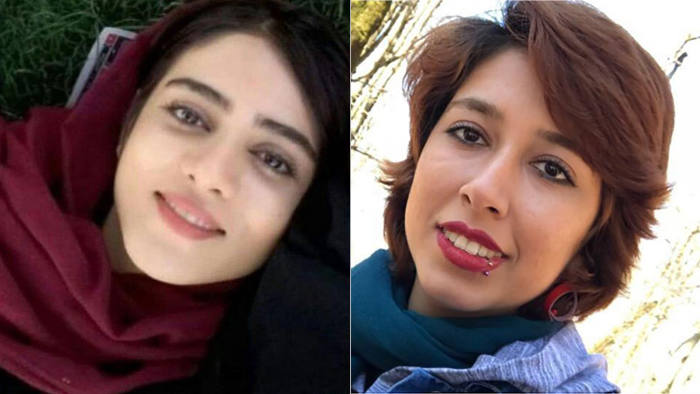
It is really an interesting question; I think that the answer is somehow relative! I said this because I have tasted the two different world to praise one’s life and it is different. The picture above is the girl or woman, who burned herself before the “Judge” because she disguised herself as masculine to get into the football stadium as in Iran the women are not allowed to watch the half-naked men!! It might be a laughingly easy joke for the world, but actually, I asked myself after shockingly read this news, how much worth is one’s life;

This question once become in my head when I left Iran, a so-called third world country, in Germany. There I’d see how life could be worthy.

In Iran we have taken it much easier when someone died, it sounded so naturally, but here in Germany, I mentioned that it isn’t!

Here, as C.G.Jung says; It is the point; We are all individual in a self-living insistence: Cogito, ergo sum as René Descartes had said;

This is an idea of thought, which isn’t current in the “Third words” The mass of people is the main thing and not their individuality.

Anyway, my wonder has begun with the self-burning of a Tunisian at the beginning of the “so-called Arabic Spring”! But that was; in my opinion, a radio in an almost hot situation which had brought almost nothing in the end.

at the end; long talk short sense; I think the life every individual is worthy, but unfortunately this girl’s life has been lost into an unworthiness. I hope her soul will be blessed by all goodness.

Sources;

https://www.ft.com/content/2e379f74-d499-11e9-8367-807ebd53ab77

https://www.bbc.com/news/world-middle-east-49646879

Amor Fati

Standard

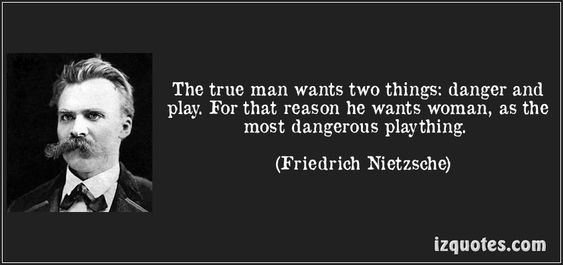
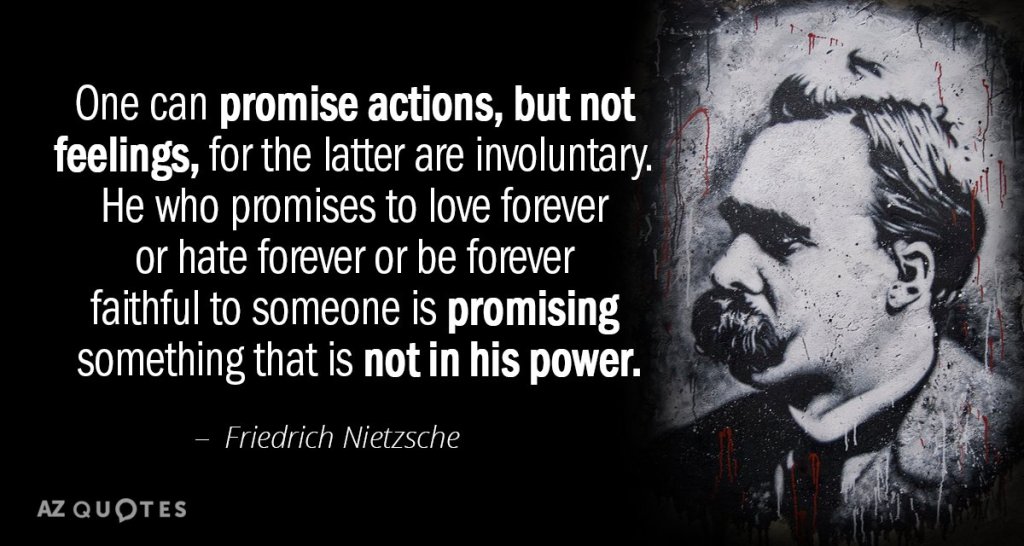
As I try to take the benefit of my golden Saturday, minute by minute, let me show my deeply feeling for this fascinating complex of the soul; Fredric Nietzsche. Stunningly, I’m knowing him again and again as a Macho, about at the beginning to an opened minded man as new!

the first record;

And the second record;

I fell in love with the philosophy as I might once write, was a book which I’ve got in hand from my brother named; The History of the Philosophy. Plato’s Socrates Socrates · ‎Republic (Plato) was not new for me but there were some new ones: Spinoza Baruch Spinoza was my first love, and it went further with Schopenhauer  Arthur Schopenhauer , Nietzsche  Friedrich Nietzsche , Kant Kant , Russel ‎Bertrand Russell, Sartre Sartre  etc.

To put it bluntly, I think that philosophy is the door to open the dark side of the soul, to recognize the self, to think: Cogito ergo sum;;

And the last but not least;

Here is a nice animation to introduce him in another line; Acceptance! The Acceptance is not to give up! 🙂 ❤

An Animated Introduction to Friedrich Nietzsche’s Philosophical Recipe for Getting Over the Sources of Regret, Disappointment and Suffering in Our Lives

By http://www.openculture.com/ in Philosophy | January 16th, 2018

The idea of acceptance has found much, well… acceptance in our therapeutic culture, by way of Elisabeth Kübler-Ross’ five stages of grief, 12-step programs, the wave of secular mindfulness practices, the body-acceptance movement, etc. All of these interventions into depressed, bereaved, guilt-ridden, and/or anxious states of mind have their own aims and methods, which sometimes overlap, sometimes do not. But what they all share, perhaps, for all the struggle involved, is a general sense of optimism about acceptance.

One cannot say this definitively about the Stoic idea of amor fati—the instruction to “love one’s fate”—though you might be persuaded to think otherwise if you google the term and come up with a couple dozen popularizations. Yes, there’s love in the name, but the fate we’re asked to embrace may just as well be painful and debilitating as pleasurable and uplifting. We cannot change what has happened to us, or much control what’s going to happen, so we might as well just get used to it, so to speak.

If this isn’t exactly optimism in the sense of “it gets better,” it isn’t entirely pessimism either. But it can become a grim and joyless fatalistic exercise. Yet, as Friedrich Nietzsche used the term—and he used it with much relish—amor fati means not only accepting loss, suffering, mistakes, addictions, appearances, or mental and emotional turbulence; it means accepting all of iteverything and everyone that causes both pain and pleasure, as Alain de Botton says above, “with strength and an all-embracing attitude that borders on a kind of enthusiastic affection.”

“I do not want to wage war against what is ugly,” he wrote in The Gay Science, “I do not want to accuse; I do not even want to accuse those who accuse.” Readers of Nietzsche may find themselves picking up any one of his books, including The Gay Science, to see him doing all of the above, constantly, on any random page. But his is never a systematic philosophy, but an expression of passion and attitude, inconsistent in its parts but, as a whole, surprisingly holistic. “My formula for greatness in a human being,” he writes in Ecce Homo, “is amor fati


That one wants nothing to be different, not forward, not backward, not in all eternity. Not merely bear what is necessary, still less conceal it… but love it.

Although the concept may remind us of Stoic philosophy, and is very often discussed in those terms, Nietzsche saw such thought—as he understood it—as gloomy, ascetic, and life-denying. His use of amor fati goes beyond mere resignation to something more radical, and very difficult for the human mind to stomach, to use a somewhat Nietzschean figure of speech. “It encompasses the whole of world history (including the most horrific episodes),” notes a Leiden University summary, “and Nietzsche’s own role in this history.” Above all, he desired, he wrote, to be a “Yes-sayer.”

Is amor fati a remedy for regret, dissatisfaction, the endlessly restless desire for social and self-improvement? Can it banish our agony over history’s nightmares and our personal records of failure? De Botton thinks so, but one never really knows with Nietzsche—his often satirical exaggerations can turn themselves inside out, becoming exactly the opposite of what we expect. Yet above all, what he always turns away from are absolute ideals; we should never take his amor fati as some kind of divine commandment. It works in dialectical relation to his more vigorous critical spirit, and should be applied with a situational and pragmatic eye. In this sense, amor fati can be seen as instrumental—a tool to bring us out of the paralysis of despair and condemnation and into an active realm, guided by a radically loving embrace of it all.