You thought you knew that abyss? It is another thing to experience it. Everything will happen to you. Think of all the frightful and devilish things that men have inflicted on their brothers. That should happen to you in your heart. Suffer it yourself through your own hand, and know that it is your own heinous and devilish hand that inflicts the suffering on you, but not your brother, who wrestles with his own devils.
— Carl Jung, The Red Book: A Reader’s Edition (Philemon)
🙏💖
It is very tempting to look at the cards of the Tarot, specifically those of the Major Arcana, as symbolic metaphors, or to put it in Jungian terms, as Archetypes/Archetypal Images. This is understandable; even in the oldest of decks, these cards seem to evoke deeper meanings.
However, sometimes a card might just be a card…
And sometimes, the truths they point to are more obvious than they might seem.
So while the dense symbolism of the astral cards in the Tarot can undergo radical re-imaginings, it probably behooves us to take a step back, and consider them for what they say they are: stellar objects. And while one can extrapolate layers of denser astrological symbolism, this too can be stripped back (not that I don’t ascribe them with deeper meanings myself).
The Tarot isn’t being subtle here: it presents us with three astral directives/directions:
I watch sunbeams dance on a turquoise sea
Alabaster clouds swirl round the golden sun
The sunlight warms and invigorates me
Watching tasseled shadows is so much fun.

Alabaster clouds swirl round the golden sun
Melting azure waves stretch out on the shore
Meandering warm sands, naked toes burn
On varnished sea shells, tales of ocean lore.

Melting azure waves stretch out on the shore
Lavender skies arch over beaming waves
On zephyr's back sunning themselves birds soar
In sun-lit sparkling seas fishes play.

Lavender skies arch over beaming waves
The sunlight warms and invigorates me
In sun-lit sparkling seas fishes play
I watch sunbeams dance on a turquoise sea.


#Pantoum
The pantoum is a poetic form derived from the pantun, a Malay form:specifically from the pantun berkait, a series of interwoven quartains.
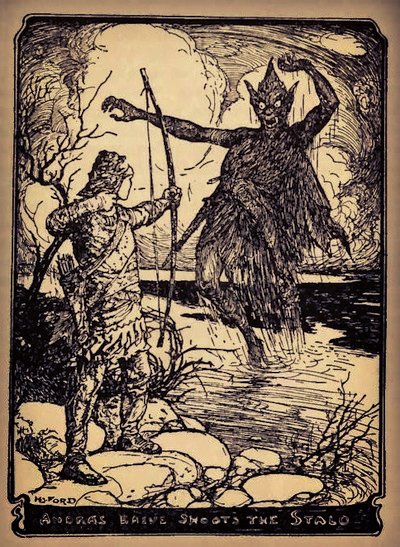
Andrew Lang wrote this Sámi tale in English in The Orange Fairy Book 1906.
Once upon a time there lived in Lapland a man who was so very strong and swift of foot that nobody in his native town of Vadso could come near him if they were running races in the summer evenings. The people of Vadso were very proud of their champion, and thought that there was no one like him in the world, till, by-and-by, it came to their ears that there dwelt among the mountains a Lapp, Andras Baive by name, who was said by his friends to be even stronger and swifter than the bailiff. Of course not a creature in Vadso believed that, and declared that if it made the mountaineers happier to talk such nonsense, why, let them!
The winter was long and cold, and the thoughts of the…
In the heat of the conflict between the Greeks and the Trojans, the Gods took sides. Hera, Queen of Olympians, and Athena, the Goddess of War and Wisdom, were still offended at having lost the Judgement of Paris, though Athena was worshiped by the Trojans – until Odysseus found a way to desecrate her Trojan temple. Aphrodite, having won over the young Trojan prince with the offer of Helen, stood on the side of Troy, even whisking Paris away from a vengeful Menelaus.
Apollo, offended by Agamemnon, sent a plague that afflicted the Greeks – in response, Agamemnon supplicated the God, but not without violating the honor of his most powerful ally, Achilles (this is actually how the Iliad opens).
Artemis, Apollo’s sister, is equally offended when the aforementioned Agamemnon kills a stag in her Sacred Grove. Agamemnon is forced to make a sacrifice – his daughter…
You know what?: I have enough of the Fu,,,ng stuff called; trademark!
As I remember, in the end of the 60’s I was about 17th years old and was one a few western companion of the “Hippy-time in that period, in which the Shah’s regime tried to keep the relationship to the west but in a controlled way.
in this situation, I got the moving in the west; Love. Peace, Freedom.
I had a hard way to look after it and also to fight against the mute people around. we were a few in those days but very powerful!
Anyway, I know this song by the C. S. N&Y and I get to know that it is written by another one. I really don’t care though, I am happy it is written by a woman ❤
So, in my opinion there is not the matter of who take the winner card. It is a wonderful song which described us all:
We are stardust, we are golden We are billion year old carbon And we got to get ourselves back to the garden
Among the slew of iconic late-60s acts who played Woodstock 50 years ago, one name stands out conspicuously for her absence: Joni Mitchell. Was she not invited? Did she decline? Was she double-booked? Mitchell was, of course, invited, and eagerly wanted to be there. The story of her non-appearance involves alarming headlines in The New York Times and an appearance on The Dick Cavett Show the day after the festival that her manager, Elliot Roberts and label head David Geffen, decided she simply couldn’t miss.
Her significant other at the time, Graham Nash, reached the upstate New York festival with CSNY, “by helicopter and a stolen truck hot-wired by Neil Young,” reports the site Nightflight. But Geffen and Mitchell, seeing the headline “400,000 People Sitting in Mud,” and a description of the roads as “so clogged with cars that concertgoers were abandoning them and walking,” decided they shouldn’t take the risk. (She described the scene as a “national disaster area.”) Instead, they watched news about the mud-splattered event from Geffen’s New York City apartment (other accounts say they holed up in the Plaza Hotel).
So how is it Mitchell came to write the definitive Woodstock anthem, with its era-defining lyric “we’ve got to get ourselves back the garden”? In the way of all artists—she watched, listened, and used her imagination to conjure a scene she only knew of secondhand. CSNY’s version of “Woodstock” (live, below, at Madison Square Garden in 2009) is the one we tend to hear most and remember, but Mitchell’s—her voice soaring high above her piano—best conveys the song’s sense of youthful hippie idealism, mystical wonder, and just a touch of desperation. (At the top, she plays the song live in Big Sur in 1969.) David Yaffe, author of Reckless Daughter: A Portrait of Joni Mitchell describes the song as “purgation. It is an omen that something very, very bad will happen with the mud dries and the hippies go home.”
Mitchell did make the Cavett Show gig, alongside Stephen Stills, David Crosby, and Jefferson Airplane, all just returning from the festival. But she didn’t have much to say. Instead, the gregarious Crosby does most of the talking, describing Woodstock as “incredible, probably the strangest thing that’s ever happened in the world.” Surveying the scene from a helicopter, he says, was like seeing “an encampment of a Macedonian army on a Greek hill crossed with the biggest batch of gypsies you ever saw.” Later on the show, Mitchell played “Chelsea Morning” and other songs, after performances by Jefferson Airplane.
“The deprivation of not being able to go,” she remembered, “provided me with an intense angle” on the festival. “Woodstock, for some reason, impressed me as being a modern miracle, like a modern-day fishes-and-loaves story. For a herd of people that large to cooperate so well, it was pretty remarkable and there was tremendous optimism. So I wrote the song ‘Woodstock’ out of these feelings, and the first three times I performed it in public, I burst into tears, because it brought back the intensity of the experience and was so moving.”
She did finally get the chance to play “Woodstock” at Woodstock, in 1998 (above, on electric guitar), for an appreciative long-haired, tie-dyed audience—many of them nostalgic for a moment they missed or were too young to have experienced. The performance highlights the “sense of longing that became essential to the song’s impact,” as Leah Rosenzweig writes at Vinyl Me, Please. “Sure, it was the irony of the century”: the song that best captured Woodstock for the people who weren’t there was written by someone who wasn’t there. “But it was also a perfect recipe for Mitchell to do what she did best: draw humans together while remaining completely on the sidelines.”



 lampmagician
You must be logged in to post a comment.