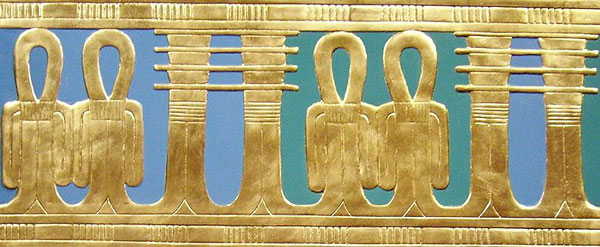
Tyt Amulet (The Divine Knot of Isis)

Standard

Tyt! Another mystical sign of the Goddess Isis. A beautiful, magical amulet of life.

The Tjet (Tyet, Tet, Tit, Tat, That, Thet) is also commonly known as the Isis knot or Isis girdle. Some commentators have argued that the symbol was originally a variant of the Ankh also here. It has a similar appearance (except its “arms” are bent downwards) and could also have a similar meaning, sometimes being translated as “life”. As a hieroglyph, it represented the Tjet amulet.

Decoration detail: tomb of prince Khaemwaset, son of Ramses III, in the Queens Valley, Luxor West Bank, Egypt
agefotostock

This divine presence was dedicated to Khâemouaset, as we read the story here, thanks to Marie Grillot. 🙏💖

A “Tyt” Amulet of Khâemouaset, son of Ramses II

via égyptophile

Amulet Tyt (knot of Isis) from Khâemouaset – red jasper – New Kingdom – 19th dynasty
Discovered on his mummy, in 1851, in the “small underground” of the Serapeum in Saqqara by Auguste Mariette
Department of Egyptian Antiquities of the Louvre Museum – E 2990 B – inventory number: N 759
entered the collections in 1853 by “acquisition sharing after excavations” – photo © 1996 Musée du Louvre / Christian Larrieu

This Tyt, or “knot of Isis” amulet, 7.3 cm high and 3 cm wide, is finely worked in red jasper. The column of hieroglyphs that it bears indicates the name of the deceased to whom it is dedicated: “The great (or the superior) of the craftsmen, the priest-sem (and) son of the king, Khaemouaset”.

Born of Queen Isis-Nofret, Khâemouaset was the fourth son of Ramses II. If he is immortalized near his father on battle scenes in the sovereign’s temples, he will not be destined for a military career. Indeed, by a “paternal” decision – motivated by “political” reasons – he will be appointed to the pontificate of Ptah in Memphis. Thus he will begin very early “his priestly career with the god,” which was mainly for Ramses II “an excellent way to monitor closely and in complete confidence the power of the great theological centres whose riches were also recorded throughout the reign. ” (Christian Leblanc, “Ramses II and the Ramesseum”).
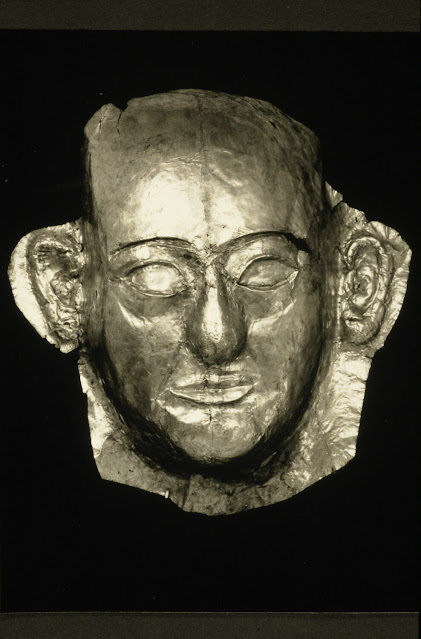
Funerary mask of Prince Khâemouaset – gold – New Kingdom – 19th dynasty

Discovered on his mummy, in 1851, in the “small underground” of the Serapeum in Saqqara by Auguste Mariette

Department of Egyptian Antiquities of the Louvre Museum – E 2291 – photo©1990 Louvre Museum/Christian Larrieu

This prince, who became the high priest of Ptah, left the memory of an intelligent and erudite man. “The main originality of Khâemouaset was his extraordinary taste for ancient things. He had the monuments of the Old Kingdom restored at Saqqara, Giza and Abusir”… Among his many actions and reforms, he “modified the mode of burial of bulls Apis at the Serapeum” (Christophe Barbotin, Elisabeth David “The ABCdary of Ramses II”).

It is there, precisely in the “small underground passages”, that Auguste Mariette will discover his tomb by chance, in 1851, among the tombs of the Apis… “it could be that the mummy from which I collected the remains, instead to be that of an Apis, was that of Prince Kha-em-uas himself. Imagine a mummy of human form, destroyed in all its lower parts from the chest. A thick mask of gold covered the face. Around the neck were passed two chains of gold, from one of which three amulets were suspended….” This is one of them… Until now, Egyptologists remain perplexed about this place of burial of the prince because it is not certain that his first tomb was in another place, which would mean that the location where Auguste Mariette found these remains in disorder would rather correspond to a reburial that occurred later. The excavations to be undertaken by the Louvre Museum in this part of the Serapeum may help to solve this enigma.

Amulet Tyt (knot of Isis) from Khâemouaset – red jasper – New Kingdom – 19th dynasty

Discovered on his mummy, in 1851, in the “small underground” of the Serapeum in Saqqara by Auguste Mariette

Department of Egyptian Antiquities of the Louvre Museum – E 2990 B – inventory number: N 759

entered the collections in 1853 by “acquisition sharing after excavations” – photo © 1996 Musée du Louvre / Christian Larrieu

In “The precious stones of Pharaonic Egypt, the example of the jewels of the Serapeum of Memphis”, Christiane Ziegler thus presents the amulets “Tyt” (“knot of Isis”) whose existence is attested from the Old Kingdom: “In red stone, they often carry an engraved text, in connection with the blood of the goddess Isis. They are in connection with the myth of Osiris, assassinated, then dismembered by his brother Seth, and whose members gathered by his wife Isis will then be reanimated thanks to her magic power”.

Amulet Tyt (knot of Isis) from Khâemouaset – red jasper – New Kingdom – 19th dynasty

Discovered on his mummy, in 1851, in the “small underground” of the Serapeum in Saqqara by Auguste Mariette

Department of Egyptian Antiquities of the Louvre Museum – E 2990 B – inventory number: N 759 (entered the collections in 1853, by “acquisition sharing after excavations” – photo © 1996 Louvre Museum / Christian Larrieu

published here in Auguste Mariette “Le Sérapéum de Memphis”

Its appearance is difficult to describe, but in “Ancient Egypt and its gods”, Jean-Pierre Corteggiani manages to give this rather evocative image of it: “It has the shape of an ansée cross whose two lateral branches would be flattened loops falling on either side of the vertical branch”. And he recalls that, in the Book of the Dead, the ‘Formula for the Knot-Tyt’ recommends threading it on a thread of sycamore fibre, then placing it around the neck of the mummy on the day of the burial: thus adorned, the deceased is assured, by virtue of the words to be pronounced, that “the magic power of Isis will be the protection of his body”.

This “Knot of Isis” by Khâemouaset entered the Department of Egyptian Antiquities of the Louvre Museum in 1853 by “acquisition sharing after excavations” under the main number: E 2990 B (inventory number: N 759)…

Marie Grillot

Sources:

Amulet of Khâemouaset https://collections.louvre.fr/ark:/53355/cl010008595

Paul Pierret, Catalog of the Historic Room of the Egyptian Gallery, Paris, 1882, p. 128, No. 539.

Auguste Mariette, The Serapeum of Memphis, Paris, Gide, 1857, p. 15, pl. 20.

Christian Leblanc, Ramses II and the Ramesseum, L’Harmattan, Paris, 2019.

Gods, tombs, a scholar. In Egypt in the footsteps of Mariette Pacha, Boulogne-sur-Mer (External, France), Château-musée, 10/05/2004 – 30/08/2004.

Christophe Barbotin, Elisabeth David, The ABCdary of Ramses II, Flammarion, Paris, 1997.

Christiane Ziegler, The precious stones of Pharaonic Egypt, the example of the jewels of the Serapeum of Memphis, in Bulletin of the National Society of Antiquaries of France, 1996, 1999, pp. 244-251

Jean-Pierre Corteggiani, Ancient Egypt and its gods, Paris, 2007.

Isabelle Franco, Dictionary of Egyptian Mythology, Paris, 2013.

EEN KORTE TRIP NAAR HET LAND VAN DE FIETSEN.

Standard

A Short Trip to the Land of Bicycles. P. 2

Bergen aan Zee + Amsterdam (Van Gogh)

I thought to share my second post with not many words but more illustrated, as the first one was long sayings! Another reason is my better half; my active wife wants to kidnap me again to visit her sister in a small town near Kassel, Germany. Therefore, let’s have a look at the rest of our shivering journey.

The place is one of the rare hilly areas in the almost flat land of Holland. That’s why is known as Bergen (Hills or mountains).

I was once lucky to take a few shots; I thought they were unique somehow.








And finally, we tried one day to drive to Amsterdam. Actually, to see a lot of things, but once you are in the world of Vincent van Gogh, you forget all other items!

And for all the famous flowers:

One thing only bothers me is that I didn’t see the famous “Starry Night”; either it wasn’t there that I couldn’t believe it, or I blindly missed it. Then, let’s listen to the beautiful song by Don McLean.

Have a lovely weekend everybuddies. 🤗🥰🦋💖🌞

Clear Definition!

Standard

How Honest is the One with his/her own Soul?

Small and hidden is the door that leads inward, and the entrance is barred by countless prejudices, mistaken assumptions, and fears. ~Carl Jung, CW 10, Page 154.

Thx; Lewis Lafontaine

wheel-of-life
Tour Travel Tibet

As a young man, I knew something about the sensual rituals of India and the Far East but only in passing. But when I broke away from Islam and tried to be an atheist for a short time, I got to know Buddha, which was the best thing that could have happened to me; Philosophical, spiritual welfare with logic!

Later, I learned much more when I began to play on the stage and had to practice Yoga. We had a young teacher (he wasn’t so young as I first thought, he had just succeeded in getting no wrinkles on his face! He later said that this all comes from being aware of the feelings and their effects on one’s outward appearance; always relax!). He explained why we must know Yoga when we want to be an actor: On the stage, he said you must not get out of breath. And with the help of practising it, we can know our bodies which on the stage is very important. I have learned a lot from him, and it still helps me even though on the stage of life.

Anyway, with all this knowings, I came to the West. That was the middle of the 80s, when Bagwan, or Bhagwan Shree Rajneesh with his movement, was highly influential. The first young people (primarily women) whom my brother and I met in Cologne, where we lived for a few years, were all his followers. I don’t want to tell much about this, though it looked to me those days it could be an excellent business for earning more money! These are actually harmless. What surprised me was the way of use or misuse in learning or, much more to say, teaching eastern wisdom. First, it happened when my wife (girlfriend those days) got pregnant and decided to give birth to our child in a yogi way.

She told me that in a small town near our city, there is a maternity clinic, and they do it with the eastern method; Yoga and birth in the bathtub. I happily agreed because I knew it from Iran as some yogis friends were doing it often. After a while, she told me that the chief doctor also teaches Yoga if I’d like to participate there. I went along, maybe not to learn but to check how it might go. It was disappointing! There were no inner feelings, rather more like sporty training. Getting to know the body was not the point, but getting sweaty! I broke it up and went outside.

Interestingly, the doctor wasn’t surprised or curious to know why I did so but looked at me as a spy from the East to find out what kind of fraud he was. Years later, she tried in different groups to practice Yoga; even a newly arrived couple from India led the latest one. But every time she came back from Yoga, she was excited and sometimes even with sore muscles! As I’ve learned, there had to be something wrong with understanding yoga in this country.

Now, if you are still there and are not bored, here are some words by Dr Jung about this issue and some explanations. I love this humble honesty from such a great man.

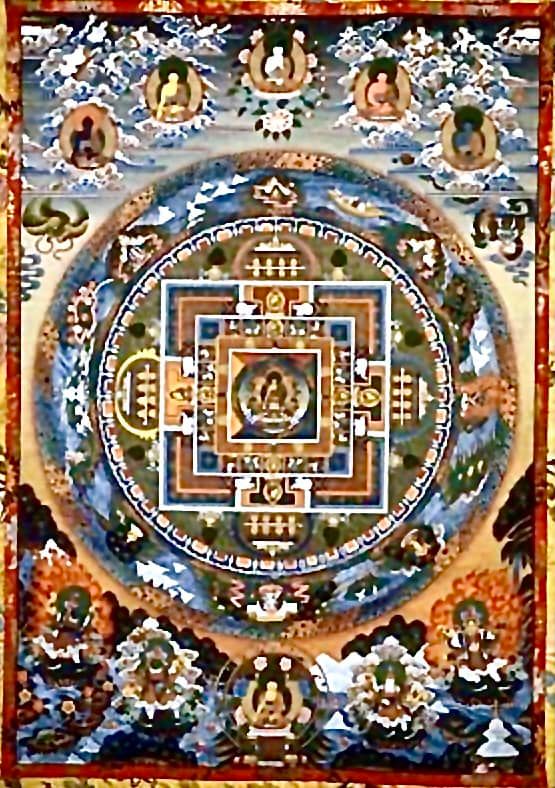
In his explanation, Dr Jung writes in his book; Dream and Dream Interpretation about Mandalas and their meaning in comparison between the East and the West, which he got the chance; (as he wrote): in 1938, he had an opportunity to meet and speak with a lamaistic Rinpoche, named Lingdam Gomchen in a Monastery of Bhutia Busty (near Darjeeling) about the Mandala (Khilkor). He explained it as a “dmigs-pa” (pronounced migpa), a mental picture (imago mentalis) which can only be constructed by imagination by a trained lama. No mandala is like the other; they are individually different. Also, the mandalas you see in monasteries and temples have no special meaning since they are only external representations. The true mandala is always an inner image, which is gradually constructed by (active) imagination when a disturbance of mental balance or thought cannot be found and must therefore be sought because it is not included in the sacred doctrine.

And further;

There are some texts, such as Shri-Chakra-Sambhara-Tantra,(²), which contain instructions for making the “mental image”. The “khilkor” is strictly separated from the “sidpe-korlo”, the wheel of the world, representing the course of human existence according to the Buddhist view. In contrast to the “khilkor”, the wheel of life consists of a ternary system, namely the rooster = lust, the snake = hate or envy, and the pig = ignorance or unconsciousness (avidya). Here we throw out the dilemma of three and four, which also play a role in Buddhism. We will reencounter this problem as the Dream Series progresses.

(²) The Serpent Power, hrsg. From Avalon, 1919.

मंडलः “circle.”
With heartfelt thanks to Petra Glimmdall

Mandala

The mandalas in their cultic use are of great importance, as their centre usually contains a figure of the highest religious value: either Shiva himself, more often embracing the Shakti, or Buddha, Amitabha, Avalokiteshvara, or one of the great Mahăyăna teachers, or also simply the Dorje, the symbol of all the gathered divine powers of a creative and destructive nature. The text of the “Golden Flower“, which originates from Taoist syncretism, also specifies special “alchemical” properties of this centre in the sense of the “lapis” qualities and those of the “elixir vitae”, i.e. a pharmakon Athanasia.

Knowing this high rating is not insignificant; for it accords with the central meaning of the Individual Mandala Symbols, which possess the same qualities, so to speak, of a “metaphysical” nature – implying, if we are not mistaken, a psychic personality centre which is not identical with the “I”. I have observed these processes and formations for twenty years on a relatively large amount of empirical material. I have neither written nor lectured about it for fourteen years so as not to bias my observations. But when Richard Wilhelm presented me with the “Golden Flower” text in 1929, I decided to publish at least a hint of the results of my observations. One can’t be too careful about these things; because the instinct to imitate, on the one hand, and almost morbid greed, on the other hand, to seize someone else’s feathers and dress up with them in an exotic way tempts all too many people to take up such “magical” motifs and to use them externally like an ointment.

Although this article might be getting longer, I would like to add his simple explanation (or complaint, appeal?) on society and how one must endure all these.

 “recognition of the shadow is reason enough for humility, for genuine fear of the abysmal depths in man” (CW 14: par. 452)

Dr Jung; was a Man of Knowledge, although with Awareness of his Humility.

You do everything, even the most absurd, to escape from your own Soul. One practices Indian Yoga of any observance, observes dietary laws, learns theosophy by heart, prays mystical texts from all of world literature – everything because one does not get along with oneself and lacks any belief that anything worthwhile could come from one’s own Soul. So, gradually the Soul has become that Nazareth from which nothing good can reach, which is why one fetches it from all four winds: the further back and the more unusual, the better. I don’t want to disturb such people in their favourite activities; Still, if someone who wants to be taken seriously, and also is just as delusional and thinks that I use yoga methods and yoga teachings, and possibly have let mandalas drawn to lead my patients to the “right point”, then I have to protest and accuse these people of reading my writings with an almost culpable inattention. The teaching that all evil thoughts come from the heart and that the human Soul is the vessel of all evil must be deeply rooted in these people. If that were the case, then a god would have done a sad job of creation, and then it would really be high time to switch to Markion, the Gnostic, and give the incompetent Demiurge the jolt. However, it is ethically exceedingly convenient to leave the sole care of such an idiot children’s home to God, where no one can put the spoon in their own mouth. Man is worth taking care of himself and has in his own Soul from which something can become. (wie Meister Eckhart sagt; „ez ist zemale inne, niht uze, sunder allez inne“ {Deutsche Mystiker, hrsg, von Pfeiffer, 1845/57, Bd, 2, S. 8,37.} (As I could understand Meister Eckhart’s saying so far, it means: It is all one inner, not ours but all internal one.)

It is worth patiently observing what is happening in the Soul in silence; the most and the best happens if it is not regulated from outside and above. I’ll gladly admit it: I have such high regard for what happens in the human Soul that I would shy away from disturbing and creating the quiet workings of nature with clumsy access. That’s why in this case, I even gave up my own observation and entrusted this task to a beginner who was not burdened by my knowledge, just so as not to disturb. The results I present are the pure, conscientious, and accurate introspection of a man of undeterred intellect who never wanted to show off and not be boasted about. True connoisseurs of psychic materials will therefore see without difficulty the unity and immediacy of the results.

From Traum und Traumdeutung (Dream and Dream interpretation), The dream symbol the individuation process; Mandalasymbolic.

Thanks for your interest. 🙏💖🤗🙏

Somebody Up There Likes Me!

Standard

Although the title is from a classic film from 1956, I thought it fits here with my story. Honestly, I wasn’t sure if I ever could tell this story; it may be because of my idiotic behaviour at that moment. But today, as I accompany the Earth’s rotation around the sun for sixty-eighth times, and with the help of a few sips of my favourite whiskey, I gather the courage to do it.

This story is about a miracle! Do you believe in miracles? I do, as I have experienced it throughout my life several times. I don’t want to tell them all, just an example: it happened in my school days; I was circa eleven or twelve years old. One day, I had forgotten to bring my school assignment, which I had to give the teacher in the afternoon. It was still early in the morning that I noticed it was missing. Therefore, during the break in class, I ran home (about less than one Km) to get it, but nobody was at home. My mother was out at work, and I hadn’t the key to get in. I tried with every window may one could be open with no success. I just stood there in the yard and began to pray! Suddenly I heard a noise; I looked up and saw a window opening mysteriously, and I could get in. I really don’t know what happened, but I could get back to the school with my papers.

Now I will tell you the new one; it happened some weeks ago, on a hot summer day when I was at work (driving my taxi), and it was a lot of orders to carry out. I have to mention that on this day I wanted to visit the bank and throw some money into my account and early in the morning before I began to work, as I was in a hurry, I took all my papers (inc. saving book and all the cash) which I always keep together in a packet, and pushed them in my fanny bag. It was around midday that I needed terribly to jump on any toilet, and as I was in a hotel taking some bags for transporting, I asked for the bathrooms.

Anyway, long story short, I did my job and hurriedly came along to continue my work. Several hours later in the afternoon, I was taking a customer to the train station as I thought I had a pause after this and I could get to the bank that suddenly I noticed I had no fanny bag on my belly! I was shocked; it looked like a nightmare. I told myself; just keep calm and think about where I left it. The answer came soon: in the hotel’s damn toilet. I immediately called my colleague who knew the employees in the hotel to ask them if they had found the bag, and I continued working. He called me back to say that no bag was found!

I am lost! I thought I had to get to the hotel personally to search for it. But there was still a lot to do. The only way for me was to keep calm and concentrated, not cause an accident until to get a chance to drive there. This period was, for me, very exhausting.

Various thoughts were passing through my mind. I was becoming angrier and angrier at myself; why the hell I wasn’t careful when I knew I had so many worthy things inside it? I tried to remember what could be in the bag and noticed that it was all I had; every vital piece of paper man could need to live in this bureaucratic world! Don’t lose your hope, I said. I remember through my many years working, I have found twice such a big briefcase full of money and gave them to the police to find the owner, and thought; I had to be redeemed then! I’ve called all the ghosts, including my brother Al, my father, and my mother; please, help me!

In the late evening, when I finished working, I drove to the hotel. The hotelier told me sadly that nothing had been found. I might convince myself. I looked everywhere and even asked the cleaning service who couldn’t speak German! But nothing. It is lost, I said to myself. What an idiot finds a bag full of money and gives it back? And I drove to the bank to block my account. But it wasn’t so easy! I had to call the emergency to secure my account. I have tried three times but strangely without success. I gave it up and drove home. But before I got out of the car rang my phone; it was the hotelier, saying I have the fanny bag; I think it is yours; I’ll look inside it if I am allowed. There are a lot of things in it; I think it is yours!! Allegedly someone had seen it in the toilet, took it, and left it on the counter behind a plate.
Then I thought, There is somebody up there who likes me!

Music, Art, Beauty of Divine in Ancient Egypt.

Standard

In ancient times, the lotus flower was significant in their religion. Meaning creation and rebirth symbolised the sun because at nightfall, it closes and goes beneath the water, and at dawn, it climbs up above the water and reopens. And for Egyptians, the lotus represented rebirth.

On the other hand, the Egyptians were very musicians (especially women) and music lovers. Therefore, when we add something intoxicating like wine with the colour blue, it would be a perfect ceremony! Indeed, the beauties of nature have some undeniable connection to each other, and here is no exception.

The blue lotus flower looks almost fan-like across many images found in tomb paintings, papyrus scrolls, sculptures, and even headdresses.
It has also been revealed that they (lotus flowers) can produce heavy intoxication when steeped in wine. This explains the bottles wrapped in the flowers painted into scenes. Over three days or so, the wine’s chemical make-up is changed by the flowers brewing it. The wine is then drunk, and the benefits are experienced!
Psy Minds

Now, let’s see what we have here: A beautiful musician, music and an open lotus in a blue wine jar. It couldn’t be better! With heartfelt thanks to Marie Grillot for introducing this precious find.

A lute player… in a wine cup…

via Egyptophile

Cup with a lute player – earthenware with black design – Reign of Amenhotep III
Rijksmuseum van Oudheden, Leiden, AD 14
by acquisition from the Giovanni Anastasi Collection, 1828 – museum photo

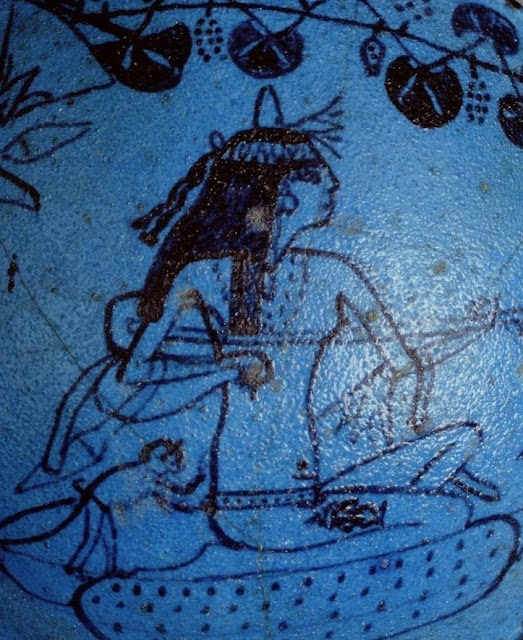
This delicate blue earthenware cup, 4.5 cm high and 14 cm in diameter, tells a story… which can be interpreted according to one’s sensibilities…

In 1840, Conradus Leemans saw in it, laconically, “the image of a woman kneeling in a cradle and playing the guitar “… But, looking more closely at this fine and harmonious drawing traced in black, one can “read” a lot more about the character, its environment and the induced symbolism…

This lute player appears faithful to the representations of some of her colleagues found on the walls of Theban tombs…

She is sitting on her right leg folded under her, while the left is slightly raised. Her nudity reveals her slender body, the tip of a breast, the delicate curve of the hips, and the hollow of the navel. A lovely belt – probably of pearls – girds her waist, hiding the top of the pubis.

Beneath her right arm, positioned behind her, is the sound box of her lute. The long handle of the instrument, which is adorned with two ties ending in elegant pendants that intersect, is held horizontally by her left arm. The hands represented somewhat schematically are thus free to move on the strings and play the melody… There is a delicious detail: in the hollow of each elbow is a lotus stem, in button on one side, in bloom on the other…

Cup with a lute player – earthenware with black design – Reign of Amenhotep III
Rijksmuseum van Oudheden, Leiden, AD 14
by acquisition from the Giovanni Anastasi Collection, 1828 – museum photo

The musician reveals a beautiful profile, typically Egyptian, illuminated by a stretched eye surrounded by kohol. Her tripartite wig of heavy black hair is adorned with a floral headband. It is held by two wavy ties that seem to float at the back of her head, while in front, near the ointment cone, an open lotus flourishes.

Her hair reveals an earring and, around her neck, hangs a necklace with two rows of pearls…

On her thigh, we notice a tattoo in the image of the god Bès. This bearded and grotesque dwarf, revered for his protective role, notably knew how to appease evil spirits with his music, playing the harp or the tambourine while sketching a dance step…

Behind her, leaning forward towards her lower back, a small monkey, as charming as it is amusing, seems to want to grab her belt…

The large and soft cushion on which she is seated occupies the lower part of the bowl. They leave from both sides by opening out, on the whole, the circumference of the vegetable stems that end up joining. This lush vegetation thus gives the impression that the musician is placed under an arbour… For Arielle P. Kozloff (Amenophis III, the sun pharaoh): “The scene is framed by two poles ending in a lotus on one side and by a papyrus on the other”. For the Rijksmuseum van Oudheden in Leiden, where the cup is exhibited under the reference AD ​​14, “the young girl is seated under an arbour with bunches of grapes”.

Cup with a lute player – earthenware with black design – Reign of Amenhotep III
Rijksmuseum van Oudheden, Leiden, AD 14
by acquisition from the Giovanni Anastasi Collection, 1828

Thus, for the RMO, this particular environment combined with “the presence of the mischievous monkey faithful companion of Bès, as well as the image of Bès, who was also the god of drunkenness, indicate that the bowl was intended to drink wine “…

Therefore, the “Festive” context for this artefact dated from the reign of Amenhotep III and, more precisely – according to Arielle P. Kozloff – from the end, as specific details of the female anatomy suggest: “The elongated torso, the very slight sagging of his flank and the fold under the umbilicus “…

If no information is known on its “antique” provenance, we know that, at the beginning of the 19th century, this cup ended up in the hands of Giovanni Anastasi. According to the “Who Was Who in Egyptology”, he was then: “one of the essential merchants in Egypt, acting as Swedish-Norwegian consul-general in Egypt, 1828-57; in addition to his commercial activities, he carried on an extensive trade in antiquities, employing agents to buy from inhabitants of Saqqara and Thebes; He sold a large collection of 5,600 coins to the Dutch Government in 1828 for 230,000 francs; another was sold in London at the British Museum in 1839, and a third (1129 lots) was auctioned in Paris from June 23 to 27, 1857”.

This is how, since 1828, the pretty musician has charmed visitors to the Rijksmuseum van Oudheden in Leiden…

Marie Grillot

Sources:

Cup with lute player https://www.rmo.nl/en/collection/search-collection/?term=&department=&object=&period=&material=&place=&inventory=AD+14

Reasoned description of the Egyptian monuments [sic] of the Museum of Antiquities of the Netherlands in Leiden by Conradus Leemans, Rijksmuseum van Oudheden te Leiden – Publication date 1840 – Publisher HW Hazenberg – European Collection libraries – (n° 118) https://archive.org/stream/descriptionrais00leidgoog/descriptionrais00leidgoog_djvu.txt

Arielle P. Kozloff, Amenophis III, the sun pharaoh, RMM, 1993

Sibylle Emerit, Music and Musicians https://www.academia.edu/4888251/Music_and_Musicians

Kate Bosse-Griffiths, Two Lute-Players of the Amarna Era, The Journal of Egyptian Archaeology, Vol. 66 (1980), p. 70-82 https://www.jstor.org/stable/3856391

Who Was Who in Egyptology, Bierbier, M., London: Egypt Exploration Society

The Purpose of Imitation (Society)

Standard
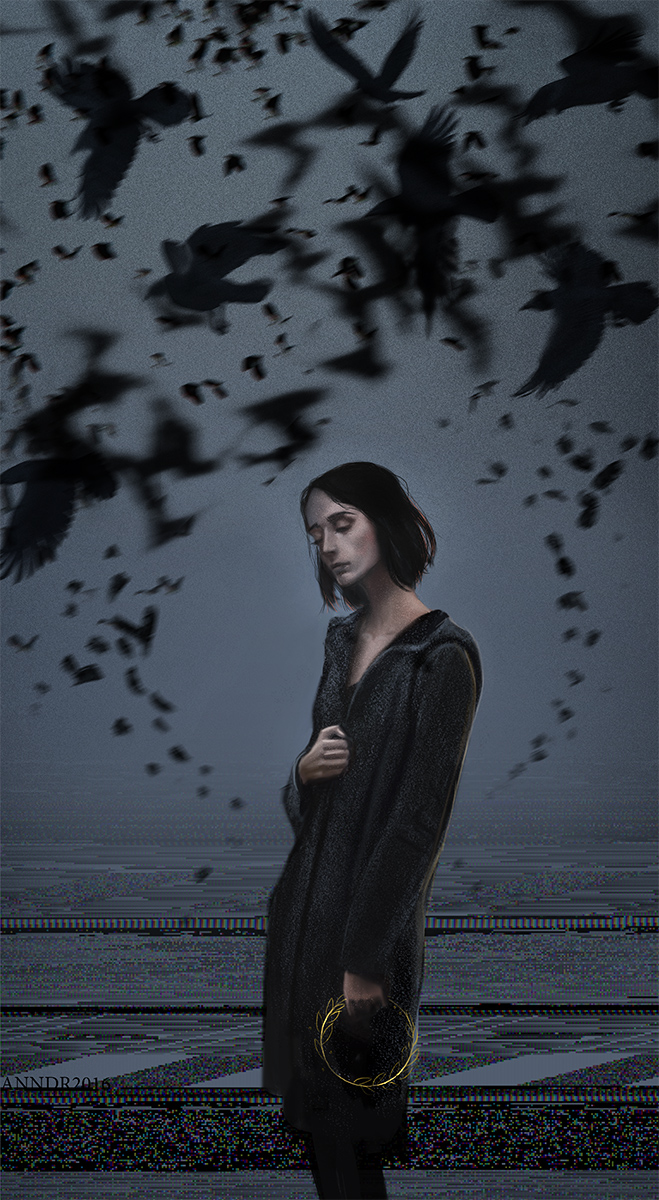
imitation by anndr on DeviantArt
deviantart.com

Prologue!
You might wonder that I write about and from Dr Jung so often. I read many of his books nowadays, and every time I look back on my own experiences, I find similarities and many examples among his explanations, and I see that I can learn a lot. Hopefully, for a good reason, I think it might help you too if you consider your life with these issues.🙏✌💖 So, let’s begin:

I understand very well what Dr Jung is talking about here below about imitation, the importance of this is evident. Still, the abuse of it in the way of mass control, or lack of personality characteristics, forces one to imitate someone else rather than find own individuation. Honestly, I was once an imitator (that’s why maybe, I became a good actor!) Of course, after puberty, I reached my inner person and discovered the individuum; my talent remained. I could imitate many prominent people and become famous at family parties. 😉

I was born and lived in a country where the individuum lacked (it is always much easier to let others decide!). After that, when I came to the free world and felt the individuum in (some) people, my conclusion was that freedom and education cause individuality.
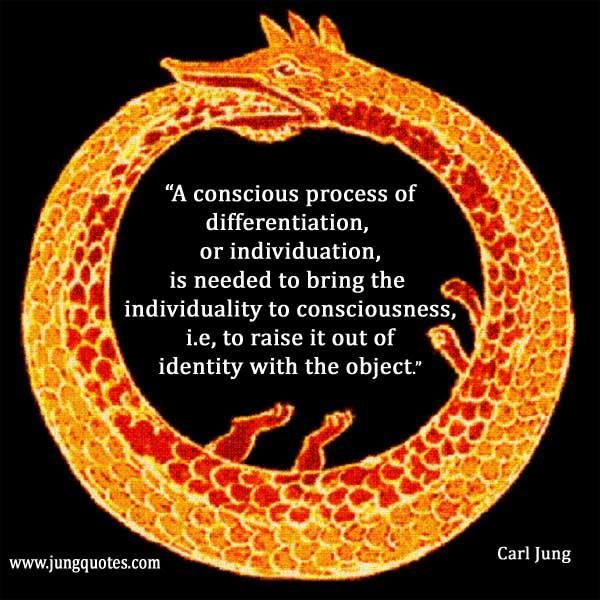
Individuation is to divest of false wrapping. C. Jung

I might quote from my brother’s book: The Limbo; When humans (Homosapiens) climbed down the tree and lost their sharp teeth and nails, have got afraid. They got confused and lost their individuality and soul. Therefore, they built society so as not to feel left alone. I think humans had begun to fear their own selves. And preferred to get lost in the mass!

Here’s a piece of his book on this topic. (the consequence of the assimilation of the conscious, from; The Relationship btw I and unconscious.)

(Hu)Man has one faculty which is most useful for the collective purpose and most harmful for the individual, and that is imitation. Social psychology cannot do without imitation, for without it, mass organisations, the state, and the social order are simply impossible; After all, it is not the law that makes the social order, but imitation, in which concept suggestibility, suggestion and spiritual contagion are also included. But we also see every day how the mechanism of imitation is used, or rather abused, for the purpose of personal differentiation: To do this, one simply imitates an outstanding personality or a rare quality or activity, whereby a differentiation from the immediate environment of external relationships comes about. As a punishment for this – one might almost say – the similarity with the spirit of the surroundings, which nevertheless exists, increases an unconscious, compulsive attachment to it. Usually, the attempt at individual differentiation, falsified by imitation, gets bogged down in the pose. Yet, the human being remains only a few degrees more sterile than before at the stage at which one was. To discover what is actually individual in us requires thorough reflection, and we suddenly become aware of how tough it is to discover individuality.

May the force be with you all. 🤗🦋💖

Een Korte Trip Naar het land van de Fietsen.

Standard

A Short Trip to the Land of Bicycles. P. 1 😜

Bergen aan Zee

Let’s now behold a view of that short escape into the windy North Sea but beautiful landscape. I admit I’m a complete summer lover, and since I don’t have enough of it in Germany, I’d like to enjoy it on vacation. Of course, our purse had a hunger strike this year and didn’t want to fulfil our wishes. Therefore, we decided to get into the neighbour Holland. (Even though it wasn’t as cheaper as one might wish!)

I like Holland and the Dutch people, as I might mention before. Although this time, the aim was not to play some dumb things but to ride bicycles to make something good for the body. However, I have to confess that I was unsure a bit if I could get on the bike without panic! I hadn’t ridden any for more than fifteen years, and it’s a long time. But, as we know, In this case, learning is learned! I have had no problem; I rode like a master from the first minute.

The bulge below my stomach is my fanny pack, nothing else. 😁😉

Anyway, we rode for three days, about a hundred kilometres (well, we are not the youngest anymore!). It was very windy sometimes, though it was not the problem, the wind just was too cold. Indeed we were lucky that the weather was not getting worse; it didn’t rain so much, just about one evening, and we had two days of sunny (almost) warm temperature.




And the architecture is fascinating;

Daar ga je en bedankt! 🙏🥰 Of course, this must have a second part with some nice pics, including Mr Vincent van Gogh. ✌💖

Das Böse ( The Evil) The Temptation.

Standard
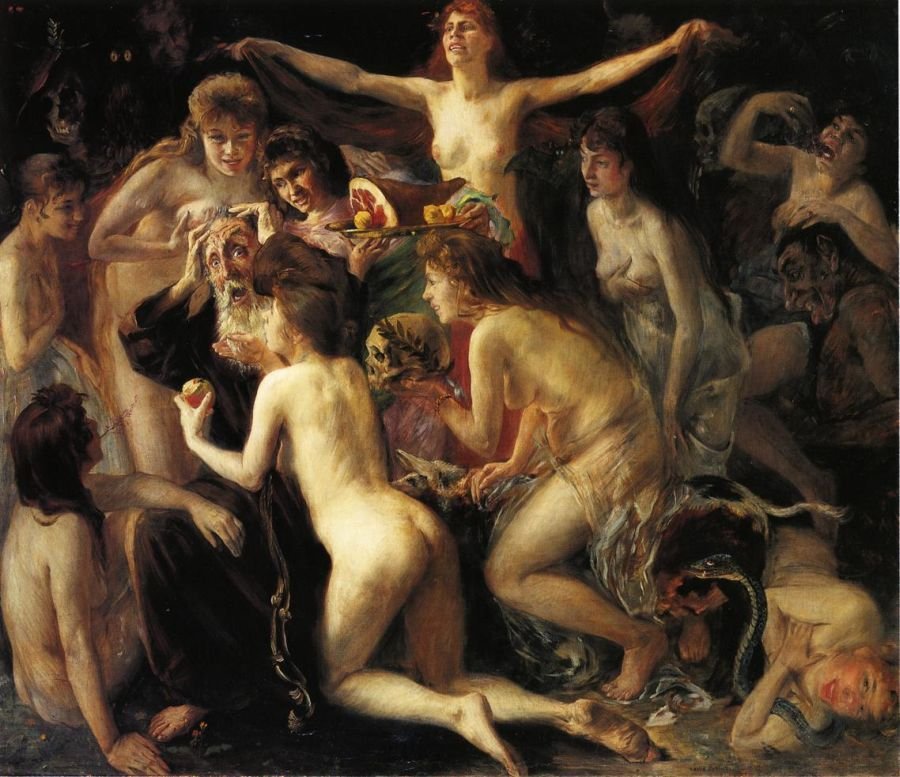
Lovis Corinth    La Tentation de St Antoine

You dread the depths; it should horrify you since the way of what is to come leads through it. You must endure the temptation of fear and doubt and, at the same time, acknowledge to the bone that your fear is justified and your doubt is reasonable. How otherwise / could it be a true temptation and a true overcome?
Christ totally overcomes the temptation of evil, but not the temptation of God to good and reason. Christ thus succumbs to cursing.
You still have to learn this, to succumb to no temptation, but to do everything of your own will; then, you will be free and beyond Christianity.

Carl Jung; The Red Book: On The Service Of The Soul, P. 139 -Lieber Primus fol. ii{v}

The “Double Birth”

Standard

Happy Birthday, Dr Jung.

Saint Anna, Virgin and Child
By Leonardo da Vinci
Wikipedia

The double birth signifies that motif known from hero mythology, which allows the hero to descend from the divine and human parents. The motif plays a significant role in mysteries and religions as a motif for baptism or rebirth. This motif also led Freud to make a mistake in his study A Childhood Memoir of Leonardo da Vinci in 1910. Without realising that Leonardo is by no means the only one who painted the motif of St. Anne Selbdritt (Saint Anna, Virgin and Child), he attempts for Anna and Mary, namely grandmother and mother, to be reduced to Leonardo’s mother and stepmother, i. H., to assimilate the image to his theory. Did the other painters all have stepmothers too? What prompted Freud to commit this violence was evidently the fantasy of dual descent suggested by Leonardo’s biography. Fantasy painted over the incongruous reality that St. Anna is the grandmother and prevented Freud himself from researching the biography of other artists who also dealt with St. Anna Selbdritt. The author himself has confirmed the “religious inhibition” mentioned on p. 17. The theory of incest that has been so strongly emphasised is also based on an archetype, the well-known incest motif often encountered in heroic myths. It derives logically from the original hermaphrodite type, which seems to go back far into primitive times. Whenever a psychological theory proceeds somewhat violently, there is a reasonable suspicion that an archetypal fantasy image is trying to distort reality, which would correspond to the Freudian concept of “religious thought inhibition”. Explaining the origin of the archetypes with the incest theory would be just as fruitful as if you scooped water out of a kettle into another vessel standing next to it, but which was connected to the kettle by the pipes. One cannot explain one archetype by another, i.e. one cannot explain at all where the archetype comes from because there is no Archimedean point outside these a priori conditions.

Carl Jung: Archetypen

Über den Archetypus mit besonderer Berücksichtigung des Animabegriffes 1936 [Fußnote S. 89] (On the Archetype with Special Consideration of the Anima Concept 1936) [footnote p. 89]

Anima and Animus

Standard

Anima and Animus; The commonality in us!


This topic might still sound strange, unfamiliar, or even unacceptable (especially to men), but I think it is one of the most important issues in our existence.
I come from a society where religion is dominant, meaning the man has the saying! Although, in big Iranian cities, men have learned (thanks Pahlavi regime) that women also have the right to live with their wishes. Nevertheless, man has always the end in his hands! These thoughts also influenced me though I was curious to understand the feminine side.
I remember well, as Al and I were often in the bookstores in southern Tehran, once I got a thick book in my hand titled: All That Men Know About Women. And when I leafed through that, I saw all the pages blanc white!
Maybe from that time, I have decided to try to understand this “opposite?”. Honestly, I had learned a lot from my mother and her female side. She taught me how to cook, sew or any other typical woman’s housework. And I tell you, men: I am thrilled and proud of having this opportunity (freedom😉 ). Through my research, I learned that understanding the woman could only be possible through looking into my own feminine. When my mother died, I kept her lessons in my mind and heart, and I could do all jobs by myself. And I admit my pride in my whole life, having so many ladies as friends (more than gents), both in so-called visual and real life. When I got to know Dr Jung, he confirmed me and my feelings. I expanded my knowledge and have learned much more about this.

Now I present (translated from German by my littleness) a part of Jung’s book: [Die Beziehungen Zwischen Dem Ich Und Dem Unbewussten]; Die Individuation, Anima und Animus. He explains here how effective is for men to consider their Anima sides.

“The parent spirits are the most practical of the possible spirits, hence the universal cult of ancestors, which initially served to appease the ‘revenants’ but later became an essentially moral and educational institution (China!). Parents are the child’s closest and most influential relatives. In adulthood, however, this influence is split off; therefore, the parent imagines are possibly even more repressed from consciousness and, because of their after-effects, perhaps even suppressing effect, are easily given a negative sign. In this way, the Parent-Imagines remain alien in a psychic ‘outside’. But what now replaces the parents as a direct environmental influence for the grown man is the woman. She accompanies the man; she belongs insofar as she lives with him and is more or less of the same age; she is not superior, either by age, authority, or physical strength. It is, however, an influential factor that, like the parents, produces an imago of a relatively autonomous nature, but not an imago which, like that of the parents, is to be split off but rather to be kept associated with consciousness. With her psychology so dissimilar to man’s, the woman is (and always has been) a source of information about things man has no eyes for. She can inspire him; Her power of foreboding, often superior to that of men, can give him a helpful warning. And her feeling, which is oriented toward the personal, can show him ways in which his feeling with little emotional connection would not be discoverable. What Tacitus says about the Germanic women is quite accurate in this respect.”

{According to Tacitus, Germanic women do not participate in feasts or plays, unlike Roman women. However, it is unlikely they were excluded from this since it was part of the women’s job to serve the men at the table. More here.}

Here undoubtedly lies one of the primary sources of the feminine quality of the soul. But it doesn’t seem to be the only source, for no man is so entirely male that he has nothing female in him. Instead, the fact is that very masculine men in particular (albeit well protected and hidden) have a very soft emotional life (often wrongly referred to as “feminine”). It is considered a virtue for a man to repress feminine traits as much as possible, just as it has been deemed unpalatable to a woman, at least up to now, to be a man’s wife. The repression of female traits and tendencies naturally leads to an accumulation of these claims in the unconscious. The imago of the woman (the soul) also naturally becomes the receptaculum of these claims, which is why the man in his choice of love is often subject to the temptation to win that woman who best corresponds to the special nature of his own unconscious femininity, also, a woman who can absorb the projection of his soul as easily as possible. Although such a choice is often viewed and felt to be ideal, it may just as well be his own worst weakness that the man is visibly marrying in this way. (This might explain some very odd marriages!)

It now seems to me that besides the woman’s influence, there is also the man’s own femininity, which explains the fact of the femininity of the soul complex. It shouldn’t be a question of a mere linguistic “accident”, for example, in the way that the sun is feminine in German but masculine in other languages, but we have the evidence of art from all times – and moreover, the famous question: “habet mulier anime”? (does a woman have a soul?). Probably most men, who have any psychological insight at all, know what Rider Haggard means when he speaks of ‘She-who-must-be-obeyed’ or which chord strikes them when they read Benoit‘s description of Antinea. They also tend to easily know what kind of woman best embodies this secret, but often only a clearly suspected fact.”

I think here it is enough for now, but there is more about that later for sure. Be well and safe, everybody. 🙏💖🌹✌🥰🦋