

Ancient Egyptian history is undeniably captivating, and exploring it with a hint of femininity makes it even more alluring.
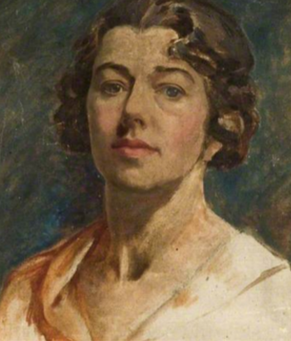
Myrtle Florence Broome (22 February 1888 – 27 January 1978) was a British Egyptologist and artist renowned for her illustrated collaboration with Amice Calverley on the Temple of Seti I at Abydos, as well as her paintings that captured the essence of Egyptian village life during the 1920s and 1930s. She was born on 22 February 1888 in Muswell Hill, London, to Eleanor Slater and Washington Herbert Broome. Broome studied art at a school in Bushey founded by Sir Hubert von Herkomer. From 1911 to 1913, she attended University College London, where she earned a Certificate in Egyptology under the guidance of Sir Flinders Petrie and Margaret Murray.
I was pleasantly surprised to come across this old post from the égyptophile site, and am excited to share this beautiful story about two women and their love for ancient Egyptian magic with you.

Therefore, I included the slogan of the Iranian women’s and men’s revolution, #WomanLifeFreedom, in this post, as it symbolises not only the struggle for freedom in Iran but also resonates worldwide.
By Marie Grillot, with my sincere thanks.
Myrtle Florence Broome, Egyptologist and… artist
via égyptophile

London, February 22, 1888 – Bushey, January 27, 1978 – Self-portrait on the right
and, on the left, a copy of her extraordinary work at Abydos:
“King Sethos receives life and dominion from the goddess Saosis” (detail)
Along with Nina de Garis Davies, Marcelle Baud, and Amice Calverley, Myrtle Florence Broome is undoubtedly one of the most gifted copyists to have worked in Egypt during the first half of the 20th century.
Myrtle was born in London’s Muswell Hill neighbourhood on February 22, 1888, into a family of music book publishers. However, it was in Bushey, Hertfordshire, that she spent much of her life, and it was there that she studied at the Beaux-Arts, developing her talents for drawing and painting.
In 1911, she joined University College London, where she studied Egyptology under the guidance of two eminent professors, Flinders Petrie and Margaret Murray, who would become the first female Egyptologists.
During the two years of classes taught by Margaret Murray, what she ironically called “the gang” was formed: it included Myrtle Broome, Guy and Winfried Brunton, Reginald (Rex) Engelbach, and Georginan Aitken, all of whom went on to have distinguished careers in Egyptology (Rex would become curator of the Cairo Museum of Antiquities).
Margaret Murray’s influence on Myrtle was undoubtedly significant, and it seems likely that she encouraged her to develop and exploit her artistic talents professionally.

In 1927, Myrtle was at the Qau el-Kebir site, where she conducted epigraphic surveys of Middle Kingdom tombs and copied their scenes.
In 1929, she was recruited by the Egypt Exploration Society and joined Amice Calverley at Abydos. This marked the beginning of a fruitful, beautiful, and enriching collaboration that would culminate in a deep and lasting friendship.
They will spend eight seasons together, eight excellent seasons in the temple and the Osereion. The task is complex, and the concentration is extreme because recording the scenes requires very particular attention, with no room left for personal interpretation. All this in rather “primitive” working conditions, sometimes perched on ladders more than 10 m above the ground and in often oppressive heat! The Abydos team is very quickly enriched by a Canadian Egyptologist and an Austrian photographer who also do excellent work, while good humour reigns.
James Henry Breasted was at a loss for words to praise their talent and admitted that it seemed impossible to find more expert and brilliant women.
The result was published in four volumes edited between 1933 and 1958 by the Egypt Exploration Society of London and the Oriental Institute of the University of Chicago, with the financial support of John D. Rockefeller Jr. A remarkable work, of unparalleled quality, and—but?—so beautiful that it remained, in a way, almost confidential for fear of damaging the plates!
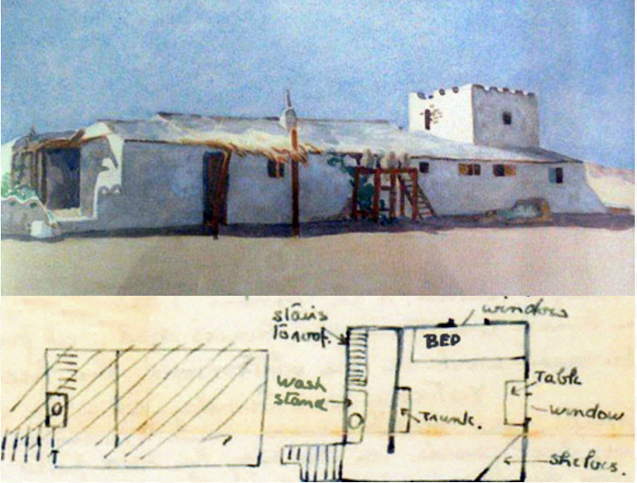
The time spent in Abydos was undoubtedly one of the happiest periods of Myrtle’s life. In the small, low-rise house she lived in—and which we can see in one of her paintings—she had: “a housekeeper whom she nicknamed Nannie and a villager, called Sadiq, who served as her advisor, bodyguard, and personal assistant. Life was frugal, however, and Myrtle took great care not to exceed their allotted budget.”
Accompanied by Sadiq, Amice, and Myrtle, they took several short trips in Amice’s car to the Red Sea, Kharga, and Dakhla. Myrtle’s paintings vividly depict the desert’s colours, with shades of pink, brown, and subtle hints of golden beige.

(c) Bushey Museum and Art Gallery; Supplied by The Public Catalogue Foundation
We feel that she loved these landscapes infinitely, that she was imbued with their colours and their light. One of her paintings is particularly touching and gives a beautiful idea of what their escapades must have been like: we see Amice sitting on a mat, near her car, taking notes in the middle of the desert! We must put ourselves in context: these two women were adventurers and pioneers!

from the Temple of Seti I at Abydos”
Their joint mission to Abydos ended due to World War II, but they remained close until Amice’s death in April 1959.
During these seasons away from home, Myrtle wrote many letters to her family; they constitute a beautiful testimony to her life, her perspective on things, and her way of sharing them. Some of her correspondence has been deposited at the Griffith Institute in Oxford.

From Egypt, she brought back not only paintings, but also photographs from which one can only realise that, in addition to her immense talents and her incredible intelligence, she was also a charming woman. Her very successful self-portrait confirms this, showing us a regular face with a certain nobility in its bearing and an expressive, frank gaze. Of her love life, we know little except for a barely sketched romance with a policeman, which she immediately renounced, convinced that “in any case, it could not have worked.”
Upon her return to England in 1937, she apparently devoted herself entirely to her parents, and especially to her ailing father…
Myrtle “passed away” on January 27, 1978… And suppose you still want to know more about this artist. In that case, you can consult her archives on the Griffith Institute website or refer to the book, published in November 2020 by AUC Press: “An Artist in Abydos: The Life and Letters of Myrtle Broome” by Lee Young, with a preface by Peter Lacovara.

Sources :
M.L. Bierbrier, editor, “Who Was Who in Egyptology”, third revised edition, London, 1995. Calverley, Amice Mary (1896-1959)”
“Obituary notice: Myrtle Florence Broome (1887-1978)”, by John Ruffle
“The Temple of King Sethos I at Abydos copied by Amice M. Calverley, with the Assistance of Myrtle F. Broome and edited by Alan H. Gardiner”, London: The Egypt Exploration Society; Chicago: University of Chicago Press, 1933-58, Vols. 1-4
“The Life of Margaret Alice Murray: A Woman’s Work in Archaeology”, Kathleen L. Sheppard
“Amice Calverley”, Journal of Egyptian Archaeology 45 (1959),85-87, Janet Leveson-Gower
Collection Broome MSS – Myrtle Florence Broome Collection https://archive.griffith.ox.ac.uk/index.php/broome-correspondence
“An Artist in Abydos, The Life And Letters Of Myrtle Broome”, by Lee Young, Foreword By Peter Lacovara, AUC Press, November 2020, 248 p.
 lampmagician
Brilliant and very educational! Thank you for posting this!
LikeLiked by 1 person
I’ve really enjoyed it myself. Thank you. 😊
LikeLiked by 1 person
Thank you for sharing this post and the beautiful images.
I always learn so much from you: I didn’t know this British egyptologist and artist.
LikeLiked by 1 person
Honestly, that surprised me, too. Thank you, dear Luisa. 🤗🙏❤️
LikeLiked by 1 person
You’re more than welcome, as always, my dear friend
🌹🙏🌹
LikeLiked by 1 person
This is a wonderful post, Aladin. Thank you for introducing me to these 2 women. They were important pioneers.
Myrtle’s paintings are outstanding, masterpieces. I’d love to see them in reallife.
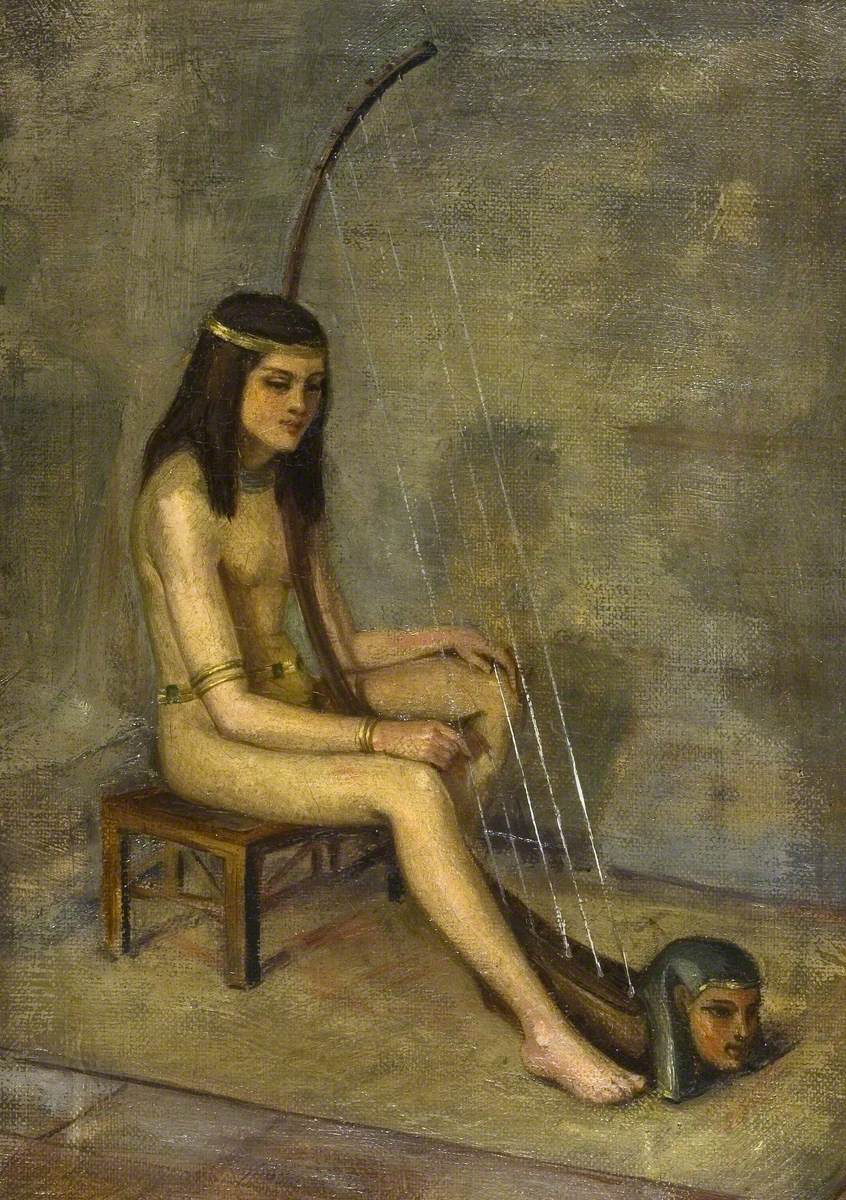
Girl with a Harp captivates me.
Again, love this and thank you!
💓🌟👍✌️🤗💓
LikeLiked by 2 people
I, myself, got excited when I read it and looked for their paintings.
Your joy brightened my day; thank you, my friend. 🤗🤗💖🙏🥰
LikeLiked by 1 person
Welcome, and thank you back to you!Art is elevating!
xo💖🙏🥰
LikeLiked by 1 person