

One of the most beautiful and sensitive tales ever written for children by one of the most sensitive authors in the world: Oscar Wilde. He was definitely different from others: unpredictable!
I’ve been coming across Oscar Wilde’s literary works and fairy tales quite often lately. I am pleased to present a captivating excerpt from one of their beautiful tales. The Selfish Giant; chapter three.

“Who hath dared to wound thee?” cried the Giant; “tell me that I may take my big sword and slay him.”
“Nay!” answered the child, “but these are the wounds of Love.”
“Who art thou?” said the Giant, and a strange awe fell on him, and he knelt before the little child.
And the child smiled at the Giant and said to him, “You let me play once in your garden; today, you shall come with me to my garden, which is Paradise.”
And when the children ran in that afternoon, they found the Giant lying dead under the tree, all covered with white blossoms.
Would you like to tackle the entire third chapter? Here it is, enjoy.
“The Selfish Giant”, Oscar Wilde
Then the Spring came, and all over the country, there were little blossoms and little birds. Only in the garden of the Selfish Giant, it was still Winter. The birds did not care to sing in it as there were no children, and the trees forgot to blossom. Once a beautiful flower put its head out from the grass, but when it saw the notice board, it was so sorry for the children that it slipped back into the ground again and went off to sleep. The only people who were pleased were the Snow and the Frost. “Spring has forgotten this garden,” they cried, “so we will live here all year round.” The Snow covered the grass with her great white cloak, and the Frost painted all the trees silver. Then they invited the North Wind to stay with them, and he came. He was wrapped in furs, and he roared all day about the garden and blew the chimney pots down. “This is a delightful spot,” he said, “we must ask the Hail on a visit.” So the Hail came. Every day for three hours, he rattled on the roof of the castle till he broke most of the slates, and then he ran round and round the garden as fast as he could go. He was dressed in grey, and his breath was like ice.
“I cannot understand why the Spring is so late in coming,” said the Selfish Giant as he sat at the window and looked out at his cold white garden; “I hope there will be a change in the weather.”

But the Spring never came, nor the Summer. The Autumn gave golden fruit to every garden, but to the Giant’s garden, she gave none. “He is too selfish,” she said. So it was always Winter there, and the North Wind, and the Hail, and the Frost, and the Snow danced about through the trees.
One morning the Giant was lying awake in bed when he heard some lovely music. It sounded so sweet to his ears that he thought it must be the King’s musicians passing by. It was really only a little linnet singing outside his window, but it was so long since he had heard a bird sing in his garden that it seemed to him to be the most beautiful music in the world. Then the Hail stopped dancing over his head, and the North Wind ceased roaring, and a delicious perfume came to him through the open casement. “I believe the Spring has come at last,” said the Giant, and he jumped out of bed and looked out.
What did he see?
He saw a most wonderful sight. Through a little hole in the wall, the children had crept in, and they were sitting in the branches of the trees. In every tree that he could see, there was a little child. And the trees were so glad to have the children back again that they had covered themselves with blossoms and were waving their arms gently above the children’s heads. The birds were flying about and twittering with delight, and the flowers were looking up through the green grass and laughing. It was a lovely scene; only in one corner, it was still Winter. It was the farthest corner of the garden, and in it was standing a little boy. He was so small that he could not reach up to the branches of the tree, and he was wandering all around it, crying bitterly. The poor tree was still quite covered with Frost and Snow, and the North Wind was blowing and roaring above it. “Climb up! Little boy,” said the Tree, and it bent its branches down as low as it could; but the boy was too tiny.
And the Giant’s heart melted as he looked out. “How selfish I have been!” he said; “now I know why the Spring would not come here. I will put that poor little boy on the top of the tree, and then I will knock down the wall, and my garden shall be the children’s playground forever and ever.” He was really very sorry for what he had done.
So he crept downstairs and opened the front door quite softly, and went out into the garden. But when the children saw him, they were so frightened that they all ran away, and the garden became Winter again. Only the little boy did not run, for his eyes were so full of tears that he did not see the Giant coming. And the Giant stole up behind him, took him gently in his hand, and put him up into the tree. And the tree broke at once into blossom, and the birds came and sang on it, and the little boy stretched out his two arms and flung them round the Giant’s neck, and kissed him. And the other children, when they saw that the Giant was no longer wicked, came running back, and the Spring came with them. “It is your garden now, little children,” said the Giant, and he took a great axe and knocked down the wall. And when the people were going to market at twelve o’clock, they found the Giant playing with the children in the most beautiful garden they had ever seen.
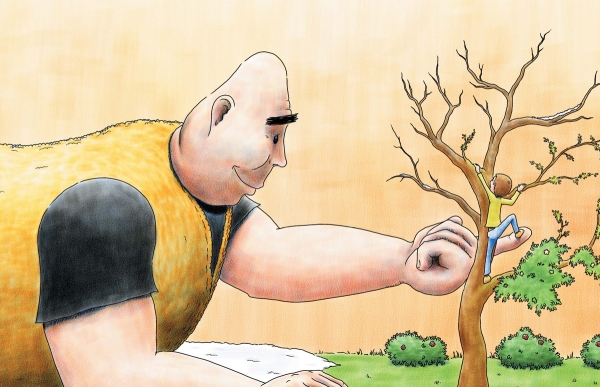
All day long, they played, and in the evening, they came to the Giant to bid him goodbye.
“But where is your little companion?” he said: “the boy I put into the tree.” The Giant loved him the best because he had kissed him.
“We don’t know,” answered the children; “he has gone away.”
“You must tell him to be sure and come here tomorrow,” said the Giant. But the children said they did not know where he lived and had never seen him before, and the Giant felt very sad.
Every afternoon, when school was over, the children came and played with the Giant. But the little boy whom the Giant loved was never seen again. The Giant was very kind to all the children, yet he longed for his first little friend and often spoke of him. “How I would like to see him!” he used to say.
Years went over, and the Giant grew very old and feeble. He could not play about any more, so he sat in a huge armchair, watched the children at their games, and admired his garden. “I have many beautiful flowers,” he said, “but the children are the most beautiful flowers of all.”
One winter morning, he looked out his window as he dressed. He did not hate the Winter now, for he knew it was merely the Spring asleep and the flowers were resting.
Suddenly he rubbed his eyes in wonder and looked and looked. It certainly was a marvellous sight. In the farthest corner of the garden was a tree entirely covered with lovely white blossoms. Its branches were all golden, and silver fruit hung down from them, and underneath it stood the little boy he had loved.
Downstairs ran the Giant in great joy and out into the garden. He hastened across the grass and came near to the child. And when he came pretty close, his face grew red with anger, and he said, “Who hath dared to wound thee?” For on the palms of the child’s hands were the prints of two nails, and the prints of two were on the little feet.
“Who hath dared to wound thee?” cried the Giant; “tell me that I may take my big sword and slay him.”
“Nay!” answered the child, “but these are the wounds of Love.”
“Who art thou?” said the Giant, and a strange awe fell on him, and he knelt before the little child.
And the child smiled at the Giant and said to him, “You let me play once in your garden; today, you shall come with me to my garden, which is Paradise.”
And when the children ran in that afternoon, they found the Giant lying dead under the tree, all covered with white blossoms.
 lampmagician
Oh, Aladin, that was such a beautiful tale! Thank you so much for sharing it and opening the eyes of my heart! Whatever you’re doing this weekend, hope you have a wonderful time! Love and light, Deborah.
LikeLiked by 1 person
The eyes of your heart are always open, my feeling tells me. And it is true; the tales are fascinating—blessing, sister. 🙏💖
LikeLiked by 1 person
I absolutely adore his chidlren’s stories. Wonderful post.
LikeLiked by 1 person
So do I, my lovely lady. Thank you… xxxx
LikeLiked by 1 person
I’d get positively teary Still got my old battered copy here.
LikeLiked by 1 person
You are my lovely Lady. xxxx
LikeLiked by 1 person
What a beautiful story. I didn’t know that Oscar Wilde wrote fairy tales. Thank you for sharing it, Aladin.
>
LikeLiked by 1 person
You made my day, dear Jeane. He is an extraordinary man. Thank you.💖🙏👍
LikeLike
Surprised by this ending since it was Oscar Wilde. Thanks. Have not read any of his fairy tales.
LikeLiked by 1 person
I thank you so much for your visit. It is much appreciated. 🙏
LikeLike
🖤
LikeLiked by 1 person
🤗🙏
LikeLike
It’s a fabulous children’s story.
I remember that when I went to read it in a primary school, on the occasion of an invitation to read day, all the children were fascinated
LikeLiked by 2 people
Wow! That’s a wonderful idea. You made it, my lovely Luisa. 🤙💖🙏😘
LikeLiked by 1 person
Thanks a lot, dearest Aladin, for your kind reply 💙
LikeLiked by 1 person
You are most welcome 😘😘💖
LikeLiked by 1 person
Sweetness. Good for me and good for your grandchildren. Thank you.
LikeLiked by 1 person
That’s it, though I have to translate it into German! 😉🙏💖
LikeLiked by 1 person
I will enjoy reading this! Thank you. I had the pleasure of visiting Wilde’s childhood home, in Dublin. I will share highlights from that visit soon. 😊
LikeLiked by 1 person
That will be great. Thank you, beautiful lady. 🙏🤗❤️
LikeLiked by 1 person
You are welcome. Thank you! 😊
LikeLiked by 1 person
Such a beautiful story Aladin, thank you for sharing it here 🙏😊
LikeLike
I totally enjoyed that tale.
I’d not heard it before, had no idea he wrote children’s stories.
I only know his book “The Picture of Dorian Grey”.
Although I had good school grades in grammar (years ago), when I wanted to do some writing I did a free course from a university to brush up.
Somewhere in that, it referred to Oscar Wilde’s writing as a prime example of proper grammar.
Now, when I have a grammar question, I find an example of the answer in the only book of his that I own; “The Picture of Dorian Grey”.
LikeLiked by 1 person
Great book, and I’ve also seen a well-made movie. He’s an extraordinary person, and your choice was brilliant. Thank you, my lovely lady. 💖🙏🌹
LikeLiked by 1 person
Welcome and thank you!!! 💖🙏💖🙏🌹🌹
LikeLiked by 1 person
Thank you for being and to Michele for giving me the link. I adore Oscar Wilde and quote his words everywhere I can!
Joanna
naturetails.blog
LikeLiked by 1 person
Thank you, dear Joanna, for your lovely comment. You are most welcome. 🤗🙏💖
LikeLike
Thank you!
Joanna
LikeLiked by 1 person