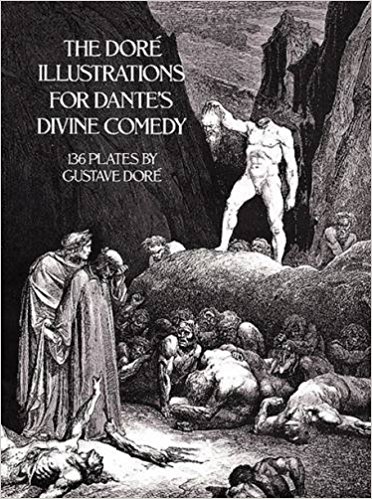
Gustave Doré’s Haunting Illustrations of Dante’s Divine Comedy

Standard

372 × 499Images may be subject to copyright.

As I remember once in FB social media, there was a discussion about old lectures and I’d stated a many; among them the masterpiece by Dante’s Divine Comedy. There, a friend began to muck about this book as a liar book which leads the people in the wrong way! Sure, I must mention here again that I’m not a religious one at all and definitely never believe in such a paradise or hell as coming in the holy religious books but for me, the great old lectures have nothing to do with such Superstitions, as I’d call them. they are the imaginations by the great genius in their life that they share with us in a wonderful way.

now here is an amazing article about a meeting between two great Artists who made a Masterpiece much greater 🙂

via http://www.openculture.com/ http://www.openculture.com/2019/02/gustave-dores-haunting-illustrations-of-dantes-divine-comedy.html

Inferno, Canto X:
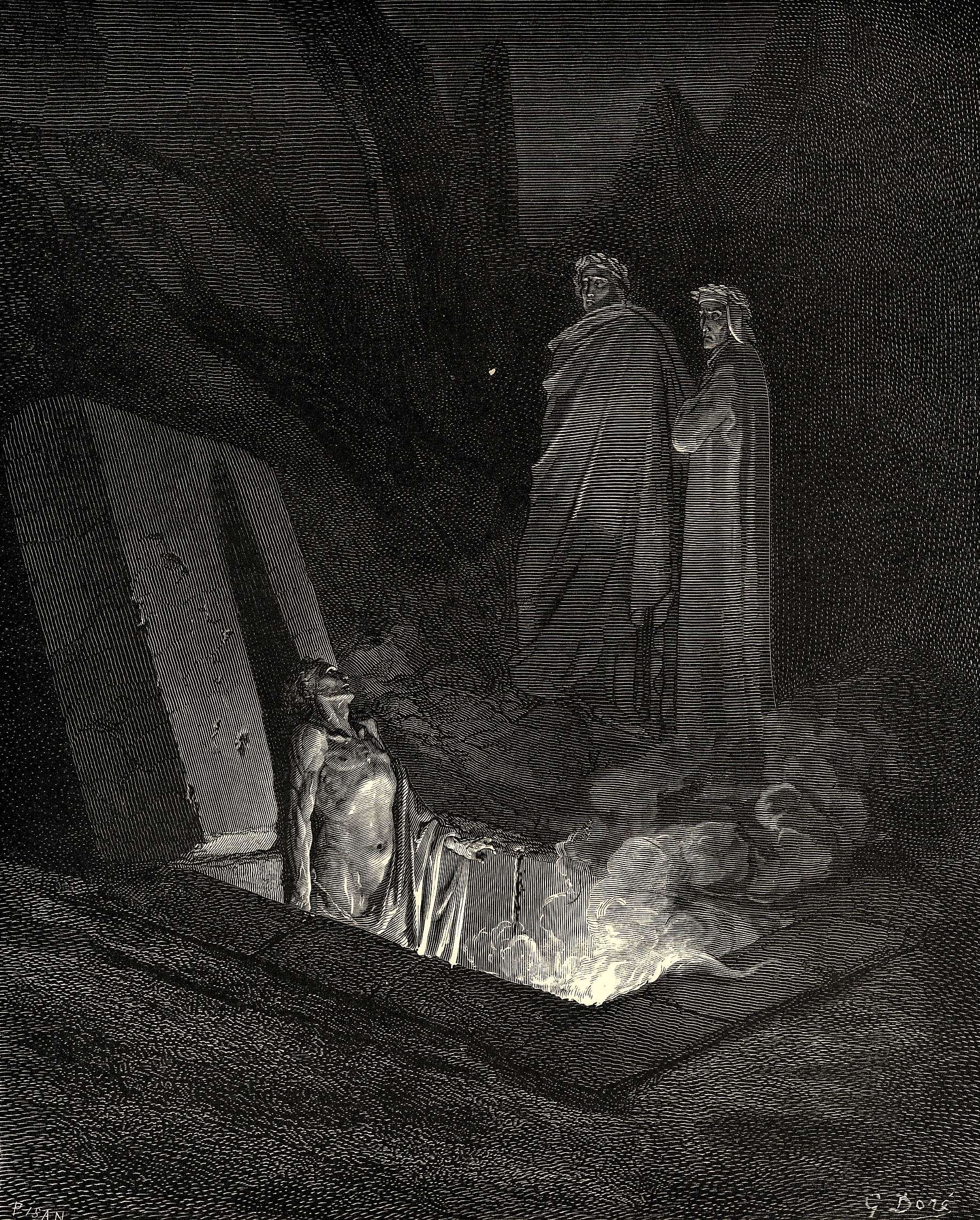
Many artists have attempted to illustrate Dante Alighieri’s epic poem the Divine Comedy, but none have made such an indelible stamp on our collective imagination as the Frenchman Gustave Doré.

Doré was 23 years old in 1855 when he first decided to create a series of engravings for a deluxe edition of Dante’s classic.  He was already the highest-paid illustrator in France, with popular editions of Rabelais and Balzac under his belt, but Doré was unable to convince his publisher, Louis Hachette, to finance such an ambitious and expensive project. The young artist decided to pay the publishing costs for the first book himself. When the illustrated Inferno came out in 1861, it sold out fast. Hachette summoned Doré back to his office with a telegram: “Success! Come quickly! I am an ass!”

Hachette published Purgatorio and Paradiso as a single volume in 1868. Since then, Doré’s Divine Comedy has appeared in hundreds of editions. Although he went on to illustrate a great many other literary works, from the Bible to Edgar Allan Poe’s “The Raven,” Doré is perhaps best remembered for his depictions of Dante. At The World of Dante, art historian Aida Audeh writes:

Characterized by an eclectic mix of Michelangelesque nudes, northern traditions of sublime landscape, and elements of popular culture, Doré’s Dante illustrations were considered among his crowning achievements — a perfect match of the artist’s skill and the poet’s vivid visual imagination. As one critic wrote in 1861 upon publication of the illustrated Inferno: “we are inclined to believe that the conception and the interpretation come from the same source, that Dante and Gustave Doré are communicating by occult and solemn conversations the secret of this Hell ploughed by their souls, travelled, explored by them in every sense.”

The scene above is from Canto X of the Inferno. Dante and his guide, Virgil, are passing through the Sixth Circle of Hell, in a place reserved for the souls of heretics, when they look down and see the imposing figure of Farinata Degli Uberti, a Tuscan nobleman who had agreed with Epicurus that the soul dies with the body, rising up from an open grave. In the translation by John Ciardi, Dante writes:

My eyes were fixed on him already. Erect,
he rose above the flame, great chest, great brow;
he seemed to hold all Hell in disrespect

Inferno, Canto XVI:

As Dante and Virgil prepare to leave Circle Seven, they are met by the fearsome figure of Geryon, Monster of Fraud. Virgil arranges for Geryon to fly them down to Circle Eight. He climbs onto the monster’s back and instructs Dante to do the same.

Then he called out: “Now, Geryon, we are ready:
bear well in mind that he is living weight
and make your circles wide and your flight steady.”

As a small ship slides from beaching or its pier,
backward, backward — so that monster slipped
back from the rim. And when he had drawn clear

he swung about, and stretching out his tail
he worked it like an eel, and with his paws
he gathered in the air, while I turned pale.

Inferno, Canto XXXIV:

In the Ninth Circle of Hell, at the very centre of the Earth, Dante and Virgil encounter the gigantic figure of Satan. As Ciardi writes in his commentary:

He is fixed into the ice at the centre to which flow all the rivers of guilt; and as he beats his great wings as if to escape, their icy wind only freezes him more surely into the polluted ice. In a grotesque parody of the Trinity, he has three faces, each a different colour, and in each mouth, he clamps a sinner whom he rips eternally with his teeth. Judas Iscariot is in the central mouth: Brutus and Cassius in the mouths on either side.

 Purgatorio, Canto II:

At dawn on Easter Sunday, Dante and Virgil have just emerged from Hell when they witness The Angel Boatman speeding a new group of souls to the shore of Purgatory.

Then as that bird of heaven closed the distance
between us, he grew brighter and yet brighter
until I could no longer bear the radiance,

and bowed my head. He steered straight for the shore,
his ship so light and swift it drew no water;
it did not seem to sail so much as soar.

Astern stood the great pilot of the Lord,
so fair his blessedness seemed written on him;
and more than a hundred souls were seated forward,

singing as if they raised a single voice
in exitu Israel de Aegypto.
Verse after verse they made the air rejoice.

The angel made the sign of the cross, and they
cast themselves, at his signal, to the shore.
Then, swiftly as he had come, he went away.

 Purgatorio, Canto IV:
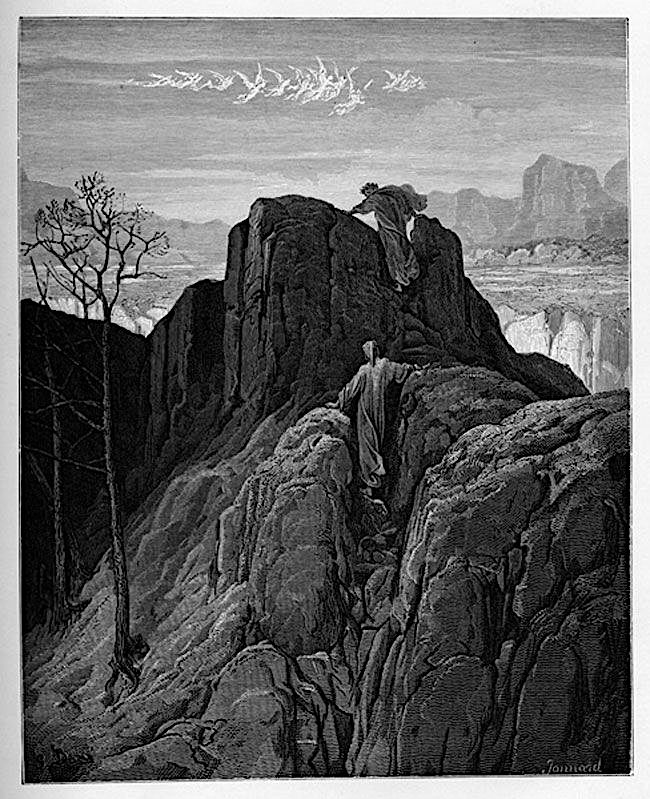
The poets begin their laborious climb up the Mount of Purgatory. Partway up the steep path, Dante cries out to Virgil that he needs to rest.

The climb had sapped my last strength when I cried:
“Sweet Father, turn to me: unless you pause
I shall be left here on the mountainside!”

He pointed to a ledge a little ahead
that wound around the whole face of the slope.
“Pull yourself that much higher, my son,” he said.

His words so spurred me that I forced myself
to push on after him on hands and knees
until at last, my feet were on that shelf.

Purgatorio, Canto XXXI:
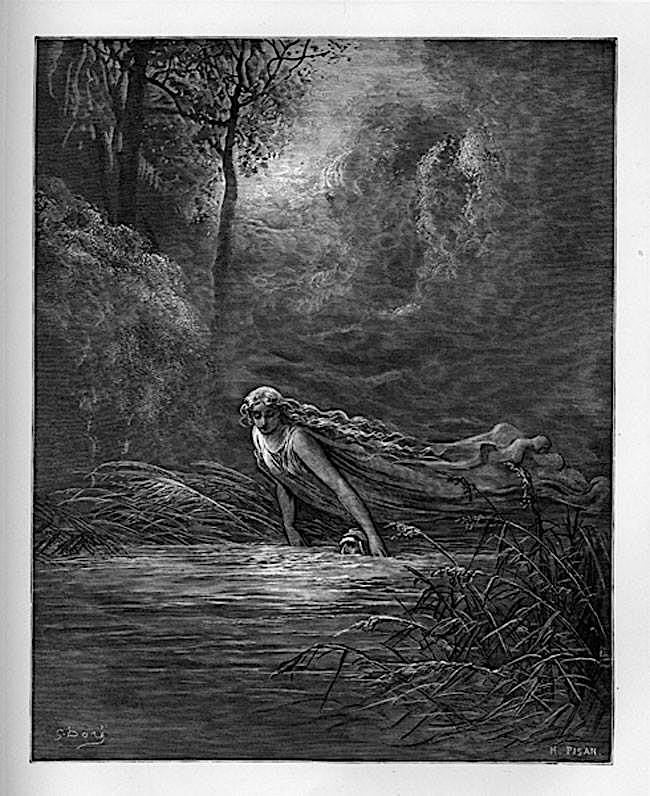
Having ascended at last to the Garden of Eden, Dante is immersed in the waters of the Lethe, the river of forgetfulness, and helped across by the maiden Matilda. He drinks from the water, which wipes away all memory of sin.

She had drawn me into the stream up to my throat,
and pulling me behind her, she sped on
over the water, light as any boat.

Nearing the sacred bank, I heard her say
in tones so sweet I cannot call them back,
much less describe them here: “Asperges me.”

Then the sweet lady took my head between
her open arms, and embracing me, she dipped me
and made me drink the waters that make clean.

Paradiso, Canto V:

In the Second Heaven, the Sphere of Mercury, Dante sees a multitude of glowing souls. In the translation by Allen Mandelbaum, he writes:

As in a fish pool that is calm and clear,
the fish draw close to anything that nears
from outside, it seems to be their fare,
such were the far more than a thousand splendors
I saw approaching us, and each declared:
“Here now is one who will increase our loves.”
And even as each shade approached, one saw,
because of the bright radiance, it set forth,
the joyousness with which that shade was filled.

Paradiso, Canto XXVIII:
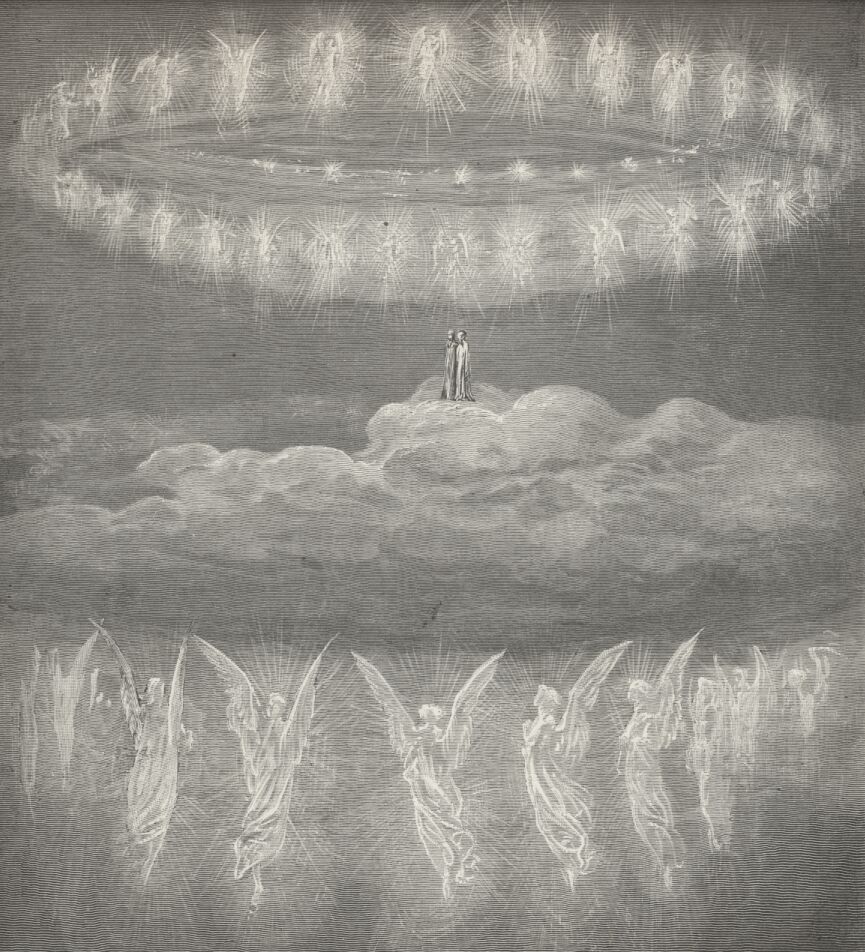
Upon reaching the Ninth Heaven, the Primum Mobile, Dante and his guide Beatrice look upon the sparkling circles of the heavenly host. (The Christian Beatrice, who personifies Divine Love, took over for the pagan Virgil, who personifies Reason, as Dante’s guide when he reached the summit of Purgatory.)

And when I turned and my own eyes were met
By what appears within that sphere whenever
one looks intently at its revolution,
I saw a point that sent forth so acute
a light, that anyone who faced the force
with which it blazed would have to shut his eyes,
and any star that, seen from the earth, would seem
to be the smallest, set beside that point,
as star conjoined with star, would seem a moon.
Around that point a ring of fire wheeled,
a ring perhaps as far from that point as
a halo from the star that colours it
when mist that forms the halo is most thick.
It wheeled so quickly that it would outstrip
the motion that most swiftly girds the world.

Paradiso, Canto XXXI:
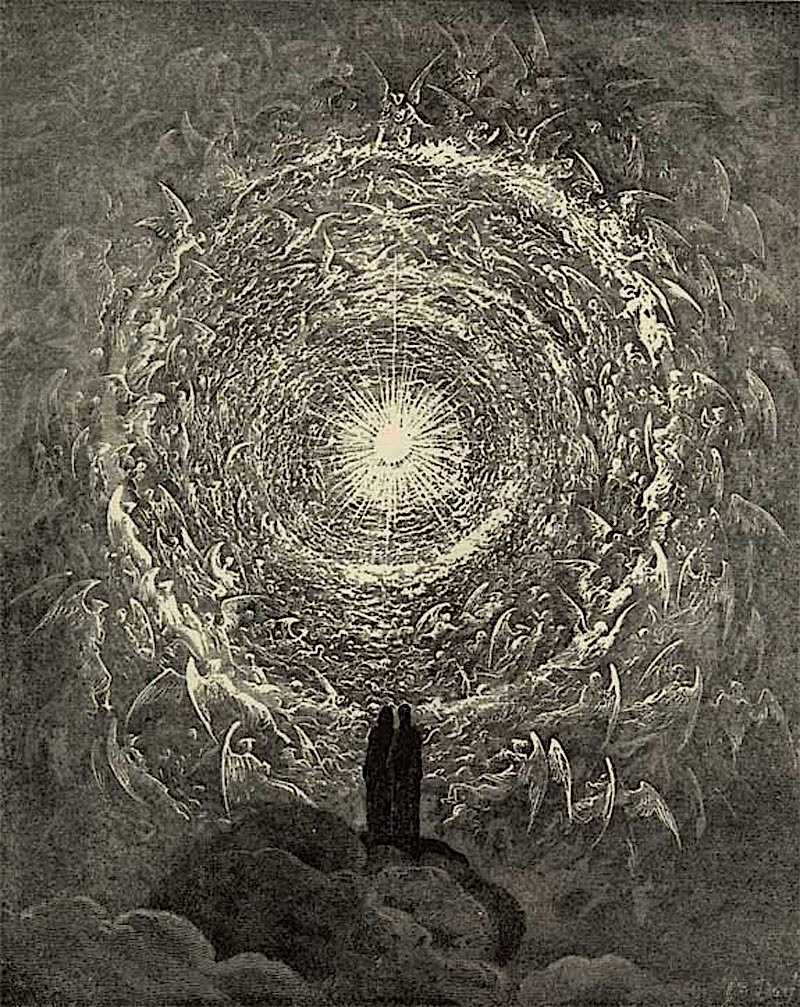
In the Empyrean, the highest heaven, Dante is shown the dwelling place of God. It appears in the form of an enormous rose, the petals of which house the souls of the faithful. Around the centre, angels fly like bees carrying the nectar of divine love.

So, in the shape of that white Rose, the holy
legion has shown to me — the host that Christ,
with His own blood, had taken as His bride.
The other host, which, flying, sees and sings
the glory of the One who draws its love,
and that goodness which granted it such glory,
just like a swarm of bees that, at one moment,
enters the flowers and, at another, turns
back to that labour which yields such sweet savour,
descended into that vast flower graced
with many petals, then again rose up
to the eternal dwelling of its love.

You can access a free edition of The Divine Comedy featuring Doré’s illustrations at Project Gutenberg. A Yale course on reading Dante in translation appears in the Literature section of our collection of 750 Free Online Courses.

If you’d like to support Open Culture and our mission, please consider making a donation to our site. It’s hard to rely 100% on ads, and your contributions will help us provide the best free cultural and educational materials.

Follow Open Culture on Facebook and Twitter and share intelligent media with your friends. Or better yet, sign up for our daily email and get a daily dose of Open Culture in your inbox. 

Note: An earlier version of this post appeared on our site in October 2013.

Related Content:

An Illustrated and Interactive Dante’s Inferno: Explore a New Digital Companion to the Great 14th-Century Epic Poem

Visualizing Dante’s Hell: See Maps & Drawings of Dante’s Inferno from the Renaissance Through Today

Artists Illustrate Dante’s Divine Comedy Through the Ages: Doré, Blake, Botticelli, Mœbius & More

A Digital Archive of the Earliest Illustrated Editions of Dante’s Divine Comedy 
(1487-1568)

Alberto Martini’s Haunting Illustrations of Dante’s Divine Comedy (1901-1944)
The Song of Love & Torcher

Standard

And then I confess that I tortured the dress that you wore for the world to look through.

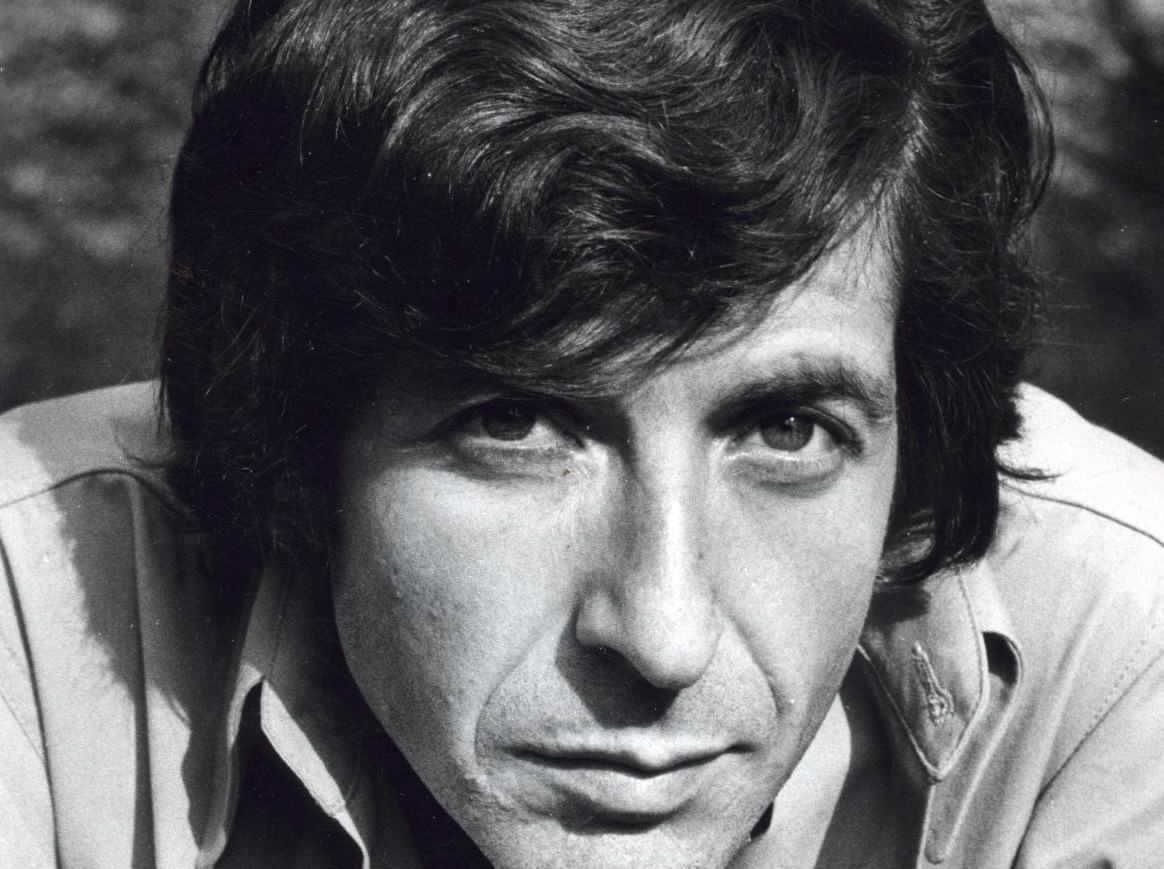
To be honest; I must thank MIKE STEEDEN for his wonderful works which mostly have a touch of Leonard Cohen, to learn me, learn me to remember one of my favourite songwriters and poet of my youth. He came to us; my brother and me, in the early seventies when we were in our most melancholic time in Tehran, Iran those days and were trying to separate us from the society, the society in which you’ve got the feeling that you’ve never belonged and it’s sad! and the only way to escape was the help with drugs. one friend, a professional bassist, came in an evening of a cold winter day and showed us his new discovery which was “the songs of love and hate” by L. Cohen.

I’ve put the vinyl record on the gramophone and it began with the song; Avalanche


Well, I stepped into an avalanche,
It covered up my soul;
When I am not this hunchback that you see,
I sleep beneath the golden hill.
You who wish to conquer pain,
You must learn, learn to serve me well.

Anyway, it was the beginning of a long friendship. But now I wanted to tell about a song by him which is not so current by some people who know Cohen but not aware of this of: “One of Us Cannot Be Wrong”


 “New Skin for the Old Ceremony” 

it is the last song of the album; New Skin for the Old Ceremony if I do not mistake 😉 and when one listens to it, can find a universe inside of it! I mean that’s Poem, you can fly in throughout the whole universe with never-ending. { oh please let me come into the storm }

I suppose that he froze when the wind took your clothes and I guess he just never got warm. But you stand there so nice, in your blizzard of ice, oh please let me come into the storm.

It is a fascinating art to write a poem, and make a song; I hope you’d enjoy it.
just lets your soul fly with. ❤


I lit a thin green candle, to make you jealous of me. But the room just filled up with mosquitos, they heard that my body was free. Then I took the dust of a long sleepless night and I put it in your little shoe. And then I confess that I tortured the dress that you wore for the world to look through. I showed my heart to the doctor: he said I just have to quit. Then he wrote himself a prescription, and your name was mentioned in it! Then he locked himself in a library shelf with the details of our honeymoon, and I hear from the nurse that he’s gotten much worse and his practice is all in a ruin. I heard of a saint who had loved you, so I studied all night in his school. He taught that the duty of lovers is to tarnish the golden rule. And just when I was sure that his teachings were pure he drowned himself in the pool. His body is gone but back here on the lawn his spirit continues to drool. An Eskimo showed me a movie he’d recently taken of you: the poor man could hardly stop shivering, his lips and his fingers were blue. I suppose that he froze when the wind took your clothes and I guess he just never got warm. But you stand there so nice, in your blizzard of ice, oh please let me come into the storm.

And here is the Avalanche;

Well, I stepped into an avalanche,
It covered up my soul;
When I am not this hunchback that you see,
I sleep beneath the golden hill.
You who wish to conquer pain,
You must learn, learn to serve me well. You strike my side by accident
As you go down for your gold.
The cripple here that you clothe and feed
Is neither starved nor cold;
He does not ask for your company,
Not at the centre, the centre of the world.When I am on a pedestal,
You did not raise me there.
Your laws do not compel me
To kneel grotesque and bare.
I myself am the pedestal
For this ugly hump at which you stare. You who wish to conquer pain,
You must learn what makes me kind;
The crumbs of love that you offer me,
They’re the crumbs I’ve left behind.
Your pain is no credential here,
It’s just the shadow, shadow of my wound. I have begun to long for you,
I who have no greed
I have begun to ask for you,
I who have no need.
You say you’ve gone away from me,
But I can feel you when you breathe. Do not dress in those rags for me,
I know you are not poor
You don’t love me quite so fiercely now
When you know that you are not sure,
It is your turn, beloved,
It is your flesh that I wear.


Thank you again
MIKE STEEDEN 🙏🙏

PS: You, the dear friends and followers who might look at my posting, may wonder why I post mostly in the weekend, it is because of my hard working all through the week, it is a kind of working in which you’d not have to use your brain, the job itself does not need any, but I can not without, therefore, I must suffer, but at the weekend I’m alive again!!

If you really want to know my kind of job, you might watch Woody Allen’s Radio Days, then you can find the solution 🤣🤣

Erman Essen: “66 Daily Sophia Lessons”

Standard

It is a true word by Dr Jung which we know it through history and unfortunately, nowadays it gets stronger and popular between the public to how easily open the mouth and show off the opinion basic on unknowing, but man must tell something, otherwise, the others think one knows nothing!

Here I share a wonderful post by Searching The Meaning Of Life! (STMOL) with many wise words as I know him as a Wiseman 🙂 with many Thanks ❤

By SearchingTheMeaningOfLife

The German writer of the “Steppe Wolf” delivers life lessons …

 “Every man’s life is a way to himself, the model of a road, the draft of a path. No man has come to be completely himself, however, everyone aspires to succeed, others to the blind, others to more light, everyone as he can “

One forgets to judge and criticize others when it is full of doubts about themselves: “Making the judge alive is the perfect excuse to not analyze your own. If we observe the people who are turning here and thereby making a verdict about what they are doing well and what the others are bad about, we will find a great lack of self-criticism. They are not conscious of their actions and their reasons because they focus their attention on the lives of others.

And they behave that way because they are afraid to radiograph themselves and be disappointed. “

When we hate someone, we hate the image of something inside us: “When we think we are hurt with someone, it is because it possesses something that touches us deeply and causes us discomfort. This one becomes a mirror of something inside us and we do not want to admit it. Otherwise, it would not bother us so much. Thus, the stingy man endures the stinging of the others with more intensity than anyone, and the indiscretion is overpowered when there is indiscretion. The person we hate is our mirror and, therefore, a spiritual master we should not underestimate. “

When we are afraid of someone is why we have given him power over us. “Often others or who have an opinion about us. We ourselves are blinded by the fury to learn what they will think … “

The tender is stronger than the hard, the water stronger than the rock, the love stronger than the violence. “The power of love, like water, lies in its adaptability to the medium where it lives. If this is transposed into everyday life, the ability to love – not just another person but a design – is confronted with the difficulties to get the best out of every situation. “

Some that are perfect are perfect because they have fewer demands than themselves: “A simple yet very effective exercise: it has been a goal of improvement for each week, and in one year your quality of life will be upgraded in a way that you can not even imagine “.

The bird breaks the shell. The egg is the world. The one who wants to be born has to break a world: “The child must abandon his childhood, his innocence in this way transform into an adult. These transition rituals always lead to the elimination of his earlier ego to allow the new ego to be born. “

Sometimes enemies are more useful than friends since windless winds do not turn: “The enemy forces us to act and get out of the comfort that made us soft. It forces us to make the best, as well as our worst self. If we can see our reactions from a distance and with a little humour, in every conflict, there is a great lesson about our own and our weaknesses. “

The school does not teach the skills and abilities that are necessary for life:   “As Esse writes in his tale” Under the Wheel “:” The school teacher prefers to have a few strands in his class rather than a single genius student. And deep down he is right because it is not his duty to form extremely brains but good philologists, mathematicians, and useful people. “

Again and again, one is thrown into the things he has loved and he thinks it is a faith while it is just laziness: “Children scare the dark because they think that there is a monster hidden among the shadows, something unknown that can attack them. In the same way, adults frighten the unknown because it involves change, risk, uncertainty. We are afraid of the new one because if we fail we know that we will hear the phrase: “I told you”.

Without personality there is no love, there is no real love deeply: “Many people are trying to show something they are not, either because they think that this is what others want or why they do not like what they are like. They are dependent on the opinion of others and desperately need their approval. However, true love is not born out of deprivation by waiting for the other to fill our inner voids or to tell us what to do. We really love something only by accepting what it is. “

Source: http://www.o-klooun.com /

Carl Jung: On the unconscious complexes of a nation triggering a catastrophe

Standard

I think I am! Therefore I am!! though, it wasn’t so easy for me; I have a hard struggling life behind, of course, everything is relative but as I can remember, I had or still can have, a lot of complexes, though, I’m lucky that I got knowing it! it might depend on my bringing up by my mam or the gene of my dad’s, I don’t know. anyway, I could work on it and recognize my dark side. Yes! I think unknown complexes strengthen the dark side of humanity. To tell about it clearly; it is the Unconsciousness.

I did fight a much with my inner devil as I really kept in my mind to recall it when I got angry about my destiny, (although, I had to do it often!) because of my hard time of growing up. There were many reasons to force me into my unknown but thanks goodness that I could rescue myself and found love instead of hate. ( As I can also say; Thanks to Fyodor Dostoevsky who learned me a lot about my inner unknown, especially in the novel: Demons in which, we can see ourselves and our soul absolutely naked!

Anyway, here again, I’ve found a great read by http://jungcurrents.com/ the words of C. G. Jung as a wonderful teacher, with a help of my dear friend and sister Elaine Mansfield to share with you because; We hu-wo-man, are a complex of two sides of the existence, nature, life, being! And therefore, we must find out the balance in between. there, we can survive and find the inner freedom and that’s the point.

via: http://jungcurrents.com/

From The Symbolic Life, Vol. 18 of the Collected Works, (Princeton, 1976 ), Paragraphs 1374-1378

For about half a century now science has been examining under the microscope something that is more invisible than the atom—the human psyche—and what it discovered at first was very far from enjoyable. If one had the necessary imagination one would actually be shattered by these discoveries. But the psychologist today is in the same position as the physicist, who has discovered the elements of a future atomic bomb capable of turning the earth into a nova. He sees it merely as an interesting scientific problem, without realizing that the end of the world has come tangibly closer. In the case of psychology things are not quite as bad as that, but all the same it has discovered where those demons, which in earlier ages dominated nature and man’s destiny, are actually domiciled, and, what is more, that they are none the worse for enlightenment. On the contrary, they are as sprightly as ever, and their activity has even extended its scope so much that they can now get their own back on all the achievements of the human mind. We know today that in the unconscious of every individual there are instinctive propensities or psychic systems charged with considerable tension. When they are helped in one way or another to break through into consciousness, and the latter has no opportunity to intercept them in higher forms, they sweep everything before them like a torrent and turn men into creatures for whom the word “beast” is still too good a name. They can then only be called “devils.” To evoke such phenomena in the masses all that is needed is a few possessed persons, or only one. Possession, though old-fashioned, has by no means become obsolete; only the name has changed. Formerly they spoke of “evil spirits,” now we call them “neuroses” or “unconscious complexes.” Here as everywhere, the name makes no difference. The fact remains that a small unconscious cause is enough to wreck a man’s fate, to shatter a family, and to continue working down the generations like the curse of the Atrides.

If this unconscious disposition should happen to be one which is common to the great majority of the nation, then a single one of these complex-ridden individuals, who at the same time setting himself up as a megaphone, is enough to precipitate a catastrophe. The good people, in their innocence and unconsciousness, do not know what is happening to them when they are changed overnight into a “master race” (a work of the devil, who has so often changed horse-apples into gold), and an amazed Europe is hard to put to accommodate itself to the “new order” where anything so monstrous (one thinks of Maidenek in relation to Eckhart, Luther, Goethe, and Kant!) is not merely a possibility but a fait accompli.

Countless people have asked themselves how it was possible for a civilized nation like Germany to fall into this hellish morass. I once wrote that Germany is the land of spiritual catastrophes.6 If the neo-German madness proclaims that the Germans are the chosen people, and if they then, out of envious rivalry, persecute the Jews with whom they have certain psychological peculiarities in common (behind every persecution there lurks a secret love, as doubt behind every fanaticism), we are indeed confronted with something quite apart, a state of being “elect.” For nobody can fall so low unless he has a great depth. If such a thing can happen to a man, it challenges his best and highest on the other side; that is to say, this depth corresponds to a potential height and the blackest darkness to a hidden light. This light is certainly invisible today because it is blocked up in the depths of the psyche. Indeed everything has gone so desperately awry in Germany, and what has happened is an infernal caricature of the answer the German spirit should have given to the question put to Europe by a new age. Instead of reflecting on this question, it was taken in by that fake figure of the Superman, which the neurotically degenerate mind of Nietzsche invented as a compensation for his own weakness. (Not without some excuse, however, since the Faust that made the pact with the devil was his godfather.) Germany has soiled her name and her honour with the blood of the innocent and brought upon her own head the curse of the election. She has aroused such hatred in the world that it is difficult to make the scales of justice balance. And yet the first to enter with the Saviour into paradise was the thief. And what does Meister Eckhart say? “For this reason God is willing to bear the brunt of sins and often winks at them, mostly sending them to people for whom he has prepared some high destiny. See! Who was dearer to our Lord or more intimate with him than his apostles? Not one of them but fell into mortal sin, and all were mortal sinners.”
The psychiatrist knows that certain dangerous unconscious forces can be rendered harmless, or at least held in check if they are made conscious, that is. if the patient can assimilate them and integrate them with his personality. In so far as psychiatrists are concerned with the psychic treatment of such complexes, they have to do every day with “demons,” i.e., with psychic factors that display demonic features when they appear as a mass phenomenon. To be sure, a bloodless operation of this kind is successful only when a single individual is involved. If it is a whole family, the chances are ten to one against, and only a miracle can provide the remedy. But when it is a whole nation the artillery speaks the final word. If this is to be avoided one must begin with the individual—and lamentably long-drawn-out and hopeless labour of Sisyphus this may seem. At any rate, people are so impressed by the suggestive power of megaphone oratory that they are inclined to believe that this bad means—mass hypnotism—could be put to a good purpose by “inflammatory” speeches.

Getting In the Mood: How Pot Could Change Depression And Anxiety Treatment

Standard

as in my experience, they’re among the best time in my life 😉 I can only remember of one of my friends, an excellent musician gave up smoking cigarets, he’d just smoked cannabis. In any case, exaggeration in any matter and in any direction is a wrong way! 😀

“If you use a lot of cannabis, it generally makes their mood or anxiety worse,” says Tishler, bluntly. “But on the other hand, if people use very small amounts of cannabis, we find it can actually benefit their mood and anxiety. So, my approach with patients is very low dose in the evening, which effectively creates a period of intoxication that dissipates over the course of the night, but the benefits to mood persist throughout the next day.”

An interesting article about the issue 🙂

https://hightimes.com/study/getting-mood-how-cannabis-could-change-depression-anxiety-treatment/

via: https://hightimes.com/

Even the world’s most seasoned tokers have experienced the overwhelming and frightening feeling of THC-induced anxiety. We’ve all taken a hit (or consumed an edible) too many, inadvertently thrusting our stoned minds into a vortex of bleak thoughts, or even raising unsubstantiated questions like why is everyone looking at me right now?

Thus, while cannabis has been proven to be beneficial for a wide range of medical conditions, one might assume that it doesn’t offer much relief for mood-related disorders like depression and anxiety.

In fact, most past research suggests that ganja has an adverse effect on these conditions. And, besides the veteran-backed emergence of treatment for PTSD, most states don’t allow physicians to recommend cannabis for these other types of mood disorders.

Regardless of those anecdotal inklings some cannabis users have about the terrifying effect pot can have on anxiety and depression, new research suggests that more patients may be seeking treatment for mood-related disorders than any other medical classification, including pain-related conditions.

In a recent study conducted by CB2 Insights, researchers found that over 34 per cent of patients seeking medical cannabis were aiming to alleviate mood-related disorders like anxiety, depression, PTSD, and others. Pain-related conditions were a close second, encompassing 33 per cent of the patients that took part in the evaluation.

“We went into this study with a clear mind, and we actually believed that pain would be at the top,” says Dan Thompson, the chief marketing officer of CB2 Insights. “We wanted to look at what the second, third, and fourth most prominent primary conditions were, and how big of a discrepancy there was between them. The fact that mood-related disorders bubbled to the top was a surprise to us, so the report kind of came just from that.” 

In the report, CB2 Insights assessed nearly 500 patients across multiple states over a four-week period. The findings were essentially published to highlight the fact that, outside of PTSD, most states with medical legalization don’t list mood-related disorders as a qualifying condition.  

Currently, only seven states and Washington DC allow certified healthcare practitioners to provide a medical recommendation for patients to treat any condition with cannabis, so long as the doc deems it an appropriate remedy.

In Massachusetts, one of the few states that actually allow physicians to endorse Mary Jane-use at their own discretion, Dr Jordan Tishler believes he’s had substantial success in treating depression and anxiety with small doses of medical-grade greens.

A Doctor Who Knows How to Get Patients in the Right Mood

Dr Tishler runs the New England-based medical cannabis clinic InhaleMD, and also founded the Association of Cannabis Specialists, an organization that promotes education and advocacy in regard to medical cannabis care. He’s also a firm believer that, in a small and controlled dose, THC-heavy flower can be extremely beneficial for patients suffering from depression and anxiety.       

“If you use a lot of cannabis, it generally makes their mood or anxiety worse,” says Tishler, bluntly. “But on the other hand, if people use very small amounts of cannabis, we find it can actually benefit their mood and anxiety. So, my approach with patients is very low dose in the evening, which effectively creates a period of intoxication that dissipates over the course of the night, but the benefits to mood persist throughout the next day.”

To ensure that those suffering from anxiety and depression obtain proper treatment, Tishler gets extraordinarily specific with each patient. Although dispensaries are technically not obliged to follow a doctor’s orders when it comes to dosages, the Massachusetts-based cannabis specialist tells each patient exactly what to get, when to use it, and how to use it.

Getting In the Mood: How Pot Could Change Depression And Anxiety Treatment

Courtesy of Dr.Tishler

For mood-related disorders like anxiety and depression, he’ll often recommend a small dose of THC-laden bud right before bedtime.

“There are Benzos, which we try not give people too often because they can be highly dangerous,” Tishler told us. In that case, generally speaking, the low dose of cannabis in the evening is enough to replace the Benzos. And I’ve seen this. I’ve also seen people come in on Klonopin, and over time, we’re able to win them right off of that.”   

While he doesn’t necessarily subscribe to the idea that cannabis can fully replace antidepressant medication in every case, Tishler sees remarkable benefits to using medical-grade ganja as a supplement to reduce opioid dependencies and help deal with the negative side effects of SSRIs.

“The side effects to SSRIs include weight gain, the feeling of not having any joy, and there’s also a whole bunch of sexual side effects for both men and women. Interestingly, cannabis can help offset those side effects so that if you need to be on an SSRI… using cannabis as a supplement can make the whole thing work better,” he explains.

The Future of Research on Mood-Related Disorders and Medical Cannabis

One of the main issues with past studies on how cannabis impacts these two particular mood-related conditions is that doses were not typically controlled or administered properly. In turn, this created a stigma that cannabis has an adverse effect on anxiety and depression.

But to Tishler, all this means is that we need to conduct better research, and that starts with implementing more controlled dosing regimens.

“Particularly with regard to the mood disorders, the amount of cannabis is so critical,” he says. “I think that when we look at this older literature and see that the results are totally mixed, if we could go back and actually control what people are getting, then we would really be able to demonstrate that low doses are beneficial and higher doses are nonbeneficial. We’d be able to find that breakpoint.” 

Unfortunately, as long as cannabis remains illegal on the federal level, it will be difficult to conduct this research in a proper manner. But according to Thompson of CB2 Insights, he believes that will likely change once Big Pharma – for better or for worse – finally situates itself in the budding cannabis space.  

“They’ll either do so to protect themselves or as an understanding that it’s time to collaborate with it,” says Thompson. “Whatever the motivation, Big Pharma will absolutely enter the cannabis space.”

Although Thompson doesn’t necessarily believe cannabis will be a replacement for opioids, he does believe it can be used in tandem to reduce opioid usage. And the same goes for with antidepressants. “Trying to find that balance of how traditional Pharma can work with cannabis in an integrated treatment plan,” he says, “is certainly the future.”