Superstitions You Might Find in Atonement TN

Standard

really amazing 🙂

Teagan Riordain Geneviene's avatarTeagan's Books

Saturday, November 10, 2018

The amazing Sue Vincent recently hosted me at her Daily Echo blog.  We were talking about superstitions and I shared some from my youth.  I had a great time at Sue’s and I hope you’ll click over to visit her.

I expect the townsfolk in fictional Atonement, TN would tend to be superstitious.  How could they be otherwise with all the strange goings on and supernatural beings?

The first writing advice I heard was something I took to heart ― Write what you know.  When I wrote Atonement, Tennessee I followed that guidance and created a fictional southern town where the urban fantasy takes place.  Of course, the second novel, Atonement in Bloom, is also set there.

I made it a very small, rural town so some of the manners and personalities I grew up with would not seem out of place.  The townsfolk…

View original post 1,000 more words

#writing #music: #TheWho

Standard

jeanleesworld's avatarJean Lee's World

A rare gift comes to the writer when the story and its mixed tape of music ka-chunk and transform. No longer is the music merely the writer’s atmosphere, her source of ambience while storytelling. Oh no. The music is the heroine. The music is the villain. The music is the tension. The music is the scene.

Quadrophenia_(album)This happened to me during 2010’s National Novel Writing Month when I first began drafting Fallen Princeborn: Stolen. At the time I was only using instrumental music for storytelling, while  music like The Who’s Quadropheniahelped me survive the piles of grading in my dropbox. The month had barely started, so I was early in the story of Charlotte and her sister leaving their abusive family in the Dakotas for Wisconsin. Their coach bus breaks down in the middle of nowhere. Another peculiar bus appears with far-too-friendly good Samaritans, and despite Charlotte’s suspicions…

View original post 1,044 more words

An #Author #Interview with @Celine_Kiernan, Part 1: #writing & #worldbuilding in #fantasy #fiction with a little help from #history

Standard

jeanleesworld's avatarJean Lee's World

199_Celine_webBorn in Dublin, Ireland, 1967, Celine has spent the majority of her working life in the film business, and her career as a classical feature character animator spanned over seventeen years, before she became a full-time writer. I am honored to spend this week and next sharing her thoughts on world-building, research, character, audience, and hooks.

First, let’s talk about the imagination behind the worlds. I see on your biography you spent years in film and animation. What drew you to visual storytelling as a profession before written storytelling? How does your work as an animator influence the way you write today?

farewell__inksketch_by_tinycoward_d1xwof1-pre Illustration of Chris and Wynter from Poison Throne

From the moment I could hold a pencil I was always either drawing or writing. In terms of satisfaction, I don’t think there’s a dividing line between the two disciplines for me. But at different stages in my life…

View original post 1,682 more words

Carl Jung: Tarot Cards Provide Doorways to the Unconscious, and Maybe a Way to Predict the Future

Standard

via http://www.openculture.com/

A majestic play cards

jung-and-tarot

As analyst Marie-Louise von Franz recounts in her book Psyche and Matter:

Jung suggested… having people engage in a divinatory procedure: throwing the I Ching, laying the Tarot cards, consulting the Mexican divination calendar, having a transit horoscope or a geometric reading done.

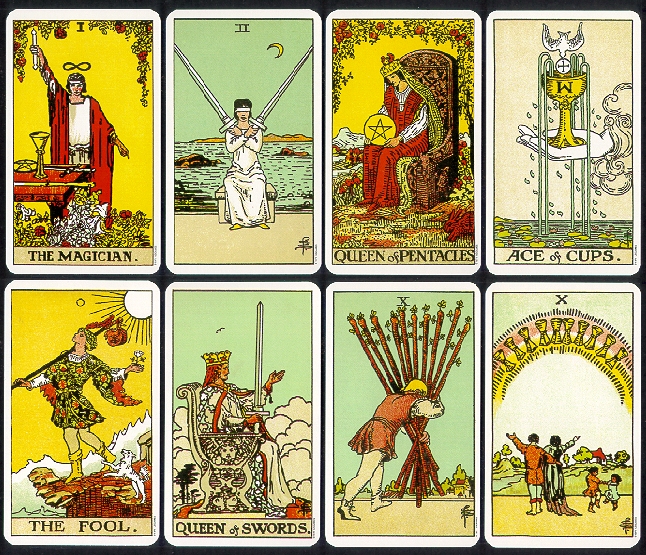
It is generally accepted that the standard deck of playing cards we use for everything from three-card monte to high-stakes Vegas poker evolved from the Tarot. “Like our modern cards,” writes Sallie Nichols, “the Tarot deck has four suits with ten ‘pip’ or numbered cards in each…. In the Tarot deck, each suit has four ‘court’ cards: King, Queen, Jack, and Knight.” The latter figure has “mysteriously disappeared from today’s playing cards,” though, examples of Knight playing cards exist in the fossil record. The modern Jack is a survival of the Page cards in the Tarot. (See examples of Tarot court cards here from the 1910 Rider-Waite deck.) The similarities between the two types of decks are significant, yet no one but adepts seems to consider using their Gin Rummy cards to tell the future.

The eminent psychiatrist Carl Jung, however, might have done so.

As Mary K. Greer explains, in a 1933 lecture Jung went on at length about his views on the Tarot, noting the late Medieval cards are “really the origin of our pack of cards, in which the red and the black symbolize the opposites, and the division of the four—clubs, spades, diamonds, and hearts—also belongs to the individual symbolism.

They are psychological images, symbols with which one plays, as the unconscious seems to play with its contents.” The cards, said Jung, “combine in certain ways, and the different combinations correspond to the playful development of mankind.” This, too, is how Tarot works—with the added dimension of “symbols, or pictures of symbolical situations.” The images—the hanged man, the tower, the sun—“are sort of archetypal ideas, of a differentiated nature.”

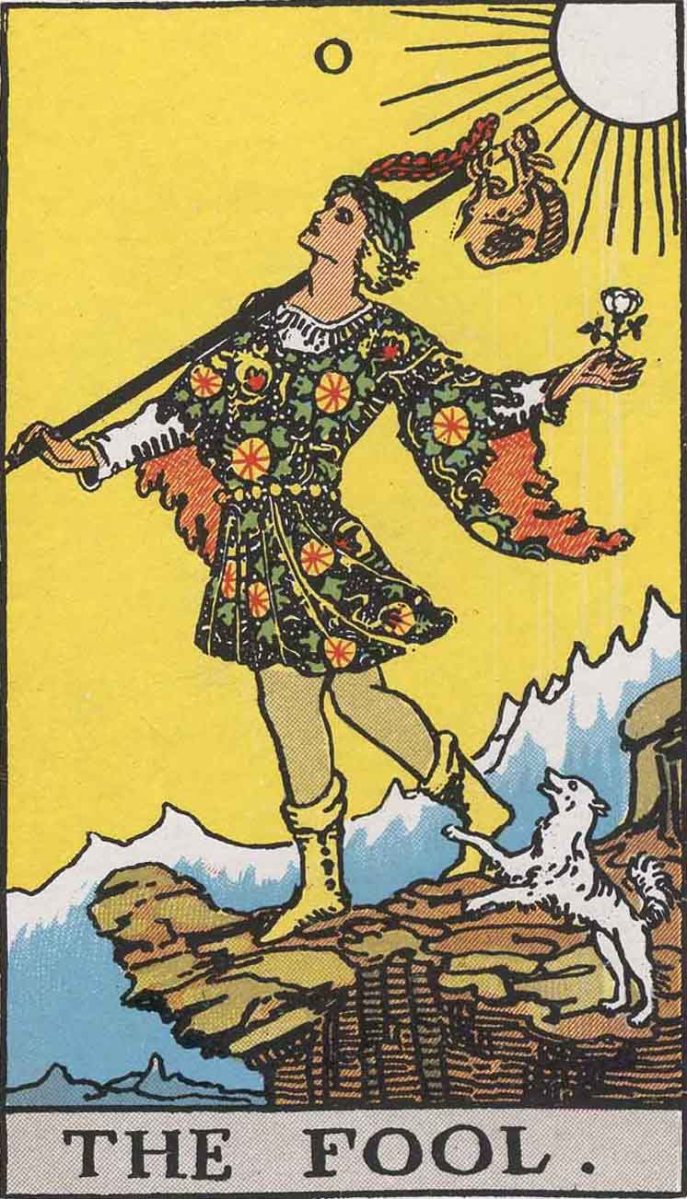
RWS_Tarot_00_Fool

Thus far, Jung hasn’t said anything many orthodox Jungian psychologists would find disagreeable, but he goes even further and claims that, indeed, “we can predict the future when we know how the present moment evolved from the past.” He called for “an intuitive method that has the purpose of understanding the flow of life, possibly even predicting future events, at all events lending itself to the reading of the conditions of the present moment.” He compared this process to the Chinese I Ching, and other such practices. As analyst Marie-Louise von Franz recounts in her book Psyche and Matter:

Jung suggested… having people engage in a divinatory procedure: throwing the I Ching, laying the Tarot cards, consulting the Mexican divination calendar, having a transit horoscope or a geometric reading done.

Content seemed to matter much less than form. Invoking the Swedenborgian doctrine of correspondences, Jung notes in his lecture, “man always felt the need of finding an access through the unconscious to the meaning of an actual condition, because there is a sort of correspondence or a likeness between the prevailing condition and the condition of the collective unconscious.”

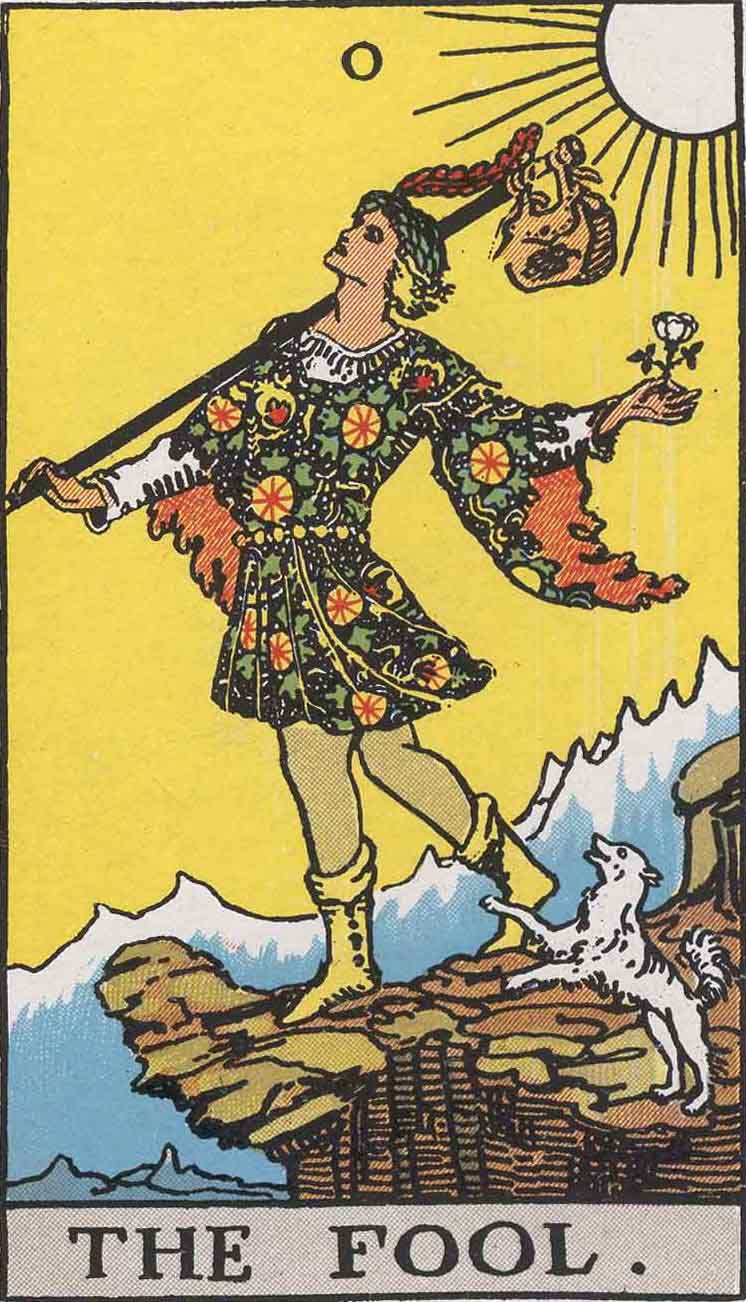
Rider-Waite-1

What he aimed at through the use of divination was to accelerate the process of “individuation,” the move toward wholeness and integrity, by means of playful combinations of archetypes. As another mystical psychologist, Alejandro Jodorowsky puts it, “the Tarot will teach you how to create a soul.” Jung perceived the Tarot, notes the blog Faena Aleph, “as an alchemical game,” which in his words, attempts “the union of opposites.” Like the I Ching, it “presents a rhythm of negative and positive, loss and gain, dark and light.”

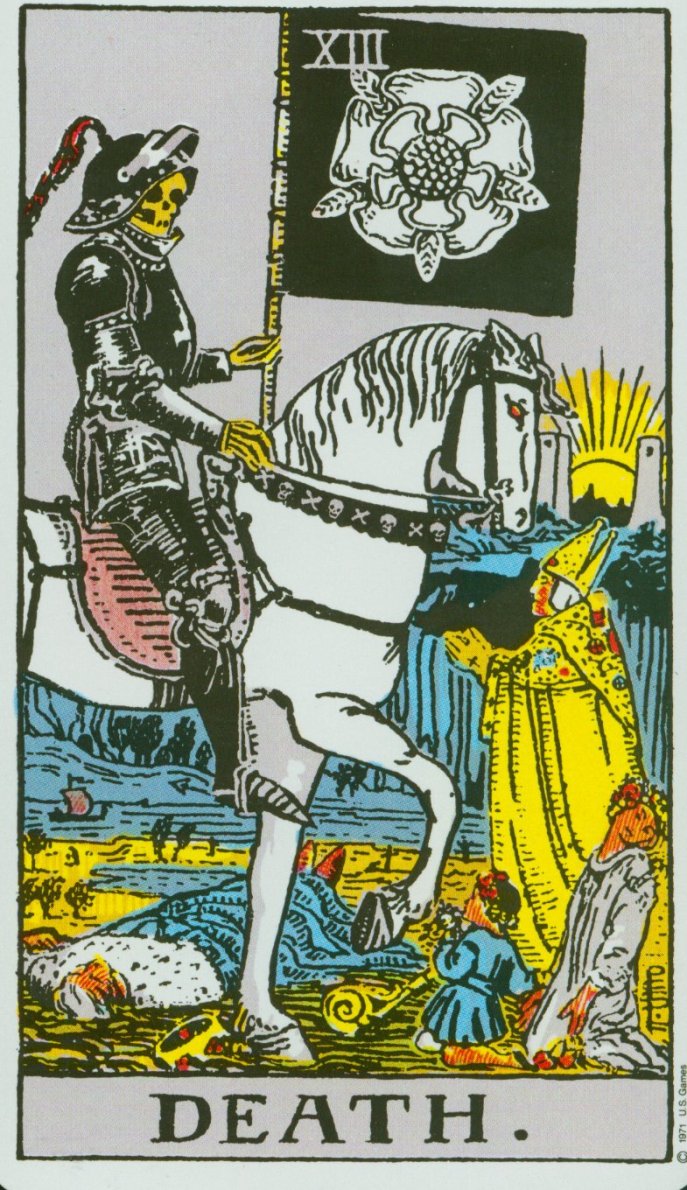
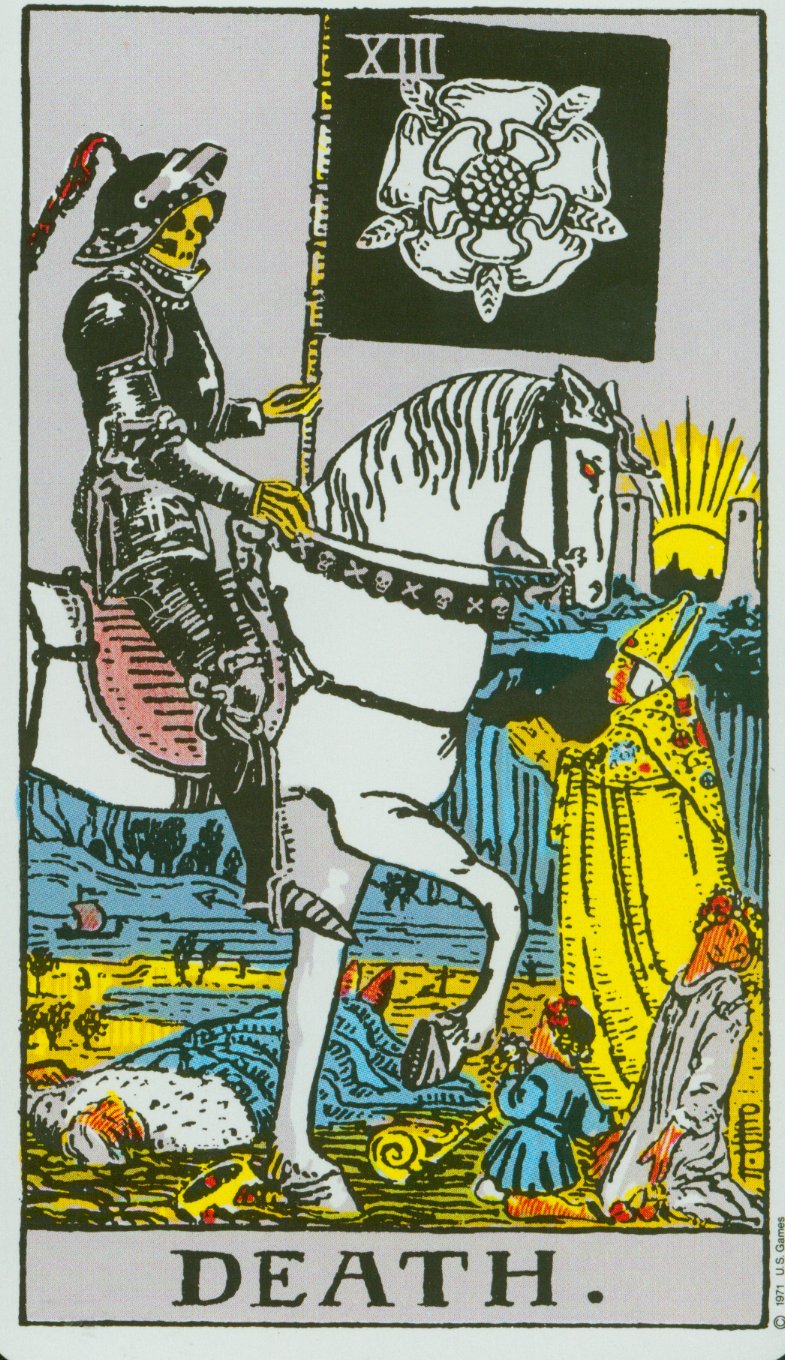
RW-Death

Much later in 1960, a year before his death, Jung seemed less sanguine about Tarot and the occult, or at least downplayed their mystical, divinatory power for language more suited to the laboratory, right down to the usual complaints about staffing and funding. As he wrote in a letter about his attempts to use these methods:

Under certain conditions it is possible to experiment with archetypes, as my ‘astrological experiment’ has shown. As a matter of fact we had begun such experiments at the C. G. Jung Institute in Zurich, using the historically known intuitive, i.e., synchronistic methods (astrology, geomancy, Tarot cards, and the I Ching). But we had too few co-workers and too little means, so we could not go on and had to stop.

Later interpreters of Jung doubted that his experiments with divination as an analytical technique would pass peer review. “To do more than ‘preach to the converted,’” wrote the authors of a 1998 article published in the Journal of Parapsychology, “this experiment or any other must be done with sufficient rigour that the larger scientific community would be satisfied with all aspects of the data taking, analysis of the data, and so forth.” Or, one could simply use Jungian methods to read the Tarot, the scientific community is damned.

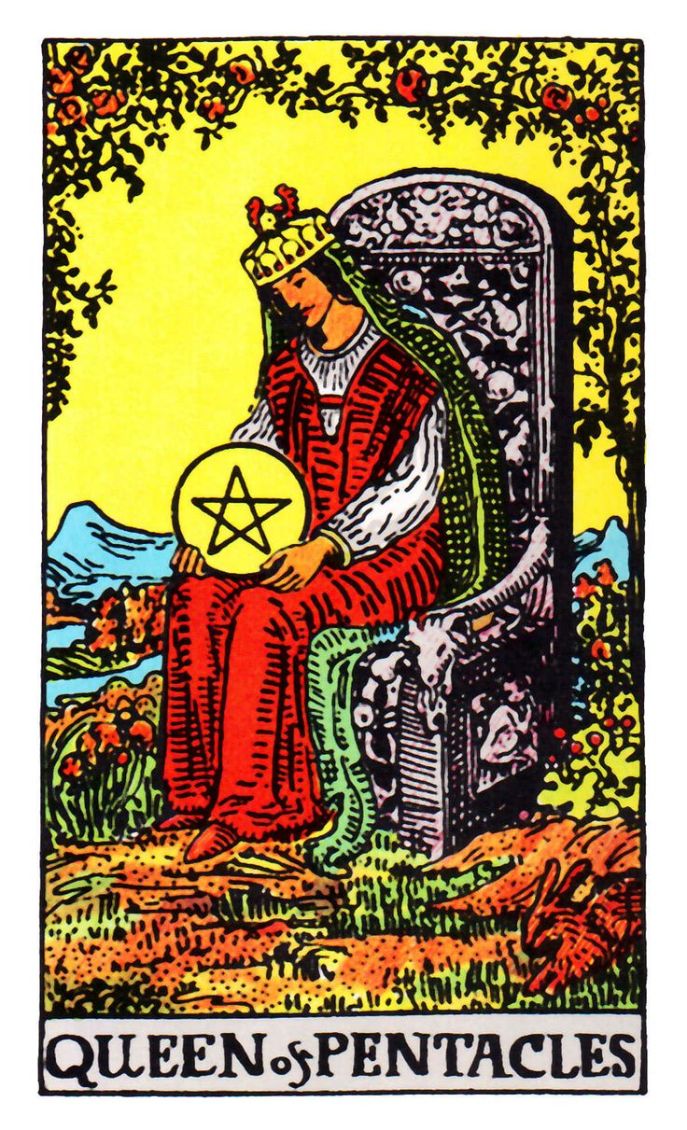
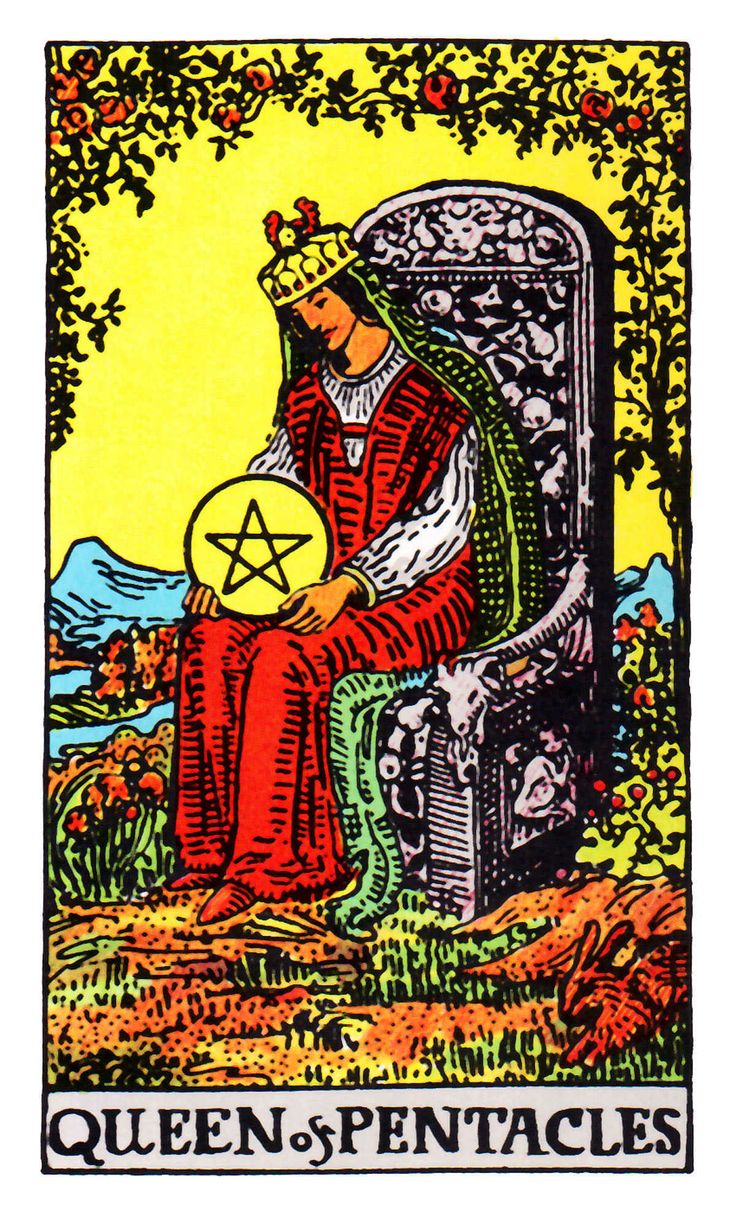
RW-Queen-of-Pentacles

As in Jung’s many other creative reappropriations of mythical, alchemical, and religious symbolism, his interpretation of the Tarot inspired those with mystical leanings to undertake their own Jungian investigations into parapsychology and the occult. Inspired by Jung’s verbal descriptions of the Tarot’s major arcana, artist and mystic Robert Wang has created a Jungian Tarot deck, and an accompanying trilogy of books, The Jungian Tarot and its Archetypal ImageryTarot Psychology, and Perfect Tarot Divination.

You can see images of each of Wang’s cards here. His books purport to be exhaustive studies of Jung’s Tarot theory and practice, written in consultation with Jung scholars in New York and Zurich. Sallie Nichols’ Jung and Tarot: An Archetypal Journey is less voluminous and innovative—using the traditional, Pamela Coleman-Smith-illustrated, Rider-Waite deck rather than an updated original version. But for those willing to grant a relationship between systems of symbols and a collective unconscious, her book may provide some penetrating insights, if not a recipe for predicting the future.

Related Content:

Alejandro Jodorowsky Explains How Tarot Cards Can Give You Creative Inspiration

The Tarot Card Deck Designed by Salvador Dalí

Twin Peaks Tarot Cards Now Available as 78-Card Deck

Josh Jones is a writer and musician based in Durham, NC. Follow him 

Wotan in the Shadows: Analytical Psychology and the Archetypal Roots of War by Ritske Rensma

Standard

In my opinion, someone like Dr Jung does not necessarily live in between two wars to be aware of the aggressiveness or pugnacity of the human! Although I must remind it here that I’ve heard once Dr Freud in his last years living on this planet, had warned the society (after the publication of the book; [Mein Kampf], by Hitler, that: >This madness must be Stopped< but nobody had listened to it!

via https://www.depthinsights.com/Depth-Insights-scholarly-ezine/wotan-in-the-shadows-analytical-psychology-and-the-archetypal-roots-of-war-by-dr-ritske-rensma/

Anything that disappears from your psychological inventory is apt to turn up in the guise of a hostile neighbour, who will inevitably arouse your anger and make you aggressive. It is surely better to know that your worst enemy is right there in your own heart. Man‘s war-like instincts are ineradicable – therefore a state of perfect peace is unthinkable (Jung, 1946, par. 456).

Spread the love    nietzsche-12201411_s-RF123pd-300x300
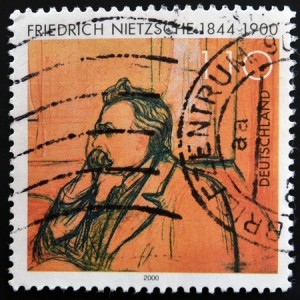
 
introduction

Jung lived in a time of crisis. He was confronted with the atrocities of two world wars, spent his final years in the climate of the cold war, and was hugely concerned about mankind’s inability to find solutions to the recurring occurrences of the mass conflict he was forced to witness in his lifetime. It should come as no surprise, then, that Jung wrote extensively about the possible causes of war and conflict. A central notion which he defended throughout his career was that the roots of war are to be found in the human psyche, in what he called our “war-like instincts,” which we will never be able to eradicate:

Anything that disappears from your psychological inventory is apt to turn up in the guise of a hostile neighbor, who will inevitably arouse your anger and make you aggressive. It is surely better to know that your worst enemy is right there in your own heart. Man‘s war-like instincts are ineradicable – therefore a state of perfect peace is unthinkable (Jung, 1946, par. 456).

It was these instincts which Jung saw as lying at the root of both world wars. According to him, these instincts “bubble up” to the surface whenever they have been repressed for too long a time, and if no way is found to integrate such forces into consciousness, the results can be catastrophic. In this article, I will argue that Jung developed and fine-tuned many of his ideas about this topic through a dialogue with the ideas of philosopher Friedrich Nietzsche. As I pointed out in an earlier article about Nietzsche’s influence on Jung (published in Depth Insights in fall 2012   ), Jung found Nietzsche’s work extremely compelling. In his semi-autobiography Memories, Dreams, Reflections, he even went as far as to connect Nietzsche to what he saw as the central task underlying his life’s work:

The meaning of my existence is that life has addressed a question to me. That is a supra-personal task, which I accompany only by effort and with difficulty. Perhaps it is a question which preoccupied my ancestors, and which they could not answer? Could that be why I am so impressed by the problem on which Nietzsche foundered: the Dionysian side of life, to which the Christian seems to have lost the way? (Jung, 1965 [1961], p. 350)

In this article, I will show that Nietzsche had a particularly strong influence on Jung’s thinking about war and conflict. I will also show how Jung’s ideas about this topic changed over time, culminating in a final theoretical position which revolves around the concept of the archetypal shadow. In order to sketch this development on Jung’s part in a clear and coherent manner, I will divide this article into three sections, each of which will deal with a different time period from Jung’s career:

Phase 1: The early years.

In order to examine Jung’s early ideas about the psychological roots of war, we will look at the article “Role of the Unconscious” from 1918, which is the clearest and complete text about this topic from Jung’s early years.

Phase 2: The Wotan years.

In the 1930s Jung goes through a phase in which he refers to the part of the psyche he associates with war and violence by the term “archetype of Wotan.” In order to examine the core ideas of this phase, we will look at two key texts from this time period: the short article “Wotan” from 1936 and the transcription of the seminar Jung gave on Nietzsche’s Also Sprach Zarathustra in 1934.

Phase 3: The shadow years.

From the early 1940s onwards Jung stops using the term “archetype of Wotan” in his texts about war and violence and begins using the term “archetype of the shadow” instead. In order to examine this final developmental stage, we will look at the article “Fight With the Shadow” from 1946.

To simplify the task of discussing this development, I will refer to the stages outlined above as Phase 1, Phase 2 and Phase 3. The “dividing line” that I will use to demarcate between these phases is the term “archetype of Wotan”, which Jung only uses in Phase 2. Phase 1 is thus defined as lasting up until the point where he begins to use this term, which he does for the first time in the seminar on Zarathustra in 1934; Phase 2 is thus defined as lasting from 1934 until he starts to use the term “archetypal shadow” instead (the earliest text I have found in which this term is present is from 1943   ). Phase 3, lastly, is defined as everything after the end of Phase 2 (1943-1961).

Phase 1: The early years

As I already explained above, the text from Phase 1 in which Jung elaborates most clearly on his ideas about war and violence is the article “Role of the Unconscious” from 1918, published in an English translation in The Collected Works of C.G. Jung, Volume 10. Since this is also the only text from Phase 1 in which he makes an explicit connection between this topic and the ideas of Nietzsche, it is this text that we will focus on to analyze Jung’s early ideas about the psychological roots of war.

Role of the Unconscious” is not an article which deals specifically with the topic of the psychological roots of war. It seems to have been written primarily to put forward the core ideas of Jung’s theoretical framework to a general audience, with a strong emphasis on making the differences with Freud clear. Jung wrote it at the end of the First World War, however, and for that reason, it should come as no surprise that the topic of war was heavily on his mind. The middle part of the article, then, deals almost entirely with offering possible psychological explanations for the calamities that had just swept across Europe. Jung begins this part of the paper by reflecting on what he calls here the “barbaric”, “dark”, “primitive” and “animalistic” dimension of the psyche (Jung uses all these terms as synonyms in “Role of the Unconscious”). His core observation about the origins of this part of the psyche is that it is the residue of our evolutionary history, which, as Jung observes, is marked by a very long period of “primitive” prehistory and only a comparatively short period of “cultured” history. For this reason, the “primitive” part of the psyche exerts a much stronger influence on our behaviour than the “cultured” part, according to Jung:

A mere fifty generations ago many of us in Europe were no better than primitives. The layer of culture, this pleasing patina, must therefore be quite extraordinarily thin in comparison with the powerfully developed layers of the primitive psyche (Jung, 1918, par. 16).

As influential and powerful as this part of the psyche is, however, it has nevertheless been repressed by Western culture for a very long time according to Jung. Showing quite clearly the influence of Nietzsche, Jung associates this repression with the values of Christianity. Nietzsche himself repeatedly wrote that Christianity represses the instincts; it is at war with the primitive, bodily self. Jung shares this observation. Christianity, as Jung writes in “Role of the Unconscious”, “split the Germanic barbarian into an upper and a lower half, and enabled him, by repressing the dark side, domesticate the brighter half and fit it for civilization” (Jung, 1918, par. 17). But the more this dark, animalistic, “inner barbarian” is repressed, the more the unconscious seeks to correct this one-sided attitude by activating the primitive aspects of the self. This, according to Jung, is what the unconscious does time and again: it offers what he calls a compensation to the attitudes and values of our consciousness once these become too narrow and restrictive. Because Western culture was unable to integrate such a “primitive” compensation in an appropriate manner during the years leading up to the First World War, the results were catastrophic. War and violence ensued, on a global scale:

By being repressed into the unconscious, the source from which it originated, the animal in us only becomes more beastlike, and that is no doubt the reason why no religion is so defiled with the spilling of innocent blood as Christianity, and why the world has never seen a bloodier war than the war of the Christian nations. The repressed animal bursts forth in its most savage form when it comes to the surface, and in the process of destroying itself leads to international suicide (Jung, 1918, par. 32).

This, then, is Jung’s core observation about the psychological roots of war in Phase 1: that the one-sidedness of Christian culture led to an unconscious compensation consisting of primitive archetypal content, which in turn led to the violence and frenzy of the first world war. Because “Role of the Unconscious” deals so extensively with this topic, it is an excellent text to look at if one is interested in Jung’s early ideas about it. What “Role of the Unconscious” also makes clear, however, is that a connection exists between Jung’s ideas about the primitive, “barbaric” part of the psyche and the philosopher Friedrich Nietzsche. On this topic Jung does not elaborate very much on “Role of the Unconscious”, writing only the following:

This annoying peculiarity of the barbarian was apparent also to Nietzsche – no doubt from personal experience […] (Jung, 1918, par. 19).

What Jung means with this rather vague statement is never made entirely clear in “Role of the Unconscious”, as there are no further references to Nietzsche in its pages. In order to make sense of it, we have to look at two texts from what I have defined in the introduction as Phase 2: the transcription of the seminar Jung gave on Nietzsche‘s Also Sprach Zarathustra in 1934, and the article “Wotan” from 1936.

Phase 2: The Wotan years

As I explained in the introduction, Jung makes an important change to his ideas about war in Phase 2. He now begins to identify a particular archetype of the collective unconscious with war, violence and conflict — the archetype he calls in this phase the archetype of Wotan. Jung took inspiration from Germanic mythology when naming this new archetype: Wotan (also transcribed as “Woden” or “Odin”) is the name of the Germanic supreme God. Wotan was associated primarily with war and fury, which goes a long way towards explaining why Jung decided to use this name for the archetype he associated with the roots of war. Jung himself described Wotan as follows:

He is the god of storm and frenzy, the unleasher of passions and the lust of battle; moreover he is a superlative magician and artist in illusion who is versed in all secrets of an occult nature (Jung, 1936, par. 375).

The way Jung describes the archetype of Wotan in Phase 2 is highly similar to what he had to say about the primitive part of the psyche in “Role of the Unconscious”. The best paper to establish this is his short article “Wotan”, published in an English translation in The Collected Works of C.G. Jung, Volume 10. In this article, written by Jung in 1936, Jung repeatedly refers to the archetype of Wotan as the “dark” part of the psyche, which is the exact same metaphor he also used in “Role of the Unconscious” to describe the primitive part of the psyche. Another key similarity to “Role of the Unconscious” is that he states that the archetype of Wotan was repressed during the Christian era and that it is now becoming dominant again because of the psychological mechanism of compensation. Furthermore, in order to explain why the archetype of Wotan is still so powerful, Jung uses the same kind of “evolutionary” reasoning he also employed in “Role of the Unconscious”: the longer a particular part of the psyche has been dominant in our evolutionary history, the stronger its force, no matter how much cultural baggage is put on top of it to repress it. In Wotan Jung phrases this idea as follows:

Archetypes are like riverbeds which dry up when the water deserts them, but which it can find again at any time. An archetype is like an old watercourse along which the water of life has flowed for centuries, digging a deep channel for itself. The longer it has flowed in this channel the more likely it is that sooner or later the water will return to its old bed. The life of the individual as a member of society and particularly as part of the State may be regulated like a canal, but the life of nations is a great rushing river which is utterly beyond human control, in the hands of One who has always been stronger than men (Jung, 1936, par. 395).

Because of these similarities, I think that the conclusion is entirely justified that Jung used the term archetype of Wotan to refer to the same part of the psyche he called the “primitive psyche” in “Role of the Unconscious”.   As we have seen, Jung made a connection in “Role of the Unconscious” between this primitive part of the psyche and Nietzsche but failed to make clear what this connection exactly entailed. In the texts from Phase 2 in which Jung discusses the archetype of Wotan, however, we find ample information to help us make sense of it. Nietzsche, as Jung claims in these texts, was among the first in Europe in whom the archetype of Wotan was constellated. In the seminar on Zarathustra, which Jung gave in 1936 and which shares many central themes with the “Wotan” article,   Jung makes this connection especially clear:

It is Wotan who gets him, the old wind God breaking forth, the god of inspiration, of madness, of intoxication and wildness, the god of the Berserkers, those wild people who run amok (Jung, 1988 [1934], Vol. 2, p. 1227).

We can now finally begin to make sense of the fact that Jung was so interested in Nietzsche. Nietzsche, Jung felt, helped him to understand the age in which he lived—an age characterized by an outbreak of violence on a massive scale. Since Nietzsche was “gripped” by the same archetype which later led to the outbreak of this violence, studying the great man’s writings was a way to understand the psychological roots of this phenomenon. This also explains why Jung went as far as to devote an entire seminar to Nietzsche’s Zarathustra. As Jung puts it in the seminar:

Perhaps I am the only one who takes the trouble to go so much into the detail of Zarathustra — far too much, some people may think. So nobody actually realises to what extent he was connected with the unconscious and therefore with the fate of Europe in general (Jung, 1997 [1934], p. xix).

Jung’s thinking about the psychological roots of war, however, did not stop in the 1930s. As is the case with many of Jung’s core concepts, he continued to refine his ideas about it, arriving at a final theoretical position only after the end of another time of intense violence: the Second World War. It is to that final theoretical position that we will now turn. In order to examine it, we will look at what I consider to be the most important text Jung wrote about war in the final phase of his career: the short article “Fight With the Shadow”, which Jung originally delivered as a speech in 1946 for BBC radio.

Phase 3: The shadow years

Jung begins “Fight With the Shadow” by making the same observation he also makes in Phase 1 and Phase 2: that an uprush of compensatory, instinctual material was present in the psyche of the European people as early as the 1910s and was responsible for the century’s abundant cases of war and violence. As he himself puts it:

As early as 1918, I noticed peculiar disturbances in the unconscious of my German patients which could not be ascribed to their personal psychology. Such non-personal phenomena always manifest themselves in dreams as mythological motifs that are also to be found in legends and fairytales throughout the world. I have called these mythological motifs archetypes: that is, typical modes or forms in which these collective phenomena are experienced. There was a disturbance of the collective unconscious in every single one of my German patients. One can explain these disorders causally, but such an explanation is apt to be unsatisfactory, as it is easier to understand archetypes by their aim rather than by their causality. The archetypes I had observed expressed primitivity, violence, and cruelty (Jung, 1946, par. 447)

From the outset, then, it is clear that “Fight With the Shadow” is strongly related to the key themes of the first two phases. Jung even makes a particular reference to “Role of the Unconscious“, stating that he wrote in 1918 about “peculiar disturbances in the unconscious of my German patients which could not be ascribed to their personal psychology.” The rest of the article is equally consistent in terms of its central themes. Where we see a remarkable difference between “Fight With the Shadow” and the first two phases, however, is in the terminology Jung uses. As we have seen, Jung made frequent references to the archetype of Wotan in Phase 2. This terminology, however, is not present in “Fight With the Shadow”, nor is it present in any other text from Phase 3. Instead, Jung now uses the concept of the shadow to explain the forces which were unleashed during the two world wars:

Like the rest of the world, [the Germans] did not understand wherein Hitler‘s significance lay, that he symbolized something in every individual. He was the most prodigious personification of all human inferiorities. He was an utterly incapable, unadapted, irresponsible, psychopathic personality, full of empty, infantile fantasies, but cursed with the keen intuition of a rat or a guttersnipe. He represented the shadow, the inferior part of everybody‘s personality, in an overwhelming degree, and this was another reason why they fell for him (Jung, 1946, par. 454).

In order to understand this concept properly, it is crucial to realize that Jung used the term shadow in two different ways, making a distinction between the personal shadow and the archetypal shadow. Jungian analyst Daryl Sharp defines the personal shadow as follows: “[it] is composed for the most part of repressed desires and uncivilized impulses, morally inferior motives, childish fantasies and resentments, etc. – all those things about oneself one is not proud of. These unacknowledged personal characteristics are often experienced in others through the mechanism of projection” (Sharp, 1991, p. 123).

The personal shadow, then, consists entirely of contents from what Jung called the personal unconscious, as everything that is associated with it has become unconscious through the mechanism of repression and has, therefore, become unconscious during the individual‘s lifetime. For this reason, there is nothing innate or archetypal about the personal shadow. In his later years, however, Jung began to contrast the personal shadow with the archetypal shadow (see for example Aion par. 19 (Jung, 1952)). In contrast to the personal shadow, the archetypal shadow is innate. It is the same in everyone and consists of content not acquired during an individual’s lifetime. Instead, it is made up of content that was acquired over the course of mankind’s evolutionary history.

Although Jung doesn’t mention which version of the shadow concept he is talking about in “Fight With the Shadow” — confusingly, he merely uses the term “shadow” without any kind of prefix – there is more than enough evidence that it is the archetypal shadow he is talking about. To begin with, Jung stresses time and again that the unconscious material he is discussing in this article is innate and therefore archetypal. I have already quoted him above, for example, as writing the following:

As early as 1918, I noticed peculiar disturbances in the unconscious of my German patients which could not be ascribed to their personal psychology. Such non-personal phenomena always manifest themselves in dreams as mythological motifs that are also to be found in legends and fairytales throughout the world. I have called these mythological motifs archetypes (Jung, 1918, par. 447).

As Jung makes clear in this quote, the content of the compensatory uprush of instinctual unconscious material he observed as early as 1918 could not be ascribed to the “personal psychology” of his patients. In short, it did not stem from the personal unconscious, but from the collective unconscious, the content of which is innate and archetypal.

Another hint that it is the archetypal shadow Jung is talking about in “Fight With the Shadow” is related to the fact that an entire group of people is confronted with this specific unconscious manifestation. As Ann Casement (2006) points out in her introduction to the concept of the shadow in The Handbook of Jungian Psychology, the personal shadow is a compensation for a certain one-sidedness in the life of the individual; the archetypal shadow, however, is constellated in response to a certain one-sidedness in the cultural life of an entire group of people. It is quite clear that Jung is talking about the latter kind of compensation in “Fight With the Shadow”, as he is not analyzing the psychological dynamics of a single individual in this text—rather, he is looking at the dynamics of the psyche of the entire people of Europe, with a special focus on the Germans. Although he does single out Hitler in particular, he makes it quite clear that Hitler was only a mouthpiece: he gave voice to psychological disturbances that were present in every single one of his followers.

As I already stated above, apart from the terminology, no core ideas have changed in Phase 3 about war and violence. The archetypal shadow is the term Jung now uses to describe the exact same phenomenon, which he explained by using the term archetype of Wotan in Phase 2. Is it the case, then, that these two terms are synonyms? Do both the archetype of Wotan and the archetype of the shadow refer to the same archetypal part of the psyche? Even though Jung never explicitly explains that this is the case, I believe that it is very much possible to establish that this is true.

One way to do this is by examining the mythological symbols Jung associated with these two archetypes. When discussing the archetypal shadow in Phase 3 of his career, for example, Jung frequently stated that the Christian figure of the devil was a manifestation of this particular archetype (Jung, 1943, par. 143). In Phase 2, Jung said exactly the same as the archetype of Wotan (Jung, 1936, par. 374). On top of the fact that the mythic figures he associated with these two archetypes are the same, we should also note that the phenomenon Jung tried to explain by means of these concepts is the same. In Phase 2, for example, Jung uses the term archetype of Wotan to explain the success of Hitler at the end of the 1930s; in Phase 3 he explains the success of Hitler by using the term archetypal shadow. To me, this means that concluding that the archetype of Wotan and the archetype of the shadow were synonyms for Jung is entirely justified.

So why did Jung stop using the term archetype of Wotan in Phase 3? For myself, I have come to conclude that this change of terminology is probably related to the fact that calling Wotan an archetype can give rise to the belief that one subscribes to the notion of a racial unconscious. The God Wotan, needless to say, is a mythic figure found only in Germanic culture, which means that it makes very little sense to say that he is innate unless one is of the opinion that there is a Germanic racial unconscious with innate material only to be found in Germanic people.

Although Jung flirted with ideas of this nature, most Jung scholars have concluded that he abandoned such ideas in the forties and did not make them a part of his final theoretical position. What I think Jung concluded in Phase 3 is that Wotan is not an archetype, but what is known in Jungian language as an “archetypal image”—a specific cultural manifestation of a collective innate structure. It is the innate structure which is inherited and can be found in every individual; the cultural manifestations the archetype gives rise to, however, are specific only to a certain group of people.

By using the more general term “archetypal shadow” for the innate psychological structure, it becomes much more clear that there is no room for race-specific innate components in Jung’s theoretical framework. That Jung would want to stress this after the atrocities of the Nazi regime should come as no surprise. Needless to say, the idea that there is a difference between the Germanic psyche and the psyche of other races was something that the Nazis not only flirted with but turned into the bedrock of their elitist, race-based philosophy.

Conclusion

This fear of being accused of a Nazi sympathizer perhaps also explains why Jung stops making so many references to the ideas of Nietzsche in Phase 3. As we have seen, such references are abundantly present in Phase 2, with Jung even devoting an entire seminar to Also Sprach Zarathustra. In Phase 3, however, the references to Nietzsche become much less frequent and elaborate. After the end of World War Two, Nietzsche had become a controversial figure: his concept of the übermensch had been popular among the Nazi party elite, which they joined with great enthusiasm to their own pseudo-scientific theories about the general superiority of the Arian race. Jung perhaps thought it wiser to stop explaining his own ideas by comparing them to Nietzsche, as such comparisons could quite easily lead to him being mistaken for a closet Nazi supporter or a defender of elitist racial theories.

Nevertheless, I do think that the information provided in this article lends strong support to the notion that Jung’s final theoretical position on war and violence was inspired by Nietzsche. What I hope to have shown clearly and persuasively is that the ideas Jung put forward about the archetype of the shadow in Phase 3 stand quite firmly at the end of a long line of development, which began with “Role of the Unconscious” in Phase 1 and continued with the seminar on Zarathustra and the “Wotan” article in Phase 2. Since Jung drew quite openly on Nietzsche’s ideas in these first two phases, it follows logically that the theoretical position he defends in Phase 3 represents the outcome of his dialogue with Nietzsche’s work.

I think seeing this development clearly is important for several reasons. For one, it shows us how important a historical approach is when reading Jung’s work. He made important and drastic changes to both his ideas and terminology over time, which means one should be careful when combining ideas from texts from different time periods. It also sheds new light on his concept of the shadow, illuminating how important the difference between the personal and archetypal shadow is and showing very clearly how central the concept of the archetypal shadow is to Jung‘s final theoretical take on war and conflict.

Lastly, I think this development also makes overwhelmingly clear how important Nietzsche was to Jung. Most importantly, it shows to which Jungian concept we might turn if we want to know where we can see Nietzsche‘s influence most strongly. As I hope to have shown in this article there is substantial evidence that this concept is the archetypal shadow.

References

Casement, A. (2006). The Shadow. In R. K. Papadopoulos (Ed.), The Handbook of Jungian Psychology. New York & London: Routledge.

Jung, C. G. (1918). The Role of the Unconscious.  In The Collected Works of C.G. Jung (Vol. 10). Princeton: Princeton University Press.

Jung, C. G. (1936). Wotan. In The Collected Works of C.G. Jung (Vol. 10). Princeton: Princeton University Press.

Jung, C. G. (1943). On the Psychology of the Unconscious.  In The Collected Works of C.G. Jung (Vol. 7). Princeton: Princeton University Press.

Jung, C. G. (1946). Fight with the Shadow.  In The Collected Works of C.G. Jung (Vol. 10). Princeton: Princeton University Press.

Jung, C. G. (1952). Aion.  In The Collected Works of C.G. Jung (Vol. 9.ii). Princeton: Princeton University Press.

Jung, C. G. (1965 [1961]). Memories, dreams, reflections. New York: Random House.
Jung, C. G. (1988 [1934]). Nietzsche‘s Zarathustra: notes of the seminar given in 1934-1939. Princeton: Princeton University Press.

Jung, C. G. (1997 [1934]). Jung’s seminar on Nietzsche‘s Zarathustra (abridged edition). Princeton: Princeton University Press.

Rensma, R. (2012). Jung’s Reception of Friedrich Nietzsche: A Roadmap for the Uninitiated. Depth Insights, 1(3).

Safranski, R. d. (2002). Nietzsche: A Philosophical Biography. London: Granta.
Sharp, D. (1991). Jung Lexicon – A Primer of Terms and Concepts. Toronto: Inner City Books.


Dr Ritske Rensma is a lecturer in the field of Religious Studies at University College Roosevelt, an international honors college of the University of Utrecht in the Netherlands. He is the author of the book The Innateness of Myth (London: Bloomsbury, 2010), which analyses Jung’s influence on the American comparative mythologist Joseph Campbell.


(Image Credit  Copyright: http://www.123rf.com/profile_neftali77

The Story of Lewis (TV series), Oxford, My Wife and Me!

Standard

Unfortunately, I have not much time to write my thoughts, as I must work almost 50 hours a week (yes, the life is not always fair!) but now in these days as I have a few holidays I take this opportunity to share with you; friends about this beautiful city: Oxford. 🙂

p429181_b_v8_ao

I don’t know if anybody has seen or watched this dramatic Police serial on the TV, I myself spotted this about last year on one the “not so popular” channel in the German TV and I was immediately in love with that as my wife joined me later in the same way. It is really a very sensible TV loop and in the opposite of many others, it’s very intellectual. created and written by Colin Dexter.

Anyway, It was a very strong reason to plan a trip to Oxford to see this wonderful city with so many fascinating old buildings and universities as we’re following the stories which were interesting enough, to watch the structures and the houses here and there in the streets.

Although, not being untold that I’ve found later that this serial began primarily under the name; Inspector Morse “had been played by John Thaw” who died of cancer in 2001 and thereafter it follows under the name Inspector Lewis with Kevin Whately who had played as Surgent Lews by Morse, here in the new episode took the post of inspector with Laurence Fox as DS James Hathaway.

In any case, long speech and short sense as one may say, we have decided to take a short trip to Oxford in May and were lucky because of the weather, as it was wonderfully sunny and warm 🙂 and as we walk through the streets between these giant walls, it seems we’re learning with every breath we took, something new 😉 and I can just recommend undertaking the trip to everyone in to this amazing city.

https://en.wikipedia.org/wiki/Inspector_Morse_(TV_series)

https://en.wikipedia.org/wiki/Lewis_(TV_series)

Shakespeare’s “Macbeth” from a Jungian view

Standard

fallenAngel's avatarstOttilien

when they all know the good as good, there arises the recognition of evil. When they all know the good as good, there arises the recognition of evil.

This article explores the psychological underpinnings of  Shakespeare’s “Macbeth” from a Jungian view. Carl Jung left a great deal of ambiguity surrounding his work. He understood, as long as there have been men and they have lived, they have all felt this tragic ambiguity and everybody must accept his or her “Shadow” during the individuation process. Ambiguity between good an evil, and a failed individuation is the core theme in the tragedy Macbeth: “Fair is foul, and foul is fair” say the three witches in the beginning of the play and this paradox is touched again by Macbeth: “So foul and fair a day I have not seen”. The enemy and death is “foul” – bad – but the outcome of the battle is “fair” – good, only because he has won.So the play Macbeth is about the evil, but as we see mostly the evil in us, and this evil is first impersonated by the witches. That is…

View original post 2,542 more words

‘Know thyself’ is not just silly advice: it’s actively dangerous

Standard

From: https://aeon.co/users/bence-nanay

Bence Nanay is a professor of philosophy at the University of Antwerp and Senior Research Associate at the University of Cambridge. He is the author of Aesthetics as Philosophy of Perception (2016).

https://aeon.co/partners/american-philosophical-association

Edited by Sam Dresser

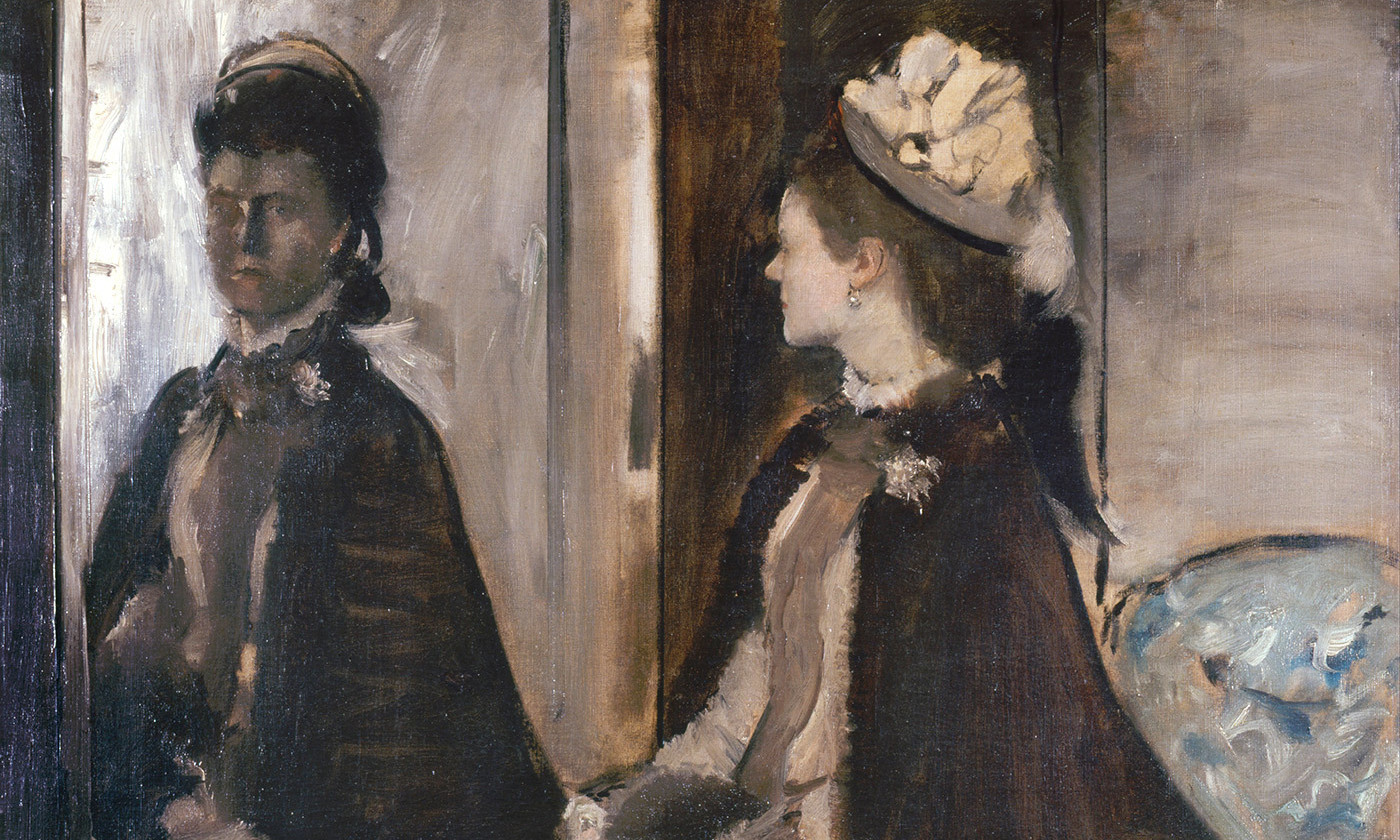
idea_sized-edgar_degas_-_mrs_jeantaud_in_the_mirror_-_google_art_project

Detail from Madame Jeantaud au miroir by Edgar Degas c1875. Courtesy Wikipediaways

As I always keep believing in that; know thyself, that’s the first step in our life; the very beginning.

There is a phrase you are as likely to find in a serious philosophy text as you are in the wackiest self-help book: ‘Know thyself!’ The phrase has serious philosophical pedigree: by Socrates’ time, it was more or less received wisdom (apparently chiselled into the forecourt of the Temple of Apollo at Delphi), though a form of the phrase reaches back to Ancient Egypt. And ever since, the majority of philosophers have had something to say about it.

But ‘Know thyself!’ also has self-help appeal. Is your aim to accept yourself? Well, you need to know thyself for that first. Or is it to make good decisions – decisions that are right for you? Again, this would be difficult unless you’ve known thyself. The problem is that none of this is based on a realistic picture of the self and of how we make decisions. This whole ‘knowing thyself’ business is not as simple as it seems. In fact, it might be a serious philosophical muddle – not to say bad advice.

Let’s take an everyday example. You go to the local cafe and order an espresso. Why? Just a momentary whim? Trying something new? Maybe you know that the owner is Italian and she would judge you if you ordered a cappuccino after 11am? Or are you just an espresso kind of person?

I suspect that the last of these options best reflects your choices. You do much of what you do because you think it meshes with the kind of person you think you are. You order eggs, Benedict, because you’re an egg’s Benedict kind of person. It’s part of who you are. And this goes for many of our daily choices. You go to the philosophy section of the bookshop and the fair-trade section at the grocer’s shop because you are a philosopher who cares about global justice, and that’s what philosophers who care about global justice do.

We all have fairly stable ideas about what kind of people we are. And that’s all for the best – we don’t have to think too hard when ordering coffee every morning. These ideas about what kind of people we are might also be accompanied by ideas about what kind of people we are not – I’m not going to shop at Costco, I’m not that kind of person. (This way of thinking about yourself could easily slide into moralising your preferences, but let’s not open that can of worms here.)

There is, however, a deep problem with this mental set-up: people change. There are tumultuous periods when we change drastically – in times of romantic love, say or divorce, or having children. Often we are aware of these changes. After you’ve had kids, you probably notice that you’ve suddenly become a morning person.

But most changes happen gradually and under the radar. A few mechanisms of these changes are well understood, such as the ‘mere exposure effect’: the more you are exposed to something, the more you tend to like it. Another, more troubling one, is that the more your desire for something is frustrated, the more you tend to dislike it. These changes happen gradually, often without us noticing anything.

The problem is this: if we change while our self-image remains the same, then there will be a deep abyss between who we are and who we think we are. And this leads to conflict.

To make things worse, we are exceptionally good at dismissing even the possibility that we might change. Psychologists have given this phenomenon a fancy name: ‘The End of History Illusion’. We all think that who we are now is the finished product: we will be the same in five, 10, 20 years. But, as these psychologists found, this is completely delusional – our preferences and values will be very different already in the not-so-distant future.

Why is this such a big issue? It might be okay when it comes to ordering the espresso. Maybe you now slightly prefer cappuccino, but you think of yourself as an espresso kind of person, so you keep ordering an espresso. So you’re enjoying your morning drink a little bit less – not such a big deal.

But what is true of espresso is true of other preferences and values in life. Maybe you used to genuinely enjoy doing philosophy, but you no longer do. But as being a philosopher is such a stable feature of your self-image, you keep doing it. There is a huge difference between what you like and what you do. What you do is dictated not by what you like, but by what kind of person you think you are.

The real harm of this situation is not only that you spend much of your time doing something that you don’t particularly like (and often positively dislike). Instead, it is that the human mind does not like blatant contradictions of this kind. It does its best to hide this contradiction: a phenomenon known as cognitive dissonance.

Hiding a gaping contradiction between what we like and what we do takes significant mental effort and this leaves little energy to do anything else. And if you have little mental energy left, it is so much more difficult to switch off the TV or to resist spending half an hour looking at Facebook or Instagram.

‘Know thyself!’, right? If we take the importance of change in our lives seriously, this just isn’t an option. You might be able to know what you think of yourself in this moment. But what you think of yourself is very different from who you are and what you actually like. And in a couple of days or weeks, all of this might change anyway.

Knowing thyself is an obstacle to acknowledging and making peace with constantly changing values. If you know thyself to be such-and-such a kind of person, this limits your freedom considerably. You might have been the one who chose to be an espresso person or a donating-to-charity person but, once these features are built into your self-image, you have very little say in what direction your life is going. Any change would be either censored or lead to cognitive dissonance. As André Gide wrote in Autumn Leaves (1950): ‘A caterpillar who seeks to know himself would never become a butterfly.’

The Eunuch and the Emperor

Standard
From; http://www.historytoday.com/archive/history-today/latestunnamed-1.jpg

Was the eunuch Earinus the lover of Domitian, one of Rome’s ‘Bad Emperors’? Llewelyn Morgan pieces together the extraordinary relationship between them.

Roman poetry offers many pleasures, but one thing it does not often provide is insight into the lives and experiences of the socially marginalised. We hear a lot about members of the social and political elite, from whom came both the authors and most of the readers of literature in Rome. We also see a fair amount of abuse directed at figures who might threaten the control exerted by this elite, such as influential women or powerful ex-slaves. Sympathetic accounts of the lives and aspirations of such people are, however, thin on the ground.

No group in Greco-Roman society was more maligned than the one to which Earinus belonged. He was a eunuch. To a culture that associated sexual potency with social respectability, eunuchs were beneath contempt. Yet for a brief moment in AD 94 Earinus transcended his contemptible condition, or at least that is how it appears from examination of the historical record. The story of Earinus tells us something about an individual’s efforts to achieve dignity in a culture that despised him.

Earinus was a slave owned by Domitian, Roman emperor from AD 81 to 96. Our evidence for Earinus’ life comes almost entirely from the poetry of Statius and Martial, the leading lights of Rome’s literary culture during Domitian’s reign. Like Caligula, Nero or Caracalla, Domitian is one of the ‘bad emperors’. He was undoubtedly paranoid (‘Shortage of funds made him rapacious’, wrote his biographer Suetonius, ‘and fear made him savage’). Yet there is a case to be made that, while less tactful than other emperors, he understood the essential character of imperial rule and was a competent and assiduous administrator. The greater prominence of Domitian in the public eye and the more blatantly autocratic nature of his regime left its mark on contemporary literature: one reason for the comparative neglect of Statius and Martial in modern scholarship is their sycophantic treatment of the emperor. But there is more to both poets than flattery and, even when they do schmooze Domitian, there is considerable historical interest in how they go about it.

Fragments of a colossal statue of Domitian from Ephesus, first century AD, Photograph by Sophie HayFragments of a colossal statue of Domitian from Ephesus, first century AD, Photograph by Sophie HayOne aspect of this more autocratic tendency under Domitian has special relevance for Earinus. Domitian had appointed himself Perpetual Censor, the guardian of traditional Roman morality. Among his enactments as Censor, courtesans were forbidden from travelling in litters, a conveyance that conveyed status, and a senator was expelled from the Senate for being too keen on dancing. More disturbingly, when a Vestal Virgin committed adultery, Domitian had her buried alive. (Her lovers were beaten to death with rods in the Forum.) But this puritanical zeal also saw him ban child prostitution and child castration; with a characteristic eye for detail he also introduced price controls, thereby ensuring that slave dealers who still had eunuchs on their books would not benefit from a rise in price as the commodity became more scarce.

Six poems by the epigrammatist Martial, all from his ninth book, and one longer composition by Statius, from his occasional poems known as Silvae, describe an elaborate, international ceremony in AD 94. Earinus, at the time aged between 16 and 18 years old, cut his long hair short and sent the cuttings, enclosed in a gold box studded with precious stones and accompanied by a golden mirror, as an offering to Asklepios, god of medicine, at his shrine in Pergamon (Pergamon is now Bergama in western Turkey, but was then an important city in the wealthy Roman province of Asia).

Statius’ poem recounts Earinus’ life up until that moment in AD 94, in the highly stylised manner of court poetry. It is the poetic counterpart, consciously so, of the gold, bejewelled box that bore his hair to Pergamon. Extracting dependable biographical information about Earinus from it (and from Martial’s epigrams on the same topic) is a challenge, but what we can gather is that Earinus had been born at Pergamon and was either a slave from birth or had been sold into slavery (perhaps by impoverished parents) at a very early age. Trafficked to Rome, in conditions certainly grimmer than those Statius describes (a swan-drawn chariot driven by Venus herself …), Earinus entered the service of the emperor.

At some point, but most likely when still a very small child, Earinus had been castrated. A Byzantine medical treatise by Paul of Aegina describes the kind of procedure he underwent:

When still infants, children are placed in a basin of hot water. Then, when the parts are relaxed, the testicles are squeezed with the fingers while still in the basin until they disappear and, being dissolved, no longer feel solid to the touch.

Castration of male children, by this or by a surgical method, produced a commodity for which dealers could ask high prices: a slave considered more malleable and docile, representing no threat to an owner’s womenfolk and whose boyish good looks would be preserved beyond the natural age of puberty.

Eunuch slaves and ex-slaves of the emperor’s household would become a significant phenomenon in the later Roman Empire, in some cases wielding immense power. In Earinus’ day, however, the imperial eunuch was still a rarity. One interesting exception is Posides, an official of the Emperor Claudius half a century earlier, who was involved in some capacity in the conquest of Britain. Posides was notorious for his immense wealth and extravagant building projects. There is an attractive theory that he gave his name to Positano, jewel of the Amalfi Coast: a spectacular Roman villa underlies much of the modern town and may have been called Posidetanum, the villa of Posides.

***

The sources never let us forget that Posides was a eunuch. His condition both fascinated and appalled Romans. They also encountered eunuchs in the cult of Cybele, notable for the galli, eunuch acolytes of the goddess, who processed through Rome to the accompaniment of drums, cymbals and raucous music. Self-castration for the galli was a way of distancing themselves from ordinary life and drawing closer to the divine. (The Skoptzy, a Christian sect in 19th-century Russia, are another example of such a phenomenon.) Cybele’s festival was an important one in the Roman calendar, but the galli were never something the Romans could feel comfortable with.

Eunuchs were a decadent, eastern phenomenon, an alien and alarming presence to many in Rome. Representative of this attitude is the poet Claudian in his attack on Eutropius, a political rival of Claudian’s patron Stilicho, also a eunuch. Claudian runs through a litany of horrifying events – speaking animals, showers of stones, fountains turned to blood – but insists that all fall short of the ultimate prodigy Eutropius, a eunuch consul. The consul, chief magistrate of the traditional Roman state, represents Rome’s austere traditional values; a eunuch their polar opposite. Claudian was writing three centuries after Earinus and Posides, but his prejudices were entirely in tune with Roman tradition.

Boiled down to its essence, Greco-Roman sexual morality was about maintaining the integrity of the male body. Domitian, meanwhile, was Roman morality in human form, the censor perpetuus. Yet by the time we encounter him, Earinus had become one of Domitian’s closest retainers, seemingly held in great affection by the emperor. (Suetonius mentions ‘a small boy clad in scarlet with an abnormally small head’, to whom Domitian would chat during shows in the Colosseum; I have wondered whether this is a glimpse of Earinus.) His precise role in the palace was as Domitian’s minister, which in Latin means cupbearer: Earinus prepared and served the emperor’s wine. This brought him into intimate contact with the emperor, allowing Statius to inflate the privilege he enjoyed, having contact as he did with ‘the right hand [of the emperor] that the Getae seek to know, and Persians, Armenians and Indians to touch’. But a Greco-Roman cupbearer was unlike a wine butler in one critical respect. The slave that poured the wine was expected to serve the master in other ways as well: Seneca writes of the minister who, ‘dressed like a woman, wrestles with his age: he cannot escape his boyhood … and remains awake all night, dividing it between his master’s drunkenness and his master’s lust’.

***

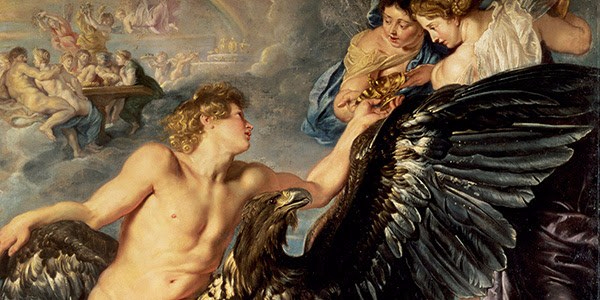
Martial and Statius imply that Earinus was Domitian’s lover as well as his wine server and dwell at length on his attractiveness. Martial spends three poems riffing on his name, its meaning being ‘springlike’, which the poet associates with delicacy, youth and beauty. Statius has Venus, goddess of love, first setting eyes upon him at Pergamon, ‘a boy radiant with the star of exceptional beauty’ and mistaking him for one of her own sons, a Cupid. Both poets also work hard to assimilate Earinus to Ganymede, Jupiter’s cupbearer and lover. It is also true that, throughout history, eunuchs have been the object of sexual exploitation and that was as true in antiquity as for castrati in 18th-century Europe. So it may seem obvious that Domitian and Earinus’ relationship was the same as that between Ganymede and Jupiter.

The Kidnapping of Ganymede by Peter Paul Rubens, 1611-12The Kidnapping of Ganymede by Peter Paul Rubens, 1611-12

For all that, there is no proof that relations between Earinus and Domitian were carnal in nature. The task facing these poets was to exalt the emperor’s cupbearer and one way to achieve this, in a highly artificial literary culture, was by amplifying stereotypical traits of beauty and sexual attractiveness. It is worth considering Earinus’ appearance in his later teens, when the physical consequences of his castration were no doubt becoming more obvious: the unnaturally high voice, the lack of facial hair and his youthful features. In Late Antiquity the rather otherworldly appearance that eunuchs developed would make angels and eunuchs interestingly interchangeable artistic categories; similar language was used of the castrato’s uncategorisable voice. Depicting Earinus as an ethereal beauty comparable to Ganymede may be a similar strategy. Above all, Earinus must be a fitting attendant for Domitian himself and the emperor’s own facial beauty was a regular theme of these poets: ‘You are sans pareil, boy’, says Statius’ Venus. ‘The only one more beautiful is he to whom you will be given.’

We can speculate all we like on Earinus’ wider experiences, but all we really know is what happened in AD 94. The primary significance of his offering to Asklepios is clear enough and confirmed by the poets. It is a coming of age ceremony. Martial uses the key word ephebus, meaning a boy at the point of puberty, but the cutting and dedication of long hair, which was associated with boyhood, as a mark of transition to manhood was a well-established ritual. The golden mirror that Earinus also sent to Pergamon carried a similar symbolic force. As Statius describes it, it appears to function like a photograph, an item that captures and perpetuates his youthful beauty but which now, like the boy’s long hair, is surrendered and dedicated to the god as he leaves his childhood behind him.

What is peculiar about all this is that, as a eunuch, Earinus could never ‘come of age’ in the standard fashion. As Statius writes, had Earinus never been castrated, ‘You would have sent more than one offering to Asklepios’ threshold’. As it is, Earinus can only send his hair to indicate his change in status; an uncastrated teenager would have dedicated both his hair and the first shavings of his beard. In other words, the ritual Earinus had secured for himself (and for what it is worth the poets do seem clear about his agency in persuading Domitian to allow it) is an approximation of a ritual appropriate only to an uncastrated man. Earinus is insisting on becoming an adult, notwithstanding the insurmountable obstacles, and is asserting his maturity in the most conventional way he can.

A Romano-British castration clamp

A Romano-British castration clamp

Growing up was not the only significant transition Earinus experienced in AD 94. From an introduction to Statius’ third book of Silvae and from an ancient title to his poem about Earinus we learn that he was also no longer a slave. He is introduced as Domitian’s libertus and named ‘Flavius Earinus’. In other words, he had been freed by the emperor and had adopted the coveted ‘three names’ of a free man, T. Flavius Earinus, adding elements of his former master’s name to his own. Manumission of favoured slaves was a common practice in Rome, but the late teens was an astonishingly early age to achieve it and a sign of the esteem in which Domitian held him. Earinus’ escape from slavery seems as relevant to his ritual as his age. Long hair was a mark of slaves as well as children and cutting it was symbolic of one’s achievement of freedom. Slavery and childhood were conditions easily assimilated in antiquity: male slaves, whatever their age, were addressed as pais or puer, ‘boy’, a reflection of their subordinate status; a freed slave, however, could proclaim himself homo inter homines, ‘a man as good as the next man’.

So when Earinus cut his hair short, it symbolised in two parallel ways his transformation in status: he is no longer a slave and he is no longer a boy. Statius is vague about the precise rationale of the dedication to Asklepios, but Martial talks of the offerings sent to Pergamon as rata uota, ‘vows fulfilled’. The implication seems to be that Earinus had promised these offerings to Asklepios, if he secured something he desired from the god. Surely what Earinus had requested of Asklepios was to be relieved of his role as cupbearer, which entailed at one and the same time an end to his childhood and his servile status.

After this flurry of activity, ceremonial and poetic, Earinus returns to obscurity. Domitian, no longer Earinus’ master after his manumission, but still his patron, was assassinated two years later in AD 96, so the silence may have many explanations. The only possible glimpse of his future life is an inscription that survives in Florence, originating in Rome, seemingly an epitaph erected by ‘T. Flavius Earinus’ for Luria, dead at 21; the text indicates a marital relation between the two. We cannot be certain that this is our Earinus, but if the inscription has been accurately rendered, there cannot have been many of that name wandering around the Eternal City.

Earinus may have left a trace of an entirely different kind behind him, or so at least scholars of Pergamon suspect. The evidence is a rapid expansion of the cult of Asklepios at Pergamon, datable from the turn of the first and second centuries AD; in other words, to precisely the time when the shrine had been the scene of Earinus’ act of dedication. During Domitian’s reign, significantly, the hereditary priests of the cult were given the honour of Roman citizenship and henceforth, like Earinus, bore Domitian’s family name of Flavius. Domestic events within the Imperial court could have a disproportionate impact in the Empire at large and it is safe to assume that the ceremony in AD 94 for the emperor’s favourite was magnificent. At Pergamon the theory is that the patronage bestowed upon the shrine of Asklepios by Earinus and, by extension, the emperor himself, was the spark that propelled the Asklepieion at Pergamon into its period of greatest celebrity.

***

In the decades after Earinus’ dedication, the cult centre, which had existed since the fourth century BC, was remodelled on a much grander scale, becoming nothing less than the premier health resort of the Roman Empire. The Asklepieion at Pergamon was a religious spa, like a combination of Lourdes and Harrogate. Alongside treatment spaces, there were temples and a library and a theatre for the distraction of patients who might spend extended periods of time at the shrine. ‘Asia flocks to Pergamon’, we hear, though ‘Asia’ here is the Roman province (now, roughly, western Turkey), not the continent. In a passage from the satirist Lucian, Asklepios is one of the young, upstart gods that the head of the gods, Zeus, complains have robbed him of the respect that humanity used to give him:

Since Apollo founded his oracle at Delphi and Asklepios his hospital in Pergamon and the temple of Bendis arose in Thrace and the temple of Anubis in Egypt and the temple of Artemis in Ephesus, these are the places where they all run and celebrate feast-days and bring hecatombs, and offer up ingots of gold, while I, they think, being past my prime, am sufficiently honoured if they sacrifice to me once every four whole years at Olympia.

In its heyday the Asklepieion must have been quite something to behold. Treatment began with ‘incubation’, sleep within the precincts of the shrine: Asklepios communicated the appropriate course of therapy through dreams. One of the many instructions received from the god by Aelius Aristeides, a long-term patient at Pergamon, was to smear himself in mud from the Sacred Well and run three times around the temples. With potentially hundreds of people at any one time undertaking therapy dictated in their sleep, among them the great and good of the province of Asia, the mind boggles. It was also a dream of Asklepios that brought to the shrine at Pergamon its most famous alumnus, Galen, the greatest physician of the ancient world. He had been following a conventional education of philosophy and politics until Asklepios visited his father in a dream and instructed him to send Galen to study medicine (the Asklepieion was a place of education, too: think Lourdes-Harrogate-Oxford). Galen’s influence on medical practice in antiquity and the Middle Ages stretched from western Europe to India. It is strange to imagine that Earinus’ ceremony may have been its source.

***

But Asklepios is not just a fortuitous presence in Earinus’ story. He was born in Pergamon and Statius claims, somewhat implausibly, that he had had a connection to Asklepios from the beginning. But there is a logic over and above private loyalties in making these offerings to this of all gods. Asklepios was the healer god, ho Soter Asklepios in Greek, ‘Asklepios the Saviour’; his shrine was the place you went to be cured. Paul of Aegina, who provided us with the technicalities of castration earlier, did so only grudgingly. Castration is contrary to medical principle, he insists, since ‘the object of our craft is to restore parts of the body from an unnatural to a natural state’. Earinus’ condition, in ancient medical terms, was unnatural, but what his dedication to Asklepios symbolised is his escape from the two handicaps to which his castration had consigned him, immaturity and slavery. In social terms, Earinus has been cured, restored to a natural state, and I think his prayer to Asklepios, in fulfilment of which he vowed his hair and the boyish image captured by the mirror, has a simple explanation. Like all supplicants to the god of medicine, Earinus prayed to be made good.

By making his dedication as he does, T. Flavius Earinus indicates that his prayer to Asklepios has been granted. And while we read all of this through the filter of a deeply conservative set of values, in which uncompromised manhood represents the ideal state, one is impressed and moved by Earinus’ efforts to achieve what the ancient world considered respectability, having been dealt the grimmest of hands in a society that saw physical and social disability as moral failings.

We should not forget the emperor, whose permission was a prerequisite of everything that Earinus achieved. Some scholars of these poems have seen a contradiction between Domitian’s intolerance of the practice of castration and his affection for a eunuch, even suggesting that Martial and Statius may be hinting at Domitian’s hypocrisy: the moralist who slept with a eunuch. There is a precedent in antiquity for reading the story of Earinus as evidence that Domitian was a bad ’un, too. The historian Cassius Dio, writing a century or so later, makes the lurid claim that, although Domitian ‘entertained a passion for a eunuch named Earinus’, he outlawed castration across the Empire out of spite towards his dead elder brother Titus, who had a particular penchant for eunuchs. In actual fact, Dio probably had no better idea about Earinus than we have and was, like us, extrapolating as best he could from the writings of Statius and Martial.

The poets certainly do not downplay the tension: Martial precedes his epigrams on Earinus in Book Nine with poems celebrating Domitian’s anti-castration law and Statius explicitly refers to Domitian’s legislation, commenting that it came too late to save Earinus. Whether Domitian slept with Earinus or not, there seems to be no contradiction here at all. The flipside of banning castration is precisely the rehabilitation of a eunuch, his reinvention as a ‘proper’ man. Both are the hallmark of an emperor who styled himself the unrelenting champion of moral decency. Domitian’s censoriousness could lead him to acts of intolerance and despotism, but in the case of Earinus he did the decent thing.

Llewelyn Morgan is Tutorial Fellow in Classics at Brasenose College Oxford and University Lecturer in Classical Languages and Literature.

Sketchy Thoughts

Standard

    it’s one some stories which my brother wrote when he still lived with me on this Earth. i know i should begin with my own writing but i think that i’m still not prepared or honestly have’t enough time to prepare myself. therefore, i call my brother for help and thanks god he was a confirmed Autor and has so many unpolished stuff, i thought; Why not 🙂                                                                    

A_Colorful_Cartoon_Student_with_a_Stack_Books_Royalty_Free_Clipart_Picture_100908-153096-378053

     The Whys   “by Al Fazel”                                                             

  Oh, how I always hated to get up early in the morning going to school and sitting on those uncomfortable squeaky benches listening to the words and rules and formulas and events and other things that were told, made and occurred long before I was born. What the hell was it good for to know that the exact value of the tangent of an acute angle is given by dividing the length of the side of the triangle that is opposite the angle by the length of the side adjacent to the angle? Or I had no idea why I had to go to school to learn about the meaning of syllogism in Aristotelian Logic and the difference between universal affirmative and particular negative. The questions I desperately searched for their answers were: why should it all go at my expense? Why human being (that two of them were guilty that I am a part of their species) was so enthusiastically interested to compel me learning all these stuff? My childish syllogistic reasoning wanted to know the answer(s) to these whys, which in my opinion are much more significant than hows, ifs and whens. Hadn’t we been something wiser, wouldn’t have we instead tried to help children understanding the reasons of their going to school and hearing about the logical and mathematical arguments at the first stage? Learning is good but just when we know the whys of learning before the learning itself begins. Or is it perhaps the case that even those of highest authority and knowledge on educational procedure neither have any idea as to all this because they were being just some former victims of the same procedure, ha? 

                                         Cartoon_Eraser_Vector_Clip_Art_Illustration_Picture_111206-203209-456001